



kostel svatého Václava a Leopolda Church
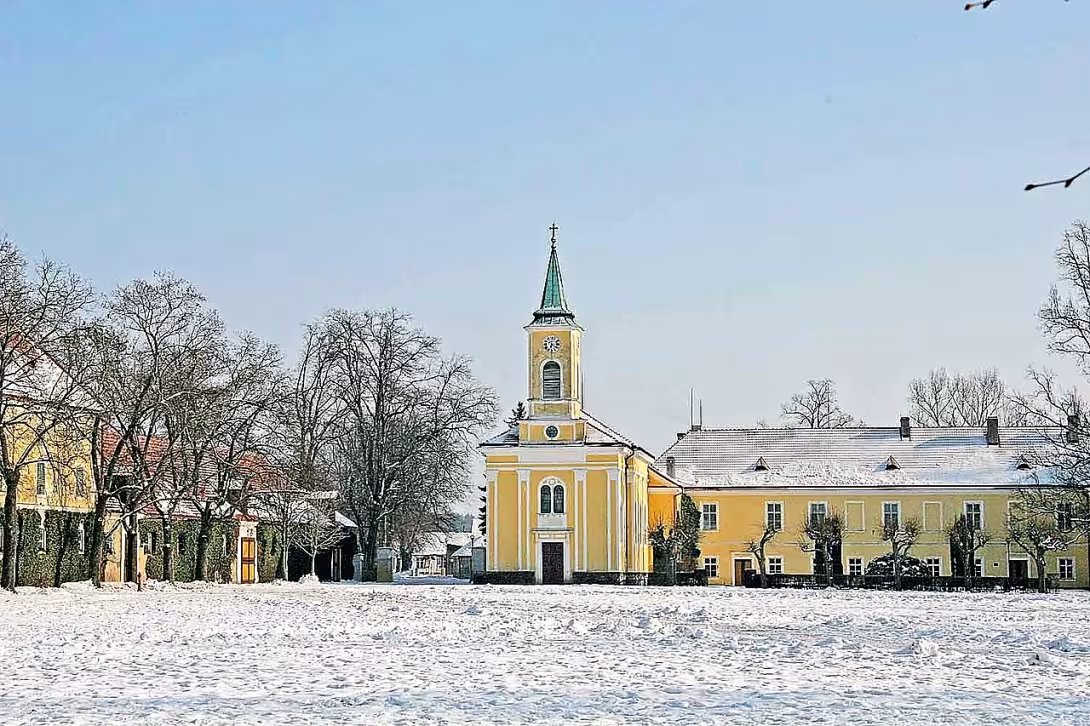
The church of St. Wenceslas and Leopold is located in the area of Kladrub imperial stallion in the village Kladruby nad Labem in the district of Pardubice. The building is connected to the chateau with which it forms the dominant central space of the stallion. Together with the whole area it is protected as a cultural monument and led in the catalogue of the National Heritage Institute under registration number 16212 / 6-2096.
The oldest mention of the church dates back to 1359, when it was recorded as the parish church of the Kladrub parish. The oldest building was built in the late Middle Ages. A significant break in his history has brought about the 17th century for the reign of Emperor Leopold I. In 1668 the church was rebuilt in Baroque style and subsequently consecrated by the Archbishop of Prague, Count Jan Bedřich of Valdštejn.
The demolition and recovery were repeated. In 1757 the church burned down together with the chateau. It was repaired in the following year, but it lasted a long time. At the end of the 19th century it was decided to tear it down in 1857. The new church was built in 1859 in a Neo-Classicist style on the site of the burnt-out building. The chateau wood plate was taken care of by the construction.
The architecture of the church has not changed since its last reconstruction. It is a one-ship construction of a late classical style with a tower at the head. The tower held a rare element of the past - three mosaic paintings on a golden background depicting Christ and the prophets of Isaiah and Daniel from the original church.
The interior is richly equipped. The main altar carries a picture of the murder of St. Wenceslas. Side altars depict St. Elizabeth and St. Francis of Serafin. Red marble baptism dates back to the 19th century. Among the most valuable items are the pearl-edged cross 127 cm high, which was the gift of Jerusalem's emperor František Joseph I. In the church there is also a three-piece painting with Klan with shepherds, the arrival of three kings and the escape to Egypt. It is supplemented by smaller images with scenes from the life of Christ, including Annunciation, Birth of the Lord, Circumcision and Escape to Egypt.
By the end of 2024, the church served as a parish church of the Kladrub parish. After her merger with the Přeč parish, he became a filial church. However, it remains an important part of the crest of the Chinese complex and a valuable proof of the historical development of the Czech sacral architecture.
Then and now
Drag the slider to compare how the landmark may have looked when it was built with the view today.
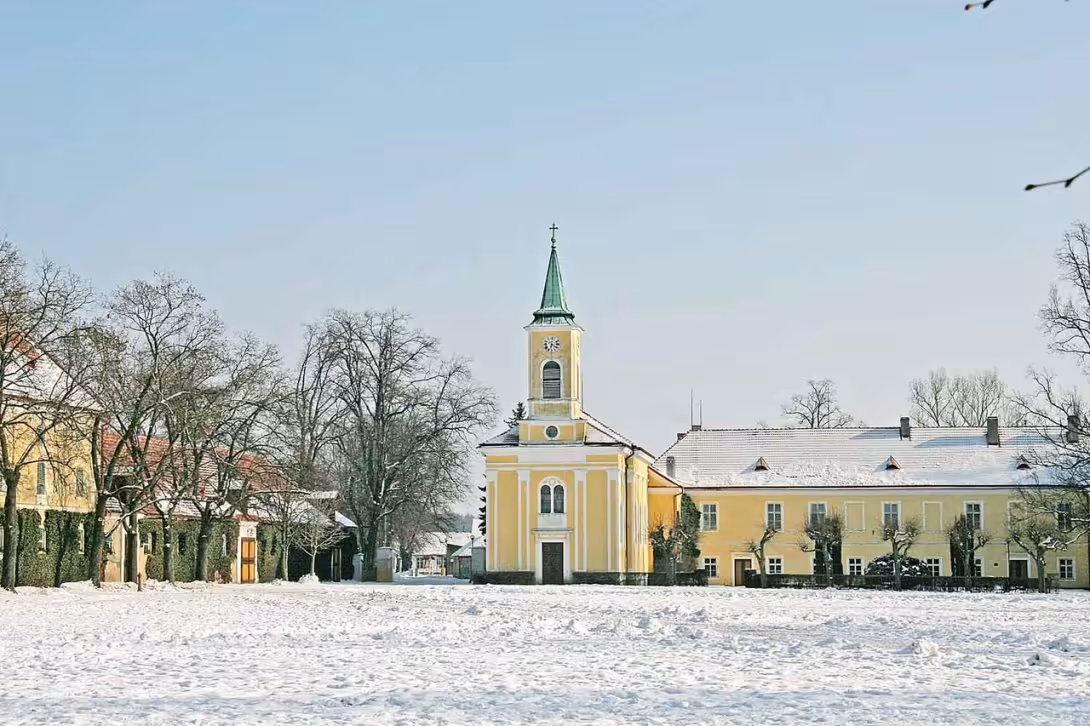

The historical appearance on the left is an AI-generated visualisation and serves as inspiration only.
Historical milestones
- 1359
- The first written mention of the church as a parish church.
- 1668
- Baroque reconstruction and consecration of the church.
- 1757
- Church fire and subsequent repair.
- 1859
- The position of the New Classicist Church in the place of the burnt-out Baroque building.
Architectural development
The first church from 1359 was probably a simple Romanesque or Gothic building. In 1668 it was rebuilt in Baroque style while only the tower with mosaic paintings was preserved. After the fire in 1757 the church was repaired and in 1859 a new church was built in its place in a neoclassical style. The tower from the original Baroque building was preserved and integrated into a new form. The church is built of stone and has simple but representative available.
Historical events
- 1359
- First written mention of the church as a parish church in Kladruba.
- 1668
- Baroque reconstruction of the church by order of Emperor Leopold I. and consecration by Count Jan Bedřich of Valdštejn.
- 1757
- The church burned down along with the chateau, subsequently repaired.
- 1859
- Built in a new classical form of the church on the site of a burnt-out Baroque building.
Owners
The sequence of owners with years if available, otherwise zero.
Points of interest
- The church of St. Wenceslas and Leopold is connected to the chateau and forms the dominant area of the imperial stallion in Kladuby nad Labem.
- The oldest written mention of the church dates back to 1359, when it was the parish church of the Kladrub parish.
- In 1668 the church was rebuilt in Baroque style and consecrated by Archbishop Jan Bedřich of Valdštejn.
- The church tower keeps three mosaic paintings on the golden background of the original church, depicting Christ and the prophets of Isaiah and Daniel.
- The church was rebuilt in 1859 in a neo-classicist style after tearing down the older building.
Guide
This guide is narrated by a synthetic voice generated by artificial intelligence.
Show guide text
This text was created by artificial intelligence and has not been editorially reviewed. It may contain inaccuracies.
The Church of Saint Leopold and Saint Wenceslas stands in the grounds of the imperial stud farm in Kladruby nad Labem in the Pardubice region. It is structurally connected to the castle and forms the dominant feature of the central space of the stud farm. Along with the entire complex, it is protected as a cultural monument. Until the end of 2024, it was the parish church of the Kladruby parish. Following its merger with the Přelouč parish, it became a subsidiary church.
The first mention of the church dates from 1359, already as a parish church. During the reign of Emperor Leopold the First, it was rebuilt in the Baroque style in 1668. It was consecrated by the Prague archbishop Count Jan Bedřich z Valdštejna. In 1757, the church burned down together with the castle. It was repaired the following year, but in 1857 it was demolished. In its place, a new church arose in 1859 in the late classical style, which it retains to this day. It was built by the castle polisher Talíř.
It is a single-nave church with a simple tower on the façade. Above the portal is a Latin inscription. In translation it reads as follows: To the glory of almighty God, the saints Wenceslas and Leopold, patrons of Bohemia and Austria, erected by Emperor Leopold the First in the year of salvation 1668, having deteriorated over the centuries and rebuilt from the foundations by Francis Joseph the First, Emperor of Austria, in the year of salvation 1859.
In the tower, three mosaic images on a golden background have been preserved from the original church. They depict Christ and the prophets Isaiah and Daniel.
The main altar bears a painting of the Martyrdom of Saint Wenceslas. On the left side altar is a painting of Saint Elizabeth, and on the right, Saint Francis Seraphic. The baptismal font made of red marble dates from the nineteenth century.
Noteworthy is a cross richly inlaid with mother of pearl, one hundred twenty-seven centimetres high. It was a gift from Jerusalem to the Austrian Emperor Francis Joseph the First. Mother of pearl also adorns two paintings in silver frames with gilded angels in the corners. The larger of them is a triptych. In the centre it shows the Adoration of the Shepherds, to the right the Arrival of the Three Kings, and to the left the Flight into Egypt. The smaller painting depicts scenes from the life of Christ: the Annunciation of the Virgin Mary, the Birth of Christ, the Circumcision of the Lord, and likewise the Flight into Egypt.
Tips for visitors
We recommend visiting the church of St. Leopold and St. Wenceslas in the late morning or in the tarde when the light is ideal for photography. Parking is available in front of the Kladrub imperial stallion. We recommend taking with you comfortable shoes and compass. The most important places for photographic efforts are at the entrance to the church, on its wreaths and near the statue of St. Wenceslas. In the vicinity we will find other sights such as Kladrub Chateau or the natural reserve Labovicky Forest. Families with children are recommended to visit during the school year so that children can benefit from an interactive exhibition in the church.
When visiting the church of St. Leopold and St. Wenceslas, remember to take tea or coffee with you, because you will not find any refreshment services on the premises. It is also ideal to have a compass with them to easily navigate the premises.
We recommend visiting the church of St. Leopold and St. Wenceslas with family or group of friends, because the tour is suitable for all ages. The most important places for photographic efforts are at the entrance to the church, on its wreaths and near the statue of St. Wenceslas.
When visiting the church of St. Leopold and St. Wenceslas, we recommend taking with us comfortable shoes because the tour takes approximately 30 minutes. It is also ideal to have tea or coffee with you so that they can refresh themselves during the tour.
We recommend visiting the church of St. Leopold and St. Wenceslas between April and October, when the conditions for photography are unreal. The most important places for photographic efforts are at the entrance to the church, on its wreaths and near the statue of St. Wenceslas.
When visiting the church of St. Leopold and St. Wenceslas, we recommend to take a compass with them so that they can easily navigate the premises. It is also ideal to have tea or coffee with you so that they can refresh themselves during the tour.
Frequently asked questions
Can the monument be visited?
Yes. We verified the opening hours or admission on the official website (8. 10. 2026); you will find them in the visitor information on this page. Please double-check with the operator before you travel.
What are the opening hours and admission?
Details verified on the official website (8. 10. 2026) are listed in the visitor information on this page. Official website: https://farnost-prelouc.estranky.cz/
Where is the monument?
Location: Kladruby nad Labem, Pardubický kraj. The map on this page shows the exact spot.
Why is the monument protected?
It is listed in the Central List of Cultural Monuments of the Czech Republic as a national cultural monument (register no. 272). It is protected as part of a larger listed ensemble.
For kids
Imagine going back to the past, when the church of St. Leopold and St. Wenceslas stood as a hidden treasure on the premises of the Kladubo imperial stallion. This place was full of life, work and diligence. The stallion was a place where horses were raised to be the best in the world. And the church was their sanctuary.
Who lived here? It was the people who took care of the horses they gave food, drinking water and bundles. They were craftsmen who built a stud and a church. And it was the priests who prayed for all these people.
Businesses nearby
Do you run a restaurant, accommodation, shop, museum, rental, wellness or other visitor service near this monument? Show yourself directly to the people heading to it — this is how they will see you in the app and on the web:
Nearby
- Kladrub imperial stallion with breeding herd of the Old Kladrub horse, which is a unique example of the targeted cultivation of the landscape.
- Natural reservation Kladruby nad Labem with rich flora and fauna, including meadow forests and wetlands.
- Castle Kladruby nad Labem with historical interiors and exposures associated with the stallion.
Accommodation nearby
Trips and activities nearby
Guided tours, tickets and activities nearby from GetYourGuide
Affiliate link: if you buy from the partner, we may receive a commission. The price for you does not change.
Search tours and activities →Themed route
1. Castle Kladruby nad Labem, Chateau - Take a look at the historical interiors and exhibits associated with the stallion. 2. Kladrub imperial stallion, stallion - Admire the unique breeding of the old Kladrub horse and cultivated landscape, about 500 metres away. 3. Church of St. Wenceslas and Leopold, Church - Visit this historic object, which is the main destination of the journey. 4. Natural Reserve Kladruby nad Labem, Nature Reserve - Discover rich flora and fauna in the meadow forests and wetlands, approximately 1 km away.
Seasonal recommendations
Spring During the spring, kostel svatého Václava a Leopolda in Kladuby nad Labem will turn into a picturesque scene, when the surrounding meadows and forests are awakened to life. The light of the sun, which penetrates through the stained glass, creates a color game in the interior of the church, while outside blooming trees and green vegetation give the whole place a peaceful and refreshing atmosphere. It is an ideal time to walk around where you can meet the first birds and fresh spring air. I recommend visiting the church early in the morning when the air is clean and the crowds are minimal. It is suitable to dress according to variable weather - light layers, but with the possibility of adding a jacket, because the spring sun often alternates with a cold wound.
Summer In the summer months, kostel svatého Václava a Leopolda offers not only rich history, but also pleasant sitting in its shadow. The warm sunlight illuminates the facade and creates a pleasant, but not too hot environment in the interior. The surrounding landscape is lush and green, ideal for a short walk along the surrounding fields or a visit to nearby water areas. In the main summer season, however, it is recommended to arrive early in the morning or late in the afternoon to avoid a larger crowd of tourists. Suitable is light but decent clothes, hat and sunglasses because the sun on summer days can be intense.
Autumn Autumn brings golden and red shades to Kladrub nad Labem, which are reflected also around the church. The mild sunlight that passes through the leaves creates a quiet and nostalgic atmosphere in the church, while the weather out there alternates with rainy days and sunny moments. It is a time when the church appears to be a peaceful refuge from colder weather. It is recommended to visit it in the morning when the air is fresh and the traffic is lower. Suitable is warmer clothes, but still comfortable, because autumn weather is usually unstable - umbrella and light jacket will not be wasted.
Winter In winter months, kostel svatého Václava a Leopolda becomes a picturesque winter scenery, with snow cover and frozen trees giving the whole place a fabulous look. The weak winter light, which penetrates through the stained glass, creates a calm and meditative atmosphere in the interior, while outside you can look forward to a quiet walk on snowy roads. In addition, the church offers a pleasant environment for a short prayer or rest. It is recommended to visit it in the morning when opening times are longer and crowds are smaller. It is suitable for warm but comfortable clothes - warm jackets, gloves and tight shoes, because winter weather is usually cold and variable.
Visualizations and artistic views


The visualisations are generated by artificial intelligence and serve as inspiration.
Photos from the area
Real photos taken near the monument


Zdroj a licence jsou uvedeny u každého snímku.
Atmosphere of the place
This atmospheric visualisation of the place and period was generated by artificial intelligence. It is not real footage of the location.
Tips from visitors
No tips yet. Be the first!
Log in and add your tip.
Sources and literature
Photos: Palickap / CC BY-SA 4.0 — Wikimedia Commons. The author and licence also appear when you hover over the image.
Faktickým podkladem tohoto textu byl článek na Wikipedii, jehož autory jsou přispěvatelé Wikipedie. Článek je dostupný pod licencí CC BY-SA 4.0.
Location on the map
Příběhy a pověsti
Legendy, pověsti a příběhy spjaté s touto památkou
Fotografie návštěvníků
Zatím žádné fotografie. Buďte první, kdo přidá fotografii z návštěvy!
Log in a přidejte svou fotografii nebo hodnoťte.
Za ověřenou návštěvu v aplikaci získáte víc bodů — poznáme podle GPS, že jste na místě.
Reviews and comments