






Kostel svatého Václava (Machov) Church
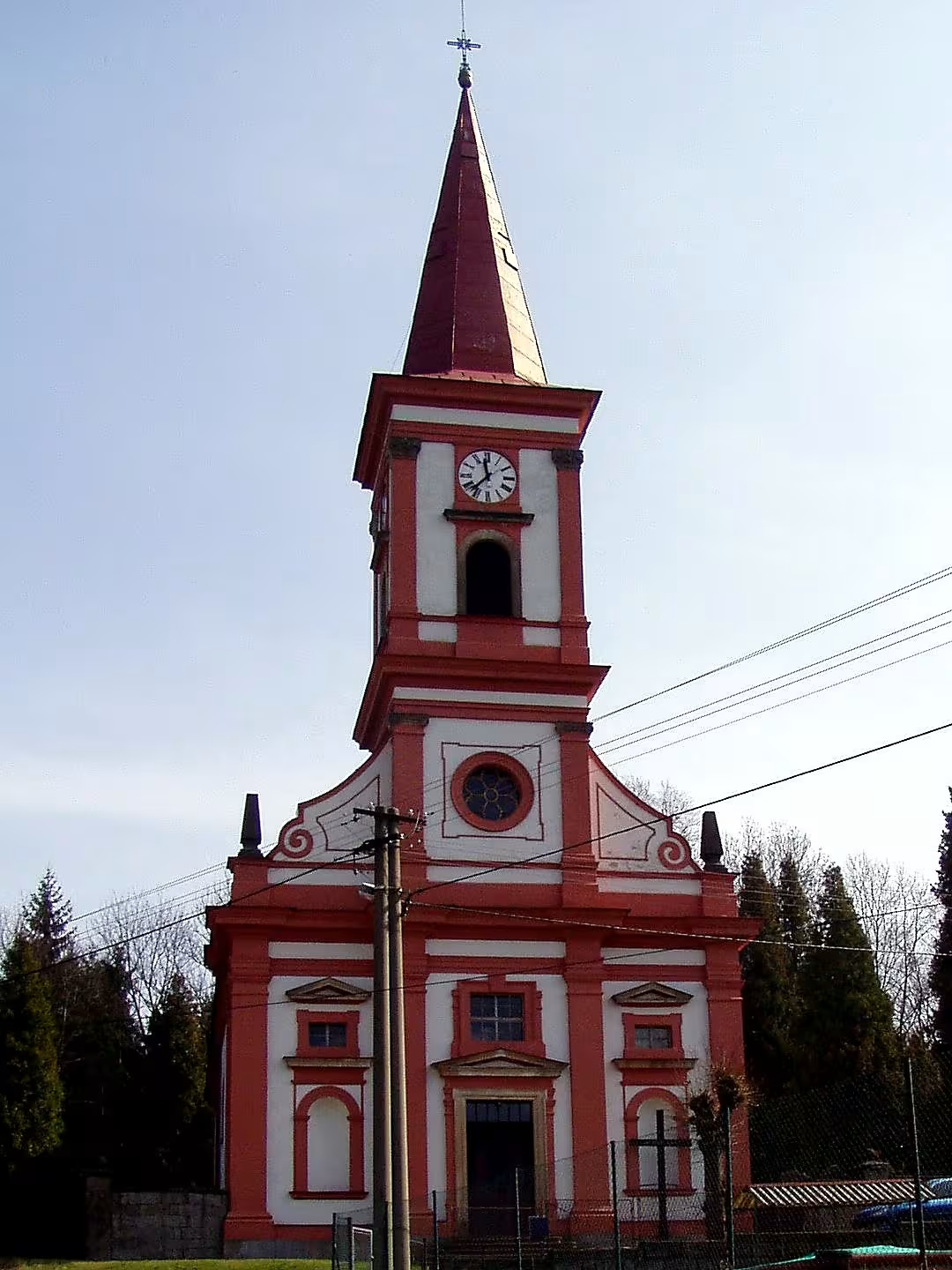
St. Wenceslas Church in Machov is a remarkable example of Czech architecture and culture of the 17th century. Located in the village Machov in the Králové Hradec region, this Roman Catholic filial church has been transformed from wood to stone and reflects wider historical changes. Recognised as a protected cultural monument in the Czech Republic, it maintains important architectural and artistic features.
The first record of the church dates back to 1369, suggesting its existence as a parish church before 1354. Originally wooden, it was destroyed by fire or decomposition in 1670. This event led to the construction of the existing stone structure in the same place, probably influenced by Vavřinec Piccolomini.
There have been significant changes over time. By 1720, both interior and exterior plastering were completed, which strengthened the elements of Baroque style. The church is equipped with a single-boat construction with a triangular presbytery and sacristy on the north side, all under the barrel vault with lunettes for windows. It stands forward behind the square, with the main entrance west.
The artistic interior is equally remarkable. In 1899, Peter Bushek and the sons of Sychrova produced the Neo-Renaissance altars. The main altar dedicated to St. Wenceslas includes a revolving stand and an altar painted by Wilhelm Kandler in 1894. Flanking these are altars for Saint Benedict, Scholastica, Francis, John the Evangelist, and Joseph, each with matching statues. In addition, the church is located rococo christening font decorated with a statue on its upper surface.
Several key events throughout its history shaped the story of the church. In 1586 a wooden bell tower was added to the original building, later demolished in 1670. In 1685 the construction of a new independent stone bell tower began. During the demolition in 1885, a foundation stone was discovered from the original wooden bell tower with the inscription of 1586. This discovery highlights the layered historical significance of the church.
Today the church of St. Wenceslas is active for services, Sunday at 11:00 and Wednesday at 16:30. Its architectural beauty and historical depth make it a convincing destination for visitors interested in the Czech cultural heritage. The preservation of the church as a cultural monument ensures that its story will continue to be shared with future generations, and invites all who visit to appreciate its lasting legacy.
Then and now
Drag the slider to compare how the landmark may have looked when it was built with the view today.
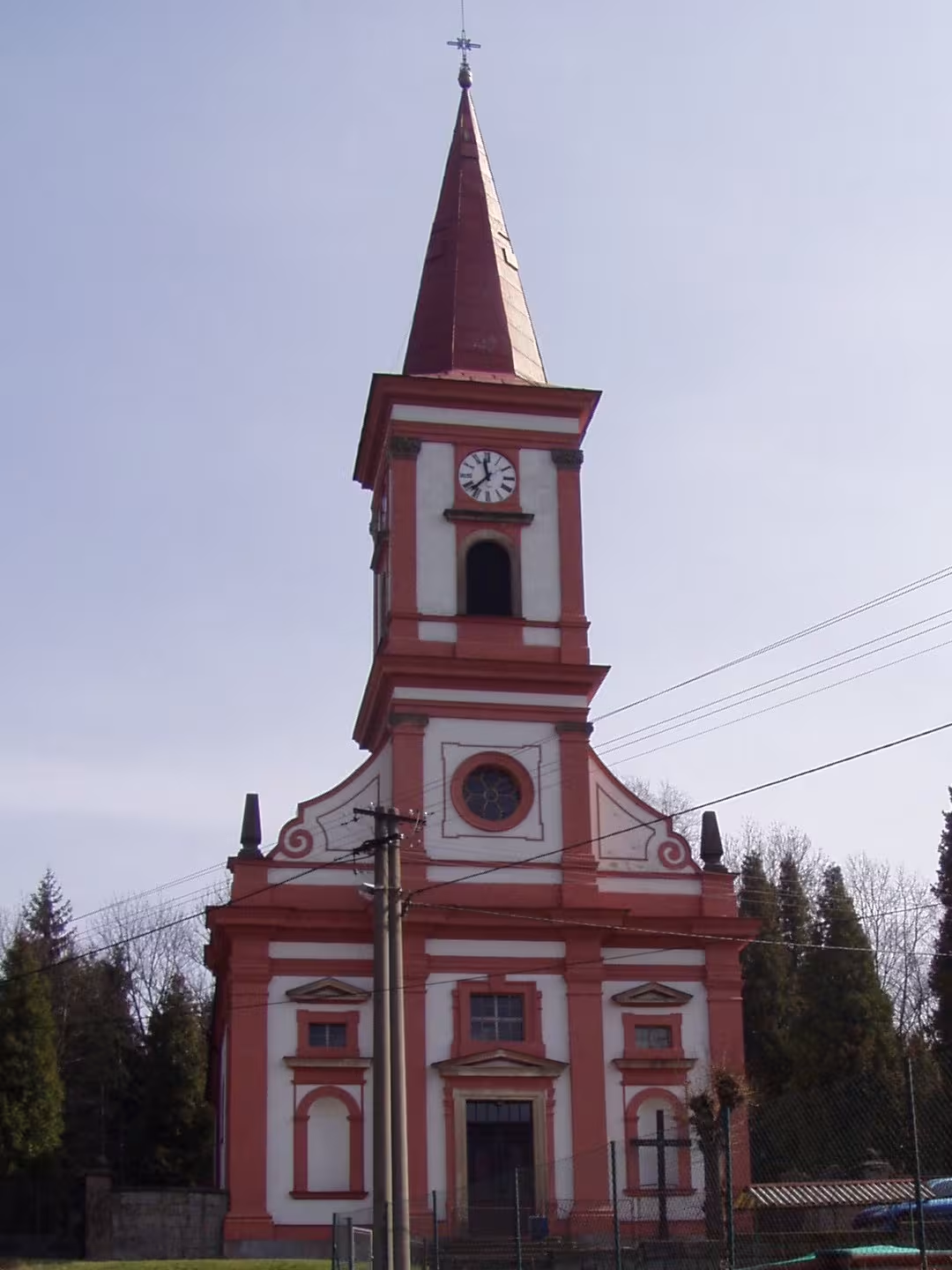

The historical appearance on the left is an AI-generated visualisation and serves as inspiration only.
Historical milestones
- 1369
- The oldest written mention of the church.
- 1586
- A wooden bell tower was added to the original construction.
- 1670
- The wooden church was demolished and replaced by a stone building.
- 1685
- The construction of a new independent stone bell tower has begun.
- 1810
- A small bell tower was added above the presbytery.
- 1885
- The bell tower was demolished; a foundation stone was discovered with the inscription 1586.
Architectural development
The Church of Saint Václav underwent significant architectural changes from its original wooden form to the stone structure in 1670. In 1720, both interior and exterior plaster were finished, which improved its Baroque style. The church has a single-boat construction with triangular presbytery and sacristy on the north side, all under the barrel vault with lunettes for windows.
Historical events
1369: The oldest written mention of the church, which indicates that it was already a parish church before 1354.
1670: The original wooden church was demolished, which led to the construction of contemporary stone construction.
Points of interest
- The transition church from wooden construction to stone in 1670 reflects wider historical changes and influence of remarkable figures such as Vavřinec Piccolomini, which probably played a role in its reconstruction.
- The base stone with the inscription of 1586 was discovered during the demolition of an independent stone bell tower in 1885, revealing layers of history under the current structure of the church.
- The Neo-Renaissance Altars created by Petr Bushek and his sons in 1899 add a distinctive artistic talent to the interior, which shows the local craftsmanship of Sychrov.
- the church is located rococo christening font with a complex statue on the top surface, highlighting a mixture of artistic styles present in the building.
- Despite numerous architectural changes over the centuries, including significant Baroque improvements in 1720, the Church of St. Wenceslas continues to serve as an active place of worship and retains cultural and spiritual importance in Machov.
Guide
This guide is narrated by a synthetic voice generated by artificial intelligence.
Show guide text
This text was created by artificial intelligence and has not been editorially reviewed. It may contain inaccuracies.
The Church of Saint Wenceslas in Machov is a Roman Catholic subsidiary church belonging to the deanery of Police nad Metují. Previously it was the parish church of the local parish. It is protected as a cultural monument of the Czech Republic.
The oldest written mention of the church dates from the year 1369, though it was probably already a parish church before 1354. The first church was wooden, and around 1586 a wooden bell tower was added to it. In 1670 the wooden church was torn down and replaced at the same location by a stone church, presumably with the contribution of Lawrence Piccolomini. It received plaster both inside and outside only in the year 1720.
In 1685 a new, separately standing stone bell tower was built. When it was demolished in 1885, a foundation stone from the original wooden bell tower was discovered above its entrance. It bears an old Czech inscription with the year 1586 and the name of the then reeve Matěj Kulhanka. Today it is bricked in above the organ. Next to it is the foundation stone from the later bell tower. According to the inscription on it, the tower was erected on September 3rd, 1685 to the honor and glory of Saint Wenceslas in the town of Machov. The small tower above the chancel dates from 1810, the pyramidal tower from 1885.
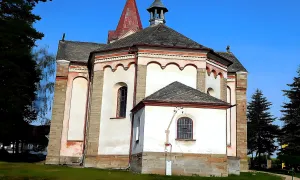
The church stands on an elevated spot beyond the town square with its main entrance facing west. It is built in the style of late Renaissance. It has a single nave, a presbytery closed by a rounded end, and a sacristy on the north side. It is vaulted with a barrel vault with recesses for windows.
The Neo-Renaissance altars from 1899 are the work of the sculptural firm Petr Bušek and Sons from Sychrova. The main altar of Saint Wenceslas has a tabernacle with a rotating interior and an altar painting by Vilém Kandler from 1894. On the left side stands the altar of Saint Benedict with statuettes of Saint Scholastica and Saint Frances. On the right side is the altar of the Sorrowful Virgin Mary with statuettes of Saint John the Evangelist and Saint Joseph. The baptismal font is sandstone, Rococo style, with a statuette on the top plate.
The Stations of the Cross consist of skillfully painted images based on designs by Führich. They were purchased in Vienna from the firm Zambach and Müller and placed in niches in the walls. On the projections on both sides of the nave stand statues of Saint Wenceslas, Saint John of Nepomuk, Saint Ludmila and the Virgin Mary of the Rosary. They come from the firm Josef Runggaldier from Grödén.
Tips for visitors
The best time to visit St. Wenceslas church in Machov is at the end of spring or early autumn, when the weather is pleasant and the natural environment is fresh vegetables. This period also tends to be less crowded than summer months, allowing for a more peaceful experience. The lighting conditions at this time are ideal for evaluating architectural details of this historic site.
Public transport options may include regional buses connecting neighbouring cities and villages. For those who drive early, it can increase your chances of finding a place.
When visiting St. Wenceslas church, it is recommended to bring comfortable walking shoes, especially if you plan to explore the surroundings or longer walks. Hats and sunscreen is also recommended during the sun days. In addition, carrying a bottle of water can help you stay hydrated during your visit.
For photographic enthusiasts, the best places to capture the church of St. Wenceslas include its external facades during the golden hours - early morning or late afternoon, when sunlight throws heat on the structure. The interior offers unique lighting conditions that highlight the complex details of the church construction. Keep in mind all restrictions regarding lightning photography inside the church.
Families and children will find St. Wenceslas church an interesting visit, especially if they enjoy learning about history and architecture. Near attractions within a 30-minute drive include natural parks where families can enjoy outdoor activities such as hiking or picnic. These areas give children a great opportunity to explore nature, while adults appreciate the historical context.
Frequently asked questions
Can the monument be visited?
Religious buildings are usually open mainly during services; at other times a visit is normally arranged with the parish or the operator. We have not verified specific times.
Where is the monument?
Location: Machov, Královéhradecký kraj. The map on this page shows the exact spot.
Why is the monument protected?
It is listed in the Central List of Cultural Monuments of the Czech Republic as a cultural monument (register no. 25194/6-1790).
Businesses nearby
Do you run a restaurant, accommodation, shop, museum, rental, wellness or other visitor service near this monument? Show yourself directly to the people heading to it — this is how they will see you in the app and on the web:
Events nearby
Zdroj akcí: otevřená data měst a obcí ČR (Národní katalog otevřených dat) a kalendář akcí Národního památkového ústavu.
Nearby
PHARMAShow interactive okolí - Restaurant, accommodation, numerous and other city in the district 15 km.
Data: OpenStreetMap contributors, district 15 km.
Historical monuments
- J. W. Goethe 28 VIII 1790 (4.7 km)
- Pamięci Francisco Pabla (4.7 km)
- Vlčinec (5.5 km)
- Poległym w I Wojnie Światowej (5.7 km)
- Fort Karola (6.4 km)
- Ochota Magdaleńska (6.7 km)
- Stanisław Moniussko (6.7 km)
- Castle Bárkov (9.1 km - 1)
ANNEX
- Host U Lidmanů (1.2 km - Machov Lhota 40)
- Dining room Pelly domy (5.0 km - U Damian 268)
- Motorest Luck (6.4 km - 28)
- Herna bar România niter (7.2 km - T. G. Masaryka 23)
- Guesthouse Sokolovna (7.5 km - Poříčská 195)
- Old Bohemian pub (7.7 km - Náchod 3)
- Hodka U Vlček (9.5 km - 26)
- Sudetka (10.2 km - Stanislav Opočenský 90)
ANNEX
- Green Valley Park Starkov (8.3 km - 11)
- Dom Gościnny Radków (8.8 km - Rynek 19)
- Guesthouse Bor (8.9 km - Broumovská 82)
- Jiráskova chata (9.1 km - 123)
- Apartments Pod Vysakem (9.2 km - 113)
- Apartments For Aunt Hedy (9.3 km - 109)
- Hotel Manor House (9.8 km - Vančurova 67)
- Hotel Praha (10.3 km - Peace Square 49)
Handlebars and sports
- Doldy (0.4 km)
- Pítrs bikes (5.1 km)
- Park Wodny Verde Montana (6.6 km)
- Albisport (7.1 km)
- Okolokol (7.1 km)
- Smuk Fit (7.4 km)
- Cyclone Bike (7.7 km)
- JM Sport (10.2 km)
Garantica Tourism and nature
- Chata pod Koruna (odb.) (4.9 km)
- Vupi Nest - zw, odb. (7.0 km)
- Nad Kovářová roklá (7.2 km)
- Radków rozwidlenie (7.5 km)
- Nad serves Czech cousin (8.2 km)
- Turov (9.2 km)
- Small Turov (9.5 km)
- Upper Radí (BUS, odb.) (9.9 km)
Accommodation nearby
Themed route
Thematic cruise route: Kostel svatého Václava (Machov)
1. Kostel svatého Václava (Machov) - Church You will begin your journey at the seclusion church of St. Wenceslas, which is not only the main spiritual warehouse of the village Machov, but also architectural pearls in the Králové Hradec Region. Its history dates back to the 13th century and offers its own material intended for Gothic interior with rich declaration.
2. St Wenceslas's Tanks - Historical Town After a long-winded church, they submit to one that needs to be discovered by ancient sculptures and plaque. This city is ideal for relaxing and conceived the historical context of the village, which is postponed in every detail of the surrounding architecture.
3. Saint Anne's Chapel - Chapel Shorts from St. Wenceslas church you will find the chapel of St. Anne, which is a smaller sacral building with assigned historical design. Its tonnage and simplicity contrasts with the main church, offering a demanding rest system for meditation or short removal.
4. Ancient pond near Machova - Pond Explore the surrounding landscape and visit the ancient pond, which is near St. Wenceslas's skeleton. This pond is carried by a beautiful natural service, but also by an important summing-up of local ecology and history, serves as a place of postponement for residents and tourists.
5. Machov Country - Garden The final point of the route is Machov country, where you can smoke natural beauty and quiet moments in the idyllic process. This garden offers its own prochas in terms of these plants and is an ideal place to relax after a new cube.
This route has its own not only appreciates the historic and ductile excerpts Machova, but also its own natural beauty and peaceful surroundings.
Seasonal recommendations
Spring: In the spring period, St. Wenceslas church in Machov is a moment of breathtaking natural beauty, when flowering shrubs and trees revive the surrounding countryside. The sunny day can mean excellent lighting for the photography church, decorated with its colorful architectural details. This season attracts visitors to look for quiet moments outside the main tourist season, so you will encounter fewer crowds. It is recommended to wear firm clothes because temperatures can be variable, and take advantage of the opportunity for a short walk in the spring environment church.
Summer: During the summer months, Machov becomes a popular destination for visitors looking for an escape from urban life. The sunny days offer ideal conditions for exploring historical interiors church with rich frescos and architecture, but can also mean a higher number of visitors. It is advisable to visit sooner or later in the afternoon to minimise contact with crowds. Wear light clothes and apply sunscreen to enjoy warm summer days without discomfort.
Autumn: Autumn brings a unique atmosphere to the church of St. Wenceslas in Machov, with its lively colors falling leaves adding melancholic beauty to the surrounding landscape. The sunny days during this period offer ideal conditions for shooting the church in its most beautiful glow, with softer lighting that highlights architectural details. Visitors can expect a slight reduction in the number of visitors and should prepare for a cooler afternoon with warm clothes while enjoying a quiet environment.
Winter: Winter season brings slightly reduced numbers of visitors to St. Wenceslas church in Machov, which means more time to explore its historical interiors without excessive crowds. Winter sunny days can provide a beautiful contrast between the pale sky and church architecture, although lighting is colder. Visitors should wear warm clothes and possibly bring an umbrella for sudden snow or rain while enjoying a quiet environment.
Visualizations and artistic views


The visualisations are generated by artificial intelligence and serve as inspiration.
Photos from the area
Real photos taken near the monument


Zdroj a licence jsou uvedeny u každého snímku.
Atmosphere of the place
This atmospheric visualisation of the place and period was generated by artificial intelligence. It is not real footage of the location.
Tips from visitors
No tips yet. Be the first!
Log in and add your tip.
Sources and literature
Photos: Addvisor / CC BY-SA 3.0 — Wikimedia Commons. The author and licence also appear when you hover over the image.
Faktickým podkladem tohoto textu byl článek na Wikipedii, jehož autory jsou přispěvatelé Wikipedie. Článek je dostupný pod licencí CC BY-SA 4.0.
Location on the map

Příběhy a pověsti
Legendy, pověsti a příběhy spjaté s touto památkou
Příběh: Kostel svatého Václava (Machov)
Bylo to v pondělí ráno, kdy Martin zjistil, že jeho celý svět se rozpadá na šipky a střepy. Vlasy moklé ze spánku vlažily jeho čelo, zatímco krovy u kostela …
Číst příběh
Pověst: Kostel svatého Václava (Machov)
Podle místní pověsti kostel svatého Václava v Machově ukrýval po celá staletí tajemství, které bylo lidem zjeveno teprve tehdy, když na to přišel správný čas…
Číst příběhFotografie návštěvníků
Zatím žádné fotografie. Buďte první, kdo přidá fotografii z návštěvy!
Log in a přidejte svou fotografii nebo hodnoťte.
Za ověřenou návštěvu v aplikaci získáte víc bodů — poznáme podle GPS, že jste na místě.
Reviews and comments