






Kostel svatého Václava v Liblici Church
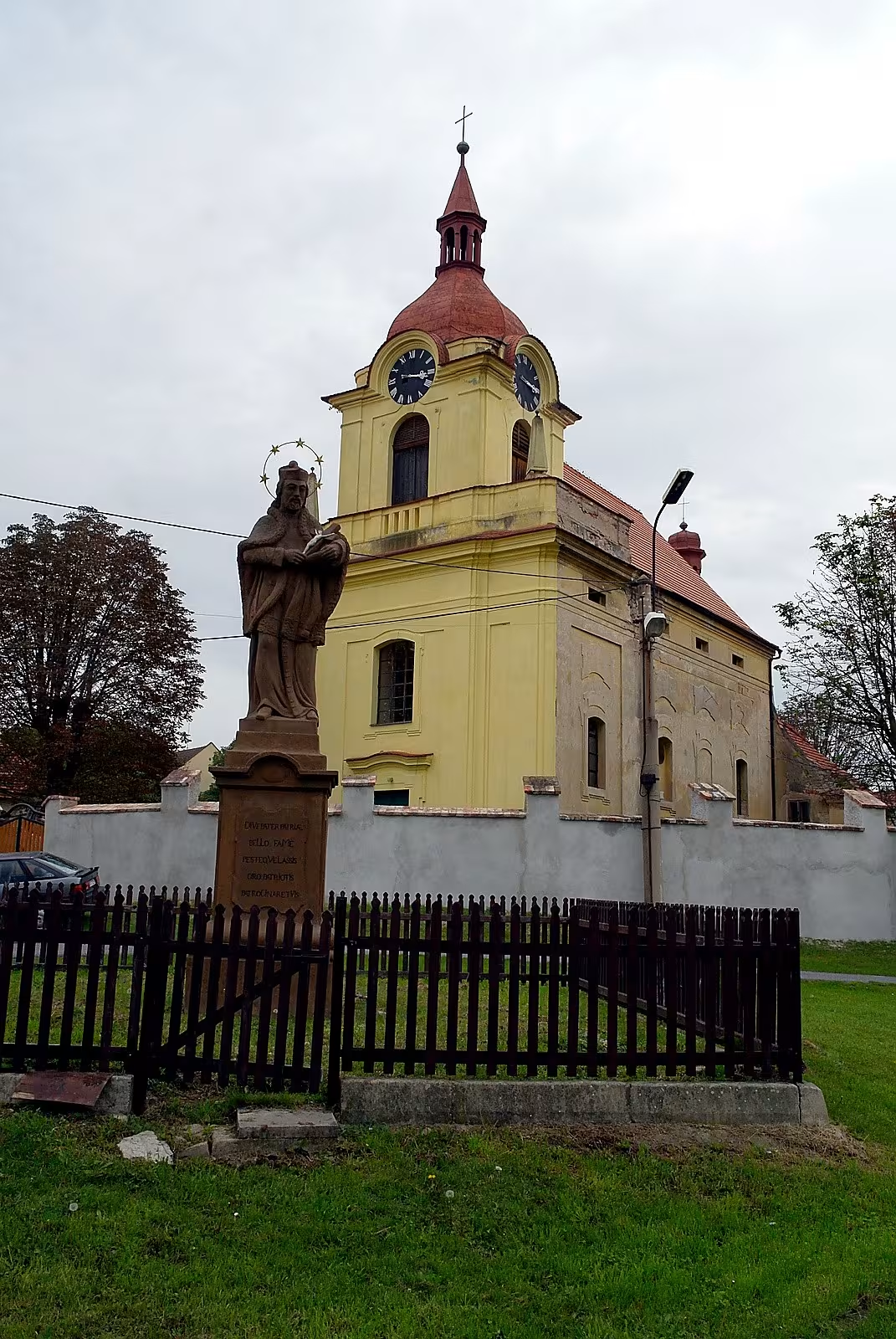
The Church of Saint Wenceslas in Liblice is a significant Roman Catholic parish church situated on a gentle hill at the village's center. It lies about 200 meters east of the historic Liblice castle. Constructed around 1384 in Gothic style, this architectural gem has undergone numerous transformations over the centuries, notably embracing Baroque renovations that have enriched its historical and cultural value. Since 1966, it has been recognized as a protected cultural monument, underscoring its importance within the region.
Liblice's origins trace back to 1321, marking its longstanding presence in the area. The Church of Saint Wenceslas was erected around 1384, reflecting Gothic architectural trends prevalent during that era in Bohemia—a part of the Holy Roman Empire at the time. This period saw significant political and religious shifts across Europe, influencing local architecture and cultural developments.
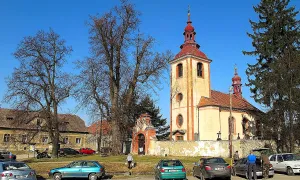
Architecturally, the church is a single-nave rectangular structure with a distinctive five-sided presbytery, complemented by oratories on both its northern and southern sides. The main facade features a central risalit topped by a pyramidal spire capped with a bulbous dome. Baroque influences are evident in the oblong windows with segmental arches, pilasters, and decorative fields adorning the side facades. The presbytery is supported by buttresses and showcases higher, semicircular-terminated windows, all under a cross vault that culminates in a star-shaped design. Original ribs are concealed beneath Baroque stucco festoons of laurel leaves converging on consoles shaped like angel heads. The church's interior includes a wooden gallery, barrel-vaulted nave, and flat ceilings in the bell tower and oratory, while the sacristy is vaulted with a barrel vault.
Throughout its history, the church has seen several modifications. In 1710, an oratory was added, possibly alongside a sacristy, marking the beginning of significant Baroque renovations. Between 1713 and 1715, a tower was constructed, and the church underwent stucco decoration enhancements. Further adjustments occurred in 1824, 1864, and 1886, each contributing to its evolving architectural narrative.
The interior is adorned with Baroque furnishings from the late 17th century, including a main altar featuring an image of Saint Wenceslas ascending to heaven, dated 1729. The church also houses smaller Rococo statues of Saints Václav and Ludmila, early 18th-century sculptures of Saints Jan Nepomucký and Barbora, and a Baroque painting of the Immaculate Conception. A notable baptismal font is embellished with a Baroque canopy and a statue of John the Baptist. Additionally, two candelabras from 1673 stand near the main altar, adding to its historical richness.
The church's surroundings include a chapel dedicated to Our Lady from 1699 and a pseudoromanesque octagonal burial chapel belonging to the Thun-Hohenstein family, featuring uneven columnar arcades. A tombstone for J. Josef Pachta, dated 1822, is also present on the local cemetery.
Today, the Church of Saint Wenceslas in Liblice remains an accessible and cherished site, inviting visitors to explore its historical depth and architectural beauty. Its status as a cultural monument highlights its enduring significance, making it a worthwhile destination for those interested in history, architecture, and religious heritage.
Then and now
Drag the slider to compare how the landmark may have looked when it was built with the view today.
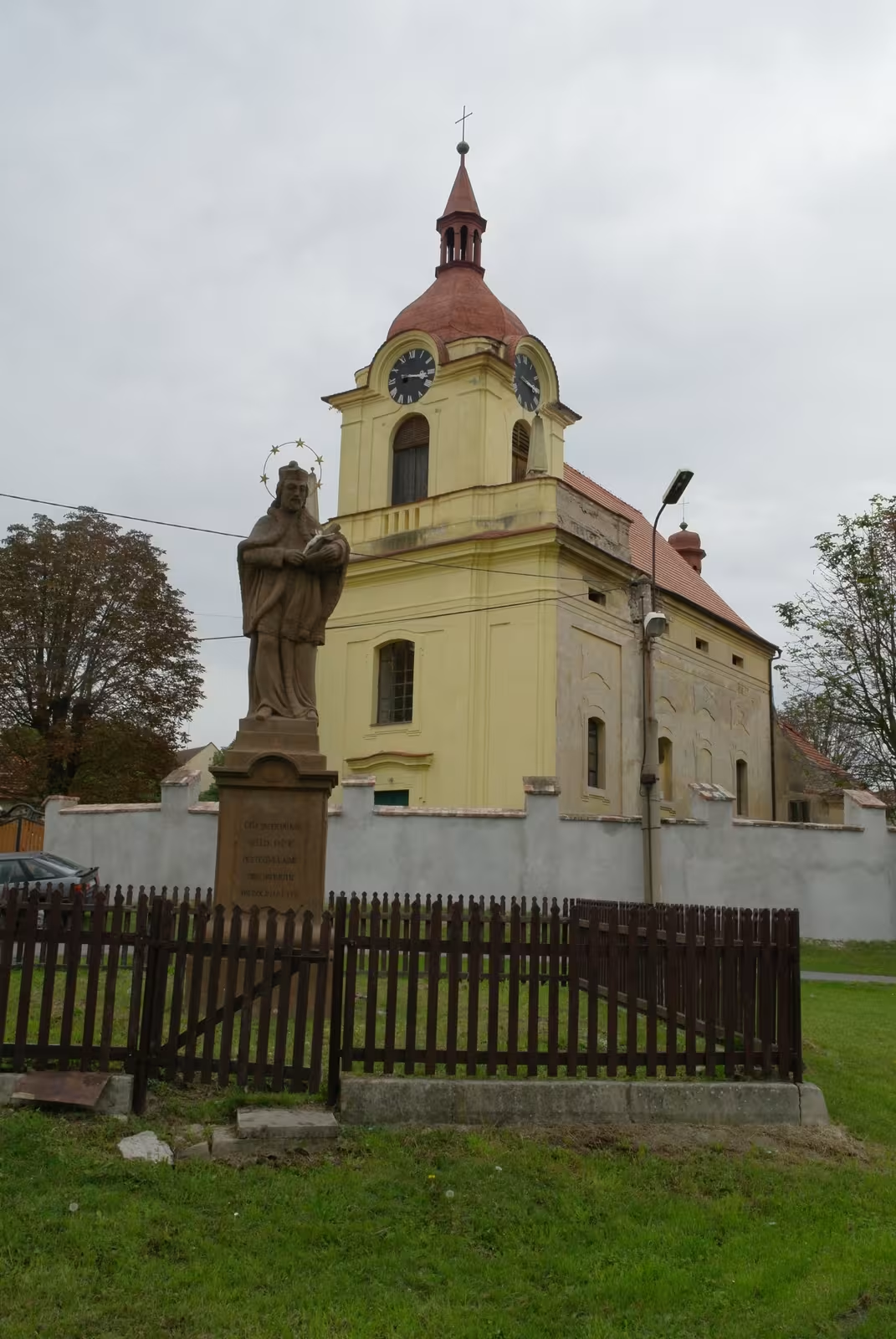

The historical appearance on the left is an AI-generated visualisation and serves as inspiration only.
Historical milestones
- 1966
- The church was designated as a cultural monument.
Architectural development
Originally built in Gothic style around 1384, the church underwent several architectural phases. In 1710, an oratory was added, followed by Baroque renovations including a new tower and stucco work between 1713-1715. Additional modifications took place in 1824, 1864, and 1886.
Historical events
The first records of Liblice date back to 1321, indicating its historical significance in the region.
In 1710, an oratory and possibly a sacristy were added, marking significant Baroque modifications.
Further renovations occurred in 1713-1715 with the addition of a tower and stucco decorations.
Points of interest
- The Church of Saint Wenceslas in Liblice features a unique five-sided presbytery, an uncommon architectural element that adds to its distinct Gothic character.
- Despite the church's Baroque renovations, original Gothic elements are cleverly concealed beneath stucco decorations, such as laurel leaf festoons and angel head consoles, preserving historical layers within its design.
- The presence of a pseudoromanesque octagonal burial chapel in the vicinity highlights an eclectic mix of architectural styles that coexist around the church, reflecting diverse influences over time.
- Among its Baroque furnishings is a baptismal font with a canopy featuring a statue of John the Baptist, which adds a layer of religious symbolism and artistry to the church's interior.
- The church’s history includes a chapel dedicated to Our Lady from 1699, indicating an enduring tradition of Marian devotion in the area that complements its primary dedication to Saint Wenceslas.
Guide
This guide is narrated by a synthetic voice generated by artificial intelligence.
Show guide text
This text was created by artificial intelligence and has not been editorially reviewed. It may contain inaccuracies.
The Church of Saint Václav stands on a gentle hillside in the middle of Liblic, approximately 200 metres east of the castle. It is a Roman Catholic parish church and has been protected as a cultural monument since 1966.
The first records of Liblic date from 1321. The Gothic church was built around 1384. A mention of the local parish comes from the same year. In 1710, an oratory was added and possibly a sacristy as well, and the church underwent a complete Baroque reconstruction. Between 1713 and 1715, the tower was built. Further modifications and repairs followed in 1824, 1864, and 1886.
It is a single-nave rectangular building with a five-sided presbytery. It is complemented by a sacristy and on the sides by a two-storey oratory. The façade is crowned with a prismatic tower with an onion dome.
The richest decoration is found in the presbytery. The original Gothic ribs of the cross vault are now covered with Baroque stucco festoons of laurel leaves. They converge on corbels in the shape of cherub heads. The vault is covered with stucco clouds, and on the triumphal arch, motifs of scales and wrapped heads alternate. The nave has a barrel vault and a wooden gallery.
The main altar is Early Baroque and dates from the second half of the 17th century. It bears a painting from 1729, showing Saint Václav with angels ascending to heaven. On either side stand Rococo statues of Saint Václav and Saint Ludmila. Two side altars are decorated with reliefs of the Crucifixion and the Annunciation. The church also contains statues of Saint John of Nepomuk and Saint Barbara in clouds, Rococo pews, and a stone baptismal font with a Baroque lid. Two tin candelabras from 1673 stand by the main altar. Beneath the altar are the tombs of the Pacht family of Rájov and the Deym family of Střítěž. The current organ dates from 1886, the original being from 1680.
In the churchyard stands the tombstone of Count Jan Josef Pachta from 1822, signed by the name Platzer. A Czech inscription recalls that he died in his 99th year as a general, court chamberlain, and lord of the Liblic estate.
West of the church stands a statue of Saint John of Nepomuk from 1770. A Latin inscription on it asks the saint, father of the nation, to protect fellow countrymen tested by war, hunger, and plague. West of the castle is a pseudo-Romanesque octagonal burial chapel of the Thun-Hohenstein family.
Tips for visitors
The best time to visit the Church of Saint Wenceslas in Liblice is during late spring or early autumn when the weather is pleasant, allowing for a comfortable exploration of the church and its surroundings. These seasons offer beautiful natural lighting that enhances the architectural details of the church and nearby historical structures. Additionally, visiting outside the peak summer months can provide a more serene experience with fewer crowds.
Walking or cycling can also be a delightful option given the scenic route through the countryside.
When visiting the Church of Saint Wenceslas and its surroundings, consider bringing comfortable walking shoes as you'll likely explore various sites including the nearby chapel and burial chapel. A camera is advisable to capture the picturesque views and historical architecture. Don't forget to bring water and perhaps a light snack if planning an extended visit.
For photography enthusiasts, the best spots include the church's facade and interior where natural light beautifully illuminates the space during certain times of the day. The gentle hill on which the church sits offers panoramic views that are particularly stunning at sunrise or sunset. The nearby chapel dedicated to Our Lady also provides a unique backdrop for photographs.
Within 30 minutes, visitors can explore additional historical sites such as the octagonal burial chapel belonging to the Thun-Hohenstein family and the local cemetery where you can find the notable tombstone of J. Josef Pachta from 1822. These nearby attractions offer further insight into the region's rich history and are easily accessible on foot or by a short drive.
Frequently asked questions
Can the monument be visited?
Religious buildings are usually open mainly during services; at other times a visit is normally arranged with the parish or the operator. We have not verified specific times.
Where is the monument?
Location: Liblice, Středočeský kraj. The map on this page shows the exact spot.
Why is the monument protected?
It is listed in the Central List of Cultural Monuments of the Czech Republic as a cultural monument (register no. 22291/2-1288).
Businesses nearby
Do you run a restaurant, accommodation, shop, museum, rental, wellness or other visitor service near this monument? Show yourself directly to the people heading to it — this is how they will see you in the app and on the web:
Nearby
Nearby, there is a chapel dedicated to Our Lady from 1699 and a pseudoromanesque octagonal burial chapel belonging to the Thun-Hohenstein family. Additionally, a notable tombstone for J. Josef Pachta from 1822 can be found on the local cemetery.
Accommodation nearby
Trips and activities nearby
Guided tours, tickets and activities nearby from GetYourGuide
Affiliate link: if you buy from the partner, we may receive a commission. The price for you does not change.
Search tours and activities →Themed route
Tematická Výletní Trasa v Liblici
1. Kostel svatého Václava
Typ: Kostel
Proč stojí za návštěvu: Tento kostel je centrálním duchovním a historickým srdcem Liblic, nabízející pohled na gotickou architekturu a bohatou historii. Je to místo klidu a úcty, kde můžete ocenit umělecké detaily a duchovní atmosféru.
2. Kaple Panny Marie
Typ: Kaple
Proč stojí za návštěvu: Postavená v roce 1699, tato kaple je příkladem barokní architektury a poskytuje klidné místo pro meditaci. Její historický kontext a umělecké prvky ji činí nezbytnou pro pochopení náboženských tradic v regionu.
3. Pseudoromaneskní oktaedrická hřbitovní kaple Thun-Hohensteinů
Typ: Kaple
Proč stojí za návštěvu: Tato jedinečná struktura přitahuje svou architektonickou neobvykleností a historickým významem pro rod Thun-Hohensteinů. Je to fascinující místo, které ilustruje evropské stavební styly a rodinnou historii.
4. Hřbitov s náhrobkem J. Josefa Pachty
Typ: Hřbitov
Proč stojí za návštěvu: Náhrobek z roku 1822 je významnou památkou, která připomíná důležitost J. Josefa Pachty pro místní komunitu. Jeho umělecké detaily a historický kontext poskytují vhled do minulosti obce.
Tato trasa nabízí pohled na bohatou náboženskou a kulturní dědictví Liblic, zatímco vás přivede k hlavním historickým místům oblasti.
Seasonal recommendations
Spring: The arrival of spring at the Church of Saint Wenceslas in Liblice brings a rejuvenating atmosphere as nature awakens around this historic site. The surrounding landscape is adorned with blossoming flowers and lush greenery, creating a picturesque backdrop for visitors. During this time, the gentle light of longer days enhances the intricate details of the church's architecture. To fully enjoy your visit, consider arriving early in the morning to avoid larger crowds that tend to gather as the day progresses. Wearing comfortable walking shoes is advisable if you plan to explore the nearby trails and gardens.
Summer: Summer at the Church of Saint Wenceslas offers vibrant light and extended visiting hours, making it an ideal time for those who appreciate historical architecture in full daylight. The warm weather allows visitors to comfortably enjoy outdoor spaces surrounding the church, such as parks or picnic areas, where they can relax after their visit. However, this is also the peak tourist season, so arriving early in the morning can help you avoid long lines and ensure a more serene experience. Light, breathable clothing is recommended for exploring both indoors and outdoors during these warmer months.
Autumn: Autumn transforms the Church of Saint Waveslas into a scene of warm hues as the leaves around Liblice turn shades of red, orange, and yellow. The softer light during this season casts a golden glow over the church's facade, offering a unique photographic opportunity for visitors. While the weather can be unpredictable, with occasional rain showers, it is advisable to wear layers that can be adjusted according to changing conditions. This period often sees fewer tourists than summer, allowing for a more intimate exploration of the site.
Winter: Visiting the Church of Saint Wenceslas in winter offers a serene and contemplative experience as snow blankets the surrounding landscape, creating a tranquil atmosphere around this historic monument. The shorter days mean that visiting hours are limited, so planning your visit to coincide with daylight is essential. The colder temperatures necessitate warm clothing, including coats, hats, gloves, and scarves, to ensure comfort during your exploration. Despite the chill, winter can be a magical time to appreciate the church's architecture against the stark beauty of the season.
Visualizations and artistic views


The visualisations are generated by artificial intelligence and serve as inspiration.
Photos from the area
Real photos taken near the monument


Zdroj a licence jsou uvedeny u každého snímku.
Tips from visitors
No tips yet. Be the first!
Log in and add your tip.
Sources and literature
Photos: Horakvlado / CC BY-SA 3.0 — Wikimedia Commons. The author and licence also appear when you hover over the image.
Faktickým podkladem tohoto textu byl článek na Wikipedii, jehož autory jsou přispěvatelé Wikipedie. Článek je dostupný pod licencí CC BY-SA 4.0.
Location on the map

Příběhy a pověsti
Legendy, pověsti a příběhy spjaté s touto památkou
Fotografie návštěvníků
Zatím žádné fotografie. Buďte první, kdo přidá fotografii z návštěvy!
Log in a přidejte svou fotografii nebo hodnoťte.
Za ověřenou návštěvu v aplikaci získáte víc bodů — poznáme podle GPS, že jste na místě.
Reviews and comments