



Kostel svatého Vavřince (Černovičky) Church
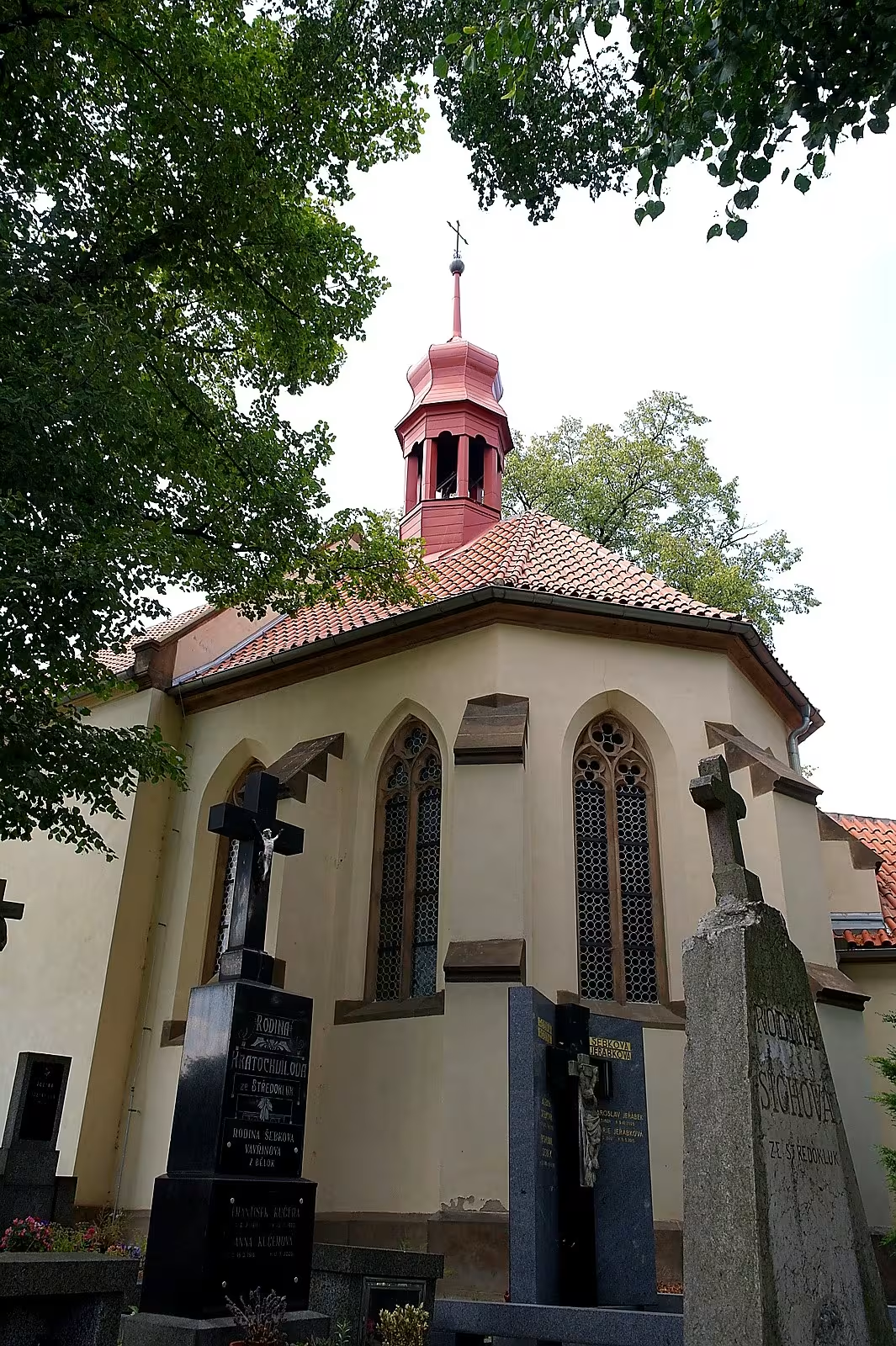
The church of St. Vavríce in Černíčky is a Romanesque building from the second half of the 12th century, located in the village of the Middle Boys in the Prague-West district. This monument is remarkable by its architectural evolution, which combines elements of Romanesque, Gothic and Baroque architecture.
Consecrated to Saint Vincent, protector of fire, the church stands in the place of the former pagan altar Perun. Catastral is part of the village Čečovice.
The construction has a rectangular one-ship form with a five-sided presbytery and a northeast pseudogotic sacristy. The presbytery, built from bricks, shows the Gothic elements as a cross rib arch and sharp windows with circles. There's a sandbox on the roof.
The interior of the presbytery is decorated with original Gothic paintings from the 14th century, while the ships are decorated with wall paintings from the first half of the 16th century with scenes of Christ's Pasha and saints Catherine and Margaret. In the priesthood there are original sedilia, gothic sanctuary and sandstone pulpit with year 1662. The main altar is decorated with a painting from 1858 by J. V. Hellich.
The church served as a cemetery in the Middle Ages, which is confirmed by three tombstones. The oldest, dated 1353 with Latin inscription, probably belonged to a Prague merchant with a Budek skirt from Černomic, patron of the church. Since the beginning of the 15th century he was the property of the Kolovrat. Under the main altar lies the marble tombstone of Vladislav Bezdružický, who died in 1575. The third tombstone from 1572 at the south wall of the priesthood belonged to the Virgin Catherine of Martinique and to the District.
In the 14th century, Romanesque apsida was replaced by a Gothic presbytery, in the second half of this century a window was walled up in the northeast wall. In 1764, baroque modifications took place with a new sacristy and crust. Between 1905 and 1910 there was a major repair of the construction.
Close to the church there is a Baroque cemetery chapel of St. Florian from the second half of the 18th century and a natural monument to Čichovický kamík.
The church is protected as a cultural monument of the Czech Republic. Chemin Neuf of Tuchoměřice takes care of his restoration. The building is open to visitors every Sunday from 2 June to 30 September between 10:00 and 17:00, where classical and spiritual music concerts, exhibitions and ceremonial mass are held at Dusicky. The pilgrimage service takes place on Sunday before the holiday of St. Lawrence in early August at 10 o'clock.
St. Vavríce Church is a valuable archive of construction styles and regional history, which offers visitors unique opportunities to see medieval paintings and tombstones.
Historical milestones
- 1353
- Creation of the tombstone of the merchant Budek
- 1572
- Grave of the Virgin Catherine of Martinique
- 1575
- Death of Vladislav Bezdružický from Kolovrat
- 1662
- Carving year on sandstone pulpit
Architectural development
The construction is based on the Romanesque basis and was supplemented by a Gothic presbytery with a cross rib arch in the 14th century. In the Baroque period, there was an extension of a new sacristy and a circle. The interior contains Gothic paintings from the 14th century and 16th century wall paintings.
Historical events
In the 14th century the apsid was replaced by a Gothic presbytery, in 1764 a Baroque reconstruction of the sacristy took place and in 1905-1910 a major repair was carried out.
Owners
Since the beginning of the 15th century the church belonged to the family of the Kolovrat family.
Points of interest
- The Church of St. Lawrence is a Romanesque building from the second half of the 12th century with elements of Romanesque, Gothic and Baroque architecture.
- consecrated to Saint Vincent, protector of the fire, stands in the place of the former pagan altar Perun.
- The interior of the presbytery is decorated with original Gothic paintings from the 14th century and the ships have wall paintings with scenes of Christ's Pasha and saints Catherine and Margaret.
- The church served as a cemetery in the Middle Ages, which is confirmed by three tombstones, which include the oldest from 1353 with Latin inscription.
- Close to the church there is a Baroque cemetery chapel of St. Florian and a natural monument to Chichovický Kamýk.
Guide
Show guide text
This text was created by artificial intelligence and has not been editorially reviewed. It may contain inaccuracies.
Welcome to Chernovice. Right now, you're standing in front of the Church of St. Lawrence, a place where time stops and every stone tells its own story. Before entering the inner space or looking around in detail, just stop for a moment and feel the atmosphere of this place. You are standing in front of a cemetery church that is not just a religious building, but a real witness to history that has been here for almost a thousand years. The first impression that radiates from the building is the feeling of stability and deep calm, which is so typical of cemetery monuments.
If you look at the overall design of the building, you see an object in front of you that originated in the second half of the twelfth century. Imagine what the world was like when the first Romanesque foundation was laid here. At that time architecture was an expression of strength and protection, which is reflected in the very core of this church. It is fascinating to think that this building has survived an incredible number of historical breakthroughs, wars and social changes. However, the Church of St. Lawrence has not been left unchanged over the centuries. On the contrary, every new era brought its own elements into it, making it a unique architectural palimpsest, i.e. layered stone text.
Now let's focus on what you can see when you're looking closely. Notice how different styles mix in architecture. Although it is the basis of Romanesque, over time, Gothic elements began to dominate and later a baroque stump joined them. This mixture is not random, but reflects the way in Chernovičky believed and aesthetics in different centuries. Look at the lines of the building and see how it goes from the brushness of the early Middle Ages to later decorating. It is this layery that makes the church a cultural monument that is protected and valued for its authenticity.
Let us now, in spirit, enter the interior, where the most precious is hidden. If you look in the presbytery space, the part where the altar is located, you'll see something really special. There are original Gothic paintings from the 14th century. These paintings are not just decorations, but in times when most people could not read, they served as an open book with holy stories and lessons. Feel the fineness of these lines and the depth of the colors that still tell their story after centuries. The interior of the church ship also accompanies you with a sense of history where every wall touches the past.
In addition to architecture and art, this place is closely linked to specific people whose lives here are carved into stone. Pay attention to the gravestones you will find in the interior. There are comments from figures who once acted in this area and left their mark. One of the oldest is the grave of the merchant Budek, which was created already in the year three hundred and fifty-three. Imagine Budka as a man of his time, who connected the Blackbirds to the outside world through trade and goods. A few centuries later, in the year five hundred seventy-two, there was a tombstone of the virgin Catherine of Martinique, which reminds us of the presence of the nobility and its influence on the administration of this country.
Only three years later, five hundred seventy-five years later, he found his last rest Vladislav Bezdružický z Kolovrat. These names are not just lists in historical books, but they are real people who have sought escape and immortality in this space. In connection with the church we also meet the figure J. V. Hellicha, which is also related to the history of this place.
Now I want to draw your attention to one particular detail that you could easily overlook, but which is very significant. Notice the sandstone pulpit. If you look closely, you will see on it the year-number of tyres six hundred sixty-two. This detail shows us precisely the moment of baroque updating of the space, when the sermon became a central element in the church and the pulpit became a dominant one from which the priest could reach out to the faithful. The sandstone from which it is made provides space with warmth and a sense of craftsmanship of that time.
Speaking of history, let me lead you to one interesting thing that borders on secrets and ancient myths. The church is dedicated to St. Vavríc. In the Christian tradition, St. Vavřinec is perceived as a protector of fire, which was crucial for the survival of the entire village in the time of wooden buildings. But the secrets of this place go even deeper, much deeper into the days before Christianity. For it is believed that the church of St. Lawrence was built in a place where the pagan altar of Perun, the god of thunder and lightning, once existed.
Think about this contrast. In a place where people once turned to the god of storms and thunder, now stands a temple dedicated to a saint to protect against the devastating heat of fire. It is a symbolic transition from the old world to a new one, from fear of natural elements to belief in spiritual protection. This continuity of the sacred place is one of the most fascinating aspects of the church in Chernovičky. The place has not changed its nature, it has only changed its face and name, but it remains the centre of spiritual religion for all generations that have passed through here.
Now that you know the stories of Romanesque foundations, gothic paintings and noble tombstones, I suggest you quietly walk past the building and try to imagine all the layers of time that this object carries. Feel the cold of sandstone, the silence of the cemetery space and the sense of humility that causes construction older than most cities in our vicinity.
Thank you for accompanying me on this short journey through time. The Church of St. Lawrence is ready to continue to bind you with its peace and mystery. Let yourself now be guided by your own curiosity, look at the details that interest you, and perhaps in the silence of the Presbytery you will hear echoes from the 14th century. I wish you a pleasant rest of the visit in Chernovíčky and I hope to say goodbye.
Tips for visitors
The best time to visit is the morning time when sunlight best highlights various architectural styles in the interior. For a quieter tour, we recommend choosing days on working days outside the main season.
For a comfortable tour, bring drinking water and clothes suitable for nature walks. Photography is possible, with the best light to capture details of the church and its surroundings during morning or late afternoon hours.
As part of the trip, you can visit the natural monument of the Chičovický kamík or the Baroque cemetery chapel of St. Florian, located nearby. Families with children will appreciate the possibility of exploring historical objects in combination with the natural environment.
Frequently asked questions
Can the monument be visited?
Religious buildings are usually open mainly during services; at other times a visit is normally arranged with the parish or the operator. We have not verified specific times.
Where is the monument?
Location: Středočeský kraj. The map on this page shows the exact spot.
Why is the monument protected?
It is listed in the Central List of Cultural Monuments of the Czech Republic as a cultural monument (register no. 1000157330).
Businesses nearby
Do you run a restaurant, accommodation, shop, museum, rental, wellness or other visitor service near this monument? Show yourself directly to the people heading to it — this is how they will see you in the app and on the web:
Nearby
The natural monument of the Chichovický Kamýk and the Baroque cemetery chapel of St. Florian.
Accommodation nearby
Trips and activities nearby
Guided tours, tickets and activities nearby from GetYourGuide
Affiliate link: if you buy from the partner, we may receive a commission. The price for you does not change.
Search tours and activities →Themed route
Thematic cruise route around the Church of St. Lawrence (Černovice)
1. Kostel svatého Vavřince (Černovičky) - Main objective Type: Religious and historical object Why is worth a visit: This Baroque church is an architectural pearl that attracts many visitors with its beauty and history. It's a place full of peace and spiritual atmosphere.
2. Natural Monument of Chichovický Kamýk Type: Natural monument Why is worth a visit: This location offers a unique opportunity to explore geological formations and enjoy a quiet moment in nature. It's an ideal place for nature lovers and photographers.
3. Baroque Cemetery Chapel of St. Florian Type: Historical object Why is worth a visit: The chapel is an excellent example of Baroque architecture and provides insight into the history of local funeral traditions. It's a place full of peace where you can enjoy a moment's rest.
This route will guide you through a short walk around the Church of St. Lawrence and offer opportunities to explore other historical and natural attractions of the surroundings.
Seasonal recommendations
Spring brings the surrounding church to life and fresh greenery creates pleasant sets for sightseeing. The soft spring light highlights the texture of the walls and gives the place a gentle touch. It is best to arrive early in the morning when the air is the cleanest. Prepare a layered jacket because the morning cooling can still smell.
In the summer months the surroundings are full of life and the sun illuminates the memory from all sides. The landscape is deep green and the air is warm. Due to the high temperatures and potential greater interest of visitors, we recommend a visit in the early morning hours to enjoy peace and avoid the greatest heat. Don't forget the headgear and plenty of fluids.
Autumn brings gold and brown tones to Chernoviček, which in combination with morning fog creates a magical and peaceful atmosphere. The sun shines lower, creating interesting shadows on the facade of the object. Ideal is a visit in the afternoon when the colors are the most distinctive. Dress well and do not forget waterproof shoes because of the wet surface.
Zimą works in the landscape very lonely and monumentally, especially in the freezing weather or snow. The atmosphere is quiet and meditative. Due to the short day and low temperatures we recommend a visit in clear noon hours. It is necessary to wear very warm clothes and solid shoes in case of ice or snow.
Visualizations and artistic views


The visualisations are generated by artificial intelligence and serve as inspiration.
Photos from the area
Real photos taken near the monument


Zdroj a licence jsou uvedeny u každého snímku.
Tips from visitors
No tips yet. Be the first!
Log in and add your tip.
Sources and literature
Photos: Horakvlado / CC BY-SA 4.0 — Wikimedia Commons. The author and licence also appear when you hover over the image.
Faktickým podkladem tohoto textu byl článek na Wikipedii, jehož autory jsou přispěvatelé Wikipedie. Článek je dostupný pod licencí CC BY-SA 4.0.
Location on the map





Příběhy a pověsti
Legendy, pověsti a příběhy spjaté s touto památkou
Fotografie návštěvníků
Zatím žádné fotografie. Buďte první, kdo přidá fotografii z návštěvy!
Log in a přidejte svou fotografii nebo hodnoťte.
Za ověřenou návštěvu v aplikaci získáte víc bodů — poznáme podle GPS, že jste na místě.
Reviews and comments