



Kostel svatých Petra a Pavla (Petrovice u Sušice) Church
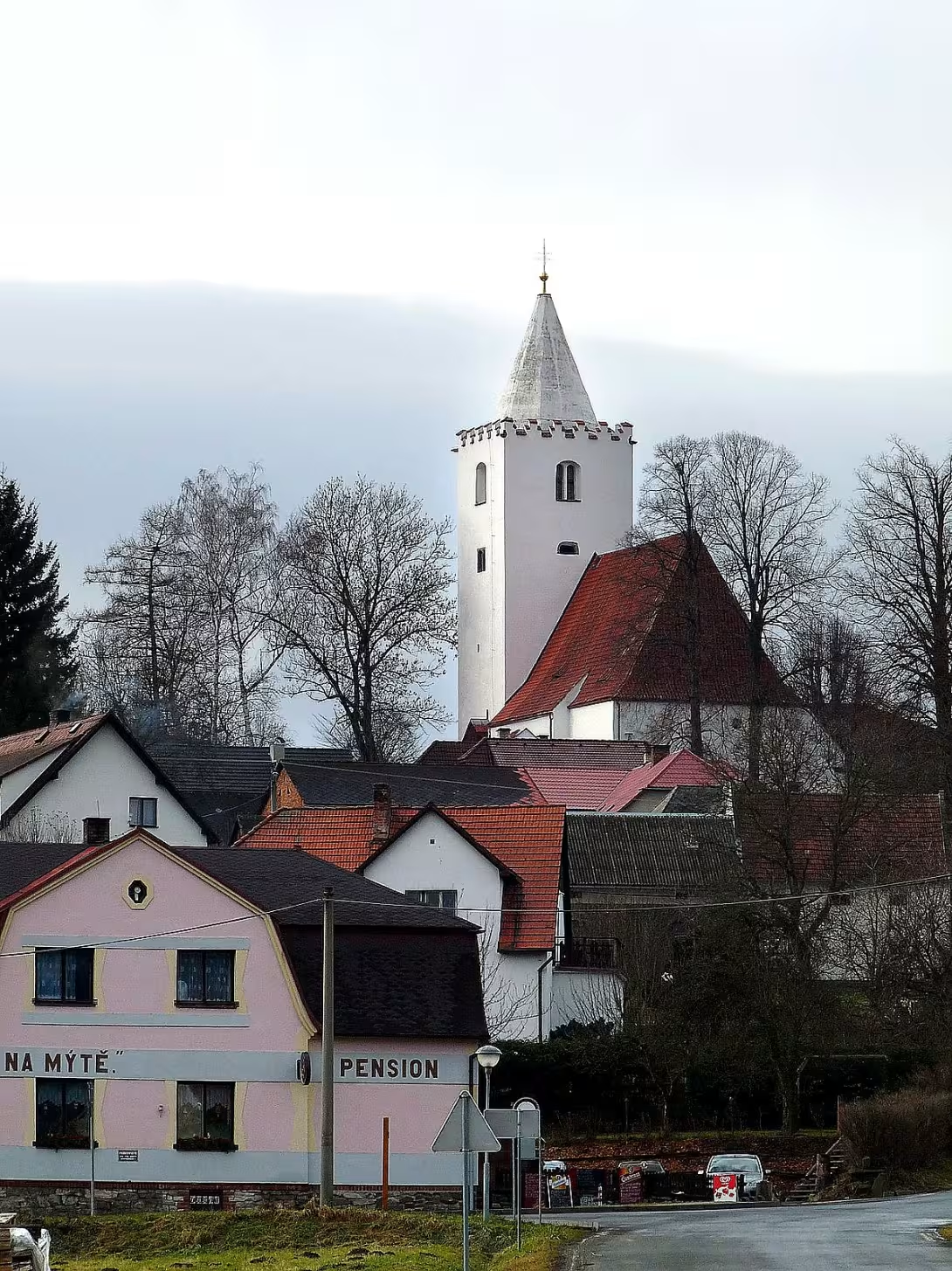
The Church of St. Peter and St. Paul is located in the heart of the village Petrovice u Sušice, less than 6 km from Susice, and forms a significant dominant landscape. It grows from the remnants of an old chateau called "Vyšehrad" and represents an interesting example of the link between parochial life and former feudal residence.
The origins of the settlement in the site are assumed to be related to gold-piling at the turn of the 11th and 12th centuries. The first written mention of the village dates back to 1319, when the capture of the knight Albert of Schönstein took place. The church is mentioned for the first time in 1366 as plebania - the designation of the medieval parish. In the past, however, he used to serve as a chapel of the Petrov chateau, as evidenced by its location in the centre of the former chateau and the strength features of the building, which apparently also performed a defensive function.
The dating of the church has long aroused confusion. Older literature interpreted the tower as a Romanesque building with typical combined windows. But newer researchers rank the construction by the end of the 13th century, the Gothic era. The rural environment often lagged behind the stylish development of larger centres. The church has undergone many reconstructions over the centuries.
Today's appearance is a one-ship building with a square presbytery on the east side and sacristy on the north side. The dominant element is a massive five-story prism tower with a roof shaped of a polygonal needle and pseudo-gothic cimburia with strength features. On the north side of the tower there is a clock dial. The oldest parts - tower and ship - were extended by sacristy in the 15th or 16th century. In 1707 there were modifications to the windows and extension of the hall. Romantic adjustment in the 19th century determined today's appearance of the battlements and roof of the tower.
The boat has a flat ceiling with baroque windows that are close to the tower circular. Under the tower there is a cross vault without ribs. The presbytery is glazed with one field of cross rib arches with a triumphant arch on the prism consoles.
The church was surrounded by a cemetery surrounded by a wall, accessible by a Gothic gate. This arrangement resembles the old central construction and gives the city a special atmosphere. The visit to Peter allows to perceive the layering of the medieval community from the beginning of the settlement to the feudal settlement to the parish church.
Then and now
Drag the slider to compare how the landmark may have looked when it was built with the view today.
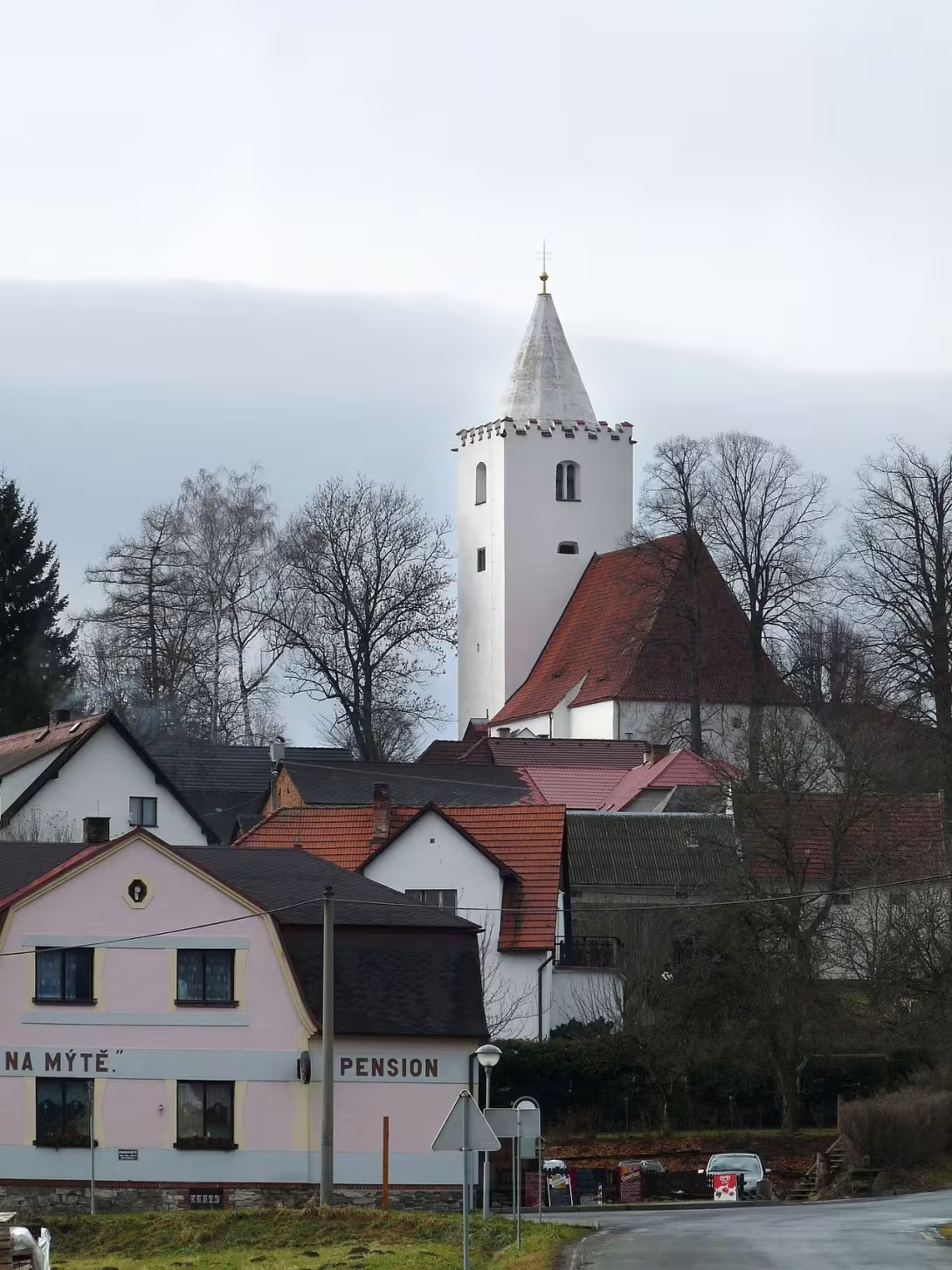

The historical appearance on the left is an AI-generated visualisation and serves as inspiration only.
Historical milestones
- zlom 11. and 12. century
- The beginning of the settlement in the location related to gold-piling.
- 1366
- First written mention of the church as plebania.
- 15.-16th century
- The expansion of the ship and the construction of the sacristy.
- 1707
- Baroque window modifications and extension of the hall.
Architectural development
The church was built in the place of the chateau with walls and walls. The oldest part are the tower and the ship from the end of the 13th century which were later extended to the north side. The presbytery is glazed with a cross vault, the ship has a flat ceiling with baroque windows. The tower is five storey with a polygonal needle and a battleship. The cemetery is surrounded by a church and surrounded by a wall, accessible by a Gothic gate.
Historical events
- 1319
- First written mention of the village Petrovice, associated with the capture of the knight Albert of Schönstein.
- 1366
- For the first time, the church is referred to as plebania, the parish church.
- 1707
- Baroque modifications of the ship's windows and extension of the hall above the north portal.
- 19th Century
- Romantic pseudo-gothic treatment, including three-stage cimbura tower.
Owners
Farnost Petrovice u Sušice, municipality Petrovice u Sušice
Points of interest
- The church stands in the place of a former chateau called "Vysehrad" and originally served as a chapel of Petrovský chateau, which also had a defensive function.
- The first written mention of Petrovice is from 1319 when Knight Albert of Schönstein was captured.
- The church is first mentioned in 1366 as plebania, a medieval parish.
- The church tower was originally interpreted as Romanesque, but newer research dates back to the end of the 13th century, the Gothic period.
- The church underwent many reconstructions, most recently in the 19th century, when it gained today's romantic appearance of the battlements and roof of the tower.
Guide
This guide is narrated by a synthetic voice generated by artificial intelligence.
Show guide text
This text was created by artificial intelligence and has not been editorially reviewed. It may contain inaccuracies.
The Church of Saints Peter and Paul stands in the middle of the Petrovice u Sušice village, not quite six kilometers west of Sušice, and forms its landmark. Settlement here apparently began in connection with gold panning at the turn of the eleventh and twelfth centuries. The first written record of Petrovice dates from thirteen nineteen. It mentions the capture of knight Albert ze Schönsteina and his delivery to a Strakonice prison.
The church stands on the remains of fortifications, which were called Vyšehrad. Around the church there used to be a cemetery enclosed by a defensive wall, and the area is entered through a Gothic gate. The church is first mentioned in thirteen sixty-six as a parish, that is, a medieval, mostly rural parish. Earlier, however, it belonged to the Petrovy château and served as its chapel. This is suggested by its location in the middle of the former fortified settlement. The building has fortification features, so it apparently also served a defensive purpose.
Older publications identify the church tower as Romanesque, mainly because of its typical paired windows. Later scholars, however, place it at the end of the thirteenth century, and thus in the Gothic period. Romanesque elements here may be a remnant. In the countryside, new styles often became established with a delay compared to larger centers.
The church was rebuilt many times. The oldest parts are the tower and the nave. In the fifteenth or sixteenth century, the nave was extended northward and a sacristy was added. In seventeen oh seven, the windows of the nave were modified and a vestibule was created above the northern portal. The present form of the roof of the tower and the three-tiered crenellation date from the Romantic alteration in the nineteenth century.
Today the church is a single-nave oriented structure, that is, with a presbytery to the east. It has a high gabled roof. On the eastern side, a square presbytery with a hipped roof adjoins it, and on the northern side a sacristy. To the western façade adjoins a massive five-story prism-shaped tower, topped with a roof in the shape of a polygonal pyramid and pseudo-Gothic crenellation. The clock face is now only on the north side of the tower; it used to be on all sides.
The nave has a flat ceiling and Baroque windows, which are circular near the tower. The space beneath the tower is covered with a ribless cross vault. The presbytery is separated from the nave by a triumphal arch. It is vaulted with a single field of a cross ribbed vault, which rests on prism-shaped consoles.
Tips for visitors
The best time to visit the church of St. Peter and Paul is during the morning hours in the summer months when the sun is favourable for photography and temperatures pleasant. In winter it is interesting to visit the church during the holidays or during the Advent, when the interior is decorated and the atmosphere is particularly magical. Always avoid weekends when the church is most visited.
If you arrive by public transport, the stop is close to the village, find a specific connection in the traffic search engine. There is also the possibility of a short walk from local stops around the church.
When visiting, wear comfortable clothes and shoes as the church is located in the historical part of the village with possible terrain inequalities. Don't forget to wear warm clothes in winter, because it can be cold in church. Prepare a macro lens for photography to capture the details of medieval architecture and the surrounding chateau.
The best places for photography are the church entrance portal, the tower with gothic windows and the interior with original frescos. For quality images, use natural light during morning or afternoon hours when the light is softer. The interior of the church is also interesting for shooting in sunlight, which penetrates the windows and illuminates historical elements.
In the vicinity of Petrovic near Susice is worth visiting the historic town of Susice, which is only six kilometres away. Here you will find a Renaissance chateau and other cultural monuments. For families with children it is interesting to visit the archaeological site of Hradišehrad in the church area, which offers the opportunity to know the medieval history of the region. In the village there is also the possibility of short walks along the surrounding forests and fields.
For families with children, a visit to the church of St. Peter and Paul is very interesting, because children can watch stories associated with the church and the chateau. In the church area you can see the remains of the medieval chateau, which children can see as an adventure. It is also recommended to visit the church during services where children can watch and engage in religious rituals. It is also advisable for children to bring a notebook and a pencil so that they can draw what interests them.
Frequently asked questions
Can the monument be visited?
Religious buildings are usually open mainly during services; at other times a visit is normally arranged with the parish or the operator. We have not verified specific times.
Where is the monument?
Location: Petrovice u Sušice, Plzeňský kraj. The map on this page shows the exact spot.
Why is the monument protected?
It is listed in the Central List of Cultural Monuments of the Czech Republic as a cultural monument (register no. 28485/4-3223).
For kids
Imagine going back to the past. Where would you be? In Petrovice near Susice, where there is a beautiful church of St. Peter and Paul. It was like a time travel game!
At that time, there were people who believed in the gods. They built a church to pray to the angels of heaven. The church was their temple where they gathered and prayed together for their families and village.
Businesses nearby
Do you run a restaurant, accommodation, shop, museum, rental, wellness or other visitor service near this monument? Show yourself directly to the people heading to it — this is how they will see you in the app and on the web:
Events nearby
Zdroj akcí: otevřená data měst a obcí ČR (Národní katalog otevřených dat) a kalendář akcí Národního památkového ústavu.
Accommodation nearby
Themed route
Thematic cruise route: Footprints of the Middle Ages and Renaissance in Petrovice near Susice
1. Church of St. Peter and Paul * Memorial - sacral architecture * The Gothic-Renaissance church stands in the place of an older chateau, whose remains can be seen in the premises. The interior with valuable frescoes and a Gothic portal reveals the region's rich history.
2. Hradiště Vysehrad (Petrovice) * Archaeological site - medieval fortress * The direct neighbourhood of the church hides the remains of the chateau from the 11th-13th century. The visit reveals how the local strategic location affected the formation of the parish church.
3. Drying - historical center * Cities - Renaissance monuments * Six kilometers away, the city attracts a Renaissance chateau and picturesque streets. The local cultural heritage complements the overall picture of the region.
* The route combines spiritual and historical tracking with the natural paradise of the Czech Forest, which is within reach of a short walk from Petrovic. *
Seasonal recommendations
Spring In the spring months, the church of St. Peter and Paul is besieged in a green garment - surrounding meadows and forests are awakened to life, while the sun's rays flow through the windows into a cool interior where the shadow of winter remains. Specific here is a quiet lighting, where the morning sun highlights the details of gothic frescoes and late afternoon creates fine, golden shadows in the church. Nature around Petrovic offers the first flowers of spring plants that complement the historic atmosphere. Practically, it is best to visit the church in March or April when the crowds are not accumulating yet - the ideal time is early in the morning, when the church is free and the light is most favourable. Comfortable shoes are recommended, because after rainy days the roads to the monument can be muddy, and light but warm clothes, because spring weather is variable.
Summer In the summer months the church shines in full power - the sun illuminates it from morning to evening, and the stained glass, which in other seasons acts as a shadow, disperses the colorful reflections into the cold interior. The surrounding area is lively, green and often visited tourists, which brings a more lively atmosphere to Petrovic. The evening lighting is also specific, when the church is sometimes lit by artificial lights during the summer months, creating dramatic contrast with the darkening landscape. The best time to visit is early morning or late afternoon to avoid the main crowds that gather in the main summer season. It is recommended light but sun protective clothing, hat and plenty of water, as in summer days can be hot around the church.
Autumn Autumn brings golden and red colors to Petrovic, which are reflected in the church windows and create a unique atmosphere. The sun shines below here, and its rays penetrate the interior through the stained glass, creating warm, copper shades. The surrounding area is quieter than in the summer, but nature offers a rich variety of colors, which complements the historical nature of the monument. There is also an evening silence, where the church appears to be an escape from the rush. The best time to visit is September or October when temperatures are pleasant and the crowds are minimal. Warmer clothes are recommended, because evenings can be cold, and comfortable shoes, as forest paths can be wet.
Winter In the winter months, the church of St. Peter and Paul acts as a mysterious, almost fairy-tale formation, surrounded by snow and frozen trees. The sun shines short and low here, and its light penetrates the interior through the stained glass, creating cool, blue shades. The surrounding area is quiet and almost desolate, which gives the monument a special atmosphere. The winter silence is also specific, when the church appears to be an escape from everyday excitement. The best time to visit is in December, when the church is often illuminated sacrament, and it creates a unique atmosphere. It is recommended that warm but comfortable clothes, because temperatures can be low, and suitable shoes, as the paths can be slippery.
Visualizations and artistic views


The visualisations are generated by artificial intelligence and serve as inspiration.
Photos from the area
Real photos taken near the monument


Zdroj a licence jsou uvedeny u každého snímku.
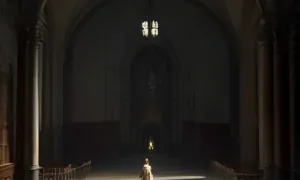
Atmosphere of the place
This atmospheric visualisation of the place and period was generated by artificial intelligence. It is not real footage of the location.
Tips from visitors
No tips yet. Be the first!
Log in and add your tip.
Sources and literature
Photos: Czeva / CC BY-SA 3.0 — Wikimedia Commons. The author and licence also appear when you hover over the image.
Faktickým podkladem tohoto textu byl článek na Wikipedii, jehož autory jsou přispěvatelé Wikipedie. Článek je dostupný pod licencí CC BY-SA 4.0.
Location on the map
More monuments – Petrovice u Sušice
Show all in the municipality




Příběhy a pověsti
Legendy, pověsti a příběhy spjaté s touto památkou
Fotografie návštěvníků
Zatím žádné fotografie. Buďte první, kdo přidá fotografii z návštěvy!
Log in a přidejte svou fotografii nebo hodnoťte.
Za ověřenou návštěvu v aplikaci získáte víc bodů — poznáme podle GPS, že jste na místě.
Reviews and comments