



Kostel Všech svatých Church
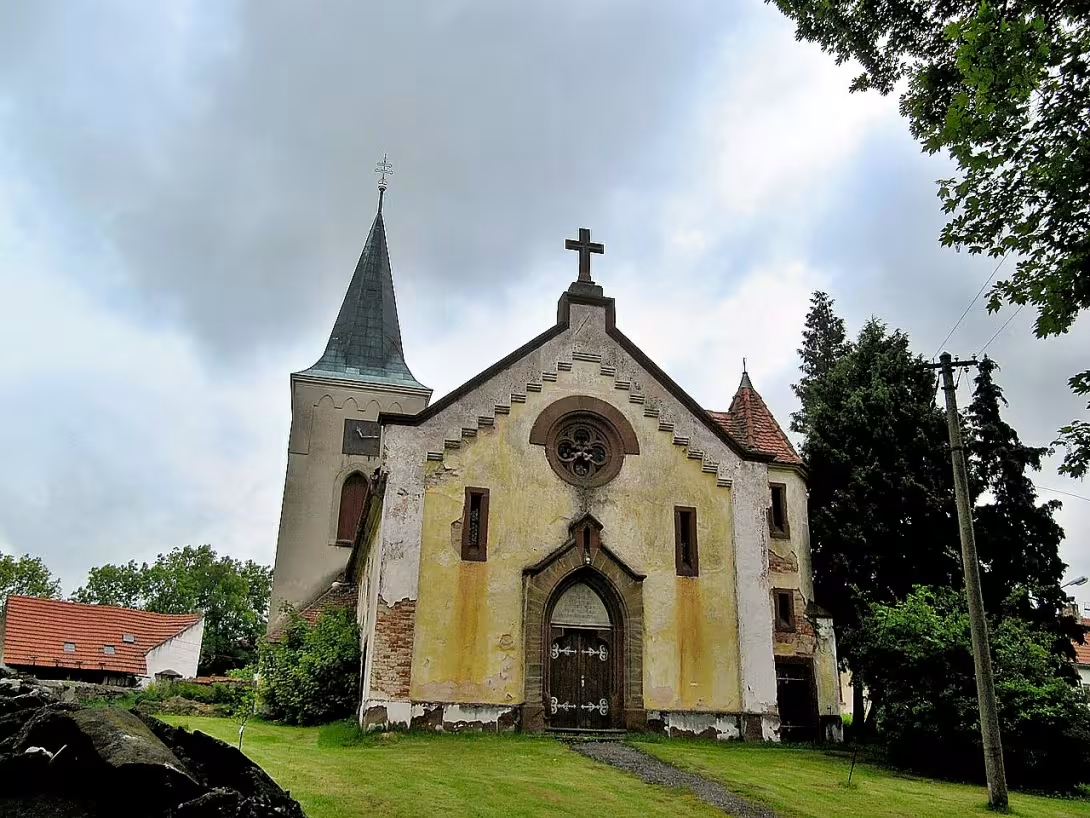
Kostel Všech svatých in Oleška is a Roman Catholic filial church on a separate island in the northeast part of the village. This Gothic building is probably from the second half of the 13th century and is protected as a real-estate cultural monument of the Czech Republic. The object of the monument protection is the church itself, the rectory with descriptive number 23, the farm building and the fenced wall with gates. Until 31 December 2004, this building served as a parish church.
Kostel Všech svatých was founded in the Middle Ages when Gothic was developed in Bohemia as a dominant architectural style. This period was characterised by political instability and frequent conflicts, but also by a cultural boom. The oldest history and specific founders are known only for the essential things of the preserved reports, with the construction bearing apparent traces of medieval origin.
On the architectural side, it is a single-boat, unoriented construction with a rectangular boat and a detached polygonal conclusion towards the northeast. There's a tower adjacent to the northwest wall. From the second half of the 13th century, a low presbytery was preserved with three sides and covered with a rib arch, whose ribs have a prism profile with cut edges. The eastern part of the church, the northwest tower and the ship have a gothic masonry in the core. The north wall of the conclusion is headed for the sacristy and is broken in with an optionally closed, richly profiled portal. The side axes of the facade contain narrow windows with cut edges. Later construction modifications include an arc frieze with thick enchantments from 1899.
During its existence, the church passed through a number of building modifications and events. In 1384, historical sources mentioned a fire that damaged the memory. In 1888 the ship's space was covered by a flat ceiling and the boat was extended by an extension with a new facade. Less than a decade later, in 1899, the tower increased by 3.5 metres and got a needle roof. From the interior equipment, the experts documented a three-legged tin baptiser from 1786.
Today, Kostel Všech svatých is registered as a real-estate cultural monument of the Czech Republic and works as a filial sanctuary. Together with the adjacent rectory, the economic building and the fenced wall with gates, they form a monument protected area on the island of Oleška.
A visit to this Gothic church offers a view of preserved medieval elements such as the original presbytery with a rib arch or Gothic masonry. It is worth a look at the architecture here and discover the development of this monument on site.
Historical milestones
- Second half of the 13th century
- the creation of a gothic church building
- 1384
- fire that damaged the memory
- 1786
- three-legged tin baptisers
- 1888
- covering the ship's space with a flat ceiling and ship expansion
- 1899
- increase the tower by 3.5 meters and add the apex roof
- 31 December 2004
- the last day the object served as parish church
Architectural development
The church is probably from the 2nd half of the 13th century with a low presbytery with three sides and a rib arch. In 1888 the boat of the church was expanded, in 1899 the tower was increased and an arc-bodied decoration was added. Gothic elements are preserved in the eastern part of the church, northwest tower and ship.
Historical events
- 1384
- The church was damaged by fire.
- 1888
- The church boat was covered with a flat ceiling and extended with an extension with a new facade.
- 1899
- The tower was raised by 3.5 metres and covered with a needle roof.
Points of interest
- This Gothic building is probably from the second half of the 13th century. In 1384, historical sources mentioned a fire that damaged the memory. - In the interior there is a three-legged tin baptist from 1786. - In 1899, the tower increased by 3.5 metres and it was given a needle roof. - It's a one-legged, unoriented building with a rectangular boat and a detached polygonal conclusion.
Guide
Show guide text
This text was created by artificial intelligence and has not been editorially reviewed. It may contain inaccuracies.
Welcome to this beautiful place where history meets the calm and loneliness of nature. You are standing in front of the Church of All Saints, which stands above the surrounding area on a separate edge in the northeast part of the village. Feel this atmosphere, this sense of isolation, which was already an intentional element when it was created. The church does not only act as a building here, but as a silent guardian of the landscape, which has long been dominated by this place. Look around you and realize that they have just entered a space that has survived for centuries, surpassing the fires and the transformation of human life.
Now let's look deeper into the past together to understand how this object came into being. This Gothic building you are now observing has its roots very deep in time, probably in the second half of the 13th century. Imagine the world back then, the world of the Middle Ages, when these stone shapes were born out of the need of faith and community. The church stood here as a pillar of life, although its journey was not always easy. Already in the year one thousand three hundred and eighty-four, there is a mention of a devastating fire that has seriously damaged this monument. Although the flames hit the very heart of this building, it still stands here as if it were meant to withstand all the pitfalls of fate. This survival ability is one of the most important aspects that radiate from this place.
Now pay attention to the architecture itself and to what you see right in front of you. Kostel Všech svatých is very specific and unusual. It's a single-storey structure, which means that its inner space is one main unit. Note that the building is not oriented according to the classical religious rules that usually point the main part of the church towards the exit. Instead, its polygonal conclusion, that is, this polygonal ending part, is headed towards the northeast. This detail gives the whole building its unique character and distinguishes it from many other churches around it.
If you look up now, you can see the tower. Note its position - it is located on the northwest wall of the building. But its present appearance is not as old as it might seem at first sight. In the year one thousand eighty-nine, the tower changed significantly. It was raised by three and a half metres at the time, and it was added to the applet roof, which gave it today's, clearly defined shape. This change was part of a wider process of modernisation and adaptation of the church, which took place during other periods. For example, in the year one thousand eight hundred and eighty eight, there was significant interference in the ship's space itself, where the ship's space was covered with a flat ceiling and the ship itself was extended. These layers of history, these gradual changes, are like a book carved into stone and wood.
If you then try to see the interior, even if you are now watching it from the outside, try to imagine the treasure that is in it. In the year one thousand seven hundred eighty six here was created a three-legged tin baptizer. It is a unique object that carries within itself the spirit of the Enlightenment period and reminds all generations of people who have been admitted here to the church community. This object is proof that the church was not just an empty box, but a living place where the most important moments of human life took place.
The interesting thing to think about is that this building has undergone such a fundamental transformation in time that it almost became a different object than it was at the time of its beginning. From the Gothic base to the fire in the late Middle Ages to the nineteenth century, when architecture adapted to new needs. And yet, despite all these changes, at its core, it remains the same church that stands on this island.
There is also one sadder but very strong track in time. If you realize that this object has served as a parish church for many centuries, then it is important to mention the date of the third January of the year two thousand and four. This was the last day of a regular spiritual life within the parish. Since then the church has become mainly a real cultural monument of the Czech Republic. This change in role, from the lively center of the community to a rare historical monument, brings a certain melancholy to the atmosphere of the place. The church is no longer just a building, it is a witness who is now silent, but his presence is still as strong.
Now I beg you, don't just listen to my words, but try to perceive the surroundings with all your senses. Take a look at the structure of the walls in detail, see how light changes on the surface of the building and how this building is compounded into the landscape around you. Go through the area around the edge to understand why this place was chosen to build this temple. Every stone and every change in tower height tells its own story about the effort of man to create something lasting in a rapidly changing world.
Thank you for spending this moment right here at the Church of All Saints. We hope that this view of his history and architecture has helped you better understand the importance of this place. We wish you the pleasant rest of your walk and invite you to further discover the beauty and mystery of this region. Dare to continue and let your curiosity guide you. Goodbye.
Tips for visitors
Best time to visit the church All saints in Oleška are in spring or autumn when vegetation is best visible and the atmosphere is calm. These periods also offer pleasant temperatures for long walks around the church.
When visiting, wear suitable clothes, as it may be cold or wet on the edge of the church. Also remember the protective sunglasses and plenty of drinking water, especially in the summer months.
The best place for photography is in front of the church during the morning or evening light, when light is softer and shadow effects create an interesting visual impression. Interesting angles for photography can also be found from surrounding roads around the church.
In the vicinity of the church you can visit the historical village Oleška, where there are other cultural monuments. It can be interesting for families with children to explore the natural environment of surrounding forests and streams that offer opportunities for various activities on the outside.
Frequently asked questions
Can the monument be visited?
Religious buildings are usually open mainly during services; at other times a visit is normally arranged with the parish or the operator. We have not verified specific times.
Where is the monument?
Location: Středočeský kraj. The map on this page shows the exact spot.
Why is the monument protected?
It is listed in the Central List of Cultural Monuments of the Czech Republic as a cultural monument (register no. 1000147894).
Businesses nearby
Do you run a restaurant, accommodation, shop, museum, rental, wellness or other visitor service near this monument? Show yourself directly to the people heading to it — this is how they will see you in the app and on the web:
Nearby
🏰 Historic sites (110)
- Memorial to victims of the Nazisme 2.1 km
- Castle Diblekov 3.9 km
- Castle Molitorov 3.9 km
- Trace Malotice 4.2 km
- Skansen Smoking 4.7 km
- Jan Zizka, Jan Hus 4.7 km
- Brewery Museum 4.7 km web
- Women's Mill 4.7 km
- Vondrachev factory 4.8 km Českobrodská 237 + 420 775 27 81 web
- victims of the world's war 4.8 km
- T. G. Masaryk, E. Beneš, M. R. Štefánik 4.8 km
- Liberation by the Red Army on May 9, 1945 4.8 km
- Monument to the victims of the world war 4.9 km
- Gallery Jan Svatoš 4.9 km Prokopova 1095 web
- Zaniklá village cukmantl 5.0 km
- zaniklá village Drbohlavá 5.1 km
- Astronomy Center Europe 5.5 km
- Museum Smoking 5.5 km Peace Square 1 + 420321783380 web
- Prokop Great 5.5 km
- Tomáš Garrigue Masaryk 5.6 km
🍽️ Restaurants and dining (93)
- Restaurant near Hálu 4.5 km Kutnomountain 369 + 420321697206 web
- Huang Hoa 4.7 km
- Confectionary Salon 4.7 km + 420 739 690 816 web
- Touring hostec 4.8 km web
- Pizza Everyday 4.8 km Square Smilický 51 + 420 720 612 456 web
- Confectionery Kral 4.8 km Square Smilický 37 722 187 008 web
- Five Days Bar 4.9 km
- Blue door 4.9 km 602331 996 web
- Museum 4.9 km
- Nostalgia u Pottery 4.9 km Pražská 102 + 420 321 697 398 web
- Pizzeria Raffaelo 5.4 km
- Meeting 5.4 km
- Restaurant on Strelnici 5.6 km Pražská 303 728 205 51 web
- Restaurant Na Statku 7.7 km Square 327 web
- Cafe 1888 7.8 km
- Na Zavisti 8.2 km
- Dining room and brewery at Svarcos 8.3 km
- Propaz 8.4 km
- Kiosek 8.5 km
- Guesthouse U Coubalu 8.6 km
🏨 Accommodation (24)
- Accommodation in brewery 4.7 km web
- Guesthouse u lva 5.5 km
- Legner 9.7 km
- Sazov Island 10.2 km
- Pod Vrbou 10.6 km
- Podvine 11.0 km
- Hotel at St. Huberta 11.1 km + 420 731 920 731 web
- Saza 11.2 km Benešovská 44 + 420 773570007 web
- U hrci 11.3 km
- Vanicek 12.0 km
- Mlyn Pataki 12.1 km Doubecká 32 + 420323660029 web
- Club Lávka Chocerada 12.1 km
- Apeyron 12.2 km
- Romantic baroque nest 12.8 km web
- Hotel Ideas 13.6 km
- Guesthouse Jaro 13.8 km
- Ostende 14.0 km
- U Sapics 14.4 km web
- Hotel Sedmikrás 14.5 km K Myth 47 + 420604950148 web
- U Míly 14.6 km
🚲 Rentals and sport (20)
- SSK Kostelec over the Black Forest 4.3 km
- Scok 5.0 km
- CYCLOSERVIS JEVANY 7.8 km Sport 359 732365079 web
- Sokolovna 8.8 km
- Cycloservice Vyžlovka - Josef Dřehal 9.7 km Skalská 275 + 420 728 508 057 web
- Sport stable Pyskopheles 10.2 km
- Cycloservis 11.1 km + 420 722286080 web
- Auto Moto Velo 12.0 km Suvorova 136 + 42077574594 web
- Sport hala 12.2 km
- Sokolovna 12.2 km
- Bike for joy 12.2 km Kollarova 972 + 420603843048 web
- Cyclosport Kern 12.7 km Sleeping 279 + 420 323 607 816 web
- Sokolovna 12.7 km
- Swimming pool Radim 12.8 km
- Samba 13.8 km + 420 604 904 737 web
- Cyclo Ondracek 14.3 km
- KOLACALEK. CZ 14.4 km Cologne 969 web
- Bowling Vojkov 14.5 km + 420323660231 web
- PARAGLEK 14.6 km
- Sokol Porečany 15.0 km
🥾 Hiking and nature (72)
- U Bricklayer 3.4 km
- pramen Cukmantl 4.6 km
- Skanzen Smoking 4.7 km
- _ 4.9 km
- Rooks 5.0 km
- Park On the Hradbás 5.4 km
- fun stopping 5.5 km
- Red top 5.5 km
- Peace Square 5.5 km
- fun stopping 5.5 km
- fun stopping 5.5 km
- fun stopping 5.6 km
- fun stopping 5.6 km
- fun stopping 5.7 km
- Study Under the field 5.8 km
- Study U Satoria 5.8 km
- Hlaváčova Lhota 5.8 km
- View from Lech's stone on the city of Smoking 5.9 km
- Source of the Kozojedský poroka 6.0 km web
- Leipzig Hora 6.1 km
Accommodation nearby
Trips and activities nearby
Guided tours, tickets and activities nearby from GetYourGuide
Affiliate link: if you buy from the partner, we may receive a commission. The price for you does not change.
Search tours and activities →Themed route
1. Kostel Všech svatých (internal space) - Explore the spiritual space of the temple and its historical elements. 2. Church tower (view) - Climb the mountain to enjoy the view from the highest point of the monument. 3. Church courtyard (outdoor area) - Take a walk in a quiet zone right by the walls of the building.
Seasonal recommendations
Spring brings about the church awakening nature and a fine, scattered light that brings a feeling of freshness to space. The atmosphere is very calm and harmonious in this period. For the best experience I recommend visiting the morning when the light is most attractive. Prepare your layered clothes because the morning temperatures can still be cold.
In the summer months, the surrounding area of the building is covered with intense sun rays and is dominated by the greatest excitement. Long days allow you to watch the shadow game on the historical walls. Due to the expected crowds, it is best to arrive right after the opening so that you enjoy your peace and avoid the greatest heat. Don't forget light summer clothes and plenty of fluids.
Autumn brings golden shades and often mysterious morning fogs to the landscape, which give the memory of melancholy. The light is low and very malleable in this period, which is ideal for observing the details of architecture. It is advisable to carry a coat or scarf because the air is usually wet. The best time for a tour is afternoon hours.
Winter is characterized by short days and quiet, up to a rough atmosphere, which is very spiritual in the interior of the church. Light is weak and requires sensitivity. Due to the shorter opening time and cold I recommend a visit around noon when the most daylight is. The need is warm and robust clothing, especially if you move around the building.
Visualizations and artistic views


The visualisations are generated by artificial intelligence and serve as inspiration.
Photos from the area
Real photos taken near the monument


Zdroj a licence jsou uvedeny u každého snímku.
Tips from visitors
No tips yet. Be the first!
Log in and add your tip.
Sources and literature
Photos: Palickap / CC BY-SA 3.0 — Wikimedia Commons. The author and licence also appear when you hover over the image.
Faktickým podkladem tohoto textu byl článek na Wikipedii, jehož autory jsou přispěvatelé Wikipedie. Článek je dostupný pod licencí CC BY-SA 4.0.
Location on the map





Příběhy a pověsti
Legendy, pověsti a příběhy spjaté s touto památkou
Fotografie návštěvníků
Zatím žádné fotografie. Buďte první, kdo přidá fotografii z návštěvy!
Log in a přidejte svou fotografii nebo hodnoťte.
Za ověřenou návštěvu v aplikaci získáte víc bodů — poznáme podle GPS, že jste na místě.
Reviews and comments