



Kouskova Lhota Fortress
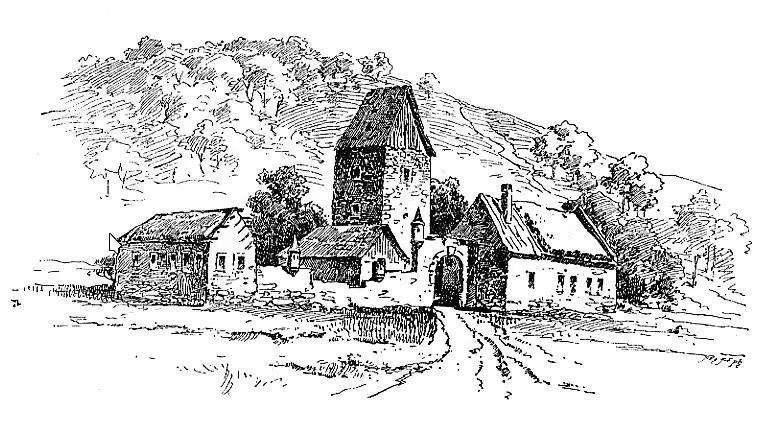
Kouskova Lhota is a partially preserved medieval fortress on the site of a desolate village in the solitude of the Black Cow, about one kilometer northwest of Neznašov near the Pudhavč in Klatovy district. It was probably created in the second half of the 15th century. In 1686, she ceased to serve as a mansion, after which her buildings had disappeared or merged with the adjacent economic court. Today, this monument is protected as a cultural heritage and is formed by a preserved tower with remains of fortification and adjoining barn.
At the time of the foundation of the fort in the second half of the 15th century, smaller noble settlements were developed in the Czech Republic. This period was characterised by the fragmentation of ownership and the emergence of harbours as local government centres. The village of Lhotka, later called Kouskova Lhota according to the House of Pieces from Sobecky, was built in places of solitude of the Black Cow in the Middle Ages. The first known owner was Milota Beneda ze Šťáhlav, commemorated in 1501.
The fortress was built of quarry stone and surrounded by a moat and a boulder that is best seen on the west side. The main preserved building is an original tower with two floors with a saddle roof. Originally, it was entered by a brick entrance on the first floor of the east wall, which was consistent with the defensive nature of the building. Part of the fort used to be a palace, which used to stand on the site of a modern barn. According to the 1655 report, there used to be a great saint, a cellar, a chamber, a kitchen with a bread oven, a larder and other living and economic rooms.
After Milot Bened of Štišek he held the village between 1521 and 1523 Jan Beneda, after which the daughter of Lidmila of Štišek inherited. The 1544 farmhouse sold it to Jan Kouskek from Spoletičky, which first mentions the fort here. Jan Kousek was originally a Klatovy townsman and gained his coat of arms in 1529 from Jiøígo of Spoletice. He had five sons with his wife Lidmila from Rome. Of these, Václav and later Jakub Kousek were listed at Lhotka, who died before 1607. The estate was managed by his son Henry, who attended the state uprising. After his death in 1621 the estate was transferred to manhood and five years later he was accepted into the fief by his brothers William and Daniel. In 1652 the owners reached the release of the estate from the manor for a fee. In 1655 the brothers Jan Adam and Albrecht Hynek Kousková shared the estate. After John Adam's death in 1657, his widow Apolon had a dispute with Albrecht Hynek about the inheritance. In 1667, Apoléna's son Ladislav Vilém Krásek sold his part to William Albrecht Krakovski of Kolovrat, who soon afterwards sold it back to Albrecht Hynku Kousek. After the death of Albrecht Hynka Kouska in 1686, the widow Kateřina Polyxen had to sell almost the entire estate to William Albrecht Krakovski of Kolovrat, who permanently connected Lhotka to the Teenage estate.
Key events include the year 1544, when the first written mention of the fort was made when Jan Kouskov was sold from Společky. In 1621, the transfer of the estate to manhood followed the participation of Henry Kousek in the state uprising. The year 1686 became an important milestone, when the fort finally lost the function of the mansion and began to lose its place. At the end of the eighteenth century, her remains were altered to a granary.
The original building complex has been partially preserved in the form of fragments of water moat and wall, and also a two-storey tower which served as a granary. The monument lies in remote solitude and offers a view of the lower noble architecture of the Czech past.
Historical milestones
- 1544
- The first mention of the fort in connection with the sale of Jan Kouskov from Sobecky.
- 1621
- The death of Henry the Bite and the subsequent transfer of the farm to manhood.
- 1686
- The fort stopped being a mansion and was attached to the Teenage estate.
Architectural development
The fortress was built of quarry stone and surrounded by a moat and a boulder. The main building is a two-storey tower with a saddle roof and the original entrance on the first floor. At the site of today's barn, there was probably a palace with a large skylight, kitchen and granary.
Historical events
1544: First mention of the fort in the sale of Jan Kouskov from Společky. 1621: Transferring the estate to manhood after the participation of Henry Kousek in the state uprising. 1686: The end of the function of the mansion and the beginning of the collapse of the building.
Owners
Milota Beneda ze Šťáhlav (1501), Jan Beneda (1521-1523), Lidmila from Štěhlak (up to 1544), Jan Kousek ze Sobětiček (from 1544), the House of Pieces from Spoletičky, Wilhelm Albrecht Krakovský from Kolovrat (after 1686)
Points of interest
- Kouskova Lhota is a partially preserved medieval fortress, which was created probably in the second half of the 15th century on the site of the extinct village in the solitude of the Black Cow. - In 1686, the fortress ceased to serve as a mansion, after which its buildings disappeared or merged with the adjacent economic court, and today the preserved tower with the remains of the fortifications and the adjacent barn is a monument. - The fort was made of quarry stone, surrounded by a moat and a boulder and its main preserved building is an original tower with two floors with a saddle roof. - The original palace used to stand on the site of a modern barn, and according to the 1655 report there used to be a great saint, a cellar, a chamber, a kitchen with a bread oven, a larder and other residential and economic rooms. - The first written mention of the fort dates back to 1544, when Lidmila of Střešek sold the farm to Jan Kousek of Společek.
Guide
Show guide text
This text was created by artificial intelligence and has not been editorially reviewed. It may contain inaccuracies.
Welcome to the place where the echoes of the past mingle with the silence of the surrounding countryside. You are standing right in front of Kouskova Lhota, eagerly waiting for its other visitors to be a monument, which has long since lost its original shine, but still carries undeniable seriousness and nobility. Look around you. You are alone, near the Black Cow near the Litter, in a place that acts distant from the rest of the world. This isolation is not random. It was here, in the heart of this quiet region, that once took place events that shaped the destinies of local families and noble pedigree. Feel this atmosphere - the silence that exists here is not empty, it is a silence full of stories that we are trying to revive together.
Now let's go back deep into the past to understand why this place was created. Kouskova Lhota is not just a random cluster of stones. It's a remnant of a world that no longer exists. This fortress was built probably in the second half of the 15th century. Imagine the times, periods of uncertainty, but also building new centres of power. However, this building was not built on barren soil, but on the site where Lhotka once prospered. That's fascinating in this place. Under your feet, in this country, there is the history of the entire human settlement, which has been completely erased from the map over time, and only this fortress is left behind as a silent guardian of the memory of a defunct village.
Now pay attention to what's right in front of you. Even though this fortress is now partially preserved, its structure still allows us to understand its original purpose. Feel these remnants of fortification. Even though they are no longer as powerful as at the time of their greatest bloom, you can still feel the need for security and protection. This fortress wasn't just home, it was a fortress. Look at that tower that's hanging over the perimeter. It's one of the most significant elements of this complex. It's interesting how its significance changed over the centuries. What could once serve as a defence or as a symbol of power was later transformed for practical purposes and served as a granary. This transformation from the manor to the economic building is a clear sign of how the world around us was changing - from chivalry ideals to practical need for management.
To fully understand the importance of this place, we need to look at the people who left their mark. The history of Kouskov's Lhota is closely linked to the specific names that carry the weight of the social arrangement at the time. The first clear trail we can trace in the chronicles dates back to 15 hundred and forty-four. In that year the name of Jan Kousek from Spoletičky, who was interested in this place of sale, appeared in connection with this claim. The fortress was already established by the government at that time. Another important figure was Henry the Piece. His death in 16,000 was a major turning point for this farm. After he left, the fort moved into another legal form and became a manste. In these names, such as Milota Beneda ze Šťáhlav or Albrecht Hynek Kousek, the fates of people who have made decisions about the lives of their subjects and the future of this region are reflected.
But now we must ask what happened to the rise that this fortress once experienced. Why are we only seeing these leftovers today? The answer lies in sixteen hundred and eighty-six. This was the year when Kouskova Lhota definitely lost its meaning as a mansion. She stopped being the center of noble life and was attached to the Teenage estate. From this moment on, her gradual decline began. Buildings that once formed a proud complex began to disappear or gradually slept with the adjacent economic court. What you see now is just a fragment, a fragment of something much bigger and more complex.
Here is one of the greatest mysteries of this place that might interest you in your next look at the surroundings. Imagine the village of Lhotka. Where exactly were her houses? What did her alleys look like when people moved in them before everything turned to dust and oblivion? Kouskova Lhota stands in a place that is basically a monument to the forgotten settlement. It is a fascinating contrast - a fortress that was supposed to last forever and protect its inhabitants, has become the only visible trace of the world's people who lived here. This existence alone, near the Black Cow, only underlines the feeling that you are moving in a space that slowly returns to the arms of nature.
Now I beg you, take your time. Take another look at the remains of the fortifications, but this time try to reconstruct their original form in spirit. Feel the structure of the stone and the atmosphere of this remote place. Kouskova Lhota does not offer you rich decorations or fancy halls, but offers you something much more precious - authentic contact with a history that is not covered in illusions, but is raw, real and deeply human.
Thank you for choosing to make this journey to history with us. We hope that this view of Kouskov's Lhota helped you better understand its meaning and the sad beauty of its decline. Continue your search now, explore the surrounding terrain and let yourself be carried away by the silence of this place. Have a beautiful journey and may the joy of discovering the hidden treasures of our history follow you. Goodbye.
Tips for visitors
The best time to visit the ruins of the fortress Kouskova Lhota is the spring or autumn season when the leaves fall and the masonry is best visible. In summer, the surrounding vegetation can be more lush and the memory more hidden. Since this is a freely accessible historical ruin, take your fixed shoes to uneven terrain, snack and plenty of drinking water, because you will not find any refreshments alone. For the photography of historical details of the 15th century masonry, the soft light of the late afternoon is best suited to highlight the structure of the original stone. In the vicinity within 30 minutes of the trip you can visit the adjacent village of Vrhavce and the neighbouring village of Nesnášov, which illustrates the character of this region. When visiting with children take care because you are moving in an unstable ruin, where the safety of the smallest visitors must be constantly monitored.
Frequently asked questions
Can the monument be visited?
This is a ruin. Such sites are often freely accessible, but some can only be visited with a guide or are closed for safety reasons. We have not verified the current situation – take care and respect any restrictions.
Where is the monument?
Location: Plzeňský kraj. The map on this page shows the exact spot.
Why is the monument protected?
It is listed in the Central List of Cultural Monuments of the Czech Republic as a cultural monument (register no. 1000150607).
Businesses nearby
Do you run a restaurant, accommodation, shop, museum, rental, wellness or other visitor service near this monument? Show yourself directly to the people heading to it — this is how they will see you in the app and on the web:
Events nearby
Zdroj akcí: otevřená data měst a obcí ČR (Národní katalog otevřených dat) a kalendář akcí Národního památkového ústavu.
Nearby
The solitude of the Black Cow, the village of Litter, the village of Nesnášov.
Accommodation nearby
Themed route
The proposed cruise route links the main destination and listed surrounding areas in logical order:
1.Kouskova Lhota (fortress) Type: Historical monument Why is it worth a visit: The main destination of our trip, which represents an interesting example of historical construction and ancient manor. A tour of this place will take you back to the past and offer a view of the preserved architecture of the fortress.
2. Neznašov (municipality) Type: Village settlement location Why is worth a visit: This picturesque village is located in the immediate vicinity and forms a natural part of the local landscape. It offers a peaceful atmosphere for a peaceful walk in the countryside.
3. Throwers (municipality) Type: Village settlement location Why is it worth a visit: Another village in the area that complements the characteristic character of the region. You can admire the traditional development here and look into the normal life of the countryside.
4. Solitude of the Black Cow (Solitude) Type: Isolated rural housing Why is it worth a visit: This secluded place in the countryside gives the whole route a unique character of peace and solitude. It is the ideal point for ending the trip in silence and aside from the excitement of larger settlements.
Seasonal recommendations
Spring brings awakening nature, where the surrounding walls and overgrown walls of Kouskova Lhota cover carpets of flowering pale and freshly green vegetation. The light is soft and low, ideal for capturing the remains of the old masonry through thin trees, the atmosphere is melancholy and quiet. During this period you will meet only a minimum of tourists, which is why it is a good time for peaceful, undisturbed exploring the premises. Put on fixed waterproof shoes, because the terrain is very muddy and slippery after the weather and spring rains, and don't forget the windproof jacket. The best time to visit is in the morning when the morning herpes gives the ruins a mysterious touch.
Summer covers Kouskov's Lhota in lush green and high grass, which almost absorbs the ground-floor walls. The sunlight penetrates through dense leaf trees and creates sharp contrasts of light and shadow on the stones, which will be appreciated by lovers of contrast photography. The atmosphere is alive, full of humming insects and roaring leaves, but also warmer. While the main season brings a slightly increased interest to tourists, the ruins rarely suffer from mass violence. Plan your tour for early morning or late evening, to avoid the biggest midday heat and sharp sun. Take light breathable clothes, headgear, plenty of drinking water and repellent against ticks that are abundant in the surrounding area.
Autumn transforms the surroundings of Kouskov Lhota into a palette of yellow, orange and red colors that create an unrepeatable visual contrast with the grey stone of the remains of the fortress. The lighting is silenced and even, sometimes supported by morning fog rolling in the valley, thanks to the often cloudy sky, which illustrates the mysterious and romantic atmosphere of the place. In this period, you will meet only occasional lonely pilgrims in memory. Practical advice includes wearing layered warm clothes and fixed trek shoes, as fallen leaves can hide the dirt of the terrain and slippery roots. The best time to visit is around noon, when the temperature reaches its daily maximum and the fog breaks down for at least a while.
Winter offers a completely exposed view of the construction of Kouskova Lhota, because the trees without leaves do not cover any details of the masonry. The landscape beneath the snow is quiet, raw and cold, while the low winter sun creates long shadows and sharp reflections on snowy stones. The atmosphere is perfectly calm, often you spend hours here all alone. Since this is an uninhabited ruin, in winter you must count on zero background and shorter daylight. Get ready with highly warm clothes, winter cap, gloves and non-slip shoes with a deep sample on the frozen surface. The ideal time for visiting is around noon when visibility is best and temperatures are more tolerable.
Visualizations and artistic views


The visualisations are generated by artificial intelligence and serve as inspiration.
Photos from the area
Real photos taken near the monument

Zdroj a licence jsou uvedeny u každého snímku.
Tips from visitors
No tips yet. Be the first!
Log in and add your tip.
Sources and literature
Photos: J. Kaisr / Public domain — Wikimedia Commons. The author and licence also appear when you hover over the image.
Faktickým podkladem tohoto textu byl článek na Wikipedii, jehož autory jsou přispěvatelé Wikipedie. Článek je dostupný pod licencí CC BY-SA 4.0.
Location on the map
More monuments – Plzeňský kraj
Show all in the region



Příběhy a pověsti
Legendy, pověsti a příběhy spjaté s touto památkou
Fotografie návštěvníků
Zatím žádné fotografie. Buďte první, kdo přidá fotografii z návštěvy!
Log in a přidejte svou fotografii nebo hodnoťte.
Za ověřenou návštěvu v aplikaci získáte víc bodů — poznáme podle GPS, že jste na místě.
Reviews and comments