



Krašov Castle ruin
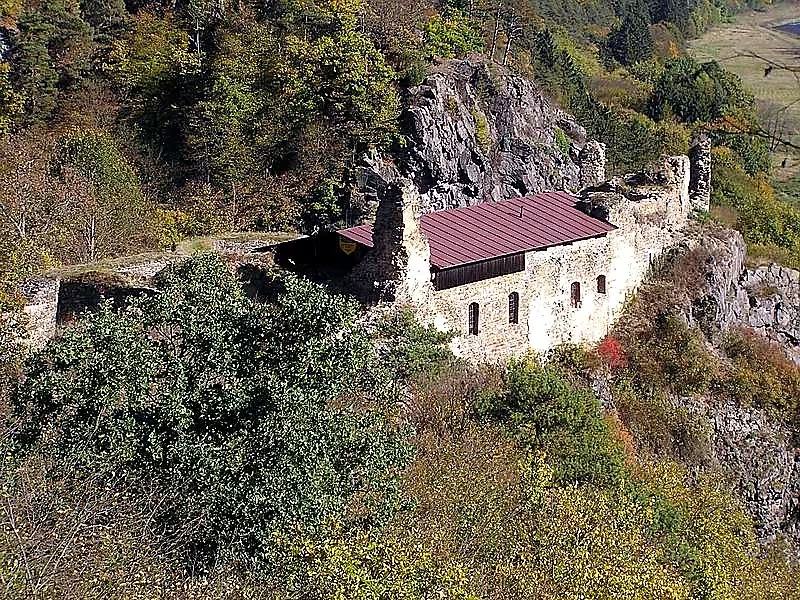
Krašov is a ruin of the castle, located in the Pilsen region, eleven kilometers from Kralovic in the Pilsen-North district. This historical object is located on a rocky edge above the mouth of the Brodeslavsky creek to Berounka and is located at a height of 310 metres, about 1.2 kilometres north of the Krašov settlement. The ruin of the castle was founded in the first third of the 13th century and belongs to the oldest noble castles in Bohemia. Since 1964, it has been protected as a cultural monument.
The castle Krašov was probably founded by Jetřich of the birth of the Grape Mountains, which makes it one of the oldest noble castles in Bohemia. The history of his ownership is complex and has undergone several changes. After Jetřich he went to the hands of Švihovský of Rýzmberk, who sold it to Kolovrat in the late 1970s. Since then the owners of the castle took turns, until in 1529 the sale of Nicholas Sviták from Landstein was transferred to the new owner.
Architecturally, Krašov is interesting in its evolution from a simple tower to a bergfrit castle. Originally it was equipped with a simpler tower, but in the second half of the thirteenth century it was built a real bergfrit. In the 15th century, further development took place with a new fortification of the foresaw and bastion, which was triggered by the formation of firearms. After 1529 the castle underwent Renaissance reconstruction and later some Baroque modifications.
The castle's ownership changed over time, reflecting political and social changes in the region. After Kolovrátky it was acquired by Svitáks from Landštejn, who sold it to various owners, including Ronjemíků from Držkovice and Hrobčický from Solopisky. In the seventeenth century, the castle was transferred by purchase to John David Boryn from Lhota and later to John Gref from Grefenberk.
Krašov went through many key events, including the looting of surrounding villages by Hussite troops in 1425. Although the castle itself was not conquered, its proximity to the conflict affected regional stability. After the Thirty Years' War, it was gradually abandoned and in the eighteenth century it served the needs of the monks of the monastery before it turned into a known ruin today.
Today Krašov is accessible as a cultural monument and offers visitors a view of the history of Czech nobility. Its architectural structure and history are a testament to the changes that the region has undergone over the centuries. Visit Krašova is not only a way to the past, but also an opportunity to appreciate the cultural heritage of the Czech Republic.
Krašov is therefore an important monument that reflects the complicated history of Czech countries through its existence and history. His visit offers a unique view of the past and recalls the importance of protecting cultural heritage for future generations.
Then and now
Drag the slider to compare how the landmark may have looked when it was built with the view today.
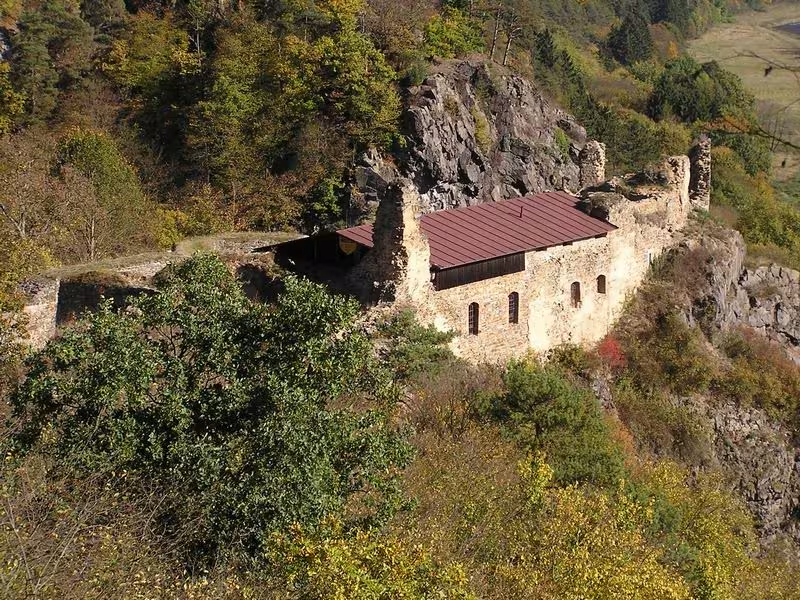

The historical appearance on the left is an AI-generated visualisation and serves as inspiration only.
Historical milestones
- 1232
- The three of Krašova uses their adjectives.
- 1529
- Sale of the castle to Nicholas Sviták from Landstein.
- 1964
- The castle is declared protected as a cultural monument.
Architectural development
Originally a castle with a tower, later built a real bergfrit in the second half of the 13th century. In the 15th century a new fortification was established with a bastion and in the period after 1529 a Renaissance reconstruction took place with subsequent baroque modifications.
Historical events
The first third of the 13th century: the foundation of the castle; 1425: plunder of surrounding villages by Hussite troops; 1529: sale of the castle to Nicholas Sviták from Landstein.
Owners
Grape trees (founders), Svihovský z Rýzmberk (fourteenth century), Kolovrati (late 14th century to 1529), Svitáková z Landštejn (since 1529).
Points of interest
- It is one of the oldest noble castles in Bohemia and was founded in the first third of the 13th century. - Architecturally evolved from a simple tower to a bergfrit castle, later underwent Renaissance and Baroque modifications. - In the 15th century, a bastion was established and a new fortification was built in response to the formation of firearms. - In 1425 Hussite troops plundered the surrounding villages, but the castle was not conquered. - In the eighteenth century, the castle served the needs of the monks of the monastery.
Guide
Show guide text
This text was created by artificial intelligence and has not been editorially reviewed. It may contain inaccuracies.
Welcome to the place where history meets the untamed force of nature. You are standing right in front of the ruins of Castle Krašov, a monumental trail of human effort that stands right before your eyes. Before you move on, stop for a moment and observe the surroundings. Look at the rocky edge this monument insists on. It's a place that acts with incredible force because of its position. Right below you is the entrance of the Brodeslavsky creek into the Berounka River. Do you hear the sound of water? This water has been flowing around these rocks for thousands of years, while the stone walls of the castle have been wInessume only a few centuries. Feel this atmosphere of peace, but it is intertwined by the nobility of the place where the fates of noble generations once ruled.
Let's go back deep into the past together to understand why this rock was chosen. Krašov is not only an ordinary building, but one of the oldest noble castles in the whole region of Bohemia. Its beginnings date back to the first third of the 13th century. At that time, the country was still forming and the need to have a solid, impenetrable seat was absolutely essential. The first traces of this place left us with names that now sound like echoes of ancient times. Already in the year one thousand two hundred thirty-two, a figure named Jetrich of Krašova appears in the historical records. He was one of the mighty family of the Grapes, and it was his era that laid the first stones under this castle. Imagine the world back then when the castle was not built for beauty, but for survival and control of strategic paths in this landscape.
Now pay attention to what you see around you. Even though the castle now appears to be a ruin, its architecture tells us the story of constant growth and adaptation. If you look at the remaining stone structures, you can see in them fascinating developments. The castle did not begin as a magnificent complex. In the early days, it was a very simple tower, which served primarily as a shelter and an observation room. But with time, the needs of its inhabitants have changed. The castle turned into a massive bergfrit castle. If you look at space now, you can feel in these stone tracks the transition phase, when the simple tower became an impressive fortress with a high tower that dominated the whole area.
However, the architecture of this place did not remain confined only in the dark medieval times. Once the times and ways of life changed, the castle changed. In later stages Krašov underwent Renaissance and Baroque modifications. This means that the place that was once a purely military fortress was gradually becoming a more comfortable seat, which corresponded to the taste of the then nobility. In the 15th century, architecture had to respond to new, more destructive ways of fighting. In response to these threats, there was a bastion and a new fortification. Although these elements are now part of a crumbling whole, their presence reminds us of how the castle had to constantly defend itself and adapt to the new technological challenges of its time.
Every era left its mark and its people with it. Krašov was home to a number of prominent personalities who carried the weight of their family names. In addition to the latter, there were other powerful gentlemen like Sezima z Krašovic. Later, the castle became part of the property of powerful families, which included the House of Kolovrat. Here we can remember Albrecht from Kolovrat, Hanuš from the second from Kolovrat or Jana from Kolovrat. These people were not just tenants here, but the actual administrators of this place, who were determining the direction of political and social events. In the year one thousand five hundred twenty-nine there was another fundamental change in the history of the castle, when it was sold to Nicholas Sviták from Landstein. This change of ownership meant another chapter in the long and complex history of this place.
The interesting thing that may interest you in looking at these ruins is the constant transformation that the castle has undergone. It is fascinating how one rock island could transform itself from a simple tower through a massive medieval fortress to a Renaissance and Baroque mansion. It's like a layering of time where every generation built on what was before it, while trying to bring something new. This constant transformation is what makes Krašov so special. It's not just a pile of stones, it's a living record of human ambition, fear, and desire for beauty.
But now I will not hold you back. Krašov offers you much more than you can tell during a single recording. I suggest you continue your walk and see the surrounding terraces and rocks. Feel the silence of this place and let yourself be carried away by imagination. Looking at the rocks at the streams, you can imagine how there were patrols standing here centuries ago watching every movement in the valley. We thank you for visiting this historic monument and spending your time getting to know it. We wish you a pleasant further discovery of the beauty and mystery of our country.
Tips for visitors
The best time to visit the ruins of castle Krašov is in the summer months, especially from May to October. This period offers the most beautiful light for shooting and pleasant temperatures for walking. Visit the castle in the morning when there are fewer people and the sun illuminates rocky terrain in an ideal way.
When visiting the ruins of the castle it is advisable to take with you shoes suitable for moving on uneven terrain, protective sunglasses and plenty of drinking water. Also remember a piece of barn or lunch if you plan to spend several hours at the ruin.
Photography is one of the main attractions of Krašova. The best places for photos are at the top of the rocks, where you can capture a panoramic view of the surrounding landscape and the flow of Brodeslavsky creek to Berounka. Morning light is ideal for shooting details of ruins.
In the vicinity of the castle you can visit the village of God, which offers a picturesque view of the landscape and the possibility of relaxing in local restaurants. It is advisable for families with children to plan extended walks along the surrounding paths where children can play in the open area and enjoy the natural environment.
Frequently asked questions
Can the monument be visited?
This is a ruin. Such sites are often freely accessible, but some can only be visited with a guide or are closed for safety reasons. We have not verified the current situation – take care and respect any restrictions.
Where is the monument?
Location: Plzeňský kraj. The map on this page shows the exact spot.
Why is the monument protected?
It is listed in the Central List of Cultural Monuments of the Czech Republic as a cultural monument (register no. 1000148930).
Businesses nearby
Do you run a restaurant, accommodation, shop, museum, rental, wellness or other visitor service near this monument? Show yourself directly to the people heading to it — this is how they will see you in the app and on the web:
Nearby
Influence of the Brodeslavsky creek to Berounka, the village of God, settlement Krašov.
Accommodation nearby
Trips and activities nearby
Guided tours, tickets and activities nearby from GetYourGuide
Affiliate link: if you buy from the partner, we may receive a commission. The price for you does not change.
Search tours and activities →Themed route
Thematic cruise route involving the ruins of castle Krašov
1. The ruin of Castle Krašov - Type: Historical landmark - Why is it worth a visit: Interesting exploration of the ruins of the castle, which represents an interesting part of regional history. During the trip you can enjoy panoramic views of the surrounding countryside and look at the remains of old walls.
2. Influence of Brodeslav creek to Berounka - Type: Natural interest - Why is it worth a visit: Beautiful natural area where you can relax and see the water flow. This soft space is ideal for a short stop during the trip.
3. Villages Body - Type: Local village - Why is it worth a visit: Visit the traditional Czech village where you can see architectural monuments and enjoy local gastronomy. The village offers a quiet rest and the opportunity to immerse yourself in rural life.
4. Osada Krašov - Type: Local settlement - Why is it worth a visit: Visit a nearby settlement which is part of the historical context of the ruins of the castle. Here you can see houses and buildings with rich cultural heritage.
This route offers a combination of history, nature and rural life, an ideal choice for those who want to know the region around the ruins of castle Krašov.
Seasonal recommendations
In spring the ruin comes alive thanks to lush green and blooming nature, which gently covers the old masonry. The atmosphere is full of hope and freshness, while the morning dew gives rocks a special shine. We recommend moisture-resistant shoes because roads can be muddy after spring rains. An ideal visit in the morning is when the air is the cleanest.
The summer season brings rich green crowns of trees that create a strong contrast with grey sandstone. Ruin acts majestically and openly in full sun, which attracts many people. Because of the season, it's best to arrive first thing in the morning to avoid the biggest crowds. Remember light clothes, hat and plenty of fluids to refresh.
Autumn is the most romantic time for Krašov when golden leaves and morning fog create a mysterious and melancholy mood. Lighting is soft and warm, which gives the wonders depth and drama. Layer clothes are suitable to protect you from the cold wind. The best time for a walk is shortly before sunset.
In winter, silence and raw beauty rule the monument, especially if the masonry is covered by a layer of snow. The landscape is minimalist and the atmosphere is very calm, without tourist rush. It is necessary to have warm and waterproof shoes with anti-slip soles and sufficient frosty clothing. Count on shorter opening times and we recommend a visit at noon when the most daylight is.
Visualizations and artistic views


The visualisations are generated by artificial intelligence and serve as inspiration.
Photos from the area
Real photos taken near the monument


Zdroj a licence jsou uvedeny u každého snímku.
Tips from visitors
No tips yet. Be the first!
Log in and add your tip.
Sources and literature
Photos: JAn Dudík at Czech Wikipedia / CC BY-SA 3.0 — Wikimedia Commons. The author and licence also appear when you hover over the image.
Faktickým podkladem tohoto textu byl článek na Wikipedii, jehož autory jsou přispěvatelé Wikipedie. Článek je dostupný pod licencí CC BY-SA 4.0.
Location on the map
More monuments – Plzeňský kraj
Show all in the region


Příběhy a pověsti
Legendy, pověsti a příběhy spjaté s touto památkou
Fotografie návštěvníků
Zatím žádné fotografie. Buďte první, kdo přidá fotografii z návštěvy!
Log in a přidejte svou fotografii nebo hodnoťte.
Za ověřenou návštěvu v aplikaci získáte víc bodů — poznáme podle GPS, že jste na místě.
Reviews and comments