



Kratice Granary
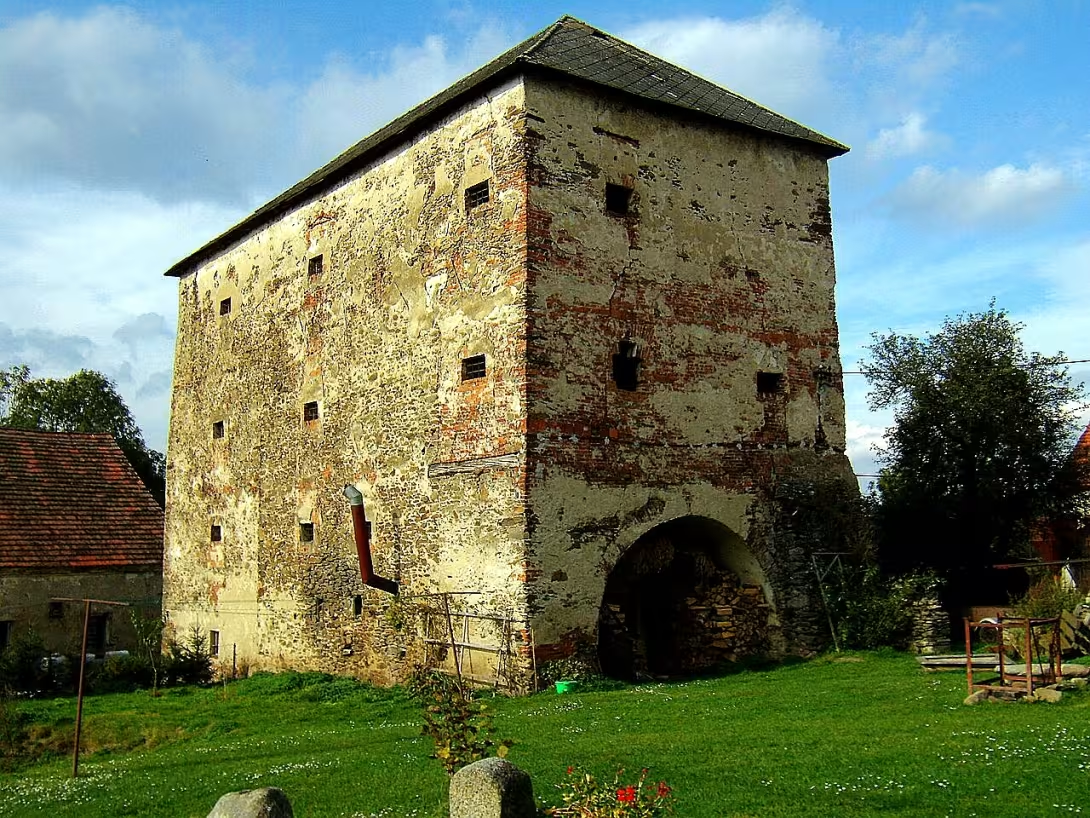
Kratice, also known as Barbora, are originally a Gothic fortress west of Kvasetic near Plánice in Klatovy district. The building has been converted into a baroque granary throughout history, yet it has kept its characteristic tower available until today. Since 1964, it has been protected as a cultural monument.
The first written mention of the village Kratice dates back to 1379, when it belonged to the Nepomuk monastery. After his demise during the Hussite Wars, the village was attached to the Green Horus estate. Historians differ on the question of the precise establishment of the fortress. While experts such as August Sedláček and Miloslav White Hlavík attribute its creation to Ladislav from Šternberk after 1580, other sources suggest that construction could have been built in the second half of the 14th century.
The building features a two-storey tower with a rectangular ground plan with dimensions of 21 to 9.3 metres and a height of 16 metres. The tower stands in the middle of the economic court and its interior is led by an arched entrance. The original Gothic defensive features, such as the shooting windows, were replaced by small rectangular windows with intertwined bars in the Baroque reconstruction at the beginning of the nineteenth century. Inside, however, the shooting windows are partially preserved. There are other economic buildings around the tower, such as baroque barns, cabins, and Renaissance economic buildings, which do not have monument protection.
The importance of the fort as a noble mansion gradually fell. In 1599 it was bought by Adam ze Šternberka and connected to the Planic Manor. Already in 1638 the fortress in the springs was referred to as abandoned. The subsequent adaptation to the granary at the beginning of the nineteenth century changed the internal purpose of the construction, but preserved its massive tower structure as a dominant of the entire court.
This monument represents valuable evidence of the transformation of noble settlements from Gothic defence function to economic use in the Baroque period. Visiting this place in Klatovsk offers an opportunity to look into the history of rural architecture and development of the public courts in Czech countries.
Historical milestones
- 1379
- First written mention of village Kratice.
- 1580
- The extension of the Ladislav fort from Sternberg.
- 1638
- The fortress is mentioned as abandoned in the springs.
- 1964
- Object declared a cultural monument.
Architectural development
The original Gothic fortress was expanded after 1580 by Ladislav from Šternberk. At the beginning of the 19th century, the tower was adapted to the Baroque granary, while window openings were modified. The object has a rectangular plan and a arched entrance.
Historical events
The first written mention of the village dates back to 1379. In 1638 the fort was already listed as abandoned. At the beginning of the 19th century, the tower was rebuilt into a granary.
Owners
The Nepomuk monastery (from 1379), the Green Hor estate (after Hussite wars), the House of Sternberk (from 1599, connected to the Planic estate).
Points of interest
- The fort is also known as Barbora. - The building was converted into a baroque granary throughout history, yet it kept its tower available. - The two-story tower has a rectangular plan with dimensions 21 to 9.3 metres and a height of 16 metres. - The original Gothic defence features were replaced by rectangular windows during Baroque reconstruction, but inside are partially preserved shooting windows. - Already in 1638 the fortress in the springs was referred to as abandoned.
Guide
Show guide text
This text was created by artificial intelligence and has not been editorially reviewed. It may contain inaccuracies.
Welcome to the place where the beauty and silence of the ancient centuries spread out before you. You are standing in front of the Kratice fortress, which is situated west of the Kvasetic near Plánice and immediately captures your view with its powerful yet elegant silhouette. Note the high two-story tower that rises to a height of 16 meters and dominates the entire complex. Its rectangular floor plan with dimensions of twenty-one meters to nine and three tenths of a meter resembles a fortress that once guarded the borders and now serves as a silent witness to history. You are surrounded by an open landscape, but it is this stone building that brings to the space a feeling of strength and stability.
Let's move on to the beginning of this place. The first written mention of the village Kratice dates back to 1379, when it was already part of the local settlement. At that time a Gothic fortress was probably built, whose main task was to protect the population and control the surrounding territory. In the 16th century, namely in 1580, there was a significant extension of the fort under the leadership of Ladislav of Šternberk. This nobleman, belonging to the region's great personalities, ordered to strengthen and expand the fortifications to better meet the demands of the time. A few decades later, in 1638, the fortress appeared in the springs as abandoned, suggesting that it had already lost strategic significance after its peak. Although its function has changed, the structure has been preserved and has undergone a new reconstruction over the next centuries. In 1964, this building was declared a cultural monument, thereby obtaining protection and recognition as a valuable historical object.
Now pay attention to the architecture itself, which tells you the layers of the past. When you look at the tower, you will notice that despite the Baroque reconstruction on the granary, it has kept the original tower available. A two-storey structure with a rectangular plan is a typical feature of Gothic harnesses, where the height and mass were used for defence. The tower is built of stone, although the exact kind of material in the base is not listed, you can perceive the strength and difficulty of stone walls that touch the sky. On the facade there are shooting windows - narrow holes that served as bullet holes for defensemen. These elements are a reminder of the original defensive purpose, and it can be seen, if you look closely, how they were preserved even after the Baroque reconstruction. The baroque interventions were mainly reflected in the conversion of space inside the fort into a granary, but the outer silhouette remained true to the Gothic original design. The tower thus represents a unique combination of two architectural epoch - Gothic mass and baroque functionality. Although the architects remain unknown, their work has survived for centuries and allows us to look into the construction processes of past generations.
Key stories and personalities associated with this place add another dimension to the Kratice fortress. Ladislav ze Šternberka, which expanded the fort in 1580, was an important nobleman and manager of extensive land. His involvement in the construction reflects not only the military needs of the time but also the efforts to strengthen his position in the region. Another character associated with the fortress is Adam ze Šternberka, whose name appears in historical records in connection with this area. Although there is little information about his specific activities, his presence in the chronicles suggests that the House of Sternberk was closely associated with the fate of this fortress. The fortress is also known as "Barbora," which gives the place a distinctive character and stimulates the imagination of visitors who may ask what story lies behind that name.
Now, let's look at the interesting thing that can attract even the most curious. Although the fort has been transformed into a baroque granary over the centuries, it has retained its tower form and original defence features such as shooting windows. This means that this is a unique example where the functional reconstruction did not erase traces of the original purpose, but rather integrated them into a new context. Moreover, the fact that this building is also called "Barbora," raises the question of where this name comes from and whether it is related to any legend or local tradition. Although the details of the origin of the nickname are not mentioned in historical sources, this mystery adds a mystical touch to the site and attracts further research.
In conclusion, I invite you to look at this historical monument with an open mind and a perceptive eye. Walk around the tower, admire its dimensions, and imagine what voices and steps were once heard in its stone walls. Feel how baroque reconstruction combines with the Gothic basis and how such a combination has become part of the cultural heritage we are protecting today. Get carried away by the story of Ladislav and Adam of Šternberk, who have shaped this place with their actions. And if you're interested in the secret nickname "Barbora," you might be able to discover more pieces of history in local archives or oral traditions. Thank you for taking the time to visit the fortress Kratice, and we wish you this stop to inspire you to further discover the rich past of our region. Say goodbye to this place with the feeling that you have touched something lasting, and let yourself follow the footsteps of other historical gems waiting for you.
Tips for visitors
The best time to visit is late spring or early autumn, when the surrounding landscape of Klatovska is the most photogenic and weather wishes to walk in the exterior of the fortress.
Kratice are available mainly by individual transport. Public transportation is recommended to verify the connection in the current search engine for the destination station Plánice.
We recommend fixed shoes suitable for the field and for movement around the fortress. Don't forget enough fluids and snacks, because in the immediate vicinity of the monument you may not be provided with meals.
The best light for capturing the tower layout is during the golden watch, i.e. shortly after sunrise or before sunset. Focus on the contrast between the Gothic foundations and baroque modifications of the granary.
In the surrounding area you can explore the picturesque village Plánice and the adjacent area Klatovska. For families with children the location is suitable as a destination for a shorter trip associated with exploring history in nature.
Frequently asked questions
Can the monument be visited?
This is a residential or farm building, not a museum with opening hours. Please view it from public space and respect the owners' privacy. We have no information about access to the interior.
Where is the monument?
Location: Plánice, Plzeňský kraj. The map on this page shows the exact spot.
Why is the monument protected?
It is listed in the Central List of Cultural Monuments of the Czech Republic as a cultural monument (register no. 1000139989).
Businesses nearby
Do you run a restaurant, accommodation, shop, museum, rental, wellness or other visitor service near this monument? Show yourself directly to the people heading to it — this is how they will see you in the app and on the web:
Nearby
Municipality of Plánice, Klatovska district.
Accommodation nearby
Themed route
1. Municipality of Plánice (Type: City) - Great place to start a trip and explore the local atmosphere. 2. Kratice (fortress) (Type: Historical monument) - The main destination of a trip worth visiting thanks to its history. 3. Klatovska (Type: Region) - Total territory that complements the whole trip with its beauty.
Seasonal recommendations
Spring: Kratice offers visitors a unique view of the blooming green region, which is celebrated by sunlight. This is the time of the year when nature is restored and the fortress looks in its greatest beauty with its blooming surroundings. The atmosphere is quiet and ideal for a relaxed walk. We recommend visiting Kratice at the beginning of spring, when crowds are still avoiding, so you can enjoy a peaceful environment without unnecessary restrictions. Comfortable shoes and light clothes are ideal for walking around the fort.
Summer: During the summer period Kratice is full of life, when vegetables in the surroundings become the most fertile and visitors can enjoy warm days under the sun. The atmosphere is friendly and offers the possibility of relaxation in the outdoor area of the fortress. More crowds are expected in the main summer season, therefore we recommend visiting Kratice early in the morning or later in the evening when there is a temperate temperature and fewer people. Don't forget the protective sun cream and light clothes for comfort during walks.
Autumn: Kratice offers visitors a speculative display of colour sheets, which add mild melancholy and beauty to the atmosphere. The sun begins to hide early, and the evenings are colder, which creates a calm mood for walking around the fort. This season it is recommended to visit Kratice at the beginning or end of autumn, when the crowds avoid and you can enjoy the peace in the natural environment. Hot clothes and solid shoes are suitable for convenience during walks.
Winter: In winter, Kratice offers visitors a unique view of the snow-covered fortress, which gives the place a romantic and mysterious atmosphere. Sun rays illuminating ice trees create beautiful views that are suitable for photography. Due to the cold and shorter opening times it is recommended to visit Kratice during sunny days when the temperature is lighter. Don't forget the warm clothes, the protective shoes, and perhaps a clue to the safety of walking on snow.
Visualizations and artistic views


The visualisations are generated by artificial intelligence and serve as inspiration.
Photos from the area
Real photos taken near the monument

Zdroj a licence jsou uvedeny u každého snímku.
Tips from visitors
No tips yet. Be the first!
Log in and add your tip.
Sources and literature
Photos: Krabat77 / CC BY-SA 3.0 — Wikimedia Commons. The author and licence also appear when you hover over the image.
Faktickým podkladem tohoto textu byl článek na Wikipedii, jehož autory jsou přispěvatelé Wikipedie. Článek je dostupný pod licencí CC BY-SA 4.0.
Location on the map
More monuments – Plánice
Show all in the municipality




Příběhy a pověsti
Legendy, pověsti a příběhy spjaté s touto památkou
Fotografie návštěvníků
Zatím žádné fotografie. Buďte první, kdo přidá fotografii z návštěvy!
Log in a přidejte svou fotografii nebo hodnoťte.
Za ověřenou návštěvu v aplikaci získáte víc bodů — poznáme podle GPS, že jste na místě.
Reviews and comments