






Křížová cesta (Klášterská Lhota) Way of the cross
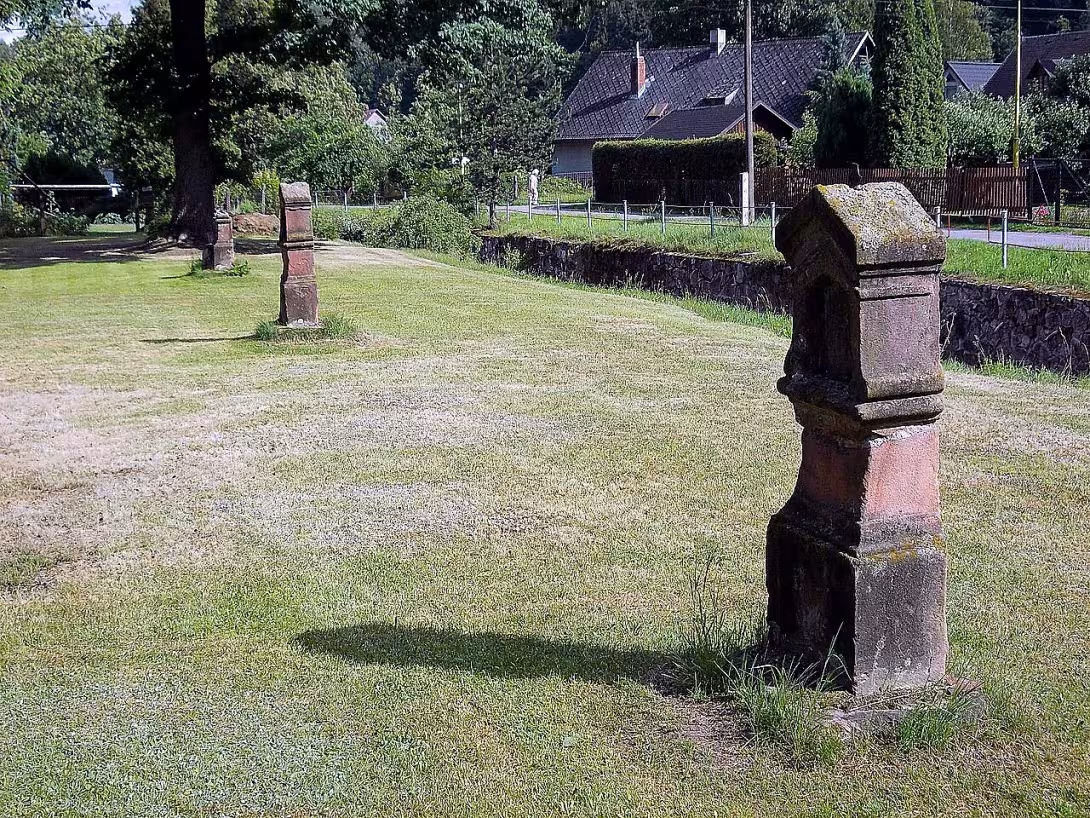
The cross road in Monasterska Lhota in Trutnovsk is a classical sacral area in the centre of the village. This cultural monument, consisting of a collection of sandstone stops and chapel of the Holy Trinity, dates back to the 19th century. It represents a valuable document of period popular piety in the Podkrkonoše region.
The creation of the ensemble is linked to the development of religious life in Czech countries in the first half of the 19th century. At that time, small sacral structures and crossroads were commonly built in the city centres as a manifestation of local faith. The chapel of the Holy Trinity was built in 1825.
The cross road itself surrounds the chapel in a rectangular plan. Individual stops are facing this central construction. To date, nine have been preserved. Each of them is made of a red sandstone with a height of approximately one and a half metres. The columns stand on a low pedestal and are finished with a chapel with a shallow nickel and a canopy.
The appearance of the chapel of the Holy Trinity was fundamentally transformed in 1905. The original walled building from 1825 was expanded by the wooden raked extension of the boat with a pair of hoops. This intervention created a specific availability: in the original stone part there is an altar, while the main ship with a crust and harmonium is located in the wooden part.
The owner of the Jelemnik estate, hrabě Harrach, participated significantly in the reconstruction and expansion of the chapel at the beginning of the 20th century. For the construction of a wooden barbed boat he donated the necessary building material. After 1945, the object gradually faded. This led to the need for overall recovery, which was successfully completed in 1999.
Today the area of the cross road in Monasterska Lhota is a fully restored monument, freely accessible on the meadow in the centre of the village. Visiting the site offers a view of the unconventional connection of stone and paved architecture within a single sacral unit which has preserved historical authenticity.
Historical milestones
- 1825
- construction of the chapel of the Holy Trinity
- 1905
- reconstruction and extension of the chapel with wooden barrier extension
- 1999
- total chapel renewal
Architectural development
The cross road is drawn from the red sandstone. The related chapel was originally a walled building from 1825, which was extended in 1905 by a wooden barbed addition to a boat with a pair of crusts.
Historical events
1825 - construction of the chapel of the Holy Trinity; 1905 - reconstruction and extension of the chapel; 1999 - total restoration of the chapel.
Points of interest
- Individual stops to the cross road surround the chapel in a rectangular plan and are facing this building. - Each stop shall take the form of a column approximately one and a half meters high with a chapel with a shallow nickel. - The chapel connects stone and wooden architecture, with an altar in the original brick part and a boat with a crust in the wooden annex. - hrabě Harrach participated in the reconstruction of the chapel at the beginning of the twentieth century, which donated building material to a wooden boat. - To date, nine stops have been preserved from the entire file made of red sandstone.
Guide
Show guide text
This text was created by artificial intelligence and has not been editorially reviewed. It may contain inaccuracies.
Welcome to Monastre Lhota, a place where time stopped and stones tell stories hundreds of years ago. Right now, you are standing in the very heart of this peaceful village, in a place that combines the deep faith of our ancestors, the craftsmanship of the old masters and the unique atmosphere of the Podkrkonoše landscape. Look around you. In front of you is a grassy area that is not just a meadow, but a sacred district dominated by a picturesque building and a set of stone elements. What you see is a cross road, a protected cultural monument that forms an inherent part of the local identity.
Feel the peace. Your attention will certainly immediately be drawn to nine preserved stops, which are built in a regular rectangle. They're thin columns carved from red sandstone, material so typical of this region. Each one reaches a height of approximately one and a half meters, a dimension close to the human figure, and perhaps that is why these stops are so close, almost intimate. These are not monumental structures that would impress you with their size, but rather silent witnesses who invite you to stop and think.
Let's take a closer look at the history of this place that began to be written in the first half of the nineteenth century. The key year is one thousand eight hundred twenty-five. It was then that the central building of the entire complex, the chapel of the Holy Trinity, was built. At that time, the village was part of a large estate which was managed by a significant noblemen. The main figure that deserved to blossom in this region and whose name is inseparably linked to this monument was hrabě Harrach. This enlightened nobleman and benefactor was not only a trustee of property, but also a man who cared for the spiritual and cultural ascension of his subjects. It was under his influence and with his support that places such as this were created to serve people to pray, comfort and meet.
The original form of the chapel from the year one thousand eight hundred twenty-five was purely walled, built of solid stone to withstand the harsh conditions of the foothills. But time passed, and the needs of the local people changed. At the beginning of the twentieth century, in precisely nineteen hundred and five, the chapel underwent a fundamental transformation. It was rebuilt and extended by a very interesting element - a wooden raked extension. This modification added its unique appearance to the construction of today, which combines a cold, solid stone with a warm and malleable wood. It is a combination of two worlds, two architectural approaches, but they form a completely harmonious whole here.
Now I'm going to invite you to search for the very stopping of the cross road. Walk around them slowly. Notice how they're deployed. Unlike many other cross roads, which rise to steep hills or guilt along the paths to distant places, here the stop surrounds the chapel in a strict rectangular plan. All of them are facing the chapel as if they were constantly guarding it or bowing to it in silent respect. Each column has its own solid structure. It rests on a low base that gives it stability. Above him is a stick with a chapel. At the top of each column you will see a shallow niche, i.e. a niche which was originally intended for Pashian paintings or reliefs representing the last path of Jesus Christ. The whole stop is then closed with a roof that protects the stone from adversity.
Look carefully at the color and structure of sandstone. The rich, reddish color is the result of geological processes going on millions of years ago. This stone was extracted in local quarry and the hands of unknown stonemakers gave it this noble form. Although the names of these masters took up time, their work here persists as proof of their skill. Every chisel you see here has been guided with respect to the material and the purpose it was intended to serve.
When you're standing here, you might wonder why stopping is just nine, when the traditional crossroads have fourteen. That's one of the little mysteries of this place. It is possible that the remaining stops in the course of the stormy history of the twentieth century have been lost, or this file has been conceived from the beginning in this more common number to fit exactly the space around the chapel. But this incompleteness does not deprive the place of dignity, on the contrary, makes us think about what these stones have endured.
The fate of the monument wasn't always filled with sunshine. After decades, when maintenance of similar church buildings was forgotten, the chapel and the crossroads received due attention only at the end of the last millennium. In nineteen hundred ninety-nine, the chapel was completely restored. Thanks to the efforts of many people, it was possible to save both the walled part and the rare paved elements. Today we can admire the memory in its full beauty, purified and reinforced, ready to serve the next generation.
Notice also the details of the chapel itself. Its architecture is simple, yet extremely impressive. The combination of white plastered walls and dark wood levelling creates an interesting contrast that is typical of this area. The Chapel of the Holy Trinity is not just a building, it is the center to which the views of all nine stone stops lie. It is the heart of the village, a place where people met in good times and bad times, on the occasion of holidays, baptism and goodbyes.
When you look at the cross road, imagine the multitudes of people who have gone through the past. Each column was a stop for prayer, for short exhalation on a hard working day, for silence of mind. Count Harrach, who watched over this region, knew well that people needed not only work and livelihood, but also the beauty and spiritual dimension of life. This cross road is a clear proof of that. It's a landscape element that cultivates its surroundings and gives it order.
Before you go any further, give yourself a moment of silence. Feel the light breaking against the edges of the sandstone columns and the shadows of the chapel extend on the grass. This place has a special power in it. It is the power of endurance, the power of faith and the power of tradition that has endured despite all changes in time. The cross road in Monasterska Lhota is not just a set of worked stones, it is a live memory of the village that you now share.
I hope this stop at the chapel of the Holy Trinity and its nine guardians have enriched you and brought you a sense of peace. When you take off your headphones, try to walk around the entire rectangle again and feel their face facing the chapel. You may see in this the symbolism of belonging and the protection this place emits.
Thank you for your attention and your interest in the history and beauty of our region. Klášterská Lhota also hides other picturesque corners that are worth discovering. Let your curiosity guide you and continue to explore the surroundings. Every path you take can reveal another shard into the mosaic of the stories that make up our shared past. I wish you a pleasant journey and many other inspirational experiences on your travels to explore. Goodbye.
Tips for visitors
The best time to visit is during bright days, especially in the morning or late afternoon. At these times, the light hits the red sandstone's best stop, highlighting its color and historical texture.
You can reach the monastery Lhota by car and public transport; Please check the current traffic connections in the search engine. Parking can be used near the centre of the village, where there is a short way to stop.
During the visit we recommend taking drinking water and comfortable clothes suitable for an outdoor walk. For photo lovers are the best places with direct but not too bright sunlight that highlight the details of sandstone columns.
If you travel with your family, the monument offers a quiet environment for joint observation of historical elements. Within a short walk in the surroundings you can visit the Holy Trinity Chapel, located in close proximity.
Businesses nearby
Do you run a restaurant, accommodation, shop, museum, rental, wellness or other visitor service near this monument? Show yourself directly to the people heading to it — this is how they will see you in the app and on the web:
Nearby
Chapel of the Holy Trinity
Accommodation nearby
Themed route
1. Chapel Holy Trinity Type: Chapel Why: Suitable starting point for the whole thematic walk and place for a short prayer.
Cross road Type: religious monument Why: The main destination of the trip, which leads the visitor through a series of stops designed to reflect.
3. Area Cross Travels Type: immediate surroundings of the monument Why: Space for quiet contemplation and quiet completion of the route in nature.
Seasonal recommendations
Spring in Monasterska Lhota brings awakening nature, when the surrounding slopes and sides around the cross road cover the first flowering herbs and fresh greenery. The sun rays penetrate even thinner treetops and create an interesting game of lights and shadows at individual stops, which gives the place a mediative and peaceful atmosphere. During this period you will meet only a minimum of visitors, so you will enjoy complete peace of mind. It is suitable for fixed and waterproof footwear, because the field roads are drenched on the tights and spring rains, as well as laminated clothing, as spring weather at the foothills can be very variable.
Summer offers lush vegetation and deep shade beneath the grown trees that line the route and provide welcome relief during hot days. The golden rays of the setting sun in the late afternoon magically illuminate the stone details of the relief and encourage photo documentation. Since this is the main tourist season, it is recommended to leave either early in the morning or in the evening to avoid heat waves and occasional increased movement of hikers. Wear light, breathable clothes and don't forget the headgear and plenty of drinking water, as the route rises up a slight hill and you will not find refreshments on site.
Autumn turns the surrounding landscape into a colorful palette of shades of yellow, orange and red, which gives the monument an extremely photogenic and melancholic character. The low sun creates long shadows, and the misty cold wounds lend the whole complex a mysterious and quiet mood ideal for perceptive observers. The number of tourists is falling sharply during this period, which guarantees an undisturbed atmosphere. A warmer wind-resistant jacket, long pants and tight shoes are suitable for the journey, because the fallen leaves can slide and the morning temperatures are already noticeably low.
Winter covers the cross path to snow whiteness and at the time of advent or around Christmas holidays this place is particularly peaceful and clean. The early dimming and snow cover dampens the surrounding sounds, which amplifies the spiritual dimension of the monument, while the low winter sun draws sharp shadows into the snow drapes. It is important to remember that daylight is very short, and plan a visit for morning or early afternoon hours. The absolute necessity is the quality winter footwear with anti-slip soles, warm gloves, caps and warm layers of clothing, because cold wind can blow in the open terrain.
Visualizations and artistic views

The visualisations are generated by artificial intelligence and serve as inspiration.
Photos from the area
Real photos taken near the monument


Zdroj a licence jsou uvedeny u každého snímku.
Tips from visitors
No tips yet. Be the first!
Log in and add your tip.
Sources and literature
Fotografie: JiriMatejicek / CC BY-SA 3.0 — Wikimedia Commons. The author and licence also appear when you hover over the image.
Faktickým podkladem tohoto textu byl článek na Wikipedii, jehož autory jsou přispěvatelé Wikipedie. Článek je dostupný pod licencí CC BY-SA 4.0.
Location on the map
Příběhy a pověsti
Legendy, pověsti a příběhy spjaté s touto památkou
Fotografie návštěvníků
Zatím žádné fotografie. Buďte první, kdo přidá fotografii z návštěvy!
Přihlaste se a přidejte svou fotografii nebo hodnoťte.
Za ověřenou návštěvu v aplikaci získáte víc bodů — poznáme podle GPS, že jste na místě.
Reviews and comments