



Kyjovská radnice Town hall
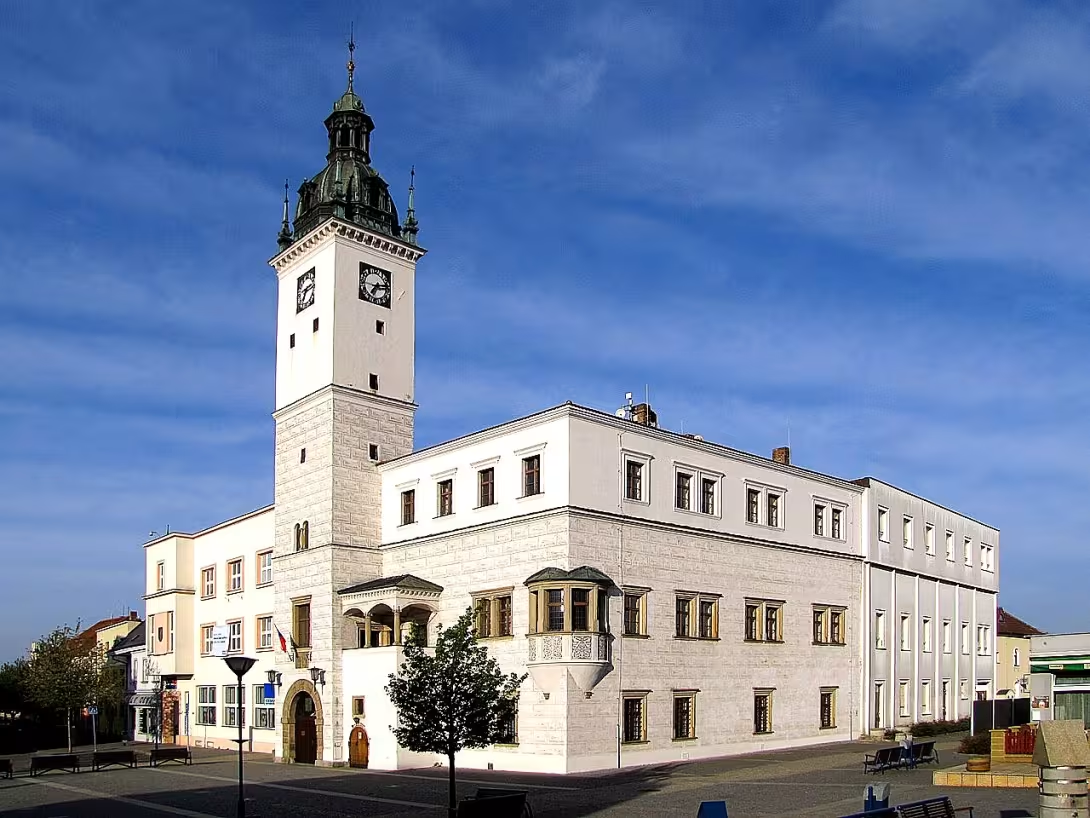
Today's town hall has deep roots in the urban past. Kyjov owned the monastery Hradisko near Olomouc until 1539 when he sold it. After several ownership changes, in 1548 the city came into the hands of the Czech Chamber for 9,000 gold coins. The decision of Emperor Ferdinand I., who was asked to return to the city by Václav Bzenecký's elders, was fundamentally reflected in further development. Bzenecký became the first mayor and during his leadership (1548-1575) initiated the economic and construction development of the city. The stone defensive towers began to be built, a malting hall was established and the square was paved over. The peak of this flowering was the construction of the town hall in 1561-1562 by Italian builders and stonemakers working in Moravia at that time. According to the records, at least six Italian families were established here in 1577. The state of the building reminiscent of Bzenecky's service remained on the memorial plate located above the entrance.
The construction has undergone many reconstructions over centuries and has been repeatedly damaged by fires. In 1582 the tower was raised and equipped with a new cover with an Austrian eagle on top. The fires from 1679, 1701 and 1721 were seriously damaging to her. After the great fire of 1876, the tower was equipped with a new Renaissance fighting according to the design of Viennese professor Karl König, which for four thousand and six hundred gold pieces was realized by the local builder Václav Paterna. During the centuries, the town hall became part of the city administration and the judiciary - since 1868 the district court has been based here, and later the prison and execution grounds have been attached.
In the 1970s, there were major building modifications. The original Renaissance facade was restored, the town hall was built in the cellars and a new town hall balcony was created. This balcony became a place for ceremonial speeches - President Václav Havel spoke here on 8 March 1990. At the beginning of the new millennium, an archaeological survey was carried out before the planned expansion, which revealed traces of settlement since the eleventh century, in particular the remains of the cabin from the first third of the eleventh century and the ceramics from the middle period. The new rear track completed in 2001 includes offices, meeting room for city council and city hall gallery. Part of the complex is also a circular fountain designed by city architect Vladimir Vasíček. The town hall is now part of the city administration and cultural life, protected as a national cultural monument.
Then and now
Drag the slider to compare how the landmark may have looked when it was built with the view today.
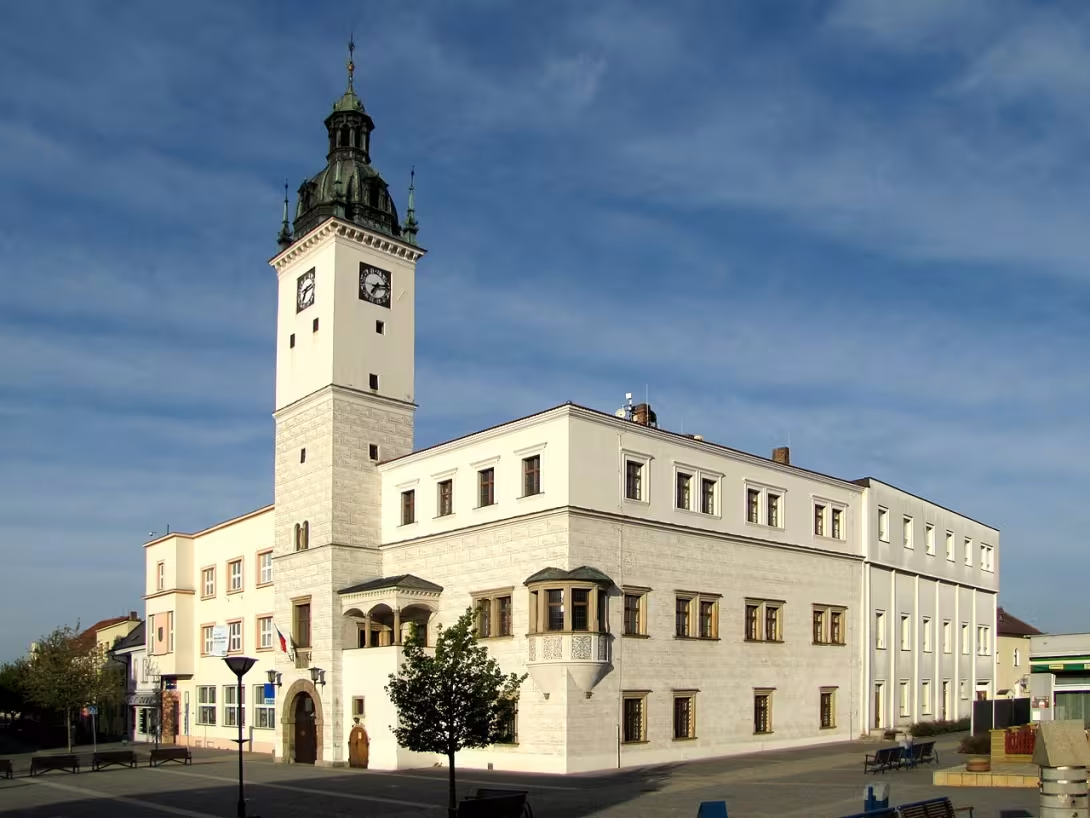

The historical appearance on the left is an AI-generated visualisation and serves as inspiration only.
Historical milestones
- 1548
- The city of Kyjov obtained a separate administrative right after redemption from the Unconsciousness by Jan Kropač and was assigned the Czech Chamber.
- 1561-1562
- The City Hall was founded as a dominant city, financed by city money and Italian craftsmen.
- 1582
- Construction and location of Austrian eagle on the tower of town hall.
- 1721
- The big fire destroyed city hall, including the tower, followed by a gradual renewal.
- 1971
- The reconstruction of the town hall, including reconstruction of the Renaissance facade.
- 2001
- Built the rear wing of the town hall with barrier-free modifications and a new circular fountain on the courtyard.
Architectural development
The original Renaissance building from 1561-1562 was built of stone and decorated with Italian elements. In the 17th century it underwent Baroque modifications, especially the tower, which was increased and equipped with an eagle. In the 19th century the soil part was rebuilt to a full floor and in the 1970s the Renaissance facade was restored and the rear tract was built with barrier-free modifications. The cellar was used as a wine cellar and later as a wine bar.
Historical events
- 1548
- The townspeople Kyjova bought the city from Jan Kropač for 7,800 gold coins and thus acquired a separate administrative right under the Reich crown.
- 1561-1562
- Built by Renaissance City Hall, financed by city budget and Italian builders.
- 1876
- The great fire destroyed part of the town hall, followed by the Baroque reconstruction of the tower and its exchange for the Renaissance can.
- 1946
- Last execution in City Hall Prison - member of the Gestapo Willi Kunz was
Points of interest
- The town hall was built by Václav Bzenecký the Elder in 1561-1562 to thank for the return of the city of the Czech Chamber, while the Italian family worked on the construction.
- Above the entrance there is a commemorative plaque commemorating the merits of Václav Bzenecký's elder for the development of the city.
- In 1582 the tower of the town hall was increased and supplemented with a new cover with an Austrian eagle on top.
- After the fire in 1876, the tower was equipped with Renaissance fighting according to the design of Viennese architect Karl König.
- Archaeological research before the City Hall expansion in the new millennium revealed the remains of a cabin and ceramics from the 11th century.
Guide
This guide is narrated by a synthetic voice generated by artificial intelligence.
Show guide text
This text was created by artificial intelligence and has not been editorially reviewed. It may contain inaccuracies.
The Kyjov Town Hall is a two-storied Renaissance building located in the western part of Masarykovo náměstí. It is the landmark of the city and is protected as a national cultural monument.
Its creation is connected with the efforts of the townspeople to free themselves from the power of the nobility. From 1126, Kyjov belonged to the Hradisko monastery near Olomouc, which sold the city in 1539. In 1548, Kyjov came into the hands of Jan Kropáč z Nevědomí. The townspeople disagreed with this and sent a delegation led by Václav Bzenecký the Elder to Emperor Ferdinand the First in Augsburg. On August 18, 1548, the Emperor decided that the city would pass into the ownership of the Bohemian Chamber once the inhabitants paid it off through a collection. Bzenecký became the first mayor of Kyjov, and under his leadership, the city experienced economic and construction development.
The most significant building of that period was precisely the town hall, built in the years 1561 to 1562 for five thousand florins. Italian builders and stonemasons, who were settled in Moravia at that time, constructed it. A memorial plaque commemorating Bzenecký's merits still hangs above the entrance today.
In 1582, the tower was heightened and crowned with an Austrian eagle. The city council met there once a week, summoned by a bell hanging by the gate. The town hall was repeatedly struck by fires, often spreading from the neighboring Jewish quarter. In 1721, it burned down including the tower. After the last major fire in 1876, the old Baroque dome was replaced with a Renaissance one according to the design of Viennese professor Karl König. Then or during the reconstruction in 1905, the attic half-story was converted into a full second floor.
From 1868 to 1948, the district court was housed in the building, and there was a prison and execution ground in the courtyard. The last execution took place on August 19, 1946, when Gestapo member Willi Kunz was hanged there.
In the early seventies of the twentieth century, the original Renaissance facade was restored, a wine bar was created in the cellars, and a balcony was added. Festive speeches are delivered from it and the Moravian Year is opened. On March 8, 1990, President Václav Havel spoke from there.
An archaeological survey in 2000 revealed remains of a log cabin from the first third of the eleventh century, a Renaissance brick cellar, and the foundations of a house from the turn of the fifteenth and sixteenth centuries under the town hall. A year later, the rear section with a courtyard, the Town Hall Gallery, and a new circular fountain were completed.
Tips for visitors
The best time to visit Kyjov Town Hall is in spring or autumn, when the weather is pleasant and you can see the building and surrounding Masaryk Square without a large crowd of tourists. In summer there are often more visitors, but in winter some parts of the monument can be closed due to snow conditions. It is always worth checking the current information on site or on the official website.
It is recommended to arrive by car and find the nearest available place, which is usually marked. The location is also well accessible by public transport - find out the current connection in the traffic search engine. The town hall is located just minutes away from the main station, so even walking from the centre is quite possible.
When visiting City Hall, take comfortable shoes because the building is historic and some parts can be covered with tiles or stairs. In summer it is advisable to carry a hat or sunglasses because the square is sunny. If you are planning to take pictures, do not forget the mobile charger, because some parts of the building are interesting even close up.
The best places for photography are the front facade of the town hall, which is richly decorated with Renaissance elements, and also the inner courtyard if available. It is recommended to photograph in a pleasant light, i.e. morning or afternoon, when the sun does not flash directly into the lens. If you want to capture the overall impression, photograph the city hall from an angle on Masaryk Square.
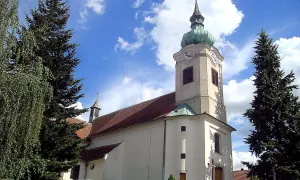
In the vicinity of the town hall is worth visiting the Church of St. Jacob the Greater, which is only about thirty minutes walking distance from the place. This Gothic church with Baroque adaptations is one of the dominant historical center Kyjova. Another interesting thing is Slovácký Park, located about two kilometres from the town hall. It is an ideal place for a short walk or picnic in nature.
For families with children, a visit to the town hall is interesting thanks to its historic atmosphere and the possibility to walk around the Masaryk Square. Children can see the old stone elements and talk about the history of the city. There is also a possibility to visit the Church of St. Jacob the Greater where children can see the Gothic architecture and perhaps the bell tower. Slovakian park offers space for outdoor games and the discovery of nature.
Frequently asked questions
Can the monument be visited?
The building is in use (offices, a school, shops and the like). The interior is generally accessible only during operating hours and tours are not usually offered; we have not verified the details. You can see the exterior from the street.
Where is the monument?
Location: Masarykovo náměstí 30/1, Kyjov, Jihomoravský kraj. The map on this page shows the exact spot.
Why is the monument protected?
It is listed in the Central List of Cultural Monuments of the Czech Republic as a national cultural monument (register no. 506).
For kids
Imagine going back 456 years to the Middle Ages. You're standing in front of a beautiful Kyjov Town Hall building and you feel like you're entering another world. It was built in the reign of King Maximilian II to serve as the seat of the local office.
This place was once home to a lot of people who made a living in agriculture, trade or craft. The city of Kyjov was small but important because it was on the road between Brno and Olomouc. It was an important stop for buyers and pilgrims.
Businesses nearby
Do you run a restaurant, accommodation, shop, museum, rental, wellness or other visitor service near this monument? Show yourself directly to the people heading to it — this is how they will see you in the app and on the web:
Nearby
- Originally a Romanes- Gothic church with later baroque adjustments, dominant of the historical centre Kyjova.
- Protected area with rich biodiversity, ideal for tourist trips.
- The remains of the 16th century stone defensive towers that were built under Václav Bzenecký.
Accommodation nearby
Themed route
Thematic cruise route Kyjov
1. Kyjovská radnice (Town Hall) * Why is it worth visiting: * The central point of the historical centre Kyjova is Kyjovská radnice, which represents the architectural pearl of the city. It's a place where history and the present meet, overlooking the streets full of life.
2. Church of St. Jacob the Greater (Gothic Church) * Why is it worth visiting: * This church is originally Romanesque-gothic and was later modified in Baroque style. Located about 300 metres from the town hall and serves as a dominant architectural element of the historical centre Kyjova, offering a view of the rich history of the city.
3. Slovakian Park (Natural Park) * Why is it worth a visit: * This natural park is located about 2 km from Kyjov Town Hall and is an ideal place for relaxation in nature. Protected territory offers rich biodiversity, making it a perfect place for tourist trips and exploring nature.
This route combines history and nature, giving travelers a comprehensive impression of Kyjov.
Seasonal recommendations
Spring Kyjovská radnice offers a unique atmosphere in the spring months when the historical building is projected into changing nature. Warm sunlight illuminates its Gothic and Renaissance details, while blooming trees and green parks in the surrounding area create a pleasant contrast to the stone facade. The air is fresh and light, ideal for walking around the city where the summer crowds have not yet arrived. It is recommended to visit the town hall early in the morning or in the afternoon to avoid clusters of tourists starting to discover the region. Clothes should be laminated - spring weather in Kyjov is variable, with temperatures fluctuating between 5 and 15 ° C. Don't forget to wear a light jacket or sweater because evenings can be cold. The tour of the interiors is also suitable in these months, as the inner spaces remain well maintained and air-conditioned.
Summer In the summer months, Kyjovská radnice becomes the center of living urban life, where its surroundings attract visitors with its historic charm and pleasant shadow of old lips. Sunlight highlights architectural details such as shields and window niche, while evenings offer pleasant temperatures for sitting in nearby cafés. In the main summer season, however, the town hall may become a target of greater interest, so it is advisable to come early in the morning to avoid queues. Light but decent clothes are recommended - temperatures are around 25-30 ° C in Kyjov, but it is often cold in the interior of the town hall. The tour can be completed by visiting a nearby castle or walking through the Elbe, where water reflects historical buildings. In the evening, it is worth going to the terrace of one of the local pubs where traditional South Bohemian specialities can be tasted.
Autumn Autumn brings to Kyjova golden colors and a calm atmosphere where the town hall appears to be permanent and still, while the surrounding area turns into a mosaic of red and yellow leaves. Cooler air and short days create an intimate mood, ideal for shooting historical details in a soft autumn light. In this period, the city is more peaceful, but in advent time, the first Christmas decorations or markets that enrich the city hall may appear. It is recommended to visit City Hall in the afternoon when the sun shines directly on the facade and creates long shadows that highlight its architecture. Clothes should be warm but not too heavy - temperatures fall to 5-15 ° C, and even when the sun shines, evenings can be cold. The tour of the interiors is also suitable in these months, as the inner spaces are well heated and offer a cozy environment for history.
Winter Winter Kyjovská radnice acts as a fairy-tale figure, surrounded by a white snow coat and illuminated by lamps that highlight its Gothic elements. Freezing air and quiet streets create a unique atmosphere where the city appears to be quiet but full of history. It is recommended to visit it in the afternoon when the facade reflects the last rays of the sun and creates magical effects. Clothes should be warm, layered and waterproof - temperatures often fall below the freezing point, and even if it is sunny, the wind may be steep. The tour of the interiors is pleasant in winter because they are heated and offer a cozy environment for exploring local history. If you go for a walk, remember to wear firm shoes - ice surfaces can be dangerous.
Visualizations and artistic views


The visualisations are generated by artificial intelligence and serve as inspiration.
Photos from the area
Real photos taken near the monument


Zdroj a licence jsou uvedeny u každého snímku.
Tips from visitors
No tips yet. Be the first!
Log in and add your tip.
Sources and literature
Photos: Radek Linner / CC BY-SA 3.0 — Wikimedia Commons. The author and licence also appear when you hover over the image.
Faktickým podkladem tohoto textu byl článek na Wikipedii, jehož autory jsou přispěvatelé Wikipedie. Článek je dostupný pod licencí CC BY-SA 4.0.
Location on the map


Příběhy a pověsti
Legendy, pověsti a příběhy spjaté s touto památkou
Fotografie návštěvníků
Zatím žádné fotografie. Buďte první, kdo přidá fotografii z návštěvy!
Log in a přidejte svou fotografii nebo hodnoťte.
Za ověřenou návštěvu v aplikaci získáte víc bodů — poznáme podle GPS, že jste na místě.
Reviews and comments