



Lažany Fortress
Objekt se nedochoval — na místě dnes nestojí. Následující text popisuje jeho historii, ne současnou návštěvu.
Lažany are a extinct medieval village with a fortified motte-type fortress. It was located in the district of Praha- east in the territory of today's village Štěhlice. The monument comes from the high Middle Ages and represents a typical example of a small aristocratic residence connected with a village development.
The village was probably established in the 13th century as part of the internal colonization of Czech territory. According to archaeological findings, the original residence disappeared around 1300, but the site was later resettled and performed under the name New Court. The name Lažany is based on the expression of lasa, which marked the field lying alone, fallow.
The fortress was built as a motte, that is, on an artificial deformation in the shape of a chamber cone with a diameter of 62 meters. The tower itself had dimensions of 3 x 8 meters and a stone suspect. The area was protected by a moat, a moat and a pond. The village had a series arrangement; Besides the fort, it was made up of a quarry, a pond and five to seven other buildings. These stood in the arch at the edge of the shallow pelvis, probably bounded by the economic court and the fortress itself.
The first mention of the village dates back to 1358. It concerns the dispute of Knight Bohunk Hájek of the Temple with the cisterns of the Monastery Rock on the border of the village of Šíhlice and the New Court of Lažan. In 1360 he donated Karel IV. village to Litold Hájk from the Temple after his father died, also Litold. The last owner of the fort was probably Jindřich z Lažan, which was documented in 1413.
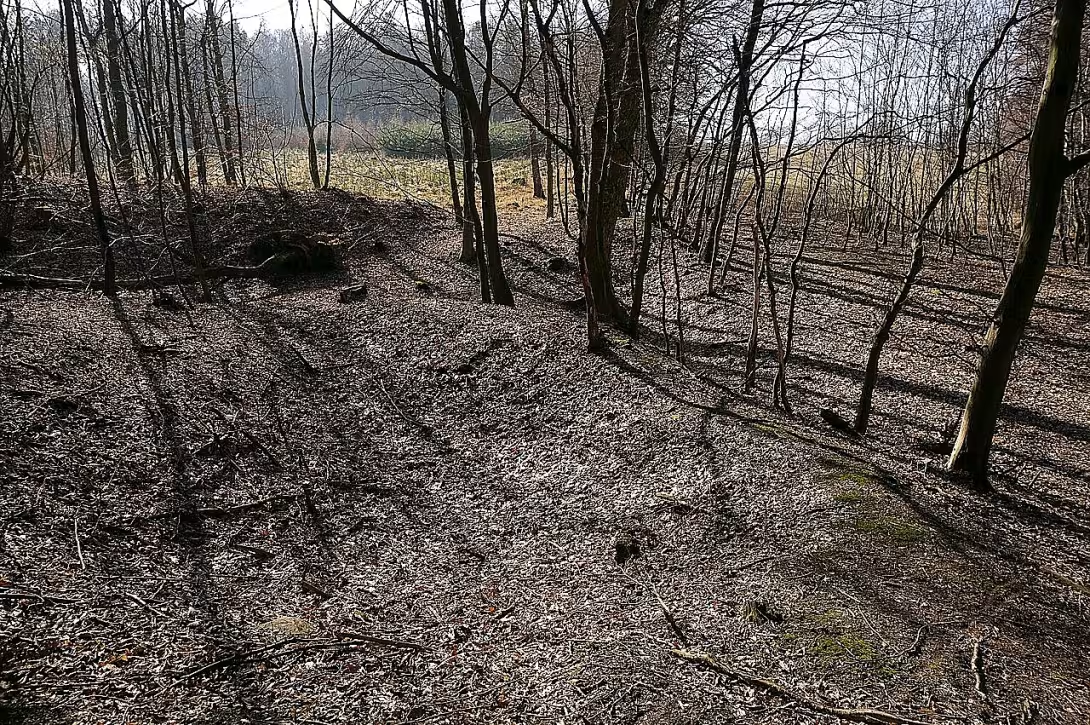
Today, the mansion and the fort are completely extinct and in their place the leafy forest grows. However, there is still an obvious fortress with a characteristic chamber cone, walls and moats. The original pond used to protect the object was torn down in 1969. Since 3 May 1958, the location has been led as a real-estate cultural monument.
Lažany is a valuable witness to the medieval settlement of landscapes and small aristocratic settlements. Visiting this quiet place allows you to imagine the form of a degraded village and its fortification.
Then and now
Drag the slider to compare how the landmark may have looked when it was built with the view today.
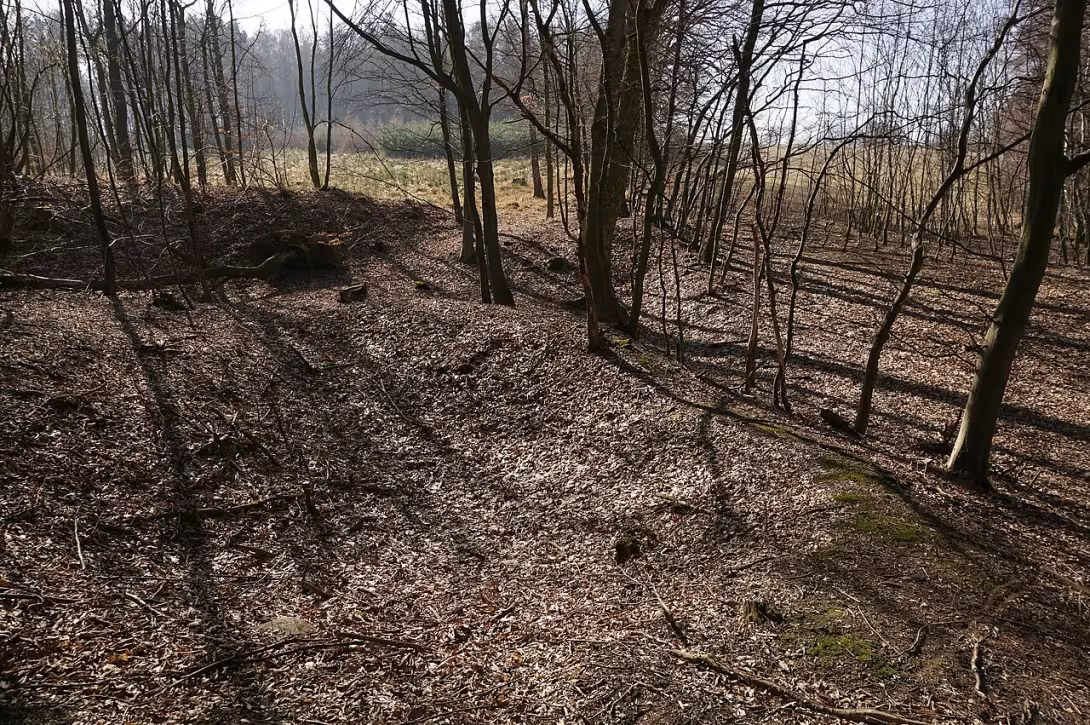

The historical appearance on the left is an AI-generated visualisation and serves as inspiration only.
Historical milestones
- 1300
- Estimated demise of the original village
- 1358
- First mention of the village in connection with the border dispute
- 1360
- Donating the village to Litold Hájek from the Temple
- 1413
- Last use of the predicate from Lažan near Henry from Lažan
- 1958
- Inclusion of the fortress in the list of real cultural monuments
Architectural development
The fortress was built as a motte with an artificial chamber cone with a diameter of 62 meters. The tower was 3 x 8 meters tall and had a stone suspect. The whole area was fortified by the walls, moat and pond.
Historical events
1358: The dispute of the knight Bohunk Hájek of the Temple with the cisterns of the Monastic Rock over the border. 1360: Karel IV. donated the village to Litold Hájek from the Temple in the summer. 1958: Announcement of the fortress by a cultural monument.
Owners
Bohunka Hájek z Chrástu (mention 1358), Litold Hájek z Chrástu (flax from Charles IV after 1360), Jindřich z Lažan (last known owner, mention 1413)
Points of interest
- The fortress was built on an artificial depravity in the shape of a chamber cone with a diameter of 62 meters. The tower was 3 x 8 meters and a stone suspect. - The name Lažany is based on the expression of the lasa which marked the field lying alone, fallow. - The first mention of the village dates back to 1358 and concerns the dispute of Knight Bohunk Hájek of the Temple with the cisterns of the Monastery Skalice. - In 1360 he donated Karel IV. village to Litold Hájk from the Temple in Litold. - The original pond that was used to protect the object was torn down in 1969.
Guide
Show guide text
This text was created by artificial intelligence and has not been editorially reviewed. It may contain inaccuracies.
Welcome to one of the most mysterious monuments around the village of Štěhlice. Stop for a moment, take a breath and look around you. You probably feel like you're standing in the middle of an ordinary, quiet, leafy forest. You hear the roar of leaves, you smell the smell of wet ground, and you see trees that have been growing here for decades. Perhaps you can think of why you came here, to this green peace, where at first sight you can see no chateau, no wall, no tower. It's because, beneath your feet and in the very configuration of this terrain, history sleeps, which goes deep into the Middle Ages. You are standing in a place where there once existed the fortress Lažany and the whole village associated with it. What you see today as nature was once the center of power, the administrative point and home for the people who lived here hundreds of years ago.
Let's go back in time together. Imagine the 13th century. At that time, the so-called internal colonization took place in Czech countries. People filled empty areas, cleaned out forests, and set up new mansions where the wilderness once ruled. It is in this spirit that Lažany was created. It was not just an ordinary village, but a place with ambition. A fortress was built to protect the settlement and to accommodate the owner of the place. At that time, it was not huge stone chateaux with deep cellars, but practical fortifications to defend and assert power over the surrounding territory. Lažany was thus created as a strategic point in the landscape that linked agricultural land use to military function.
Now pay attention to the terrain around you. Even though the buildings are long gone, the architecture of this place is still written in the landscape. Imagine you're looking at a geographic plan. The fortress wasn't built on a natural hill, but people built it on artificial depravity. Imagine a giant splatter in the shape of a chamber cone. This sap had a diameter of 62 meters. This was a colossal work that required the relocation of thousands of meters of cubic clay and stone. It was on this depraved tower that stood three times eight meters. To prevent a tower from standing on a muddy hill, it was constructed with a stone suspect that gave it stability.
Look around you and try to reconstruct the rest of the defense system in your mind. Around this artificial hill, the walls and a deep moat were spreading, which was supposed to make easy access to the tower impossible for enemies. And as the last layer of protection, there was a pond that surrounded the entire complex, creating a natural water barrier. When you walk through this forest today, note that any slight inclination or deepness in the ground may be a trace of these ancient fortifications. It is fascinating to think that under a layer of leaves and roots of trees there still exists this geometric plan of medieval engineering.
Who lived here and who controlled this place? The history of Lažan is linked to the names of knights and nobles who at that time formed the backbone of society. One of the key characters was Knight Bohunka Hájek z Chrástu. The first written mention of the village from the year three hundred and fifty-eight brings us to him, in connection with the border dispute at the time. At that time the maps were not as accurate as they are today, and disputes about where one estate ends and begins with another were common and often very passionate. Ten years later, in the year three hundred and sixty, the village was donated to Litold Hájk from the Temple. It is possible that even the famous Emperor Charles the fourth had reports about this place in his administrative decisions, as in his time the landscape of the Czech lands was dynamically changing.
The last trace of the significance of this place is found in the year one thousand four hundred thirteen, when Jindřich z Lažan still used the prediction of Lažany. The forecast was a symbol of status and ownership at the time. If someone called themselves that, it meant he was the master of this particular place. But after Henry, the trail of Lažan in the archives begins to disappear. The original village probably died about 300 years ago, which is a special paradox, because the references to it follow us later. The population may have been moved, or the settlement gradually fell apart and was swallowed up by the surrounding municipalities.
Here we come to one interesting thing that will help you better understand the character of this place. Think of Lažany. This name is not random. It is based on the expression of lasa, which in the older Czech language marked the field or areas that lay alone, fallow, far from the main centres. So Lažany was basically a private settlement. This isolation was probably the reason why the fort was built just like this - as a separate, fortified point in the landscape that was meant to guard the surrounding soils and fields. Imagine that quiet landscape centuries ago, where there was only a sound of horse-working from a distance, and this little fortress on an artificial hill dominated the whole horizon.
Today, this place has been protected as a real estate cultural monument since the year one thousand nine hundred fifty-eight. It is a recognition that even if there are no walls, the trail itself in the field has great historical value. It's a monument to the human effort to take over nature, build a safe shelter and create a community where it used to be only forest.
Now I'm leaving you to take your own time in this space. Try to move around slowly and feel the atmosphere of this extinct mansion. Watch the shape of the terrain, look in your mind for that chamber cone, and imagine how a stone tower used to stand out of it. Try to feel the contrast between today's calmness of the forest and the mountain of the work that people put into the construction of waves and moats. Lažany is a reminder that time will change everything, but history will never completely disappear if we know where to find it.
Thank you for joining me on this short journey to the depths of time. I hope you've found your way into the invisible walls of the Lažany fort in this quiet forest. I wish you a pleasant continuation in exploring the surroundings and a beautiful day.
Businesses nearby
Do you run a restaurant, accommodation, shop, museum, rental, wellness or other visitor service near this monument? Show yourself directly to the people heading to it — this is how they will see you in the app and on the web:
Events nearby
Zdroj akcí: otevřená data měst a obcí ČR (Národní katalog otevřených dat) a kalendář akcí Národního památkového ústavu.
Nearby
Municipality of Litter, Leafy Forest.
Visualizations and artistic views


The visualisations are generated by artificial intelligence and serve as inspiration.
Tips from visitors
No tips yet. Be the first!
Log in and add your tip.
Sources and literature
Photos: MartinVeselka / CC BY-SA 4.0 — Wikimedia Commons. The author and licence also appear when you hover over the image.
Faktickým podkladem tohoto textu byl článek na Wikipedii, jehož autory jsou přispěvatelé Wikipedie. Článek je dostupný pod licencí CC BY-SA 4.0.
Location on the map





Příběhy a pověsti
Legendy, pověsti a příběhy spjaté s touto památkou
Fotografie návštěvníků
Zatím žádné fotografie. Buďte první, kdo přidá fotografii z návštěvy!
Log in a přidejte svou fotografii nebo hodnoťte.
Za ověřenou návštěvu v aplikaci získáte víc bodů — poznáme podle GPS, že jste na místě.
Reviews and comments