



Lázeňské divadlo Theatre building
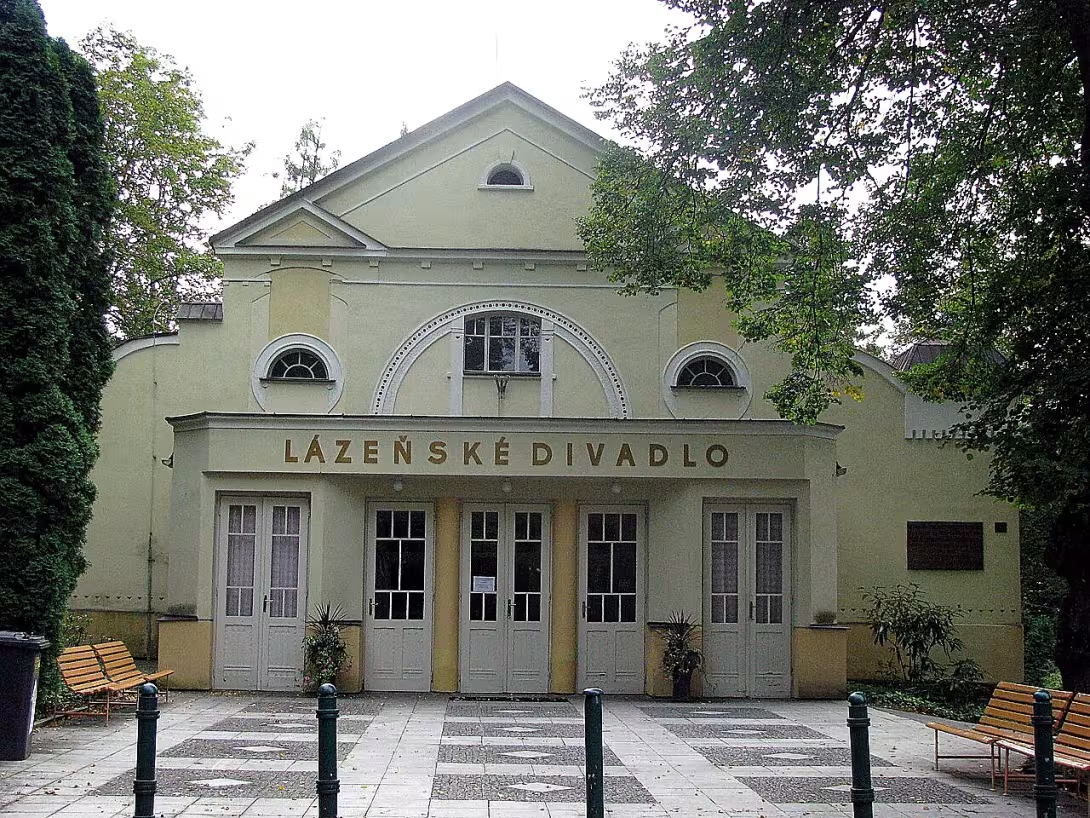
Lázeňské divadlo in Luhačovice is a neoclassical building with Art Nouveau elements, built between 1907 and 1908. The building represents an important cultural centre of the spa town and since 2005 it has been protected as a cultural monument.
The history of the theatre is closely linked to the development of Luhačovice in the early 20th century. The company Lazne Luhačovice, led by František Veselý, then sought to create a social and cultural centre. The original performance has been held since 1905 in the reading room, which came from a former master cow. The idea of building a separate building was born in 1906 on the initiative of a spa doctor and amateur Zikmund Janke. He founded the Cooperative to build and maintain the theatre in Luhačovice, which collected the necessary resources. The design of František Skopalik, who defeated the projects Dusán Jurkovič and František Roith, won the architectural competition.
The construction was carried out between 1907 and 1908 by builder Josef Schaniak from Uherský Hradiště. The work was accompanied by a lack of funding from the beginning, which negatively affected the technical quality of the building. The building lacked hygienic facilities and the roof was originally covered with cardboard only, which led to a leak in the interior. The opening ceremony took place from 27 to 29 June 1908. On this occasion, the works of Antonín Dvořák, Bedřich Smetana, Josef Suk and Oscar Nedbal were performed.
Architecturally, it is a two-storey house situated in a mild slope with a stone suspect and a lime plaster. The main facade is decorated with a triangular shield above the console ledge and half-circle windows. Side facades highlight the risalities and decorative blind windows. The interior has until today preserved the original Art Nouveau stucco decoration. In 1956, a new entrance section with a cash register and a buffet was added, but it partially covered the original Art Nouveau facade with an arches feature.
The building has undergone many modifications during the 20th century. As early as 1910, toilets were completed, in 1915 the cardboard roof was replaced by eternit and in 1925 central steam heating was installed. Between 1928 and 1929, the warehouse was added to the set. The general reconstruction between 1963 and 1964 followed the period of non-use in the 1970s, after which the building was reopened in 1979.
The theatre hosted a number of important ensembles such as the Prague Švand Theatre, the National Theatre Brno and the cabaret Red Seven. Cinematographic productions have also been held here since 1912. Currently the scene is fully functional and organizes events such as the Janáček Festival and Luhačovice, Václav Hudeček Academy and Theatre Luhačovice.
Lázeňské divadlo remains an authentic witness to the cultural upbringing of spa life in the early 20th century. Visiting this place offers an opportunity to explore the history of social life in Luhačovice and appreciate preserved Art Nouveau elements in the interior.
Historical milestones
- 1906
- The formation of the Cooperative to build and maintain the theatre and announce the architectural competition.
- 1908
- Completion of construction and ceremonial opening performance.
- 1956
- Significant reconstruction of the entrance part of the theatre.
- 2005
- The building is declared a cultural monument.
Architectural development
The original building from 1908 suffered from a lack of funding, which was manifested by the absence of sanitary facilities and poor roof cover quality. In 1956 a new entrance section with a cash register and a buffet was added, which partially covered the original Art Nouveau facade. The building underwent several waves of modernization, including installation of steam heating in 1925 and later general repairs.
Historical events
Opening ceremony in June 1908, general reconstruction in 1963- 1964, reopening after reconstruction in 1979.
Owners
The cooperative will build and maintain the theatre in Luhačovice, later the spa administration.
Points of interest
- The theatre building is a neoclassical building with Art Nouveau elements, which was built between 1907 and 1908. Since 2005, the building has been protected as a cultural monument. - The original theatre performance took place since 1905 in the reading room, which was created by the reconstruction of the former master cow. - In the architectural competition for the construction of the theatre František Skopalík won, which defeated also the famous architect Dusan Jurkovic. - Due to the lack of funding in building the building lacked hygienic facilities and the roof was originally covered with cardboard only, which caused the swelling. - The theatre interior has until today preserved the original Art Nouveau stucco decoration.
Guide
Show guide text
This text was created by artificial intelligence and has not been editorially reviewed. It may contain inaccuracies.
Welcome to Luhačovice. Right now, standing in front of this building, you're at one of the most important points in the city. The Lázeňské divadlo stands before your eyes, a building that is not only a wall and a roof, but a living witness to history, culture and social life that has been going on here for centuries. Stop for a moment, perceive the atmosphere of this place and let yourself be carried away by the sense of elegance that radiates from this object. Look at his face and try to perceive in spirit the harmony that the architect deliberately created here. It's a place where the peace of the spa town meets the excitement of artistic expression.
To understand why this building is standing right here and why it looks like this, we have to go back deep in time to the past, to the beginning of the twentieth century. Because it didn't all start by accident, but because of a vision of one particular person. It was Zikmund Janke, a local doctor who knew that it was not enough to heal the body to flourish the spa city, but also to cultivate the soul. He had a great idea that Luhačovice needed their own cultural center, a place where people could meet, watch the show and relax socially. It was thanks to his initiative and efforts that the Cooperative was founded in 1906 to build and maintain the theatre. This team then announced an architectural competition to find the best possible design for this important place. It was clear that the result was not just an ordinary building, but a real symbol of the city.
Now pay attention to the architecture itself, which you are now observing. If you look at the overall design of the building, you will see a neoclassical style that gives the building a sense of seriousness, peace and a certain nobility. It's a style that evokes tradition and stability. However, if you take a closer look at the details that are on the facade or in ornamentationes, you will find Art Nouveau style elements. This combination is fascinating. The Art Nouveau brings to the overall picture softness, organic shapes and a sense of life, which perfectly complements the stricter line of neoclassicism. Did you know that František Skopalík was chosen for winning the competition? His vision was realized by builder Josef Schaniak and the whole construction process took place between 1907 and 1908. When the theatre opened for the first time in 1908, it was a huge victory for the city.
Now let's think about the people behind this place. In addition to the said doctor Janke, who was a mover throughout the process, the name of architect Skopalik plays an important role here. His work here has left a permanent mark that you can see. Let us not forget the builder of Schaniak, who had to transfer these ambitious plans into reality. The theatre became a key centre where not only the spa visitors met, but also the locals. It was where the company was formed. Over the years, the building was changing, for example in 1956 there was a significant reconstruction of the entrance part in order to better meet the needs at the time, but its basic character was preserved. And finally, in 2005, this building was officially declared a cultural monument, which only confirms its immense value to all of us.
And now I want to tell you one thing that might surprise you and give this place a little mystery and contrast. Imagine that before this beautiful building was built, the theatre performances were not held in such a lavish hall. Since 1905 the performance took place in the reading room. And the reading room was never originally intended for that purpose. It was created by the reconstruction of a former master cow. Imagine that huge leap in history and aesthetics. From the place where cattle were once fed, the efforts of visionaries have made it a place where the highest artistic manifestations take place today. This transition from simple innkeeper use to a world of high culture is one of the most interesting stories this city has to offer. It's proof of the great influence of human will and desire for beauty on what our surroundings look like.
You're standing in front of a building that has survived for centuries, has undergone reconstructions and changes in times, but it still stands here and still fascinates us with its elegance. It's a place that encourages you to explore again. I hope this brief view of the history of the Spa Theatre has helped you better understand its meaning and beauty. Let yourself be inspired by the atmosphere of Luhačovice, walk through their streets and feel every little memory that comes your way. Thank you for your attention, and I wish you the lovely rest of your guided day. Enjoy every moment in this beautiful city.
Tips for visitors
The best time for a visit is during the spa season or during cultural events, when the building comes to life with theatre ruckus and you can admire its neoclassical architecture in full glory. Take your comfortable shoes for walks around the colonnade and a bottle for tasting mineral springs. The morning light is ideal for photography, which highlights Art Nouveau details on the facade of the building. In the nearby area we recommend a walk in the spa area, a tour of the villa Valaška and a tasting of local healing springs, all available by short walking. For families with children, the area is ideal thanks to flat terrain and plenty of space to move in green off the main roads.
Frequently asked questions
Can the monument be visited?
The building is in use (offices, a school, shops and the like). The interior is generally accessible only during operating hours and tours are not usually offered; we have not verified the details. You can see the exterior from the street.
Where is the monument?
Location: Luhačovice, Zlínský kraj. The map on this page shows the exact spot.
Why is the monument protected?
It is listed in the Central List of Cultural Monuments of the Czech Republic as a cultural monument (register no. 1275467467).
Businesses nearby
Do you run a restaurant, accommodation, shop, museum, rental, wellness or other visitor service near this monument? Show yourself directly to the people heading to it — this is how they will see you in the app and on the web:
Events nearby
Zdroj akcí: otevřená data měst a obcí ČR (Národní katalog otevřených dat) a kalendář akcí Národního památkového ústavu.
Nearby
Lázeňský areál Luhačovice, vila Valaška, minerální prameny.
Accommodation nearby
Themed route
Thematic cruise route to Luhačovice
1. Spa area Luhačovice
Type: Spa and medical facilities
Why is worth a visit: This resort is the centre of therapeutic tourism in Luhačovice, where mineral springs for relaxation and health care can be used. It's the perfect place to start your visiting program.
2. Mineral springs
Type: Natural spa resources
Why is worth a visit: Mineral springs are known for their therapeutic properties and are a key part of spa services. It's an opportunity to explore the original sources that make Luhačovice so popular.
3. Villa Valaška
Type: Historical architectural object
Why it is worth a visit: This villa is an example of regional architecture and provides a view of the history and culture of the area. Its beautiful construction and location make it an ideal place to relax after a spa visit.
4.Lázeňské divadlo
Type: Theatre equipment
Why is worth a visit: This theatre is the cultural centre of Luhačovice, where various performances and events are held. It's a great way to enjoy local culture and art after exploring spa facilities.
5. Spa Park
Type: Green area around the spa
Why is worth a visit: The park offers a quiet space for relaxation and a beautiful opportunity for a walk after exploring other attractions. It's the perfect place to close your trip.
This route offers a comprehensive view of the spa and cultural aspects of Luhačovice, allowing visitors to fully immerse themselves in the atmosphere of this unique place.
Seasonal recommendations
In spring, the theatre wakes up with nature. The gardens are beginning to bloom around the building, and the sun's rays are soft and blinding. It's the perfect time for a quiet observation of the building in the new green surroundings. I suggest you take several layers of clothing because the wounds are still cold. Visit the site in the morning, when the air is the cleanest and people are just beginning to return to the spa area.
In the summer months the mood is very lively and full of strength. The sun shines the strongest and the color of the building makes it very bright. In the main summer time there are the most people around the theatre, so it is good to arrive early in the morning to enjoy peace. Dress lightly and don't forget to protect yourself from the sun. It's the best time for long walks around.
Autumn brings tones of gold and copper to the spa environment. The leaves on the trees create beautiful colored sets for historical construction and morning fog adds mystery to the place. The mood is calm and quiet. It is advisable to carry a warmer coat and stronger shoes, because the roads can be wet. Visit the theatre in the afternoon when the light is the hottest.
Zimą makes the theatre very peaceful and somewhat distant. If the snow falls, the building looks like a fairy tale and the freezing air highlights her face. The days are short, so the light will recede soon. Get ready for the cold, so wear very warm clothes and a hat.
Visualizations and artistic views


The visualisations are generated by artificial intelligence and serve as inspiration.
Photos from the area
Real photos taken near the monument


Zdroj a licence jsou uvedeny u každého snímku.
Tips from visitors
No tips yet. Be the first!
Log in and add your tip.
Sources and literature
Photos: Pavel Langer / CC BY-SA 3.0 — Wikimedia Commons. The author and licence also appear when you hover over the image.
Faktickým podkladem tohoto textu byl článek na Wikipedii, jehož autory jsou přispěvatelé Wikipedie. Článek je dostupný pod licencí CC BY-SA 4.0.
Location on the map
More monuments – Luhačovice
Show all in the municipality
Příběhy a pověsti
Legendy, pověsti a příběhy spjaté s touto památkou

Fotografie návštěvníků
Zatím žádné fotografie. Buďte první, kdo přidá fotografii z návštěvy!
Log in a přidejte svou fotografii nebo hodnoťte.
Za ověřenou návštěvu v aplikaci získáte víc bodů — poznáme podle GPS, že jste na místě.
Reviews and comments