



lázeňský dům Tři lilie Hotel building
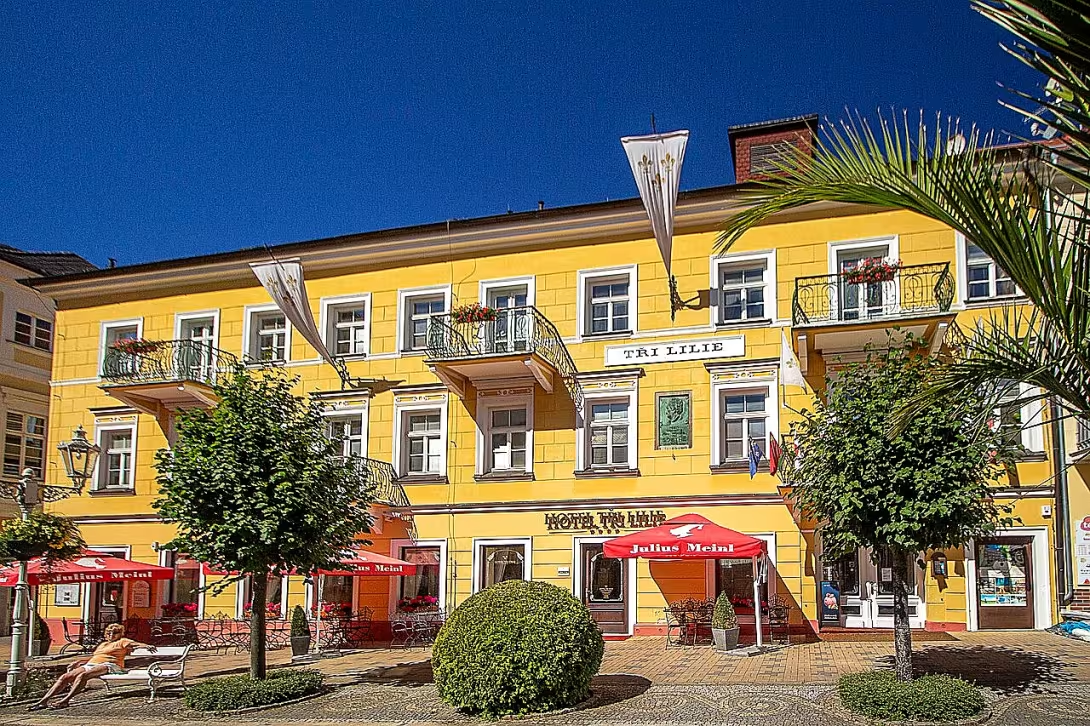
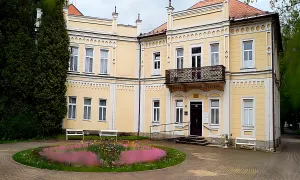
Spa House Three lilies, created in 1793- 1794, is the oldest hotel in Františkova Lazne. This Empire corner house is located on National Street 3 / 10 and represents an important historical complex in the centre of the spa.
The building was created during the spa forming period. Its builder was Anton Loimann, father of Christopher Loimann, who later acted as the first mayor of Františkova Lazne.
The building is built in Empire style. Thanks to the gradual reconstruction in 1827, 1830, 1841 and 1849, the building gained atrium, three-wing form with the inner courtyard. In 1827-1828, the first private spa was added to the house, in which saltwater baths were prepared. The interior went through modifications in 1869.
The house was closely connected to the Loimann family. Since 1850 it was owned by the balneologist Dr. Gustav Loimann, who was mayor of the city in 1862- 1872. Between 1992 and 1995 the building underwent extensive reconstruction and restoration by the French architect Jean-Louis Mayer.
The historical importance of the building is underlined by its famous guests. The poet Johann Wolfgang von Goethe lived here in 1808. The visitors also included Prince Metternich and music artist Clara Schumannová, who was treated here in 1886 and 1889.
The spa house currently functions as a four-star boutique hotel. It is a place where you can explore the history of the European spa in the centre of Františkova Spa. Historical architecture and legacy of important personalities make this building an important destination for visitors.
Historical milestones
- 1793
- The foundation of the house.
- 1808
- Johann Wolfgang von Goethe's stay.
- 1827
- Adding the first private spa.
Architectural development
The building was gradually expanded in 1827, 1830, 1841 and 1849. These modifications formed an atrium three-wing form with the inner courtyard. The overall style is empirical.
Historical events
In 1793- 1794 the building was built. The construction of the first private spa took place in 1827-1828. A major reconstruction took place between 1992 and 1995.
Owners
Anton Loimann (1793) family of Loimann (including Gustav Loimann since 1850).
Points of interest
- Three Lily Spa House, built from 1793 to 1794, is the oldest hotel in Františkova Lazne. - The building builder was Anton Loimann, the father of Christopher Loimann, who later became the first mayor of the city. - From 1827 to 1828, the first private bath was added to the house, where saltwater baths were prepared. - In 1808 there was a famous poet Johann Wolfgang von Goethe. - The guests included music artist Clara Schumannová, who was treated here in 1886 and 1889.
Guide
Show guide text
This text was created by artificial intelligence and has not been editorially reviewed. It may contain inaccuracies.
Welcome to Františkova Spa. You have just stopped before one of the most important and oldest points of this historic city. In front of your eyes is a building that is not just an ordinary house for accommodation, but a living witness of the centuries that have taken place here. You're standing right in front of the Three Lilies spa house. His name alone must welcome you with its elegance and tradition. Feel the atmosphere of peace and nobility radiating from this place. This building is the oldest hotel in the whole Františkova Lázně and its presence here has shaped the character of the whole area for centuries.
Now let's go back deep into the past together to understand how this fascinating story began. Imagine the end of the eighteenth century, exactly 1793. The city was just forming and this house was one of the first pillars to be built here. At that time, this house was not as extensive as you see it today. It was an empirical corner house, built with great balance and sense of order and symmetry. His founder and chief builder was a man named Anton Loimann. This character is absolutely crucial to local history. Anton wasn't just a simple builder, he was a man who laid the foundation for the future boom of this whole area. His family remained strongly rooted here and his influence was seen for many more years. His son, Kryštof Loimann, later became the first mayor of this city, which clearly shows how deep the ties between this house and the fate of the entire village were. The family name of the Loimans thus became synonymous with the development and stability of this place, while other family members, such as Gustav Loimann, were part of this important legacy.
Now pay attention to the very form of the building you are currently observing. Although at first sight it may seem that this construction always looked like this, its present appearance is the result of a very long and fascinating process of transformation. During the nineteenth century, the building went through several major reconstructions which gradually changed its face. It was these changes that gave her the unique, three-winged form that you now see. Notice how the building spreads out and creates an inner space, a courtyard that hides peace in the middle of a busy city. This architectural project, which in many phases also influenced the work of an architect named Jean-Louis Mayer, was aimed at making the house more and more modern for its purposes. The original, simpler corner house has gradually become a complex building that can accommodate a large number of guests while providing the privacy and comfort that spa visitors require. Feel how architecture has adapted to the needs of people here looking for rest.
The history of this place is inseparable from the names of the great personalities who once sought treatment and peace. Imagine, in 1808, the famous Johann Wolfgang von Goethe himself lived here. Imagine his steps on these streets and his thoughts that were resonating here at the time. The presence of such a man has given this house the immediate weight and glory that the house has kept for many years to come. But it is not the only glorious face that has passed through these gates. There were people like Metternich or talented musician Clara Schumannová. Each brought a piece of their own culture and meaning to this city. This house was simply a place where there was a world where political ideas, art and science were mixed.
If you look now at the development of the building in terms of its use, you will find one very interesting thing related to the development of spa care. Between 1827 and 1828 there was another fundamental change that defined the future fate of the house. The first private bath was added to the original building. This was the moment when the house finally became an integral part of the spa system. It was no longer just a house for accommodation, but a place where medical procedures and health care were prepared on the spot. This integration of private facilities for spa care was very advanced at the time and helped the building maintain its importance in the following decades, when the spa became the main pillar of life in the region.
So feel this building as a living organism that evolved along with the city. From the small corner house in 1793 to today's important and luxurious accommodation centre, which today serves as a highly rated hotel. Every reconstruction, every new wing, and every attached spa room added another layer to its rich history.
Now that you know at least part of the story of the Three Lilies, I suggest you continue your walk around this historic heart of the city. Feel how history intersects with the present in every detail around it. Enjoy the peace of Františková Spa and let yourself be carried away by the atmosphere created here by this very building and its rich past. Thank you for your attention and I wish you a beautiful and inspiring visit to our city.
Tips for visitors
The best time to visit this historic house is early morning or late afternoon when the light is softer and the facade looks best. For the best experiences we recommend walking at a time when there is no greatest rush.
Traffic to the monument is easy; the location is accessible by car and by public transport. Please check the current connection of the means of transport in the search engine to be sure.
If you want to focus on photography, focus on the corner of the building, which has a very interesting historical look. The best light for architecture pictures can be obtained when the sun is low.
When visiting we recommend to bring comfortable shoes for walking around and possibly a camera for capturing beautiful architecture.
You can walk around the spa centre of Františkova Spa, which offers a pleasant atmosphere. For families with children, walking around is very suitable because the terrain is clear and allows easy movement.
Frequently asked questions
Can the monument be visited?
The building is in use (offices, a school, shops and the like). The interior is generally accessible only during operating hours and tours are not usually offered; we have not verified the details. You can see the exterior from the street.
Where is the monument?
Location: Františkovy Lázně, Karlovarský kraj. The map on this page shows the exact spot.
Why is the monument protected?
It is listed in the Central List of Cultural Monuments of the Czech Republic as a cultural monument (register no. 1000159282).
Businesses nearby
Do you run a restaurant, accommodation, shop, museum, rental, wellness or other visitor service near this monument? Show yourself directly to the people heading to it — this is how they will see you in the app and on the web:
Nearby
Lázeňské centrum Františkových Lázní.
Accommodation nearby
Themed route
1. Three lilies (outer space) Type: architecture. Admiring the facade and the historical appearance of the spa house.
2. Three lilies (interior) Type: exposure. A tour of the inner space and knowledge of the history of the object.
3. Three lilies (area) Type: park. Rest in the garden and courtyard right by the building.
4. Spa Centre Františkova Spa Type: urban space. Walk through the centre of the village for the perception of the spa atmosphere.
Seasonal recommendations
In spring nature wakes the surrounding spa house to life. The blooming gardens and fresh air provide an optimistic atmosphere, while the fine morning light highlights the facade details. We recommend arriving in the morning when it is quieter in the surroundings. Clothes should be layered to protect you from changing spring weather.
The summer season brings full flowering green and bright, intense lighting that underlines the excellent state of the monument. The atmosphere is very lively and full of energy. Due to high season and larger crowds, it is best to plan a visit to early morning hours. Choose light, breathable clothes and don't forget enough fluids.
In autumn, the surroundings turn into gold and red tones, creating a romantic and a little melancholy mood. A fog wound gives the building a mysterious look. There are significantly fewer visitors in this period, so you can enjoy the tour in complete peace. Hot sweaters and waterproof shoes are suitable for walking in leaves.
In winter, the monument is peaceful and noble, especially if it is covered by a layer of snow. The contrast between freezing outdoor air and internal heat creates a cozy feeling. In advent time the atmosphere is more dreamy, but we recommend watching shorter opening times. Very warm clothes, hats and gloves are essential.
Visualizations and artistic views


The visualisations are generated by artificial intelligence and serve as inspiration.
Photos from the area
Real photos taken near the monument


Zdroj a licence jsou uvedeny u každého snímku.
Tips from visitors
No tips yet. Be the first!
Log in and add your tip.
Sources and literature
Photos: VitVit / CC BY-SA 4.0 — Wikimedia Commons. The author and licence also appear when you hover over the image.
Faktickým podkladem tohoto textu byl článek na Wikipedii, jehož autory jsou přispěvatelé Wikipedie. Článek je dostupný pod licencí CC BY-SA 4.0.
Location on the map
More monuments – Františkovy Lázně
Show all in the municipality

Příběhy a pověsti
Legendy, pověsti a příběhy spjaté s touto památkou
Fotografie návštěvníků
Zatím žádné fotografie. Buďte první, kdo přidá fotografii z návštěvy!
Log in a přidejte svou fotografii nebo hodnoťte.
Za ověřenou návštěvu v aplikaci získáte víc bodů — poznáme podle GPS, že jste na místě.
Reviews and comments