



Lázeňský dům Vila Lil Building
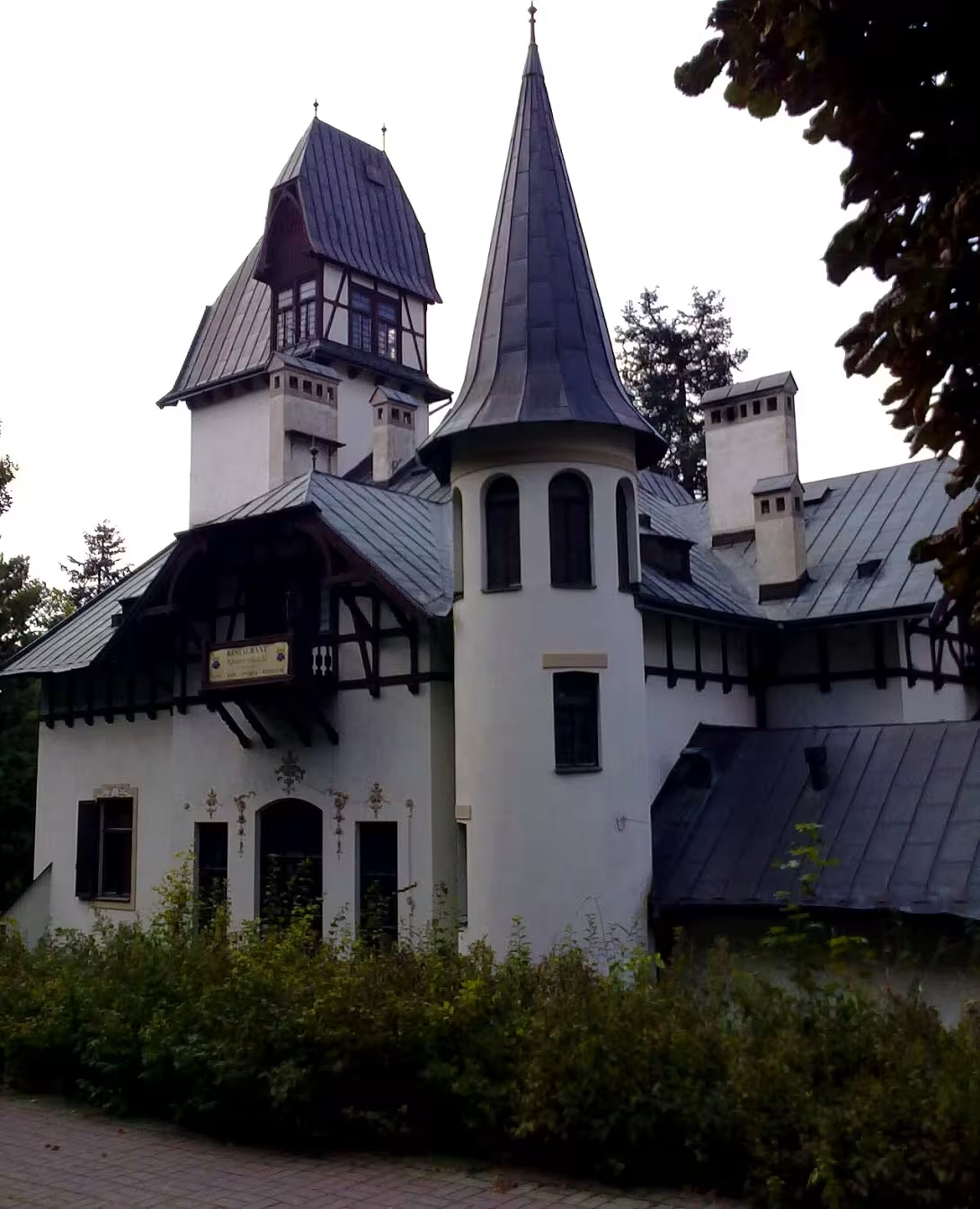
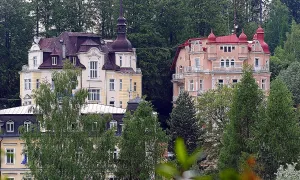
Villa Lil in Mariánské Lázně is a protected historical spa house completed in 1901. The building is located in English street on the southwest foot of Hamelika hill at an altitude of 601 meters. It stands in a steep slope above the valley meander of Ušovický creek. This representative residential building is an important example of the architecture of its time within the Bellevue district.
The building of the villa started in 1899 by the businessman and benefactor Maxmilián Franz Halbmayr. The project was developed by the local architect and builder Alexander Zickler. The building was created as a residential building with an adjacent economic building. Originally it was called Fürstenhaus Luginsland, which means the Prince's villa - a view of the landscape. Over time it was also known as Villa Halbmayr, Villa Luginsland, Villa Look ins Land or Vila Lil, for short.
Architecturally, the object is characterised by the distinct material composition on an irregular plan. There are used romantic elements of decorative levelling and castle architecture such as supporting pillars, bay, steep roofs, prism and cylindrical tower. The building consists of several parts with different number of floors. In the southern facade is dominated by a high prism view tower with a striking corner skyline, which offers unique views of the city.
The eastern main facade, visible from the English street, is single storey with a raked superstructure to the roof. In the right part of the facade there is a two-storey round tower with conical roof. The left side of the building is covered by a counter roof. The main entrance in the centre of the eastern facade covers the portal with a roof and richly carved wooden door with original forging. There is a stone sculpture of a mythical gryphus on a high supporting wall in the space in front of the facade.
Between 1901 and 1904, garden treatments were designed by Swedish landscape architect Carl Gustav Swennson. The garden was planted with rare trees. From the terrace on the west side of the building, two arches led to the Ušovice stream, connecting the villa to the adjacent park.
The owner of Maxmilián Franz Halbmayr was the son of Josef Dionýs Halbmayr, an important Mariánskolázní hotelier, politician and former mayor of the city. He built the hotel Klinger, the cafe (later Halbmayrhaus Hotel) and the hotel Maxhof. Maximilian himself was an industrialist, music lover, excellent organist and benefactor who helped with the acquisition of organs into several churches and synagogue.
Maxmilián Franz Halbmayr moved into the villa in 1901, but did not stay in the building for long. He died here in July 1903, shortly after his brother Josef Anton deceased in February of the same year. Since Maximilian had no offspring, in his will he gave Villa Lil to the city for the accommodation of rare guests. 60 000 Czech crowns contributed to its maintenance. He also donated funds to the organ to the Dean's Church of the Assumption of the Virgin Mary and to the local synagogue.
Villa Lil has been protected historically since 1958. The object remains a unique testament to the boom of Mariánskolázín architecture and wealth of industrial families in the turn of the century. Thanks to its location and details, it is worth visiting every interested person in history.
Historical milestones
- 1899
- Opening of the building of the villa in the Bellevue district.
- 1901
- Completion of building construction.
- 1958
- The villa was declared protected by a monument.
Architectural development
The building was built in the architectural style of history. The project was developed by the local architect Alexander Zickler. The construction includes the main residential building and adjacent economic building.
Historical events
1899: construction start of the residential building; 1901: completion of villa construction; 1958: declaration of monument protection.
Owners
Maxmilián Franz Halbmayr (builder, 1899- 1903)
Points of interest
- The 1901 building was originally named the Prince's Villa - a view of the landscape. - The building has a high prism view tower which offers unique views of the city. - In front of the front of the building there is a stone sculpture of a mythical gryf on a high supporting wall. - A garden with rare trees was designed by a Swedish landscape architect. - The owner in the will gave the villa to the town for the accommodation of rare guests.
Guide
Show guide text
This text was created by artificial intelligence and has not been editorially reviewed. It may contain inaccuracies.
Welcome to Marian Spa. Right now, you're facing one of the fascinating jewels of this spa pearl. In front of you is Villa Lil, a beautiful house that will consume you with its elegance and nobility. Feel its atmosphere and observe how the building naturally enters the surrounding landscape. You are located in the Bellevue district, which was a newly developed and very desirable place at the time of the building. The villa is located in a steep slope at the southwest foot of Hamelika hill, directly above the Ušovická creek, which gives it a dramatic touch while ensuring peace and privacy, which were sought by its first inhabitants.
Let's stop at the history of this place. The building of the villa began in the year one thousand eight hundred ninety-nine, when Mariánské Lázně became the world centre of health and social life. The entire construction process lasted two years and the building was completed in the year one thousand nine hundred and one. At that time, it was not just an ordinary house, but a representative residence for very rich people who sought refuge in nature, but who did not want to enjoy luxury. The project was taken up by the architect Alexander Zickler, who inserted the spirit of his time into the building. The villa was built as a main residential building, to which the economic building was attached, so that the operation of the house was completely independent and efficient.
Now pay attention to the architecture itself and the details that you can see right in front of you. Look at the overall appearance of a building that represents the style of historism. Notice how harmonious its shapes are. If you aim your view above, you will see a high prism observation tower. This tower is one of the most significant elements of the entire building. Its purpose was to offer unique views of the whole city and surrounding landscape, which, combined with the location on the slope, creates a unique experience. Look below now, to the foundation of the building. You will see a high supporting wall in front of the front of the villa, on which there is a stone sculpture of a mythical gryf. This terrifying and protective creature guards the entrance to the premises and gives the villa a hint of mystery and nobility.
When we think about people who were connected to this villa, we can't forget names like Maxmilián Franz Halbmayr or Josef Dionýs Halbmayr. It is these people who have left their mark in the history of this region and their influence is felt in how similar top objects were built in this area. Villa Lil was basically a symbol of the status and wealth of that time. It is interesting that the building today bears the name Lil, but in the year one thousand nine hundred, when it was completed, it had a completely different name. It was originally called the Prince's Villa of the Landscape View. This name accurately captivated its main priority, which is the possibility to observe the surroundings from the tower above.
Besides the house itself, think about the surroundings. The villa is surrounded by a garden where rare trees can be found. This garden was carefully designed to complement the beauty of the house and provide its inhabitants with space to relax in the surrounding exotic and rare plants. The whole complex thus consists of one unified whole, where human architecture meets carefully shaped nature.
Due to its high value and uniqueness, in the year one thousand nine hundred fifty-eight the villa was declared a monument protected. This means that the state has recognised its irreplaceable importance for the culture and history of our spa. It's proof that buildings like this aren't just a bunch of stones and bricks, but they're living witnesses to history telling stories about people, their ambitions, and the aesthetics of the early twentieth century.
Stop now for a moment and just feel the silence of this place. Imagine how, over a century ago, people were looking at the city below them, walking among rare trees in the garden, and being accompanied by a stone gryff on the supporting wall. It's a place where time stops and where you can feel the atmosphere of the old days, where the spa was the center of social belief and elegance.
I hope you're interested in this short journey through Villa Lil's history. It's a place that deserves the attention of anyone who wants to understand why Mariánské Lázně is so special. Now I invite you to take a quiet look at the surrounding area, look at the details of the facade again, and perhaps you have tried in your mind to remove all the steps into the observation tower to imagine the amazing view of the city.
Thank you for walking with me at this beautiful house. I wish you a pleasant rest of the day in our wonderful city and many other discoveries during your further discovery of the surroundings. Goodbye.
Tips for visitors
The best time to visit is spring or autumn, when the colors of nature around the creek complement the appearance of a historic building. The building is available by car and public transport; Check the current connection in the search engine.
For a walk we recommend to wear comfortable shoes because the villa is located in the hilly terrain at the foot of the top. Since there are no tours in the building, focus on the observation of architecture from the outside.
For the best photos we recommend to come to the morning or late afternoon lights that highlight the details of the historical style. The ideal angle is the view from the surroundings of Ušovický creek.
The surrounding area offers a beautiful connection with nature. You can walk along the Ušovický creek or climb to the top of the hill Hamelika, which lies in close proximity.
For families with children it is ideal to combine a view of the villa with a short trip to the surrounding countryside, allowing children to move in the fresh air in a quiet environment.
Frequently asked questions
Can the monument be visited?
The building is in use (offices, a school, shops and the like). The interior is generally accessible only during operating hours and tours are not usually offered; we have not verified the details. You can see the exterior from the street.
Where is the monument?
Location: Mariánské Lázně. The map on this page shows the exact spot.
Why is the monument protected?
It is listed in the Central List of Cultural Monuments of the Czech Republic as a cultural monument (register no. 1000138873).
Businesses nearby
Do you run a restaurant, accommodation, shop, museum, rental, wellness or other visitor service near this monument? Show yourself directly to the people heading to it — this is how they will see you in the app and on the web:
Events nearby

Zdroj akcí: otevřená data měst a obcí ČR (Národní katalog otevřených dat) a kalendář akcí Národního památkového ústavu.
Nearby
Vila leží na úpatí vrchu Hamelika nad údolním meandrem Úšovického potoka.
Accommodation nearby
Themed route
Here is the design of the thematic route:
1. Úšovický creek (natural department) - Walk along the riverbed of the stream offers peace and beauty of the countryside in the valley. 2.Lázeňský dům Vila Lil (villa) - The main destination of the journey, which represents a unique architecture in harmony with the surroundings. 3. Hamelik Hill - The climb to the top above the villa provides a view of the surrounding landscape.
Seasonal recommendations
In spring the surroundings of the villa will awaken to rich green colours and bloom local flora. Soft spring light highlights the facade details, which is ideal for outdoor photography. We recommend light but laminated clothing and walking in the morning when the air is the cleanest.
Summer brings hot days and full parks that create a lively atmosphere. The sun shines high and the building appears bright and contrasting against the shadows of tall trees. The best time to visit is early morning to avoid the noon heat, and light summer clothes are suitable.
The autumn of the garden around the monument turns into gold and red tones, creating a nostalgic mood. The light is milder and more golden in this period, which gives the building a special depth. It is advisable to choose waterproof shoes and a warm sweater, especially when walking in foggy afternoon hours.
Zimą reigns in the area of peace and quiet, which can be underlined by a layer of snow on roofs and in surrounding alleys. The atmosphere is cramped and cozy, especially in advent time. Hot winter clothes, gloves and tight footwear with anti-slip soles are essential for visitors.
Visualizations and artistic views

The visualisations are generated by artificial intelligence and serve as inspiration.
Photos from the area
Real photos taken near the monument


Zdroj a licence jsou uvedeny u každého snímku.
Tips from visitors
No tips yet. Be the first!
Log in and add your tip.
Sources and literature
Photos: Jan Macura / CC BY-SA 3.0 — Wikimedia Commons. The author and licence also appear when you hover over the image.
Faktickým podkladem tohoto textu byl článek na Wikipedii, jehož autory jsou přispěvatelé Wikipedie. Článek je dostupný pod licencí CC BY-SA 4.0.
Location on the map

Příběhy a pověsti
Legendy, pověsti a příběhy spjaté s touto památkou
Fotografie návštěvníků
Zatím žádné fotografie. Buďte první, kdo přidá fotografii z návštěvy!
Log in a přidejte svou fotografii nebo hodnoťte.
Za ověřenou návštěvu v aplikaci získáte víc bodů — poznáme podle GPS, že jste na místě.
Reviews and comments