



Lázeňský park (Karviná) Park
This page was machine-translated from Czech. The translation has not been language-checked and may contain errors.
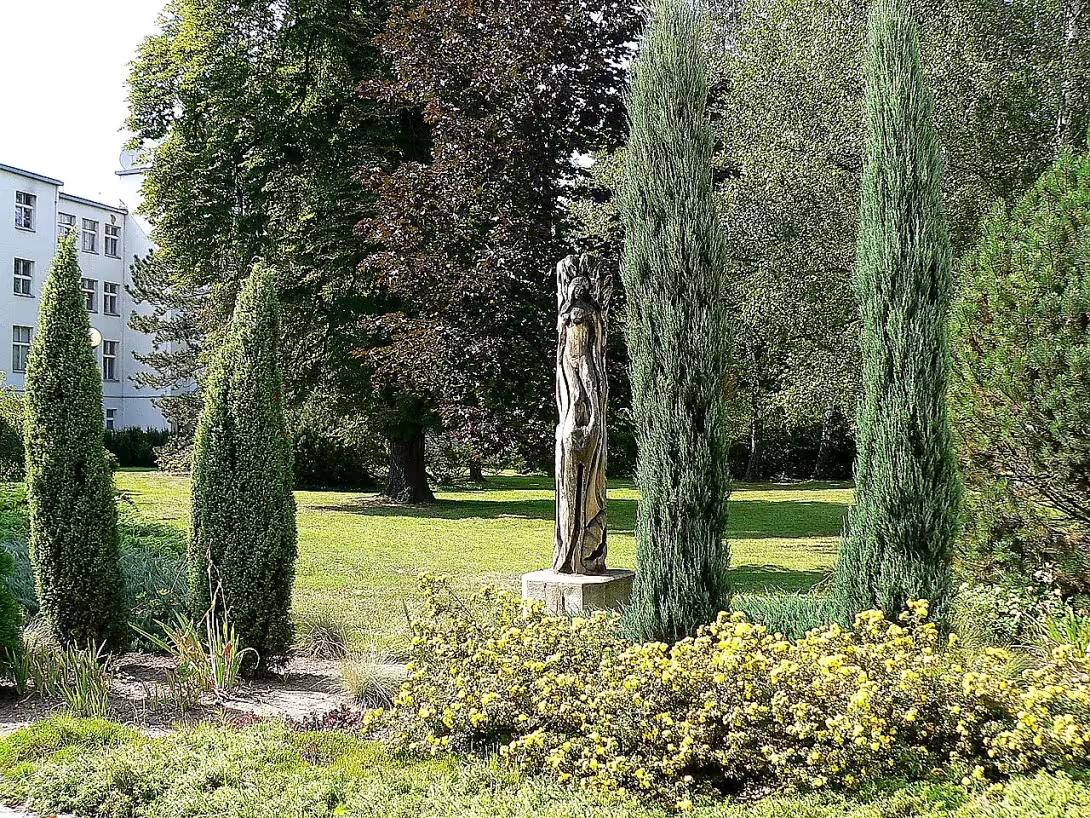
The spa park in Karviná-Darkov is a natural landscape park founded in 1895. When it was laid out, the original vegetation was kept and supplemented with mature trees brought from the Beskids. The park forms the setting for the oldest surviving buildings of the Darkov spa, and since 25 March 1992 it has itself been entered in the Central List of Cultural Monuments under number 1000122138 (older register number 13116/8-3200).
It is not only the park itself that is protected. Three further buildings are listed as parts of the monument site: the sanatorium building, the Social House from 1900–1901 and the Chapel of Saint Anne. The spa part of Darkov is also included in the Karviná urban conservation zone, likewise declared in 1992 together with the historic core of Fryštát.
The history of the place begins earlier than the park. In 1862 Baron Jiří IV Bees of Chrostina drilled a trial borehole on his land between Darkov and Stonava. He wanted to keep up with his neighbour, Baron Larisch, who was already mining coal around Karviná — but instead of coal he struck an abundant spring of highly mineralised iodine-bromine brine. In 1865 Dr Anton Fiedler, a physician from Fryštát, first used it for treatment: he heated the water and regularly bathed his patients in it in wooden tubs. That same year the first spa building went up in the Darkov cadastral area, a glazed wooden structure in the Swiss style on a stone base, which was nicknamed the Glasshouse because of its many windows.
The Silesian provincial government in Opava issued the official permit to establish the spa in 1866, and the spa was founded in 1867. In the same year Bees had the spring examined by the Viennese university professor Redtenbacher. The analysis showed that the Darkov brine contained twice as much iodine as the springs in Hall in Upper Austria, until then the most effective — and that decided the further development of the spa. The park was not created until the end of the 19th century.
The 20th century in Darkov was shaped by coal mining. Subsidence destroyed most of the original buildings, and all that remained of historic Darkov were the old spa, the spa park and a few houses on the right bank of the Olše; across the river there are now only allotment gardens and a few last houses. The importance of the original spa also declined after a modern Rehabilitation Sanatorium was built at the other end of Karviná in the 1970s. The Glasshouse, the very first spa building, had already been demolished in 1936.
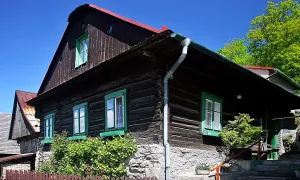
The park has its own sculptures. The bronze fountain Living Spring by the sculptor Jan Kodet from 1961 was stolen in 2022; in 2025 a replica returned to the park. A more recent work is the wooden sculpture Horse by Jan Voldán, made on the spot at the “Darkov Linden” woodcarving symposium in May 2002. Among the park’s trees you will also find a massive copper beech. The grounds also include spa villas, among them Jiřina, Maryčka and Staré lázně.
In 2025 the park underwent extensive renovation. Lázně Darkov had the park revitalised. The revitalisation included a new spa colonnade with water features, paved areas, flower beds, hedges and benches, and a new area with a fountain in front of the Social House. The first phase involved felling trees that a dendrological survey had found to be at real risk of falling. The colonnade was officially opened in August 2025. In June of the same year the government established by decree the spa town of Karviná, which also includes Darkov.
Then and now
Drag the slider to compare how the landmark may have looked when it was built with the view today.
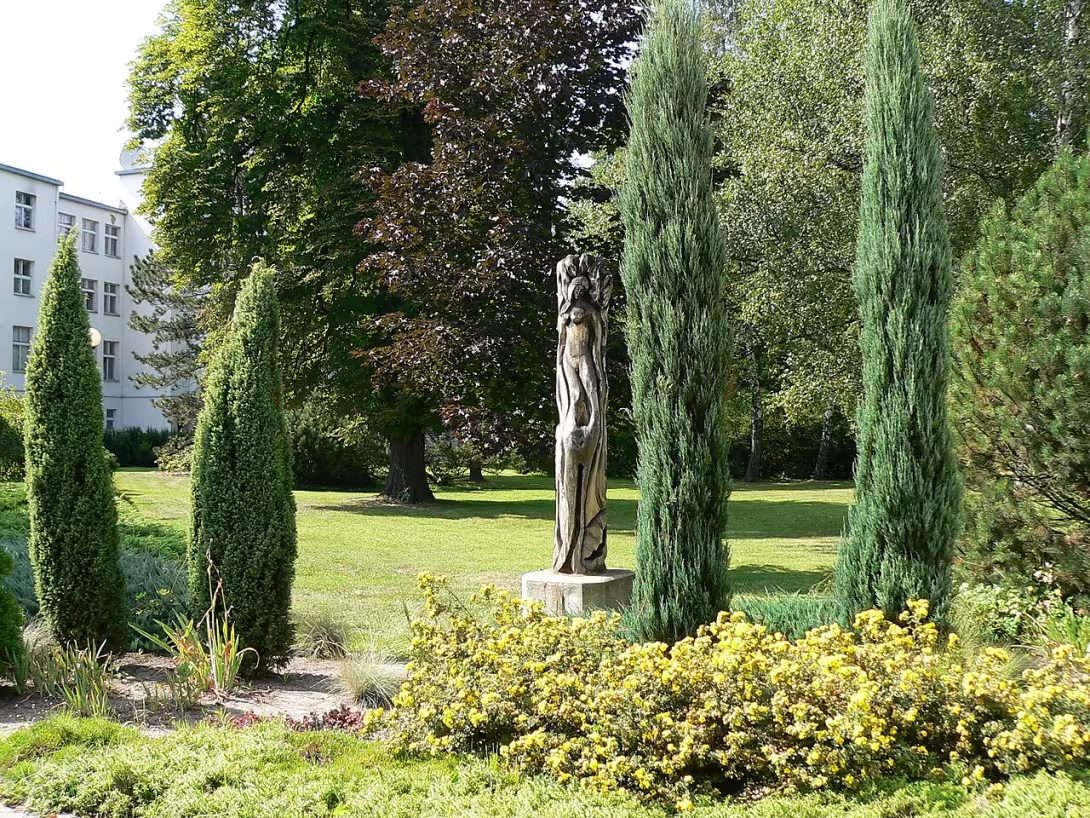

The historical appearance on the left is an AI-generated visualisation and serves as inspiration only.
Historical milestones
- 1862
- A trial borehole drilled by Baron Jiří IV Bees between Darkov and Stonava struck a spring of iodine-bromine brine instead of coal.
- 1865
- Dr Anton Fiedler, a physician from Fryštát, used the Darkov brine for treatment. The first spa building, known as the Glasshouse, was built.
- 1866
- The Silesian provincial government in Opava granted permission to establish a spa.
- 1867
- The spa was founded. An analysis by Professor Redtenbacher showed twice the iodine content of the springs in Hall.
- 1895
- The spa park was founded as a natural landscape park, with mature trees brought from the Beskids.
- 1936
- The first spa building, the Glasshouse, was demolished.
- 1961
- The bronze fountain Living Spring by Jan Kodet was installed in the park.
- 1992
- On 25 March the park was entered in the Central List of Cultural Monuments.
- 2022
- The Living Spring sculpture was stolen from the park.
- 2025
- A new spa colonnade opened with a fountain and a replica of the Living Spring sculpture. A government decree established the spa town of Karviná, which includes Darkov.
Historical events
- 1862
- Baron Jiří IV Bees drilled the first trial borehole on his land between Darkov and Stonava.
- 1867
- The spa was founded under the name Spa Place of Ráj, following a permit from the Silesian provincial government in Opava.
Points of interest
- The Darkov brine contains twice as much iodine as the springs in Hall in Upper Austria, which until then had been considered the most effective. This was shown by an analysis by the Viennese professor Redtenbacher in 1867.
- The 1862 borehole was meant to find coal. Baron Bees wanted to compete with his neighbour Baron Larisch, who had started mining earlier — but instead of coal he struck brine and founded a spa.
- The bronze fountain Living Spring by Jan Kodet stood in the park from 1961. In 2022 it was stolen by thieves of bronze sculptures; in 2025 a replica returned to the park.
- When the park was laid out in 1895, trees were brought in from the Beskids.
- Subsidence in Karviná wiped out almost all of the original Darkov. The park, the old spa and a few houses on the right bank of the Olše are all that remain of it.
- The wooden sculpture Horse was made right in the park — Jan Voldán carved it at the “Darkov Linden” woodcarving symposium in May 2002.
Guide
This guide is narrated by a synthetic voice generated by artificial intelligence.
Show guide text
This text was created by artificial intelligence and has not been editorially reviewed. It may contain inaccuracies.
The Spa Park in Darkov is one of the few places that has remained from the original village. Darkov is now part of Karviná and coal is mined in the surrounding area. Subsidence has destroyed much of the old buildings. However, on the right bank of the Olše River, old spa buildings, a spa park and several houses still stand. Mining has not yet been permitted in this part of Darkov.
The spa was actually created by accident. In 1776, coal deposits were found near Karviná and Baron Larisch began mining them. Jiří Čtvrtý Baron Bees z Chrostiny wanted to match him. So in 1862, he had an exploratory borehole drilled on his land between Darkov and Stonavá. Instead of coal, he struck a powerful geyser of salt water. It was heavily mineralized iodobromine brine from the Tertiary period.
People initially used it only in their households. In 1865, a doctor from Frýštát, Anton Fiedler, began using it for treatment. He heated the water and bathed patients in wooden tubs. That same year, the first spa building in Darkov was created, called Skleník. It was a wooden glazed structure on a stone foundation in the Swiss style. In summer it served spa guests and in winter it hosted fire brigade balls and weddings of wealthy citizens. From that time also comes the Art Nouveau Společenský dům, which has been preserved to this day.
In 1866, the Silesian provincial government in Opava permitted the establishment of the spa and a year later it was founded. Bees had the spring analyzed by Professor Redtenbacher from Vienna. It turned out that the brine contained twice as much iodine as the most effective springs in Upper Austrian Hall up to that point. This marked the beginning of the development of Darkov spa.
At the beginning of the twentieth century, modern spas were built here and most of the functionalist medical buildings still serve their purpose today. Healing water is used for bathing and mainly helps with mobility issues. In the seventies, a new rehabilitation sanatorium was built at the opposite end of Karviná and the importance of the original Darkov spa declined. However, in June 2025, Darkov obtained the official status of spa town.
Tips for visitors
The park is at its best from spring to autumn, when the spa season is in full swing and the flower beds by the new colonnade are in bloom. Allow an hour for a walk, or rather two for a circuit with a sit-down and a stop at the Social House.
It is worth combining your visit with the Bridge of the Heroes of Sokolovo, a few hundred metres downstream on the Olše. This reinforced concrete arch bridge from 1925 is a cultural monument in its own right and now serves only pedestrians and cyclists, so you can walk to it straight from the park.
The terrain is flat and the paths are paved, which is good news for pushchairs and for visitors with reduced mobility — after all, the whole place is a treatment centre for musculoskeletal disorders and is adapted accordingly. Bikes are welcome in the park, and a cycle route runs along the river.
Frequently asked questions
Can the monument be visited?
Parks and gardens are often open to the public, but some have opening hours or are part of a closed site. We have not verified the entry conditions.
What are the opening hours and admission?
We have not verified the opening hours or admission. Current information is published by the operator. Official website: http://www.darkov.cz/
Where is the monument?
Location: Lázeňský park, Lázně Darkov, Karviná, Moravskoslezský kraj. The map on this page shows the exact spot.
Why is the monument protected?
It is listed in the Central List of Cultural Monuments of the Czech Republic as a cultural monument (register no. 1000122138).
For kids
Hi! You are in a park that exists because of one big job that went wrong. More than a hundred and sixty years ago, a man drilled a deep hole in the ground here. He was looking for coal, because his neighbour had some and he wanted some too. But instead of coal, salty water shot up out of the ground — and it could heal people, too.
At first everyone probably thought it was bad luck. But then a doctor came, warmed the water and started bathing sick people in it. And it worked! Ever since, people have come here so that their legs, arms and backs stop hurting.
Businesses nearby
Do you run a restaurant, accommodation, shop, museum, rental, wellness or other visitor service near this monument? Show yourself directly to the people heading to it — this is how they will see you in the app and on the web:
Nearby
🏰 Historic sites (196)
- Obětem 1. a 2. světové války 0.1 km
- Zámek v Karviné-Fryštátě 1.3 km web
- Panna Maria Bolestná 1.3 km
- sv. Jan Nepomucký 1.3 km
- sv. Jan Nepomucký 1.3 km
- Kostel Povýšení sv. Kříže 1.3 km
- Socha TGM 1.3 km
- sv. Patrik 1.3 km
- Madona 1.4 km
- 1914-1918 1.6 km
- Zdar Buh! Sześć Boże! 2.2 km
- Kościół pw. Podwyższenia Krzyża Świętego w Kaczycach 3.4 km Ludowa 7
- KWK Morcinek – Zostali na wiecznej szychcie 3.6 km
- Socha Panny Marie 4.2 km
- 1924-1918 + 1939-1945 4.2 km
- Valtr Elsner 5.1 km
- Hermína Elsnerová 5.1 km
- Pomník horníkům 5.2 km
- Socha svatého Jana Nepomuckého 5.3 km
- Bývalý železniční most 5.5 km
🍽️ Restaurants and dining (445)
- Společenský dům Lázní Darkov 0.2 km
- Bistro Darkov 0.2 km
- Stop Cafe 0.7 km web
- Ovečka 1.2 km
- Rest&rt 1.3 km
- cafe BB bar 1.3 km
- Venezia 1.3 km
- Antalya Kebab 1.4 km
- Elektra 1.4 km Masarykovo nám. 5/4
- Vanilla 1.4 km web
- U Koplíků 1.4 km
- Bok of Ka 1.4 km Svatováclavská 33/2
- Restaurace Baron 1.4 km
- Le Café 1.4 km
- DLOUHÉ VIDLE, s.r.o. 1.5 km
- Adamo Restaurace 1.5 km
- Restaurace Zlaté časy 1.5 km
- Dinos Restaurant 1.8 km +420 774 002 162 web
- Kino Centrum Café 1.8 km tř. Těreškovové 2234/24
- Delikana 2.0 km web
🏨 Accommodation (63)
- Apartmany BB 1.3 km
- Lázně Darkov, a.s. 3.0 km Čsl. armády 2954/3 +420596372210 web
- Koleje Slezká univerzita 3.2 km Na Vyhlídce 1079/1
- Country Motorest 6.3 km
- Nasz Folwark 7.3 km
- Vulture 8.1 km U Pošty 371/4 web
- Hotel Impuls 8.3 km U Hřiště 1324/13b web
- Penzion Pod Zámkem 8.4 km +420 725 178 819
- Hotel Sport 8.9 km web
- Penzion Urban 9.0 km +420603783554 web
- Penzion U Popelků 9.3 km +420 724 200 838 web
- Penzion Amerika 9.4 km +420 736 627 315 web
- Resort Těrlicko 9.4 km +420 724 387 666 web
- Restaurace a penzion U Lesa 9.7 km +420 732 595 205 web
- U Jelena 10.0 km +420 608 751 517 web
- Hotel Fridrich 10.3 km U Hotelu 728/1 +420 596 423 229 web
- Jaškovská krčma 10.6 km web
- Mercure Cieszyn 10.6 km Motelowa
- Kemp Rostislav Rypien 10.6 km +420 604 239 075
- Boršičanka 10.8 km
🚲 Rentals and sport (90)
- STaRS Karviná - víceúčelová hala 1.5 km
- Sportisimo 1.9 km
- Tipsport 2.0 km
- Bazén Stars 2.4 km
- Hala házené 2.5 km
- Modelářské letiště Hohenegger 5.8 km
- KKS Spójnia Zebrzydowice 6.0 km
- LKS OLZA Pogwizdów 6.1 km
- Boisko Kończyce Małe 6.2 km
- Spójnia zebrzydowice 6.4 km
- Sportovní centrum Na Císařství 6.7 km web
- Sportovní hala Horní Suchá 6.8 km
- Petrovická kotlina 7.0 km Dolní Marklovice 253 +420 608712504 web
- Klub Sportowy LKS Błyskawica 7.5 km
- Cyklo ADS cykloservis 7.9 km
- Sportovní hala 8.0 km
- Kola Go 8.3 km
- Letní koupaliště 8.6 km
- sportovní areál 8.7 km
- Tor Motocrossowy - Cieszyn MX 8.8 km
🥾 Hiking and nature (101)
- Lázeňský park 0.3 km
- sady Bedřicha Smetany 1.0 km
- Sad Boženy Němcové 1.0 km
- Univerzitní park 1.4 km
- Vrchlického sady 2.1 km
- Lázeňský park, Lázně Darkov 3.1 km
- Kostel Nanebevstoupení Páně 5.8 km
- Park Rudolfa Kolaczka 6.3 km
- zámecký park 6.6 km
- Zespół pałacowy 7.0 km
- Pastuchovka 7.4 km
- Lazy 7.8 km
- Volontérská studánka 8.0 km
- Zámecký park 8.3 km
- Drewniany kościół św. Anny 8.4 km
- Rezerwat Kopce 8.5 km
- lesopark 8.6 km
- pingwin 8.7 km
- Potůčky 8.8 km
- Łąki na Kopcach 8.8 km
Accommodation nearby
Themed route
Route: Spa Park (Karviná)
1. Spa Park (Karviná) – the main destination of the route. A natural landscape park from 1895 with a new spa colonnade. 2. Social House – stands in the central part of the park, built in 1900–1901 to a design by the Viennese architect Korn. 3. Chapel of Saint Anne – a chapel in the park from 1902, built by the spa doctor Vilhelm Degré and his wife Anna Marie. 4. Bridge of the Heroes of Sokolovo – a reinforced concrete arch bridge over the Olše from 1922–1925, now for pedestrians and cyclists only.
Seasonal recommendations
Spring:
In spring the park turns green and the flower beds by the new colonnade start to bloom. It is a quiet time for a walk.
Summer:
In summer the spa season is in full swing and the mature trees give shade. The park is most pleasant in the morning and towards evening; on hot days, bring something to drink.
Autumn:
In autumn the leaves change colour and the park is quieter. Warmer clothes and a camera come in handy.
Winter:
In winter the park is quiet and has fewer visitors. Paths can be slippery, so wear sturdy shoes and warm clothes.
Visualizations and artistic views


The visualisations are generated by artificial intelligence and serve as inspiration.
Photos from the area
Real photos taken near the monument

Zdroj a licence jsou uvedeny u každého snímku.
Tips from visitors
No tips yet. Be the first!
Log in and add your tip.
Sources and literature
Faktickým podkladem tohoto textu byl článek na Wikipedii, jehož autory jsou přispěvatelé Wikipedie. Článek je dostupný pod licencí CC BY-SA 4.0.
Location on the map



Příběhy a pověsti
Legendy, pověsti a příběhy spjaté s touto památkou
Fotografie návštěvníků
Zatím žádné fotografie. Buďte první, kdo přidá fotografii z návštěvy!
Log in a přidejte svou fotografii nebo hodnoťte.
Za ověřenou návštěvu v aplikaci získáte víc bodů — poznáme podle GPS, že jste na místě.
Reviews and comments