



Lázně Petrkov Building complex
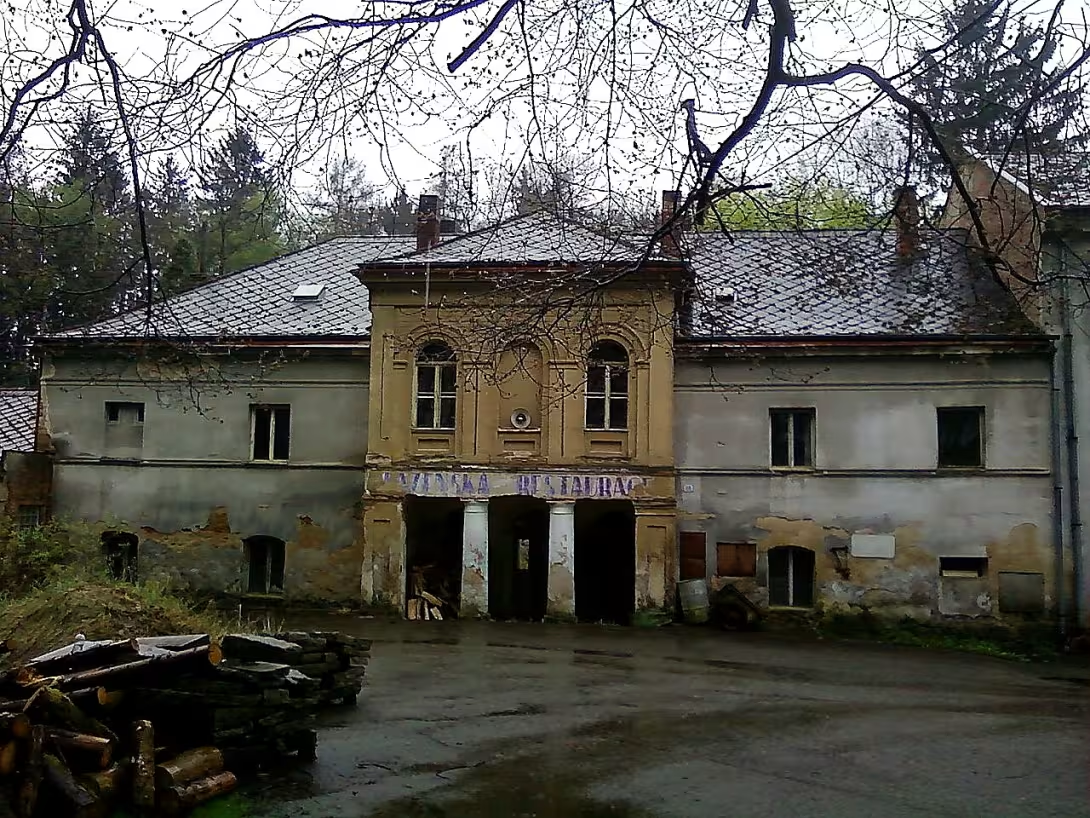
Lázně Petrkov, also known as St. John the Baptist Spa, is a Baroque area near the Spa Pond in the village of Petrkov in Havlíčkobrodsk. The building was created in 1731 after the discovery of the healing spring and for centuries it served for balneological purposes. Today it is privately owned and is in poor technical condition.
The beginning of the spa in this area dates back to 1729. According to the records, the monk Aloisius of the Augustinian monastery in German Broda, today Havlíček Broda, was searching for a source of relief from rheumatism. Originally he sought it in the well in the Church of the Finding of the Holy Cross, but was successful in the valley between the Holy Cross and Petrkov, where the water rose out of the mouth of the extinct mining stones. Successful treatment of the monk led to a lot of patients seeking the place.
The first Baroque-style spa building was built by Count Karel Josef II. z Palm-Guldenfingenu around 1731. The expert interest in the local water was confirmed in 1747 by the Czechoslovak physicist Rudolph Lodgmann von Auen, who carried out its first analysis. In 1775 the source was also dedicated to Johann Baptist Michael Edler von Sagar, the chief physician and epidemiologist of the Jihlava Region. In 1777, the buildings underwent an empirical reconstruction, the appearance of which was partially preserved in the northern part of the complex. The southern part was restored after the fire in 1890.
The property structure of the building has been varied over the centuries. After the count of Palm-Guldenfingen, the spa was owned by Eman Beránek, known as the first Czech circus. At the beginning of the 20th century the spa was in the administration of Karel Excellent and offered iron-iron steam treatments. During the reign of Marie Theresa, the area was probably a recovery facility for military officers, who were to be replaced by about 3,000. During the First World War, immigrants from Halich, after 1939 German soldiers and then the Red Army used the building. The last extensive repairs took place around 1930, when joint, skin and nervous diseases, opacity, gout and sciatica were treated.
After nationalization in 1948 the spa operation was completed. Only a restaurant that served as a cruise destination for Havlickov Brod continued to operate on the premises. After 1989, there were considerations about the construction of a medical sanatorium which were not implemented. In 2005, the owner of the buildings and land was then Minister of Agriculture Petr Zgarba, whose wife is the granddaughter of Karel Excellent. Currently, the Maria Zgarbova object belongs to the building and is in a dismal state, the owner is not interested in reconstruction.
Lázně Petrkov is an important reminder of the history of Czech spa and Baroque architecture of the region. Despite the current dilapidated condition, the complex is part of the Bohuslav Reynka Educational Path and offers the opportunity to explore the history of a place that once served thousands of people. Visiting the site is suitable for people interested in history who want to know the memory in its authentic, even devastated environment.
Then and now
Drag the slider to compare how the landmark may have looked when it was built with the view today.
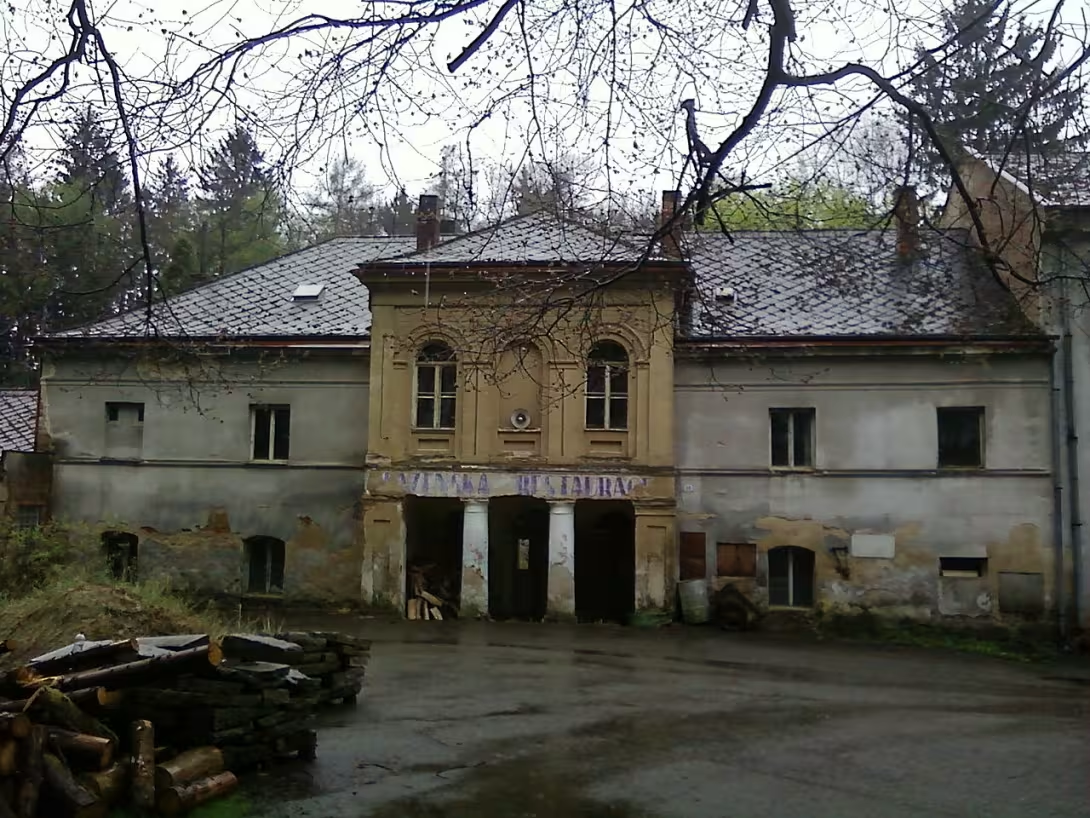

The historical appearance on the left is an AI-generated visualisation and serves as inspiration only.
Historical milestones
- 1729
- Monk Aloisius discovered a healing spring in the valley between the Holy Cross and Petrkov.
- 1731
- Count Karel Josef II. z Palm-Guldenfingenu built the first spa building.
- 1890
- The southern part of the spa complex burned down and was subsequently restored.
- 1948
- The spa was nationalized and their operation was definitively terminated.
Architectural development
The original Baroque building from 1731 was rebuilt in 1777 in the empirical style, while this resemblance was partially preserved in the northern part. The southern part of the complex was restored after the fire in 1890. The last major repairs took place around 1930.
Historical events
1729: The discovery of the healing spring by the monk Aloisiem. 1777: Building reconstruction in Empire spirit. 1948: Nationalisation and closure of spa facilities.
Owners
Count Karel Josef II. z Palm-Guldenfingenu (from 1731), Eman Beránek (around 1830), Karel Výborný (beginning of the 20th century), family Zgarb (present).
Points of interest
- The area was established in 1731 after a monk from the monastery in the then German Brod discovered a healing spring in the mouth of the extinct mining stones. - Around 1830 the spa was owned by Eman Beránek, who was known as the first Czech circus artist. - Under the rule of Marie Theresa, the area was probably a recovery facility for military officers and about 3,000 people were to be replaced. - At the beginning of the twentieth century the spa offered steam treatments using water containing sulphur and iron. - After nationalization in 1948, the spa operation was completed and only a restaurant for hikers continued to operate on the premises.
Guide
Show guide text
This text was created by artificial intelligence and has not been editorially reviewed. It may contain inaccuracies.
Welcome to Spa Petrkov, where history meets the calm of nature and where water once treated bodies and souls. You are standing in front of an area that has been the center of healing and social encounter for centuries. In front of you you can see a space that breathes through history and is closely connected to the surrounding landscape, especially the nearby Spa Pond. Stop for a moment, take a breath and feel the atmosphere of this place. Imagine how, centuries ago, people in period clothes came through here, how the noise of beds sounded, and how expectations of healing were carried through the air. To understand why these baths are here, we have to go back almost 300 years. It all began in 1729, when an unexpected discovery occurred in the valley between the Holy Cross and Petrkov. A monk named Aloisius, who came from a monastery in then-German Brod, came across a healing spring. This spring did not randomly emerge from the depths of the earth, but was found in the mouth of a degraded mining stol. At that time, faith in the healing power of water was very strong and such a discovery was not only seen as a natural matter, but almost as a gift from heaven. The report on the quality of water quickly spread and reached the ears of influential personalities. CZECH NOTE: It is thanks to this discovery and support of Count Karl Josef the second of Palm-Guldenfingen that the area you see today could have been created. In 1731 the Count had the first spa building built, thus laying the foundation for the development of the whole complex. The whole complex was designed in Baroque style, which was at the time a symbol of elegance, power and harmony. Now, if you look at the buildings in front of you, notice the overall layout and rhythm of the space. Although much has changed over time, the Baroque basis still determines the character of this place. Look at the facade of the buildings and see how architecture tries to fit into the surrounding landscape. Lázně Petrkov, also known as St. John the Baptist Spa, has gradually become a sought-after target. It wasn't just a place for the sick, but a real social salon. Over the centuries, there have been nobles, military officers and later the general public. The main reason for the visits was the treatment of rheumatism and other problems with the motion apparatus, which at that time were suffering many people. Imagine the discussions that were held here and the relationships that were made here. Among the names associated with this place appear personalities such as Rudolph Lodgmann von Auen, Johann Baptist Michael Edler von Sagar or Karel Výborný. Each of them has brought their own story to the history of these baths. Now let's think about the fate of the buildings that surround you. History is not always about blossoming, but about trials. In 1890, the southern part of the spa complex hit a tragedy in the form of a great fire. The fire destroyed a significant part of the compound, but the will to continue to operate was stronger than destruction. The southern part was subsequently restored, which shows how important these spas were to the region and to people who sought relief from their pain. Now I want to take you to one of the most fascinating characters that was related to the Petrkov Spa. Around 1830, the compound was taken by a man named Eman Beránek. You may have met this name in historical books because Eman Beránek was known as the first Czech circus artist. It is a truly unusual contrast that a man from the ranks of entertaining artists, used to noise, colour and dynamics of circus movement, owned the place of reserved peace, treatment and quiet regeneration. Perhaps this combination has brought a new kind of energy and access to the spa. Another interesting thing that remains in the archives as a probability is the connection to the monarch Maria Terezia. It is believed that during her reign, the area served as a recovery facility. This would mean that people from the highest levels of society who sought shelter from the duties of the court and wanted to regenerate their forces in the silence of nature. Imagine the luxury cars that came here and the care that was given to the health of the chosen at that time. But Lázně Petrkov was not just about luxury. It was a place where water from the depths of the earth became a bridge between different social layers. From the monk Aloisius, who discovered the spring, to the count, who built the walls, to the ordinary people who came here in hopes of healing. All these fates are embedded in the very foundations of this place. Unfortunately, every golden era has its end. For Lázně Petrkov came this moment in 1948. The site was nationalized in the course of the political changes at the time. With this act, the spa operation was definitively terminated. After over two centuries, a place that served as a centre of health and social life has lost its original function. The buildings were quiet and the spring that once attracted thousands of people stopped being the center of intensive care. Now, if you look around you, you may experience some sadness that the spa is no longer functioning in full power. But let's try another way. It is thanks to the fact that the traffic has ceased, that there has been some mystery and peace that is with us today. The area is no longer a noisy centre, but a silent witness to the past, which allows us to think calmly about how our view of health, architecture and society changed. Notice how the surrounding nature slowly returns to the buildings and how the pond still reflects the sky, just as it did at the time of the count of Palm-Guldenfingen. It's a place where you can feel the continuity of time. From the miner's gutter, from which the spring came, to the baroque glory, to Mr. Lamb's circus adventure, to the silence of the present day. Thank you for joining me on this short journey in time. Lázně Petrkov are more than just a set of buildings; It is a monument to human desire for health and beauty. Now I encourage you to take your own pace on the premises. Take a walk around the buildings, see the texture of the walls and try to imagine what interviews were held here two hundred years ago. Perhaps in silence you will hear echoes of the past or feel the same peace that visitors were looking for in the baroque times. I wish you a pleasant rest of the tour and hope the story of Spa Petrkov inspired you to further discover the beauty of our landscape. Goodbye.
Tips for visitors
The best time to visit is during the late spring or early autumn, when the surroundings of the Spa pond are colorful and quiet. In these months the light is softer and ideal for capturing baroque elements of the building without sharp shadows.
We recommend using our own means of transport or bike for the trip to the monument. The roads around Petrkova are suitable for cycling and hiking, allowing you to explore the picturesque landscape near the pond.
When shooting, focus on the detailed Baroque architecture of the building and its reflection on the surface of the Spa pond. The best lighting conditions for exterior images are in the morning when the sun illuminates the facade of the sights.
In the immediate vicinity you can visit the village Petrkov, see the church Finding the Holy Cross or going on the trail of Bohuslav Reynek's Educational Path. These places are great for a peaceful walk in nature.
For families with children, the location is suitable as a destination for a simple trip. Children can observe nature at the pond and learn the history of the region through the educational trail, which gives them a non-violent form of familiarity with local attractions.
Frequently asked questions
Can the monument be visited?
The building is in use (offices, a school, shops and the like). The interior is generally accessible only during operating hours and tours are not usually offered; we have not verified the details. You can see the exterior from the street. According to the heritage register the structure is in poor condition – do not enter it and take care nearby.
Where is the monument?
Location: Petrkov. The map on this page shows the exact spot.
Why is the monument protected?
It is listed in the Central List of Cultural Monuments of the Czech Republic as a cultural monument (register no. 1999995873).
Businesses nearby
Do you run a restaurant, accommodation, shop, museum, rental, wellness or other visitor service near this monument? Show yourself directly to the people heading to it — this is how they will see you in the app and on the web:
Nearby
Obec Petrkov, Svatý Kříž, kostel Nalezení sv. Kříže, trasa Naučné stezky Bohuslava Reynka.
Accommodation nearby
Themed route
Thematic cruise route around Spa Petrkov
1.Lázně Petrkov
Type: Historical spa
Why is worth a visit: This spa location offers a relaxing experience in a quiet natural environment. It is famous for its mineral springs and beautiful architecture that reflects the history of spa activities.
2. Holy Cross
Type: Historical site
Why is it worth a visit: This place is important for its history and connection with the legends of finding the Holy Cross. It offers a beautiful view of the surrounding countryside and is an ideal place for quiet moments.
3. Church Finding the Holy Cross
Type: Religious monument
Why is worth a visit: This church is an important architectural monument that attracts visitors with its historical and cultural value. It's a place of quiet prayer and beautiful footage.
4. Route of the Educational Trail Bohuslav Reynka
Type: Educative route
Why is it worth a visit: This route offers interesting information about the nature and history of the region. It is suitable for families with children who want to take advantage of the opportunity to increase their knowledge during a beautiful walk.
Order and distance:
- Start from Spa Petrkov where you can enjoy a relaxing start.
- From here we will look to the Holy Cross, which is approximately 5 km away and offers beautiful views of the surroundings.
- Then we will visit the Church of the Holy Cross, which lies about 3 km from the Holy Cross.
- We will entrust the route with a walk along the Bohuslav Reynka Trail, which is approximately 2 km from the church and offers beautiful experiences about nature.
This route allows you to experience the history, culture and nature of the area around the Spa Petrkov.
Seasonal recommendations
In the spring the surrounding area of the building flourishes and nature gains a fresh green color. The soft spring light highlights the details of the facade even if it is in bad condition. I recommend moisture-resistant shoes and a visit in the morning when the air is the cleanest.
The summer season brings dense greenery and intense sun, which creates sharp shadows on the walls of the object. The atmosphere is hot and calm. It is advisable to choose light clothes and hat, taking the best time to walk around the sights is late afternoon.
In autumn, the landscape is covered with yellow and red, which gives the place a melancholy touch. Frequent fog may highlight the mystery of a neglected building. Practical is to wear a waterproof jacket and head out to the golden hour before sunset.
In winter, the monument is strenuous and lonely, especially if a layer of snow covers it. The contrast of the white landscape and grey walls creates a strange, freezing mood. Don't forget to wear warm gloves and layered clothes, and plan to arrive around noon to give you enough daylight.
Visualizations and artistic views


The visualisations are generated by artificial intelligence and serve as inspiration.
Photos from the area
Real photos taken near the monument

Zdroj a licence jsou uvedeny u každého snímku.
Tips from visitors
No tips yet. Be the first!
Log in and add your tip.
Sources and literature
Photos: Freibo / CC BY-SA 3.0 — Wikimedia Commons. The author and licence also appear when you hover over the image.
Faktickým podkladem tohoto textu byl článek na Wikipedii, jehož autory jsou přispěvatelé Wikipedie. Článek je dostupný pod licencí CC BY-SA 4.0.
Location on the map


Příběhy a pověsti
Legendy, pověsti a příběhy spjaté s touto památkou

Fotografie návštěvníků
Zatím žádné fotografie. Buďte první, kdo přidá fotografii z návštěvy!
Log in a přidejte svou fotografii nebo hodnoťte.
Za ověřenou návštěvu v aplikaci získáte víc bodů — poznáme podle GPS, že jste na místě.
Reviews and comments