



malá vodní elektrárna Hučák Power plant
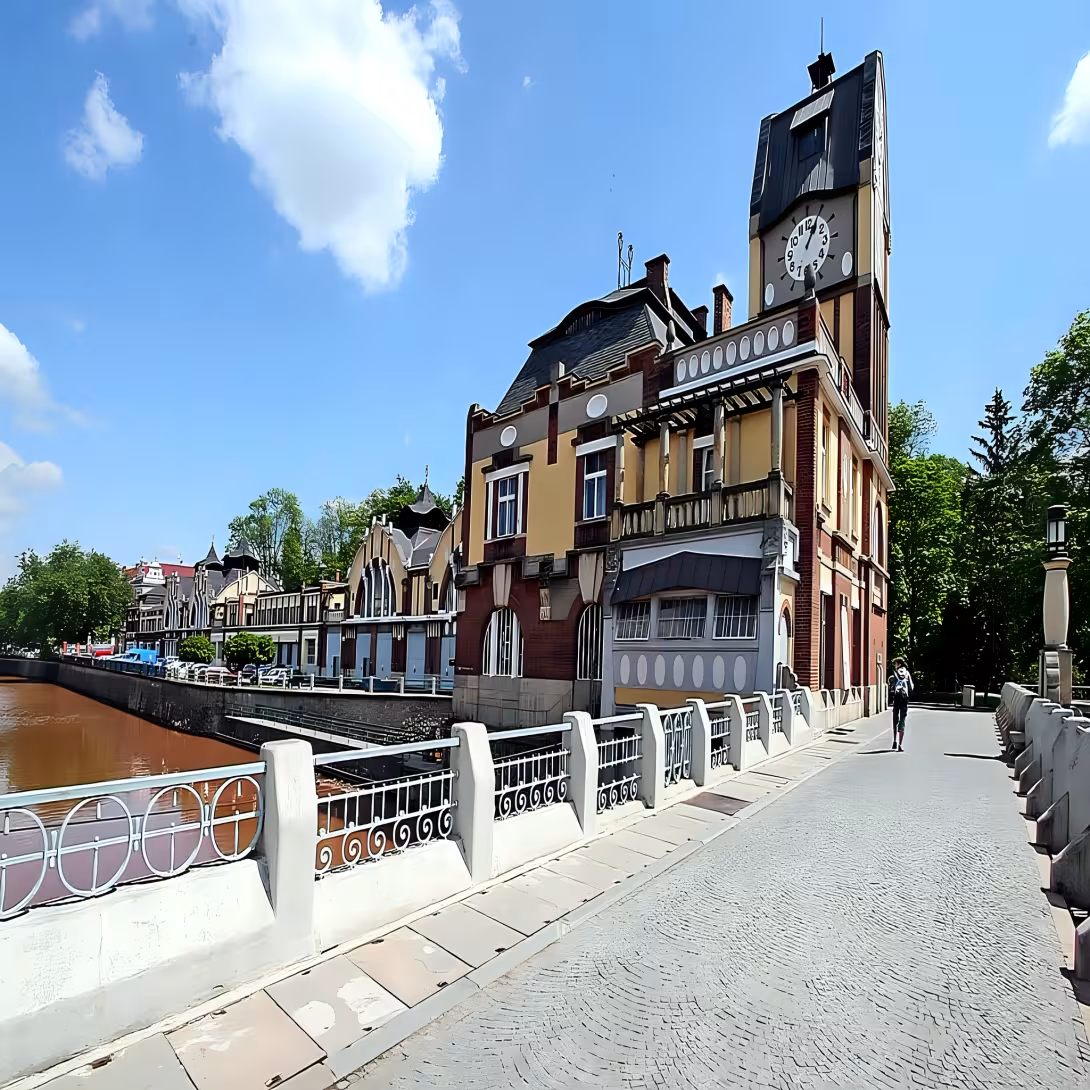
The small hydroelectric power plant Hučák is a Art Nouveau work in Hradec Králové which was put into operation in 1912. The building uniquely combines technical equipment with Art Nouveau architecture. Together with the adjacent ride, it forms an important architectural unit on the Elbe River.
The building was awarded by the City Council on 12 May 1908. The project was developed by Prof. ing. Karel Novák, Director of Prague Electric Enterprises. The Elbe flow rate varies between 3,5 and 360 m ³ / s The Novák therefore assumed the need for a steam reserve to cover consumption in times of extreme water or flow minima. This led to a decision to build a steam power plant and an electrically powered water plant before the old Jez Hučák was destroyed.
The concrete foundation began in the spring of 1909. The steam section had two boilers with an excess pressure of 11.5 atmosphere and two steam engines with 400 horsepower. They were connected to the Crusader's generators. Křižík also supplied 14 transformers and 12 kilometres of cable lines. The hydroelectric power plant itself was established on the left bank of the river on the 157th river kilometre. In 1911, under the leadership of Ing. František Jirásek and Prof. Arch. Sandera was built a concrete bridge with segmental ride.
The building was designed by the architect František Sander in Art Nouveau style. Later operating buildings were dealt with in the spirit of early modernity. The whole building serves as an example of the architectural mastery of the technical work from the period before the First World War. In the 1990s, the construction and bridge underwent sensitive reconstruction under the supervision of historical care. The original Art Nouveau decoration, ornaments and colour were restored. Replica lights were installed on the bridge on decorative stone columns.
The connection to the city network took place on 12 February 1910. That's when the arch lamps on the Grand Square were lit up. The hydrocentrale with three Francis three-stage turbines was completed in 1911 and permanently supplied energy from the end of January 1912. In 1912, the power plant was extended by a steam turbine with 1500 horsepower output. Thanks to the voltage 5000 V Hradec Králové at that time he technically exceeded Prague, which had a voltage of 3000 V.
In 1925, the first major reconstruction took place due to operational deficiencies and losses. The original three-stage turbines were replaced by three single-stage fast-moving Francis turbines of 270 kW output by the Elektrotechnical Joint Stock Company (formerly Kolben and Prague). These devices are still in operation today along with the original generators.
After 1945, the power plant was nationalized and managed by the national company VCE from 1 January 1946. The steam traction supplied the last electricity on January 5, 1946 and in 1956 the boilers and steam engines were dismantled. By 1995, the Elbe plant also provided the operation of the hydropower plant in Orlica. In 1996, the current ceremonial lighting consisting of 139 lamps was mentioned.
Currently, the building is owned by ČEZ Renewable Resources. In addition to its technical function, the building hosts the Information Centre Renewable Resources. Part of the technology for high voltage transmission was supplied by Power-Energo, s.r.o.
The monument represents a rare combination of industrial heritage and aesthetics of Art Nouveau. Its visit offers insight into the technological expansion of the early 20th century combined with unique architecture.
Then and now
Drag the slider to compare how the landmark may have looked when it was built with the view today.
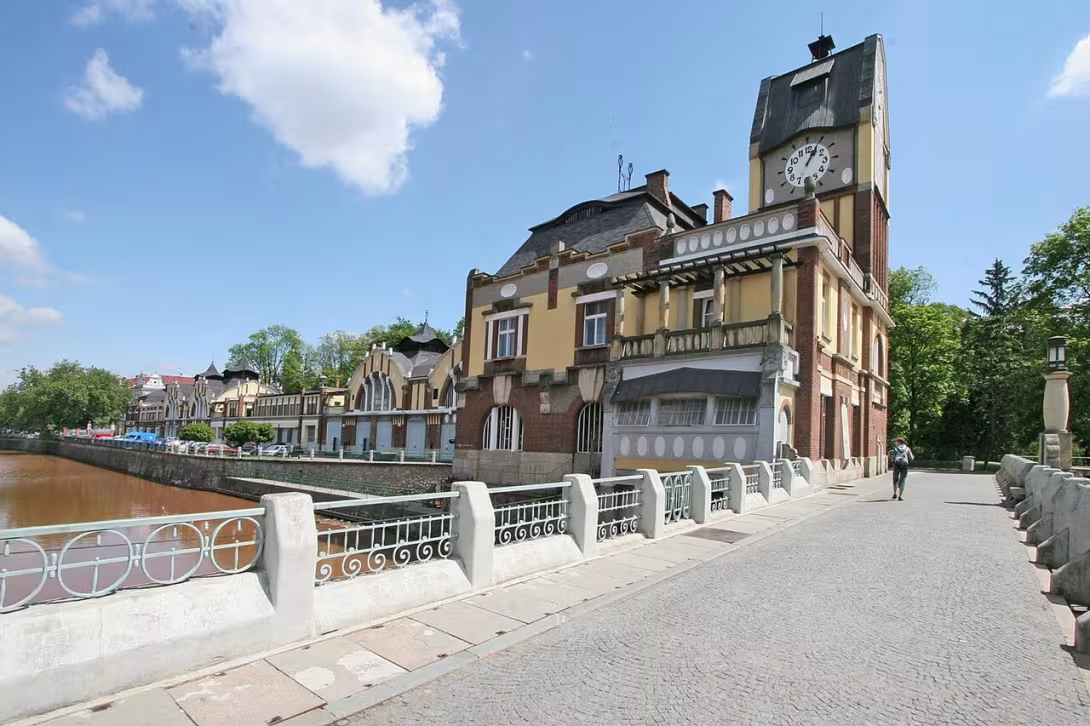
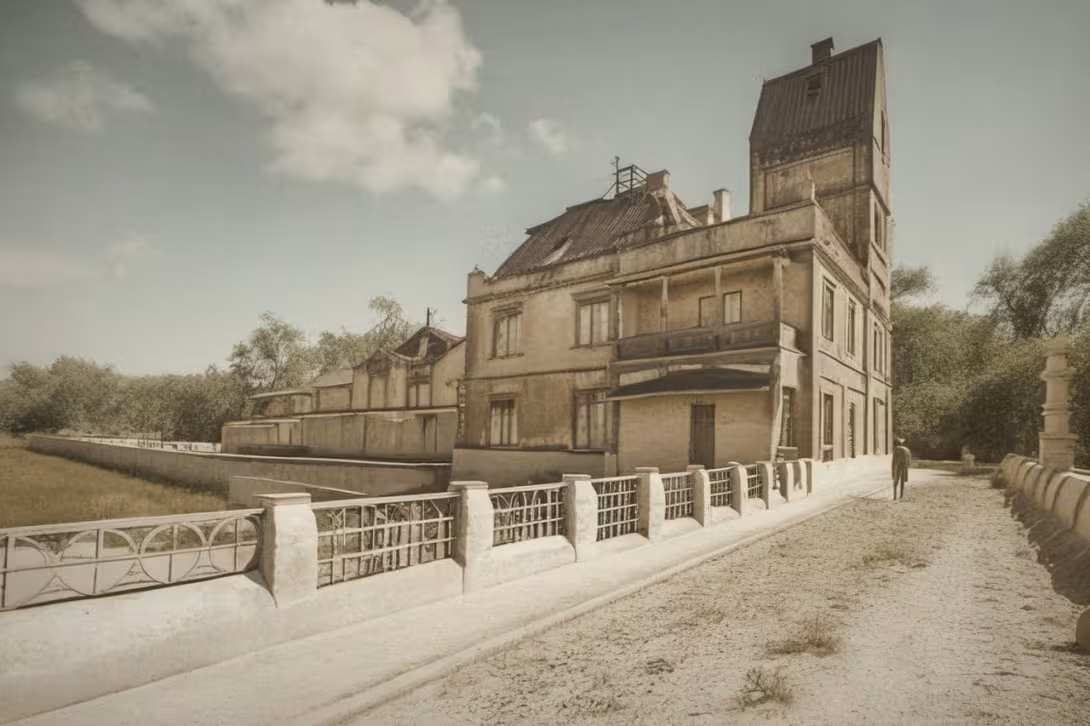
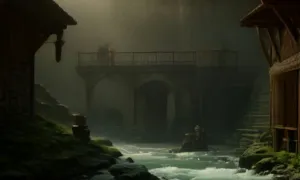
The historical appearance on the left is an AI-generated visualisation and serves as inspiration only.
Historical milestones
- 1908
- City award Hradec Králové
- 1909
- Opening of the concrete bases
- 1910
- Connecting to the city's network and lighting of the Cross Arc Lamp
- 1912
- Permanent entry into service of hydroconcentration
- 1925
- Exchange of original turbines
Architectural development
The building was built in Art Nouveau style according to František Sander's design. The operating buildings were later completed in the spirit of early modernity. In 1911, a concrete bridge was built with segmental ride.
Historical events
In 1908 the city gave up construction. There was a connection to the city network in 1910. In 1912 the hydroconcentration was put into permanent operation. The turbines were replaced in 1925.
Owners
ČEZ Renewable Resources
Points of interest
- It's an Art Nouveau piece from 1912 that connects technical equipment with architecture. - Thanks to the voltage 5000 V city Hradec Králové at that time technically exceeded Prague. - In 1910, arc lamps were lit on the Grand Square. - Some of the equipment from the first major reconstruction from 1925 is still in operation today. - In addition to the technical function, the building hosts an information centre on renewables.
Guide
Show guide text
This text was created by artificial intelligence and has not been editorially reviewed. It may contain inaccuracies.
Welcome to Hradec Kralove. Right now, you're standing in front of one of the city's most prominent technical gems. In front of you is the malá vodní elektrárna Hučák. If you look at her, you'll see how closely she's connected to the adjacent ride on the Elbe River. Together, this object forms a very strong and harmonious entity that dominates the landscape with its presence. Feel the atmosphere of this place where the power of flowing water meets human wit and aesthetic care for details. Now let's go back a little bit in time to understand why this building is so special. It all started in the year one thousand nine hundred eight, when the city of Hradec Králové officially gave up construction. At that time, it was a bold step towards modernization. A year later, in the year of the thousand and nine hundred nineteenth, the concrete foundation began. The whole process lasted several years and the construction was completed in the year thousand nine hundred and twelve. The main brain of the project was the architect František Sander, who collaborated with František Jirásek. Together with Karl Novák, they made sure that the power plant was not just a technical operation but a real work of art. Now pay attention to the appearance of the building itself. If you look at the facade and the overall shape of the object, you will notice that it is a unique work in Art Nouveau style. The Art Nouveau was at the height of modern times and its aim was to bring beauty to every aspect of life, even as practical as electricity generation. See how the technical equipment connects to the architecture. It is a fascinating connection where machines are not hidden in a simple box, but are wrapped in an elegant cloak that honours its time. It is this style that makes Hunk a monument that is unique in our region. When we talk about the people who created this place, we can't forget the names of Sander and Jirásek. Their vision was to create space that would serve the city, but at the same time will be the pride of its people. In its beginnings, the power plant was equipped with steam engines and used generators from famous Křižík. That was the top of the line at the time. Imagine the enthusiasm that must have been in the people when, in the year thousand and nine hundred and ten, the arc lamps in the Grand Square first lit up. It was the first steps to stop the city from controlling the cloud and the darkness, and the electric light was on. And that brings us to one really interesting thing that might surprise you. At the time of its creation Hradec Králové was technically very advanced thanks to this power plant. The voltage generated here was worth 5,000 volts. That was so high that at that time Hradec Králové technically exceeded even Prague. Imagine that, a small provincial city run by the capital of the state in energy. This shows the ambitions of the councilmen and the genius of architects and engineers. The permanent entry into service of the hydroconcentration in the year thousand and nine hundred and twelve then definitively confirmed its importance. Of course, time was changing and the technique went forward. In the year of the thousand and nine hundred twenty-five there was a major reconstruction in which the original turbines were replaced. What is fascinating, however, is that some of the facilities from this first major reconstruction are still preserved in the building today. It's like opening a history book where every component tells its own story about how our idea of energy and efficiency changed. Today, Hucka is no longer merely a technical object. It has become a building with a new function because it now houses an information centre. It is a place where you can learn more about the history of the city and about the water work itself. It is a beautiful example of how a historical monument can be preserved while giving it a new meaning to serve new generations of visitors. Now, if you look again at the building and the Elbe River current, try to imagine the noise of the turbines and the sense of pride that people must have had over a century ago. You stand before the symbol of progress, courage and aesthetics. It's not just about the concrete and the wires, it's about the human dream to transform the power of nature into a benefit for thousands of people. Now we invite you to explore the space around the power plant and the poison at your own pace. Walk along the water, feel the rhythm of the river and enjoy a moment of silence before continuing to discover the other beauty of Hradec Kralove. We hope this short trip to history has helped you better understand the value of this Art Nouveau unique. Thank you for your attention and wish you a pleasant continued journey through the city.
Tips for visitors
The best time to visit is late spring or autumn, when the colors of nature around the Elbe River are the most distinctive and the stream of water in the Jeze Hukák seems very dynamic. This can be reached by car or public transport; Check the actual traffic options in the current search engines.
To visit we recommend taking comfortable shoes suitable for walking along water and camera. Since it is a unique Art Nouveau construction, we recommend paying attention to details of the facade and architectural elements designed by František Sander.
For the best photos we recommend to arrive at morning or late afternoon light, when the sun gently illuminates the building of the power plant and is reflected in the lake surface. The bank of the Elbe River is the ideal place for images, from where you can see the whole complex of the construction.
With children, it is worth focusing on the observation of water flowing in the Hucka Jeze and the joint search for Art Nouveau ornaments on the building. A tour of the building along the Elbe River and at Lake Hučák is possible in the immediate vicinity.
Frequently asked questions
Can the monument be visited?
The building is in use (offices, a school, shops and the like). The interior is generally accessible only during operating hours and tours are not usually offered; we have not verified the details. You can see the exterior from the street.
Where is the monument?
Location: Hradec Králové. The map on this page shows the exact spot.
Why is the monument protected?
It is listed in the Central List of Cultural Monuments of the Czech Republic as a cultural monument (register no. 1000146628).
Businesses nearby
Do you run a restaurant, accommodation, shop, museum, rental, wellness or other visitor service near this monument? Show yourself directly to the people heading to it — this is how they will see you in the app and on the web:
Nearby
Řeka Labe a jezo Hučák.
Accommodation nearby
Themed route
Here is the design of the cruise route:
1. Lake Hunk (water surface) - Ideal place to start walking and watching water mirrors. 2. Small hydroelectric power plant Hučák (water works) - The main destination of the trip, where you can see the technical equipment for producing energy from water. 3. River Elbe (water flow) - The road along the shore offers a peaceful walk in nature next to the power station.
Seasonal recommendations
In the spring, the surroundings of the water works awaken to life and the greenery around the river begin to rise deeply. The air is fresh, and the water gets stronger after the snow melts. We recommend moisture-resistant shoes and a visit in the morning when light is fine and nature is the most colorful.
Summer brings hot days and bright suns that mirror on the water surface. The atmosphere is relaxed, typical of the main holiday. It is advisable to choose a light summer dress and cap. The best time for a walk is the late afternoon when the sun no longer burns so strongly and the water is pleasant cold.
In autumn, the landscape around the monument is colored in golden and brown tones, creating a melancholy mood. Fog over the river can give the place mystery. It's practical to carry a waterproof jacket and tight shoes on a damp surface. It is ideal to visit a place on a bright October day when the colour of the leaves is the most distinctive.
In winter, the landscape is dominated by a freezing calm and a possible layer of snow that calms the surroundings. The lighting is gray and the days are short, which creates a rough, industrial impression. Hot clothes, clothing layering and quality winter shoes are essential. We recommend a visit at noon when there is the most daylight.
Visualizations and artistic views


The visualisations are generated by artificial intelligence and serve as inspiration.
Photos from the area
Real photos taken near the monument


Zdroj a licence jsou uvedeny u každého snímku.
Tips from visitors
No tips yet. Be the first!
Log in and add your tip.
Sources and literature
Photos: Prazak / CC BY 2.5, rozlišení zvýšeno umělou inteligencí — Wikimedia Commons. The author and licence also appear when you hover over the image.
Faktickým podkladem tohoto textu byl článek na Wikipedii, jehož autory jsou přispěvatelé Wikipedie. Článek je dostupný pod licencí CC BY-SA 4.0.
Location on the map
More monuments – Hradec Králové
Show all in the municipality
Příběhy a pověsti
Legendy, pověsti a příběhy spjaté s touto památkou
Fotografie návštěvníků
Zatím žádné fotografie. Buďte první, kdo přidá fotografii z návštěvy!
Log in a přidejte svou fotografii nebo hodnoťte.
Za ověřenou návštěvu v aplikaci získáte víc bodů — poznáme podle GPS, že jste na místě.
Reviews and comments