



Malé Kolo Housing estate

Malé Kolo, also known as Lower Wheel, is a extinct medieval fortress and prehistoric settlement in the cadastral territory of Nalžovická Podstaje near the village Nalžovice. It lies above the mouth of a nameless stream into the water tank Slapa, opposite Cholin, and is protected as a cultural monument. Its importance lies in a combination of medieval fortress and archaeologically important Neolithic settlement, which represents the most eastern known settlement of the Champ culture in Bohemia.
The fort was probably created in the 13th century as a guard building over the Vltava. The medieval residence was built in a strategically important place, which controlled crossings across the river and the stream. According to historical sources, during the Hussite wars, many similar objects in the region were destroyed. In 1950, archaeological research revealed traces of prehistoric eneolithic settlement dating back to the period of Champ culture. Seven to eight rectangular residential buildings were found here, slightly deep into stale rock floors.
The preserved hardness is 26 × 28 meters. On the east, south and west side, a moat was preserved 11 metres wide with an outside wall. The central hill exceeds the bottom of the ditch by three and a half meters. On its south side there is a small wall with an interruption which corresponds to the entry position. In the southeast corner there is a deepening which is the rest of one of the buildings.
The location is freely accessible, but there is no tarmac road. It is located in a dense forest, which makes orientation difficult. Yet it offers a unique combination of historical layers - from prehistoric settlement to medieval fortress. For lovers of archeology and medieval history, Malé Kolo is an interesting place to document the long-term settlement of this territory. Its importance lies in architectural relics and archaeological findings that illuminate life in the eneolithic and early Middle Ages.
Historical milestones
- 13th century
- Status of the fort as a guard building over the Vltava.
- 15th century
- The destruction of the fortress during the Hussite wars.
- 1950
- Archaeological research led by Libuš Jansa revealed an ancient estate of eneolite.
Architectural development
The preserved fortress has dimensions of 26 × 28 metres with moat and bead on the east, south and west side. The central hill is 3.5 metres higher than the bottom of the ditch. According to other sources, the fortress had dimensions of 30-40 meters with a moat up to 12 metres wide and 7 metres deep. There was probably also a prehistoric fortification, which was destroyed by medieval modifications.
Historical events
- The position of the fort probably in the 13th century as a guard building over the Vltava.
- The destruction of the fortress during the Hussite wars.
- Archaeological research in 1950 revealed a primordial estate of eneolite.
Points of interest
- Vanished medieval fortress and ancient estate from the eneolite, which represents the most eastern known settlement of the Champ culture in Bohemia.
The fort was probably created in the 13th century as a guard building over the Vltava.
- She died during the Hussite wars, as well as other similar objects around.
- Archaeological research from 1950 revealed primordial traces of eneolite under the fortress, including seven to pluck rectangular residential buildings.
- The preserved fortress has dimensions of 26 × 28 metres with a moat of 11 metres wide and a central hill exceeding the bottom by three and a half metres.
Guide
Show guide text
This text was created by artificial intelligence and has not been editorially reviewed. It may contain inaccuracies.
Welcome to Little Wheel
You are standing in front of a place that connects two ages - a medieval fortress and the secret of prehistoric settlement. Before you, there is a fortress with a preserved moat and a boulder that captures the past as fingerprints. Look around you - here, where nature is decomposing today, once stood a fortress that guarded the rivers of the Vltava. And even deeper in the past, the houses of the people of eneolithic, whose rectangular buildings were discovered by archaeologists in the 1950s.
Let's take a closer look. The fortress, which people also called Lower Wheel, was probably created in the 13th century. It was built as a guard point that protected an important waterway. By the time the Czechs were changing, when the battles were taking place and the troops were fighting, this fortress was destroyed. Like many other similar places around here, she disappeared during the Hussite wars that changed the face of our country.
Now pay attention to what you see before you. In front of you lies the fort - the place where the fort stood. Notice the trench and the wall that are still visible to this day. These elements are proof that there was ever a fortress here. The ditch served as protection, and the wall was like a natural barrier that prevented the enemy from accessing. These elements are protected as a cultural monument because they are unique evidence of the past.
Archaeological research from the 1950s revealed that thousands of years ago, there was a primordial estate of eneolite. There were discovered rectangular residential buildings that show that people lived and worked here. This is fascinating because this settlement is the easternmost known settlement of the Champ culture in Bohemia. So there is a place before you that connects two important chapters of our history.
Let's see something more interesting. This is a place full of mysteries and secrets. How did it happen that there was a fortress and there were people from the eneolite? What were their lives and how were they different from those of the medieval guards? These questions give the place a special charm. Archaeologists have found traces here that help us partially discover these mysteries, but many remain unknown.
One of the greatest attractions of this place is that it represents the most eastern known settlement of the Champ culture in Bohemia. Cham culture is one of the most important cultures of prehistoric times in our region. The people of this culture fed on agriculture and livestock, and their housing was often well organized. Here at Little Wheel, we managed to find their clues that help us better understand their way of life.
Imagine what it must have been like to have a fortress standing here. What sounds were there - the noise of fighting, the call of guards, the noise of the Vltava. And before that, when people from the eneolite lived here - what it must have been like to hear - the noise of nature, the sounds of work, the singing. These two ages meet here and create a unique atmosphere.
Now imagine what it was like when the Hussite wars were going on. What it must have been like to see this fortress disappear and how life in this area has changed. These events are proof of how difficult the times were and how much our landscape and culture evolved.
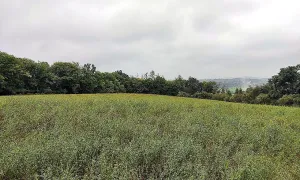
Let's see what you see here today. In front of you is nature that stretches over the mouth of a nameless stream into the water tank of Slapa. That's another interesting thing - this is where water and countries meet, and it's been a long time. The water was and is an important part of the life of the people who lived here.
In conclusion, I want to tell you that this place is unique. It's a place that connects two ages - the Middle Ages and prehistoric times. It's a place full of mysteries and secrets. And it's a place worth looking at and realizing how rich and colorful our history is.
If you like this place, you can take another tour. Nalžovice and its surroundings offer many other interesting places worth seeing. Whether you go to the water tank of Slapa or look at other historical monuments, you will be sure to discover other pieces of our history.
Thank you for coming. May you enjoy our past and may you enjoy the atmosphere of this place. When you look at us again, we will look forward to your visit.
Tips for visitors
The best time to visit Little Wheel is in spring or autumn when nature is green and light soft. In summer there are often more visitors, while in winter access can be restricted due to snow or frozen roads. It is recommended to visit the site early in the morning or in the evening when the light is ideal for photography and there is a quieter atmosphere.
Mild weather and pleasant light create the best conditions for viewing and taking photos.
It is recommended to arrive by car because public transport does not directly lead here.
The location is best accessible by car, public transport is necessary to combine.
When visiting, wear a comfortable shoe because the terrain is mostly forest and uneven. I also recommend you take a map or GPS because orientation in the forest can be difficult. If you are planning to photograph, take a macro lens, because you will find interesting details from the past.
You count on forest terrain and the possibility of taking pictures of details.
Photography is allowed, but it is necessary to ensure respect for nature and monuments. The best places for photos are the terraces of the fortress and surrounding the nameless stream, where natural light is ideal. It is recommended to photograph in the morning or evening light when the shadows are softer and the colours are more vivid.
Focus on the terraces and the surroundings of the creek, avoid direct sun.
In the vicinity of Malý Kola is worth visiting the town of Cholín, which lies right opposite the other side of Vltava. Here you will find the historical core with the church of St. Nicholas and other interesting monuments. The water tank Slapy is also an interesting location where you can see the water work used to regulate the river flow.
Choline and water tank Slapy are the closest attractions.
For families with children it is ideal to visit Malé Kolo in combination with a walk around the water tank Slapy. Children can look at nature and perhaps even watch water birds. In Cholín, children will then find room for movement and the opportunity to explore the historic city centre. It is recommended to take with you some activity such as drawing or painting so that children can capture their impressions from the visit.
The combination of nature and historical center is ideal for children.
Frequently asked questions
Can the monument be visited?
This is a structure in a public space that can usually be seen from outside free of charge. We have not verified that this particular one is freely accessible.
Where is the monument?
Location: Nalžovice, Středočeský kraj. The map on this page shows the exact spot.
Why is the monument protected?
It is listed in the Central List of Cultural Monuments of the Czech Republic as a cultural monument (register no. 1000132540).
Businesses nearby
Do you run a restaurant, accommodation, shop, museum, rental, wellness or other visitor service near this monument? Show yourself directly to the people heading to it — this is how they will see you in the app and on the web:
Nearby
Vodní nádrž Slapy
přesně naproti, na druhém břehu Vltavy
Vodní dílo sloužící k regulaci toku Vltavy a zásobování vodou.
Cholín
přesně naproti, na druhém břehu Vltavy
Město s historickým jádrem a památkami, včetně kostela sv. Mikuláše.
Lokalita je porostlá lesem, volně přístupná, ale bez vyasfaltované cesty.
Accommodation nearby
Themed route
Thematic cruise route to Little Kol and Nalžovice surroundings
1.Malé Kolo (fortress) - Nalžovice Type: Historical fortress overlooking Vltava, symbol of the region. It is interesting from a historical point of view because it served as a protection and administrative centre in the past. Today it is open freely, but without asphalt. Walking around offers a beautiful panorama over the water works.
2. Water tank Slappy - direct bank Type: Water control with significant influence on the Vltava flow. Interesting for lovers of nature and water sports. The surrounding area is forest, ideal for a short walk or picnic.
3. Choline - second bank of Vltava Type: Old town with rich history. The church of St. Nicholas, which is one of the oldest monuments in the area, is significant. Walk on the historical core is pleasant for exploring local traditions.
Route in practice: From Little Bike we will walk on the forest edge of the Water Tank Slapy (about 1 km). Then we cross the bridge to Cholin (about 5 km). We're going back down the same path, taking advantage of the views from the fortress and the water works. Total distance of approximately 7 km, ideal for daily trip.
Seasonal recommendations
Spring There is a strange atmosphere on Little Kol during the flowering of nature, when green leaves become light and shadow. In the morning there are still no large groups of visitors, so it is possible to enjoy quiet moments during the tour of the ruins. It is convenient to wear light but durable long-sleeved clothes to protect against sudden changes in weather. The best time to visit is in the morning when the temperature is pleasant and nature is still full of life. Since spring is a period of flowers and green fields, it is ideal to come here at a time when there is still plenty of sunshine, but there is not too much heat.
---
Summer In the main summer season Malé Kolo is full of life but also crowds. For a better experience it is advisable to come up with a timely time to avoid crowded places. It is recommended to wear light but durable clothes that are easily dried out, and suitable sunglasses. Due to high temperatures, it is good to bring water and light snacks. The atmosphere is warm and friendly, but larger groups of tourists need to be counted, so it is appropriate to plan a visit so that it will be given enough time to explore without stress.
---
Autumn In the autumn period, there is a special feeling of peace and quiet on Little Kol. Leaves begin to turn yellow and become light that illuminates ruins. It is suitable for clothing that protects against cold wind weather, but also allows movement. The best time to visit is in the morning when it is even slightly warmer. The atmosphere is quiet and friendly, ideal for those looking for peace and rest. Since autumn is a period of mild temperatures, it is advisable to prepare even a light slice or umbrella for possible rain.
--- Winter In winter Malé Kolo is less visited, but the atmosphere here is magical. The ruins are surrounded by white snow and sunlight, reflected from snow. It is recommended to dress in warm, multi-layer clothing that protects against cold. The best time to visit is when the snow cover is stable but not too strong. The atmosphere is quiet and romantic, ideal for those who want to experience quiet moments. Due to the shorter opening time, it is advisable to plan your visit in advance.
Visualizations and artistic views


The visualisations are generated by artificial intelligence and serve as inspiration.
Photos from the area
Real photos taken near the monument

Zdroj a licence jsou uvedeny u každého snímku.
Tips from visitors
No tips yet. Be the first!
Log in and add your tip.
Sources and literature
Faktickým podkladem tohoto textu byl článek na Wikipedii, jehož autory jsou přispěvatelé Wikipedie. Článek je dostupný pod licencí CC BY-SA 4.0.
Location on the map




Příběhy a pověsti
Legendy, pověsti a příběhy spjaté s touto památkou
Fotografie návštěvníků
Zatím žádné fotografie. Buďte první, kdo přidá fotografii z návštěvy!
Log in a přidejte svou fotografii nebo hodnoťte.
Za ověřenou návštěvu v aplikaci získáte víc bodů — poznáme podle GPS, že jste na místě.
Reviews and comments