

Mariánský sloup (Mohelnice) Marian column
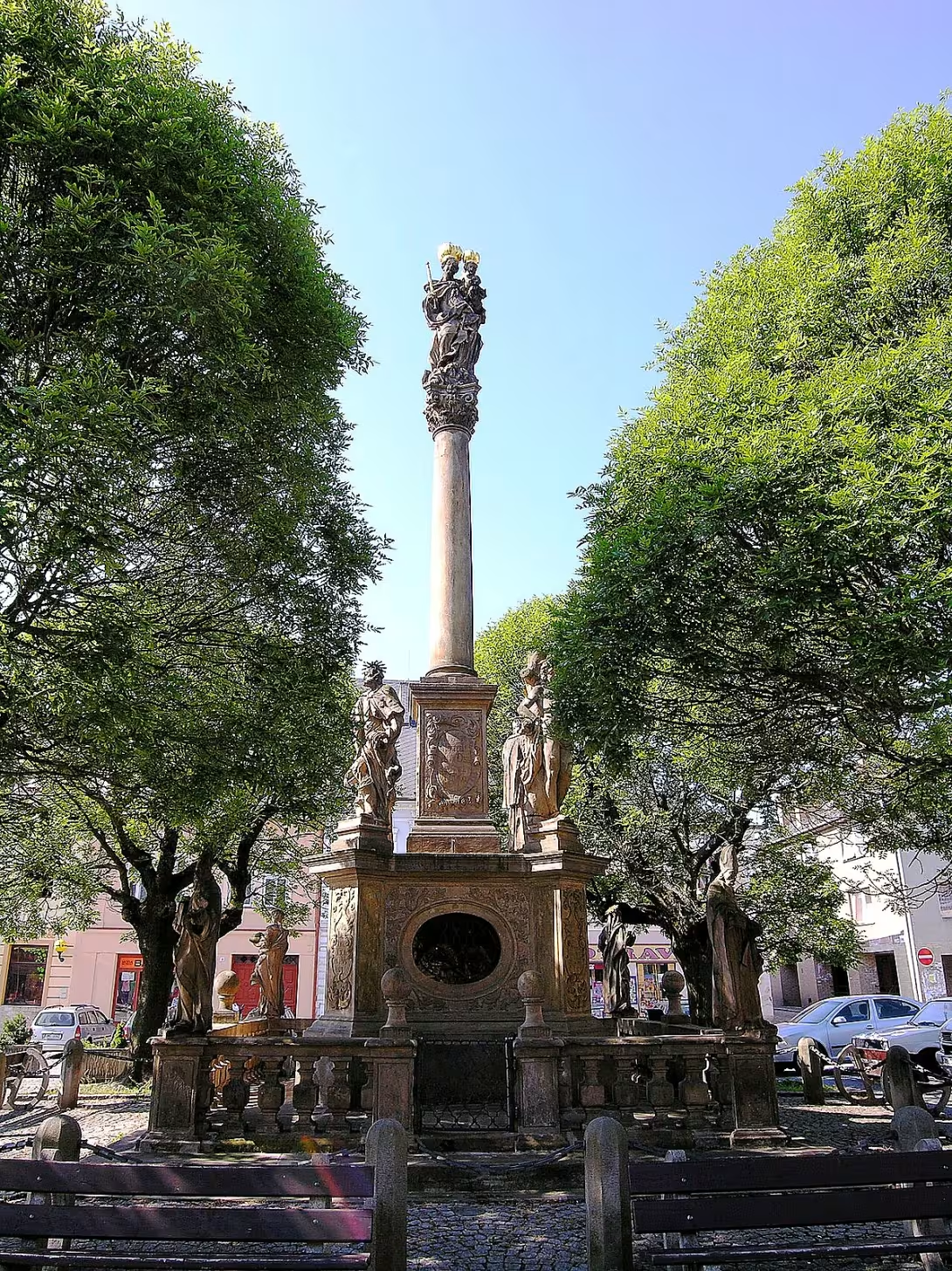
The Mariánské pole in Mohelnice on Svoboda Square is a Baroque monument in Corinthian style, built in 1717 in memory of the victims of the plague epidemic from the turn of 1714-1715. Since 1958, this work from the Maletian sandstone has been historically protected.
The last great plague epidemic in Czech countries took place in 1713-1715. The disease arrived through Austria from Hungary first to Bohemia and in 1714 it spread to Moravia. Mohelnice was hit by the plague in August 1714. This situation has led to the isolation of the city and the closure of public buildings including the church. The supply options were significantly reduced and markets were moved from the square to Olomouc Street on the outskirts of the city. To avoid famine, the Bishop of Olomouc ordered supplies of grain and firewood from the castle of Peace. The epidemic dropped in 1715, but left 263 dead, representing almost a fifth of the population of Mohelnice.
As a protection against possible future plague and as an expression of thanks for the disappearance of the epidemic, the city's representatives decided to reach out to Olomouc sculptor Jan Václav Strumer requesting the creation of a pestilence dedicated to the Virgin Mary. The artist accepted the offer for the price of 1700 gold pieces and finished the work in 1717. In the context of religious gratitude for the survival of these disasters, similar Baroque sculptures were created in many cities at that time.
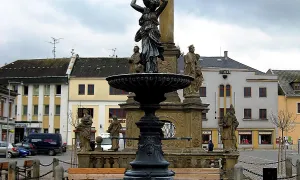
This monument reaches a height of 13 metres and is made of Maletian sandstone. On a pole finished with a Corinthian head, there is a statue of a Madonna of a life-size size that holds Jesus on his left hand. The whole building is based on a pedestal located on a massive cubic bed. On the south wall of the pedestal is depicted a consecutively lit bishop with the emblem of the Olomouc Archbishop, from which also the emblem Mohelnice is derived. The national pillars of the footbridge are set with statues of the patrons Rocha, Šebestian, František Xaversky and Karel Boromejský. The specifics of the Mohelan Marian pole are the cave carved into a footstool. There is a statue of St. Rosalie, considered a defender against the plague on the basis of a legend giving her credit for ending the plague epidemic in Palermo after burying her remains in the city. The surrounding area of the column is bounded by a square balustard, in whose corners it stands on the pillars of the statues of Saint Augustine, Ambrose, Anna and Pavlina. The course of the epidemic in the city is documented by the German inscription of the former speedster and chronicler A. L. Kellera carved into the north wall of the footstool.
In the vicinity of the monument on its eastern side there is a 4.8 meter high cast iron fountain, which is also protected by the monument. At present, this building, registered to the list of monuments of 1958, is freely accessible as a dominant feature of the Central Mohelnik Square.
This historical monument represents a valuable display of baroque art, while serving as a permanent reminder of the tragic events of the early 18th century. A visit to Freedom Square in Mohelnice offers a unique opportunity to look at this detailed sculpture up close.
Then and now
Drag the slider to compare how the landmark may have looked when it was built with the view today.
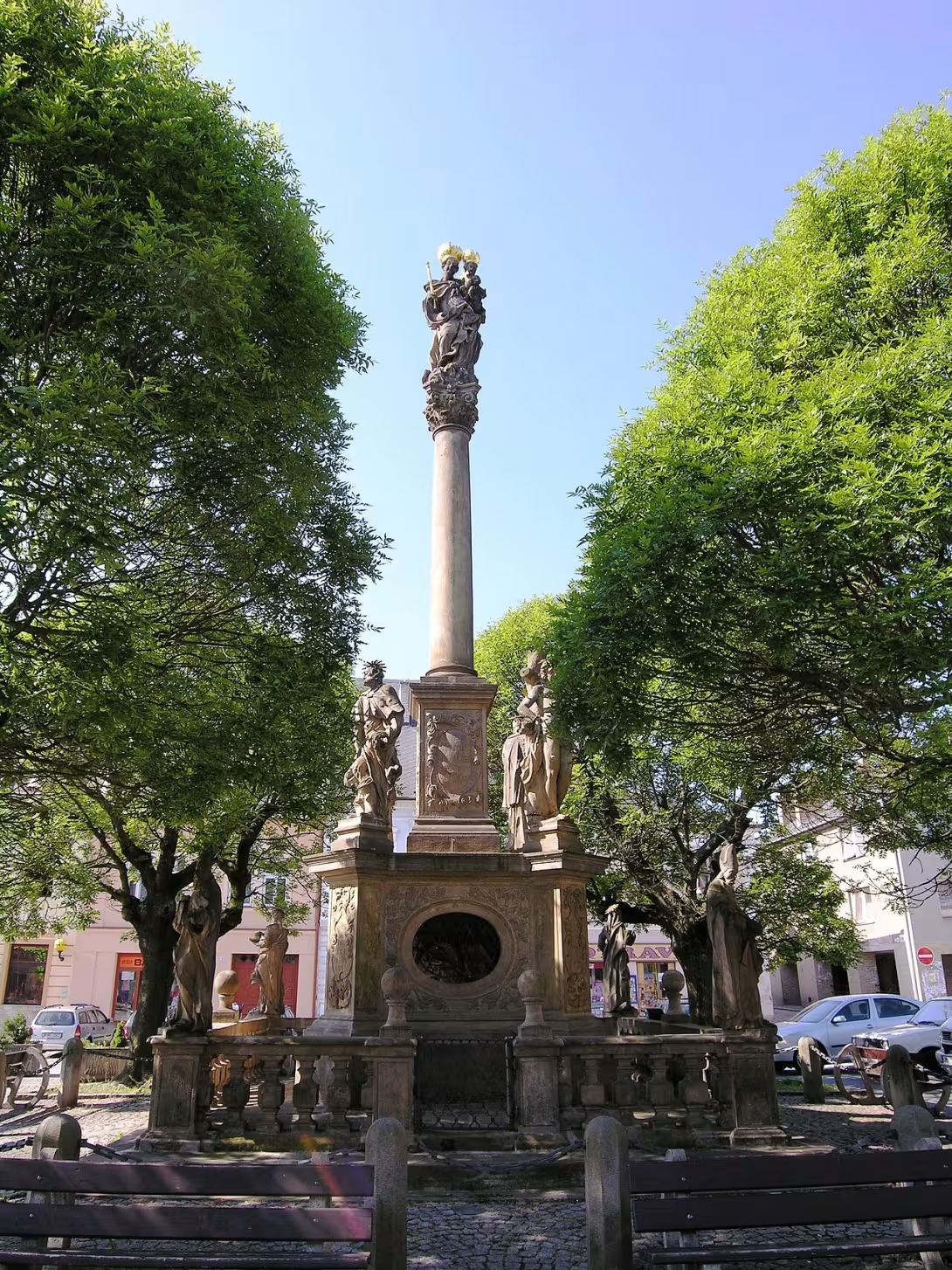
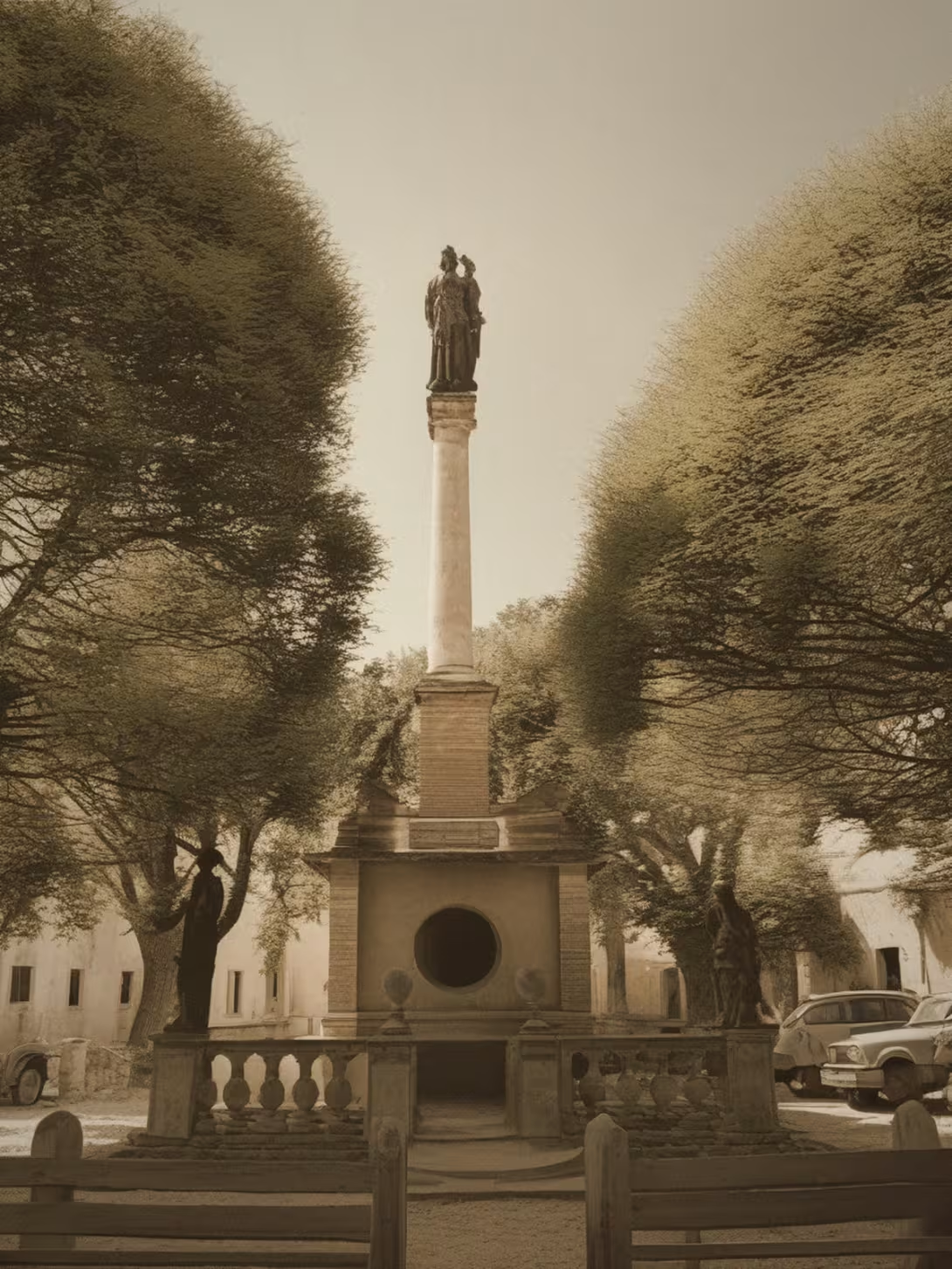
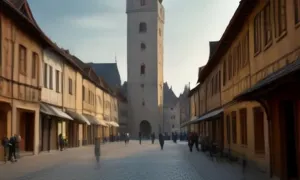
The historical appearance on the left is an AI-generated visualisation and serves as inspiration only.
Historical milestones
- 1717
- Completion of the construction of the Marian column by Olomouc sculptor Jan Václav Strumer.
- 1958
- The column was declared a protected monument object.
Architectural development
A pole of 13 metres high was made of Malatine sandstone in Baroque style with Corinthian head. The construction includes a massive cubic footstool, a pedestal and surrounding a square balustrad with pillars. The inscription of the former speedster A. L. Kellera is carved into the north wall of the footstool.
Historical events
1714-1715: The plague epidemic in Mohelnice, which caused 263 victims. 1717: Completion of the construction of the Marian pillar.
Points of interest
- The Marian pillar in Mohelnica is a Baroque monument in Corinthian style built in 1717 in memory of the victims of the plague epidemic from the turn of 1714 to 1715. - This work from the Maletian sandstone has been protected historically since 1958 and reaches a height of 13 meters. - On the column stands the statue of Madonna in supremacy with Jesus on his left hand, with the corner pillars of the footstool bearing the statues of the patrons of Rocha, Shebestian, František Xaversky and Karl Boromei. - The specifics of this column are the cave carved into the footstool, in which is the statue of St. Rosalie. - A German inscription of the former speedster and chronicler documenting the outbreak in the city is carved into the north wall of the footbridge.
Guide
This guide is narrated by a synthetic voice generated by artificial intelligence.
Show guide text
This text was created by artificial intelligence and has not been editorially reviewed. It may contain inaccuracies.
Welcome to Mohelnice. Right now, you're standing in the heart of this city, in Freedom Square, and before your eyes, there is a monumental pillar that is an inherent part of this place. This Marian column immediately captures your view with its height and impressive presence. If you look at it, you'll probably feel the special weight of history floating in this space. It is a work that dominates the entire square and serves as a silent witness for many years that the city of Mohelnice has experienced.
Now let's go back in time together and understand why this column came into being. Imagine the period around 1714 and 1715. These were very dark and difficult years for the people of this city. There was a plague epidemic, a disease that was completely unknown to people at the time, and it was very scary. This disease was extremely devastating and affected almost a fifth of the population of Mohelnic. The city was in great pain at the time, and the losses were so deep that people felt completely helpless.
But when the danger finally died out and the clouds spread over the city again, people wanted to express their deep gratitude for saving their home. Just as a token of this gratitude and a reminder of those who left in those difficult years, this Marian pillar was built in 1717. So it is not just an ordinary stone pillar, but above all a symbol of hope and survival, which reminds us of how much people valued their lives and their safety.
Now pay attention to the piece itself and take a closer look. This whole sculpture is performed in Baroque style, which is known for its richness and dynamism. Note how the whole building is processed in Corinthians style. This means that in its details you can see fine and rich decorating, which gives the whole design elegance and grandeur. This whole monument reaches a height of 13 meters, which makes it a truly impressive structure that stands high above you.
If you look at the material from which the column is made, you will see its specific texture and color. The whole piece is carved out of a Maletian sandstone. This stone is very important to this area and it is he who gives the whole monument its unique appearance, which changes according to how light hits it. If you raise your eyes higher, you will see the most important center of the column. On top of it stands the statue of Madonna, who thrones over all and has Jesus in her arms. It's a look that's supposed to create a sense of peace and spiritual protection. Around the Madonna, there are other statues that represent different patrons. These figures complement the overall meaning of the column and create rich and rich stories carved into stone.
A man named Jan Václav Strumer is behind this masterpiece. He was an important sculptor from nearby Olomouc who completed the construction of this pillar in 1717. His work in the Maltese sandstone required not only great skill, but also a deep understanding of art to capture the fineness of human figures and complexity of Corinthians details in such solid material. Strumer's talent is evident in this monument for hundreds of years that have passed since its completion.
It's interesting how this object has survived centuries and how important it has remained for the locals and for all of us. Its value was so high that already in 1958 this column was officially declared a monument protected object. This means that he looks after him as an indispensable piece of our common heritage, which we must preserve for future generations.
Now if you look at the whole column again, try to see not only what is carved, but also the invisible force of gratitude that caused it. It is a fascinating combination of art, faith and the human spirit that stands in the middle of the square and reminds us that even after the darkest times, light and a new beginning can come.
I hope this view of the Marian column helped you better understand its meaning and beauty. Please continue to walk around Mohelnice and pay attention to other details of this beautiful city. Every alley and every monument here has its own story waiting to be discovered. Thank you for your journey and I wish you a pleasant continuation in exploring the surroundings.
Tips for visitors
The best time to visit the baroque Marian column at Liberty Square in Mohelnice is early morning or morning. In these hours, the sunlight illuminates the eastern side of the monument and the adjacent historical cast iron fountain, creating ideal conditions for the acquisition of detailed photographs of sculpture decoration.
When photographing the column, it is worth focusing the lens also towards the east side, where there is a monument-protected cast iron fountain reaching a respectable height of four and a half meters. The combination of these two historical elements in a single shot offers an extraordinary view of the old building of the square.
Since the monument is located in free urban space and is viewed from the outside, it is convenient to take with you comfortable shoes for a walk along the pavement of the square, umbrella in case of variable weather and camera or smart phone with good resolution to capture baroque details from a thousand seven hundred seventeen.
You can tell the children a story about how people built this monument as a thank you for the hard times of the plague epidemic, and show them a tall cast-iron fountain standing right back.
Frequently asked questions
Can the monument be visited?
This is a structure in a public space that can usually be seen from outside free of charge. We have not verified that this particular one is freely accessible.
Where is the monument?
Location: Mohelnice. The map on this page shows the exact spot.
Why is the monument protected?
It is listed in the Central List of Cultural Monuments of the Czech Republic as a cultural monument (register no. 1000130631).
Businesses nearby
Do you run a restaurant, accommodation, shop, museum, rental, wellness or other visitor service near this monument? Show yourself directly to the people heading to it — this is how they will see you in the app and on the web:
Events nearby
Zdroj akcí: otevřená data měst a obcí ČR (Národní katalog otevřených dat) a kalendář akcí Národního památkového ústavu.
Nearby
🏰 Historic sites (112)
- Panna Maria 0.1 km
- Muzeum Mohelnice 0.1 km
- Panna Maria Neposkvrněná 0.2 km
- sv. Jan Nepomucký 0.5 km
- Kryštof Alois Lautner 0.8 km
- Madona 2.5 km web
- Žárové pohřebiště 3.3 km
- Žádlovice 3.4 km
- Památník Adolfa Kašpara v Lošticích 3.4 km web
- Muzeum Olomouckých tvarůžků A. W. 3.5 km web
- památník padlým v 1. a 2. světové válce 3.6 km
- Líšnice 4.5 km
- Vlastička Seidlová 5.1 km
- Nejsvětější Trojice 5.2 km web
- Pieta 5.3 km web
- sv. Jan Nepomucký 5.5 km
- Mírov 5.6 km
- Panna Maria Bolestná 5.7 km
- Hradiště Obersko 6.0 km
- Sv. Jan Křtitel 6.0 km
🍽️ Restaurants and dining (123)
- Kavárna U Kašny 0.0 km
- Za starých časů 0.1 km
- Kafe 3 0.1 km
- Božolé 0.1 km
- U Cechmistra 0.1 km
- kavarna a cukrarna 0.1 km
- Hradební restaurace 0.1 km
- Escobar 0.3 km
- Brusův šenk 0.3 km web
- U Pechů 0.4 km
- Rychlé občerstvení Trucker 1.7 km Družstevní 84/11
- Hospůdka u Čápa 2.3 km
- Na Pešti 3.0 km
- u Coufalů 3.5 km nám. Míru 62/9 web
- U Lišky Bystroušky 3.6 km nám. Míru 54/13
- U rytíře 3.6 km nám. Míru 115/2
- G-Bar 3.7 km
- Restaurace na růžku 3.8 km Olomoucká 146/26
- Sirkárna 4.0 km Jevíčská 260/8
- Restaurace u Třebůvky 4.0 km
🏨 Accommodation (30)
- MoravaCamp 1.0 km +420 775 111 721 web
- Vila Háj 3.2 km
- u Coufalů 3.6 km web
- Ubytovna 3.9 km Hradská 107/21 602 165 046 web
- Střelnice 4.2 km web
- Vodácké tábořiště Tydra 4.7 km +420 775 766 767 web
- Tábořiště Tydra 6.0 km
- Světnička v podhradí 8.2 km web
- Hotel Bouzov 8.3 km
- Valáškův grunt 9.1 km +420 585 346 312 web
- Old Mill Glamp 9.4 km Kozov 8 +46722244244 web
- Na Hřišti 9.9 km
- Romeo 10.5 km
- Rekreační areál Motýlek 10.6 km web
- Rodinný penzion Sobáčov 11.8 km
- Chata Jeskyňka 11.8 km
- Hotel Amco Zábřeh 12.2 km Masarykovo náměstí 43/3
- U Kováře 12.3 km web
- Penzion Tučňák 12.3 km
- Penzion NOVÁ VES 12.6 km
🚲 Rentals and sport (14)
- Bikesport Mohelnice 0.1 km web
- Sportisimo 1.1 km
- Půjčovna lodí Samba s.r.o. 2.8 km
- Skatepark 4.3 km
- SK Loštice 1923 4.5 km web
- Sportisimo 11.4 km
- Plavecký areál Zábřeh 11.7 km
- DENALI SPORT 11.9 km Československé armády 651/9
- Tenisová hala 12.4 km
- Severka 12.5 km
- TJ Postřelmov 13.6 km web
- Rakola 14.1 km +420 585 342 398
- Prosport 14.2 km Palackého 882/3 605 232 893 web
- Městský bazén Uničov 14.4 km Nemocniční 1420
🥾 Hiking and nature (158)
- parčík spartakiádní 0.8 km
- Městský park 1.1 km
- Vítejte v Lošticích 3.3 km
- Malovaný podchod 4.1 km
- Kamenná 4.2 km
- Jelení vrch 4.5 km
- Líšnická tvrz 4.5 km
- Starozámecký pramen 4.5 km
- Hrušky 4.6 km
- Vraní kopec 5.1 km
- Žernůvka 5.3 km
- Bradlec 5.3 km
- Uhliska 5.5 km
- Studničná 5.8 km
- Vyšehorský vrch 6.0 km
- Dubická vodárna 6.8 km
- Hliníky 7.0 km
- Hekelův kopec 7.1 km
- Mlýnský vrch 7.2 km
- Studánka zemřelých 7.2 km
Accommodation nearby
Themed route
Here is a proposal for a short thematic walk:
1. Marian Column (memorial) - The main point of the visit, which represents an important religious and historical element in the centre of the village. 2. Cast iron fountain (technical monument) - It's right next to the pole on its east side. It is interesting with its considerable height of nearly five metres and its protected state.
Seasonal recommendations
In spring, the surroundings are awakening to life and the fresh green creates a fresh contrast to the surface of the monument. Light is soft in this period, which is ideal for observing the details of statues. We recommend shoes suitable for wet terrain and visit in the morning when the air is the cleanest.
In the summer months, the clear sun and hot air dominates the space, which often creates a dream atmosphere. The column is best seen on a bright day, but due to intense heat it is advisable to choose the time early in the morning or late in the evening. Remember light clothes and sun protection.
Autumn brings golden colors to the city with leaves and a specific, passing light that gives the monument a melancholy touch. The atmosphere is quieter and less busy than in the season. Due to the changing weather, it is prudent to bring a waterproof coat or a warm sweater.
Zimą monument appears in a completely different light, especially if it is covered by a layer of snow and frost. The lighting is short and cold during this period, which highlights the vertical line of the column. It is necessary to have warm winter clothes, gloves and tight shoes against slippiness for a comfortable outdoor tour.
Visualizations and artistic views


The visualisations are generated by artificial intelligence and serve as inspiration.
Photos from the area
Real photos taken near the monument


Zdroj a licence jsou uvedeny u každého snímku.
Tips from visitors
No tips yet. Be the first!
Log in and add your tip.
Sources and literature
Photos: Lehotsky / CC BY-SA 3.0 — Wikimedia Commons. The author and licence also appear when you hover over the image.
Faktickým podkladem tohoto textu byl článek na Wikipedii, jehož autory jsou přispěvatelé Wikipedie. Článek je dostupný pod licencí CC BY-SA 4.0.
Location on the map
Příběhy a pověsti
Legendy, pověsti a příběhy spjaté s touto památkou
Fotografie návštěvníků
Přidat fotografiiZatím žádné fotografie. Buďte první, kdo přidá fotografii z návštěvy!
Máte k místu vzpomínku nebo zajímavý příběh?
Log in a přidejte svou fotografii nebo hodnoťte.
Za ověřenou návštěvu v aplikaci získáte víc bodů — poznáme podle GPS, že jste na místě.
Reviews and comments