



mariánský sloup v Rakovníku Marian column
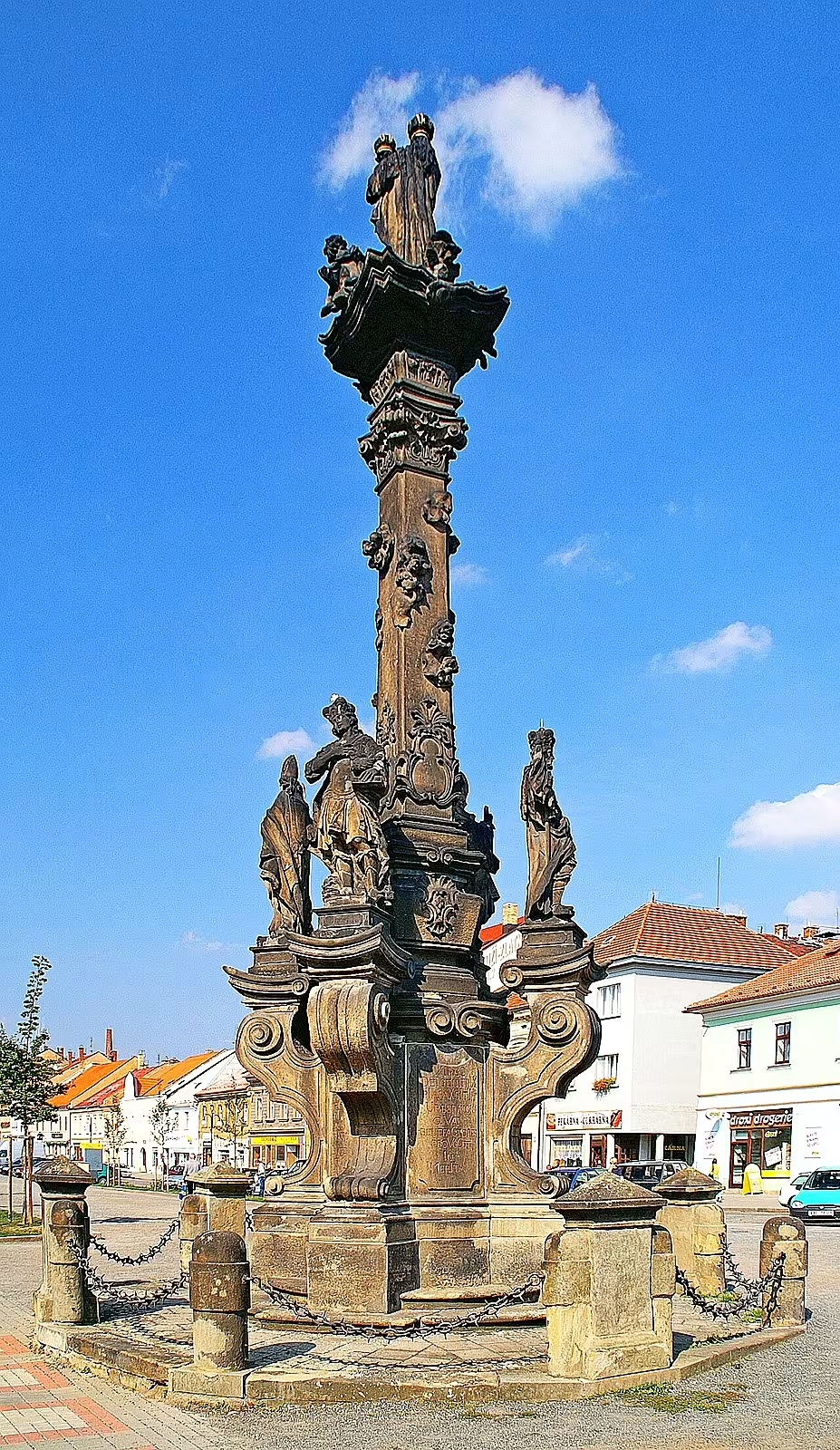
The Marian column in Rakovník is a Baroque monument located in the eastern part of central Hus Square. It is a cultural monument of the Czech Republic and was built in 1749 by the stonemason master Christopher Knopf according to the drawing of Václav Ettle as a spiritual support for pilgrims headed to Pribram on St. Horus. Its importance lies in the architectural beauty and historical context of the Baroque period, which was characteristic of the development of pilgrimage.
The creation of the column is closely linked to the spiritual life of the 18th century in the Czech countries, when Baroque architecture and religion reached their peak. The column was part of the pilgrimage route leading to the Holy Mountain near Příbrami, which underlines its importance for the spiritual life of the area and served as a place of prayer and refuge for pilgrims.
Architecturally, the Marian column is made of New Hradian sandstone, which gives it both robustness and aesthetic value. The total height is 12 metres and is decorated with statues of saints: St. Wenceslas, St. Vitus, St. Prokop and St. Vojtěch, which originally stood on the stone railing around the pillar. After a tragic event in 1829, when one of the statues was torn down and this led to the death of the child by the neighbor Kalíková, the statues were moved to the volt brackets of the pedestal. The column ends with stylized clouds with angels and heads carrying the Virgin Mary with Jesus.
The column underwent dramatic changes, especially after the tragedy in 1829. This event led to the relocation of sculptures and the replacement of stone railing by the pavements connected by chains, affecting its visual impression and safety. Although the specific ownership and management of the column are not fully documented, it is known that it was protected as a cultural monument.
The key event in the history of the column was the relocation of statues in 1829. This tragedy not only changed the aesthetic of the column, but also highlighted its spiritual and community importance when the city tried to cope with this sad incident. Today, the Marian pillar in the centre of Rakovnik is accessible to visitors and remains an important monument that reflects the rich spiritual traditions of the region.
Today, mariánský sloup v Rakovníku is not only a historical monument, but also a living witness to the past and present cultural heritage. Its architecture and history attract visitors from all over the world who want to learn more about the Baroque period and pilgrimage traditions. Visiting this column offers a unique view of the history and spiritual life of the Cancer Man, which makes it an essential destination for every interested Czech culture. The Marian column in Rakovnik is therefore more than just a monument - it is a combination of the past and the present, which is worth visiting.
Historical milestones
- 1749
- construction of the column by the stone master Christopher Knopf according to the drawing of Václav Ettle
- 1829
- moving statues of saints from railing to pedestal brackets
Architectural development
The construction is made from a Neo-hrad sandstone in Baroque style. Originally, the statues of the saints were placed on a stone railing around the pillar. In 1829, the railings were replaced by pavements connected by chains and the statues were moved to the volt brackets of the pedestal.
Historical events
In 1829, an unfortunate event occurred when one of the statues was torn down by a neighbor, resulting in the death of her child and the subsequent transfer of the statues to a higher position.
Points of interest
- Mariánské pole in Rakovník is a Baroque monument built in 1749 by the stony master Christopher Knopf according to the drawing of Václav Ettle. - The column was built as a spiritual support for pilgrims headed to Pribram on St. Horus and is part of the cultural monument of the Czech Republic. - Architecturally, the column is made of Newshod sandstone, decorated with statues of saints and ended with the Virgin Mary and Jesus. - There was a tragedy in 1829 when one of the statues was torn down, which led to the death of the child and the subsequent transfer of the statues to the volute brackets of the pedestal. - The column underwent changes in visual impression and security after the tragedy, when the stone railing was replaced by the pavements connected by chains.
Guide
Show guide text
This text was created by artificial intelligence and has not been editorially reviewed. It may contain inaccuracies.
Welcome to Cancer. Right now, you're standing in a place where time has stopped and the history of the city is in its entirety. Look before you, right at you is this noble and majestic baroque column that dominates the eastern part of Hus Square. It's the first thing that catches your eye when you move in this center. Feel the atmosphere, feel the weight of history that radiates from every stone. This monument is not just an ordinary work of sculpture, it is a symbol of faith, strength and artistic championship, which has been standing here for centuries and watching the city in its constant movement.
Let us now go back together deep into the past to understand why this pillar was created in the first place and how important it was for the people who lived here before us. Imagine 1749. The world was different then, full of deep spiritual sensations and constant paths. This Baroque column was not just built as an ornament of the square or as an important point in the landscape. He had a deeper, very sensitive message. He served as a spiritual support, as a place of stopping and prayer for all those pilgrims who set out on a long and difficult journey towards Pribrama to visit Holy Mountain. Imagine those tired people coming here after a long day of wandering, to Rakovnik, and this column was an excellent sign to them that they were on the right path, that they were safe and that they could rest for a while and seek inner peace before further effort. It was a point where the earthly journey was linked to the desire for the heavenly one.
Now pay attention to the architecture itself and the details that are right in front of your eyes. If you look at the material from which the column is made, you will see its specific texture and color. This whole building is carved out of Neo-hrad sandstone. This stone gives him his unmistakable appearance and at the same time gives him the necessary resistance to face all the weather effects for hundreds of years. Look up and watch as this stone structure sticks to the sky. It reaches a height of 12 metres, which makes it a very important and high element in this urban area. If you lift your gaze even higher, to the very top, you will see the most important. The whole column culminates in the resemblance of the Virgin Mary, which gently holds Jesus in her arms. It is this painting that spiritually closes the whole building and gives it its sacred character.
Note also the characters that complement this monument. There are statues of four saints around the column. These characters add a human dimension to the whole piece and create a rich scene that you can see from different angles. Each character has its own expression and its own role in this spiritual narrative. It is fascinating to see how the Baroque style manifests itself in these shapes and in the overall dynamics of the whole building.
But in order to understand how this work was created, we must mention the people behind it. All this successful and permanent work was the master of the stoneware Kryštof Knopf. He was a man with an incredible feeling for material who could make such fine and lively shapes out of hard sandstone. His work was carried out according to the careful drawing of Václav Ettle. Ettle was an architect who invented this whole complex structure, designed its proportions, and determined how the column should work on anyone who faces it. The union of these two men - the visionary he designed, and the master who breathed life in the stone - created this unique baroque work that we so admire today.
I have one more interesting thing for you that will help you better understand what you're seeing and why it looks like this. You may think everything is in its place, but history was a little different. In 1829, there was a significant change in how the column is composed. The statues of these four saints were not originally placed where you see them now. In front of him, they were placed on the railing. Later they were moved to the brackets of the pedestal, i.e. to the rising parts that form the basic part of the column. This change in the layout of the statues changed the overall composition of the monument and probably how people around it moved and perceived it. It is proof that even such solid stone monuments go through certain changes in time.
This Marian column is not just an ordinary stone in space. It is a protected cultural monument of the Czech Republic, which means that it is our common treasure that we must keep honestly for all future generations. It is a witness to the ancient faith, the artistic rise and history of our city.
I hope that this short journey over time has helped you better understand this piece of Cancer's history and that you enjoyed the sight of this masterpiece. But you can now go free for another tour of the city. Explore other corners, enjoy the atmosphere of the surrounding streets and get carried away by the beauty of this place. Thank you for your attention and I wish you the beautiful rest of your day.
Tips for visitors
The best time to visit the Marian pillar in Rakovník is autumn or spring, when the weather is quieter and fewer people are in the centre. This period also offers beautiful lighting conditions for photography, especially in the morning or in the evening when the sun illuminates the pillar in a special way.
For a comfortable journey we recommend the use of public transport, which allows easy access to the center and Hus Square. Current connection options can be found using an online search engine.
When visiting a Marian column, it is advisable to bring a camera or a mobile phone for a photo, because the column is a beautiful subject of entertainment. It is also important to carry protective clothing and footwear suitable for a corridor of concrete downtown.
For families with children, the Marian column is an interesting historical object, which can be part of a walk around the center of Rakovnik. The surrounding area can be visited by Hus Square with its other monuments and architecturally interesting buildings, which can be useful for educational travel.
Frequently asked questions
Can the monument be visited?
This is a structure in a public space that can usually be seen from outside free of charge. We have not verified that this particular one is freely accessible.
Where is the monument?
Location: Rakovník I, Středočeský kraj. The map on this page shows the exact spot.
Why is the monument protected?
It is listed in the Central List of Cultural Monuments of the Czech Republic as a cultural monument (register no. 1000124303).
Businesses nearby
Do you run a restaurant, accommodation, shop, museum, rental, wellness or other visitor service near this monument? Show yourself directly to the people heading to it — this is how they will see you in the app and on the web:
Nearby
Husovo náměstí v Rakovníku
Accommodation nearby
Themed route
Thematic cruise route from Cancer
1. Place of start: Husovo Square - Type: Public area, historical city centre. - Why is it worth a visit: Husovo Square is the heart of Cancer and offers beautiful overview of the Old Town architecture. It is an ideal place for understanding the historical development of the city, where there is also a beautiful town hall with a Gothic tower chimney.
2. Main Objective: Marian Column - Type: Memorial. - Why is it worth a visit: The Marian Column is one of the most famous and best-known Baroque monuments in the Czech Republic. Its impressive architecture and rich sculpture details attract many visitors who learn about history and spiritual importance.
3. Next way: Old Town Square - Type: Historical Square. - Why is it worth a visit: After exploring the Marian Column, we will look at the Old Town Square, where there are other historical monuments such as the Church of St. James and Town Hall. The square is the centre of local culture and history.
4. Cultural stop: Church of St. James - Type: Church building. - Why it is worth a visit: This Gothic church is not only an important cultural memory but also provides a view of the history of the city and its architectural development. Its interior contains rich artistic elements.
5. Final stop: Town Hall - Type: Historical building. - Why is it worth a visit: We will visit the city hall with its important Gothic tower chimney, which is a symbol of the city. It's a place full of history and beauty where you can enjoy the view of the whole square.
This route offers a way through the historical center of Rakovnik, where each stop is a reminder of the rich past and architectural art.
Seasonal recommendations
Spring
The spring visit to the Marian column in Rakovník offers a unique view of the rebuilding nature when flowering trees and bushes colour the surrounding area with vivid colours. Sunlight creates a beautiful contrast to the historical monument. Although the first visitors are beginning to appear, you can still expect a mild crowd and enjoy a peaceful walk. It is recommended to wear suitable clothes for temporary weather with the possibility to add a layer because temperatures can be varied. The best time to visit is in the early afternoon period when the sun lights up the column while avoiding the strongest heat.
Summer
In summer mariánský sloup v Rakovníku offers visitors an exciting atmosphere full of life and warmth. Sunshine lights decorate the monument while the surrounding nature is at the peak of its beauty. In the main summer season you can expect a high number of visitors, especially for earlier times when people are trying to avoid the hottest hours. It is advisable to prepare warm clothes and enough water to relieve the summer heat. The best time to visit is in the morning when the weather is still mild and the column offers a peaceful view.
Autumn
In autumn mariánský sloup v Rakovníku brings visitors a view of colorful green, when tree leaves turn into a thousand colors. Sunlight and warm light create a romantic atmosphere around the monument. Although not too long days yet, traffic is increasing, especially on sunny days. It is recommended to wear laminated clothing because temperatures can vary from cold morning and evening to mild noon hours. The best time to visit is the beekeeping or late afternoon to enjoy the colourfulness of the leaves under the sunlight.
Winter
In winter, mariánský sloup v Rakovníku offers visitors a peaceful and peaceful atmosphere where the area is covered with snow. Sunshine lights decorate the monument, while cold air brings a sense of peace. Visiting is usually lower this season, allowing you to enjoy the sights without many people. It is necessary to wear warm clothes and suitable shoes for walking on snow or ice.
Visualizations and artistic views


The visualisations are generated by artificial intelligence and serve as inspiration.
Photos from the area
Real photos taken near the monument


Zdroj a licence jsou uvedeny u každého snímku.
Tips from visitors
No tips yet. Be the first!
Log in and add your tip.
Sources and literature
Photos: Stanislav Dusík / CC BY-SA 4.0 — Wikimedia Commons. The author and licence also appear when you hover over the image.
Faktickým podkladem tohoto textu byl článek na Wikipedii, jehož autory jsou přispěvatelé Wikipedie. Článek je dostupný pod licencí CC BY-SA 4.0.
Location on the map




Příběhy a pověsti
Legendy, pověsti a příběhy spjaté s touto památkou

Fotografie návštěvníků
Zatím žádné fotografie. Buďte první, kdo přidá fotografii z návštěvy!
Log in a přidejte svou fotografii nebo hodnoťte.
Za ověřenou návštěvu v aplikaci získáte víc bodů — poznáme podle GPS, že jste na místě.
Reviews and comments