



Samsonův dům House
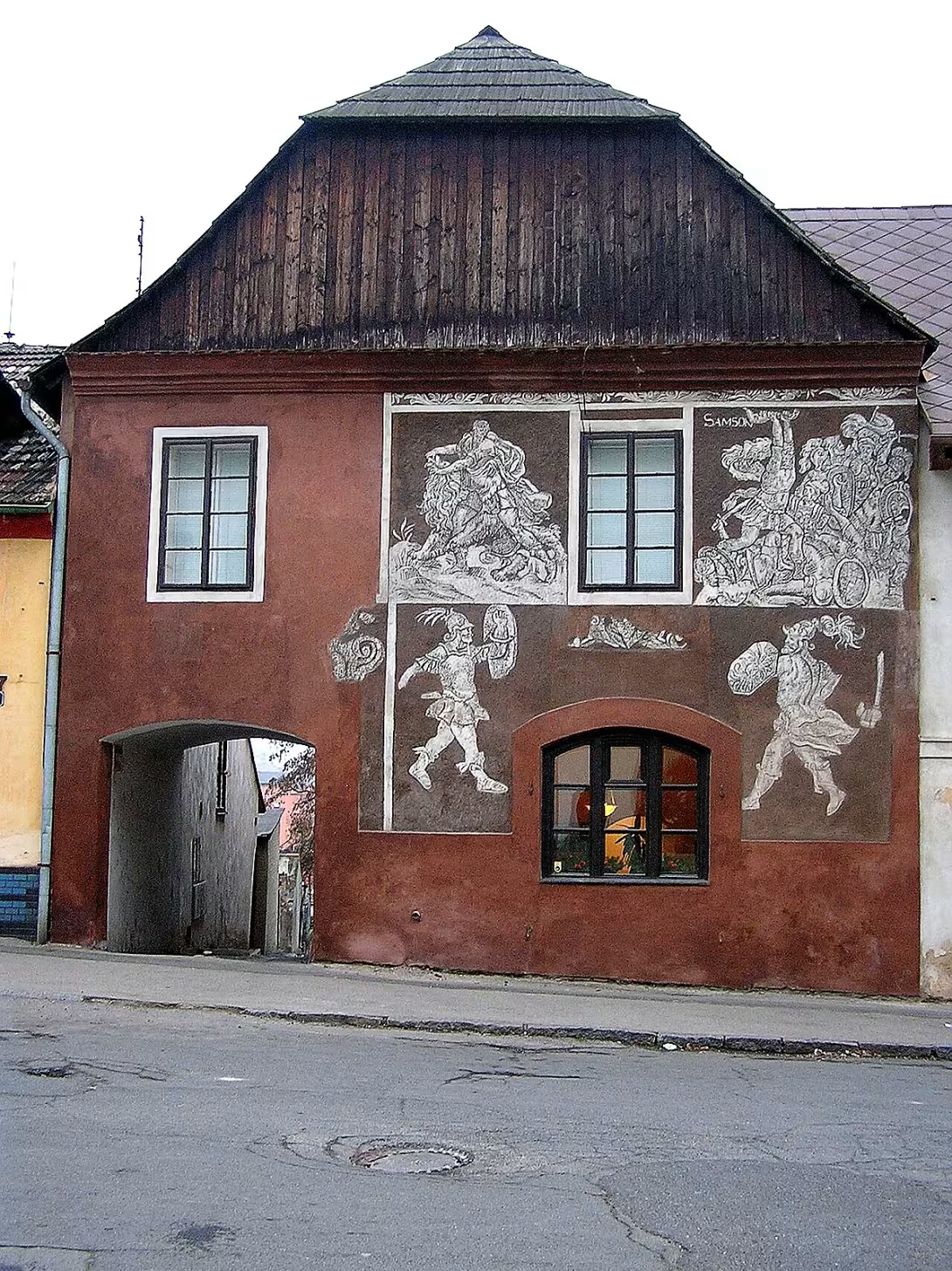
Samsonův dům, also known as the Samson House, is a Renaissance one-storey building located in Rakovnice on the corner of the High and V Brance streets. This historical object is remarkable by its sgraffiti depicting the biblical scenes from the life of Samson, which contributes to its importance as a cultural monument of the Czech Republic. The house is part of the former Jewish ghetto and is now hosted by the Samson Cafe Gallery, which hosts exhibitions and cultural events.
Originally belonged to the Samson family, in particular Bartholomew and Diviš Samson, who were cancer primary. In the 16th century the house underwent a Renaissance reconstruction during which sgraffiti was created on the facade and a wooden baroque shield was added. Originally a medieval building from a massive masonry with a valb roof was later extended above the passage to the alley of V Brance.
In the 15th century, the Jewish ghetto began to form in the vicinity of the house (Vysoká, V Brance, Grill, U Deep well). Sgraffiti on the facade depicts the biblical scenes: on the ground floor there are two knights and on the upper floors a fight between Samson and the lion and his fight against the Philistines. These sgraffiti were exposed during repairs in 1920 when they appeared on other cancer houses.
Today Samsonův dům is managed by the T. G. M. Cancer Museum and serves as a place for cultural events within the Samson Cafe Gallery. The house is located in the historical centre of Rakovnik, where it is possible to visit the church of St. Bartholomew and later built synagogue.
A visit to Samson's house offers an opportunity to explore the rich history of Cancer, especially its Jewish heritage. The house is not only an architectural monument, but also a place where art and history meet in a unique environment.
Historical milestones
- 15th century
- the formation of a Jewish ghetto around the house (High Street, in Brance, Grill, U Deep well)
- 16th century
- renaissance fundamental reconstruction of the house and creation of sgraffiti with scenes from the life of Bible Samson
- 1920
- uncovering previously hidden sgraffiti when repairing the house
Architectural development
Originally a medieval single-storey house of massive masonry with a valb roof; in the 16th century it underwent a Renaissance reconstruction, in which the facade added sgraffite and later a wooden baroque shield; It was then extended over the passage to the V Brance alley and gained an oblong accessible connecting towards the main square; On the ground floor there was a passageway to the alley that gave the street its name.
Historical events
15th century - the formation of a Jewish ghetto around the house (High Street, V Brance, Grill, U Deep well); 16th century - Renaissance fundamental reconstruction of the house and the creation of sgraffiti; 1920 - uncovering sgraffiti when repairing the house.
Owners
Originally belonged to the Samson family (Bartholomew and Diviš Samson, Mayor of Cancer) until the 16th century; then became part of the Jewish ghetto in the area since the 15th century; it is currently managed by the T. G. M. Rakovík Museum, which runs a gallery and a café.
Points of interest
- Samsonův dům is a Renaissance single-storey building with a graphic display of the biblical scenes from Samson's life. - The house belonged to the Samson family, who were cancerous mayors, and underwent renaissance reconstruction in the 16th century. - Sgraffiti on the facade showing the biblical scenes were exposed during repairs in 1920. - The house is part of the former Jewish ghetto and hosts the Samson Cafe Gallery, which hosts cultural events. - It is managed by the T. G. M. Cancer Museum and is located in the historical centre of the city with the possibility to visit the church of St. Bartholomew and the synagogue.
Guide
Show guide text
This text was created by artificial intelligence and has not been editorially reviewed. It may contain inaccuracies.
Welcome to this fascinating historical heritage, the Samson House, which stands as witnesses to the past on the corner of High and V Brance. As you look up, you can see a single-storey building with a valb roof whose architectural beauty reflects a long history. This house is truly a unique reminder of the time when local life and cultural development intertwined.
Samsonův dům has roots dating back to the Middle Ages. In the 15th century, the Jewish ghetto was founded in this place, when this part of Rakovník became home to Jews around the streets of the High, V Brance, Grill and U Deep well. This historical context contributed to the fact that the house served as the key centre of the Jewish community.
In the 16th century, this house was subjected to a significant Renaissance reconstruction, making it a unique monument with a rich history. During this reconstruction, sgraffiti appeared on the facade which depicts the biblical scenes from Samson's life. These artistic elements can tell you countless stories and refer to the rich cultural context of that time.
Take a closer look at this sgraffiti that was uncovered during repairs in 1920. These paintings are truly unique and offer a view of the past when local artists expressed their views and inspiration with biblical topics. The house belonged to the Samson family, among which Bartholomew and Diviš Samson excelled, both being cancer mayors.
The interesting thing is that even though we do not know the names of architects, their work stands as a testament to the artistic and cultural development of the time. Samsonův dům is not just a building; It's a living document of history that tells us about the past.
I recommend you to explore the surrounding parts of Rakovnik, where you can find other sights and attractions. Let yourself remember the memories of this house and its stories. With God in another exploration of this historic city!
Tips for visitors
The best time to visit Samson's house is in the spring or autumn season, when the weather is pleasant and the sunlight refreshes the architectural details of the building. This time of year also offers fewer visitors compared to winter.
When visiting bring protective clothing, especially if you plan to walk the streets around the main square. It is also useful to have a map with you or to use GPS on your phone to easily find your way to other attractions nearby.
For photography it is best to wait for a period of calm weather without strong sunlight, which can cause excessive contrast. The best light to capture the details of the building is in the early morning or evening.
In the vicinity of Samson's house there is a historic main square with the church of St. Bartholomew and later built synagogue, which together with other streets form the remains of the former Jewish ghetto. These places are interesting for those who are interested in the history of the city and its architecture.
Frequently asked questions
Can the monument be visited?
Some buildings of this kind are open for guided tours, others serve another purpose or are privately owned. We have not verified whether and when this monument is open – please ask the operator.
What are the opening hours and admission?
We have not verified the opening hours or admission. Current information is published by the operator.
Where is the monument?
Location: Rakovník I, Středočeský kraj. The map on this page shows the exact spot.
Why is the monument protected?
It is listed in the Central List of Cultural Monuments of the Czech Republic as a cultural monument (register no. 1000142127).
Businesses nearby
Do you run a restaurant, accommodation, shop, museum, rental, wellness or other visitor service near this monument? Show yourself directly to the people heading to it — this is how they will see you in the app and on the web:
Nearby
V bezprostředním okolí se nachází hlavní náměstí Rakovníka s kostelem sv. Bartoloměje a později postavená synagoga, které spolu s okolními ulicemi tvoří pozůstatky bývalého židovského ghetta.
Accommodation nearby
Themed route
Thematic cruise route: Rakovník I
1.Samsonův dům (house) Type: Historical object Why is worth a visit: Samsonův dům is one of the oldest buildings in Rakovnik, which attracts attention to its architecture and history. Today it serves as a museum where visitors can discover the rich past of the city.
2. Main Square Type: Historical Center Why is worth a visit: The main square is the heart of Rakovnik, where the church of St. Bartholomew is located. This church is an example of Gothic architecture and its views offer a beautiful perspective on the history of the city.
3. Church of St. Bartholomew Type: Church Why is it worth a visit: St. Bartholomew's Church is not only an architectural work but also a place with a rich history. Its interior and decoration represent an interesting view of the history of Cancer.
4. Synagogue Type: Historical building Why is it worth a visit: The synagogue, built after the church of St. Bartholomew, is an important historical place that resembles the Jewish community in Rakovnik. Her remains, along with the surrounding streets, tell us about the last Jewish ghetto.
5. Ambient street Type: Historical monuments Why is it worth a visit: Walk on the streets around the church of St. Bartholomew and the synagogue reveals the remains of the former Jewish ghetto. These streets offer a view of the historical structure of the city and its former inhabitants.
This route will guide you through the most interesting part of Cancer I, where each step brings new knowledge of the history and architecture of the city.
Seasonal recommendations
Spring: In the spring season Samsonův dům in Rakovnice appears in its most beautiful glow. Sun rays penetrate the interior and illuminate historical architectural elements, which contribute to a unique atmosphere. Nature is awakened from the freezing days of winter, and flowering shrubs and trees add colour and durability to the surroundings. It is advisable for a visit to come on Tuesday or Wednesday when the crowd usually gathers fewer people. Sufficient clothes should be tailored for warm and cold spring days - better with a vest that easily add or remove.
Summer: During the summer period Samsonův dům is a popular place to visit. Long sunny days and warm weather attract a large crowd, which means the best time to visit is early morning or late afternoon. Clothes should be light and light to avoid sun. In the main summer season it is recommended to come up with water drinks and protective sunglasses to ensure comfort during the visit.
Autumn: Autumn season offers Samsonův dům in an atmosphere of calm and mild heat. Tree leaves turn into living colors, which contributes to a beautiful background for shooting the sights. At this time of year the number of visitors is usually lower than in summer, so you can enjoy a more peaceful experience. It is recommended custom-made clothes for cold and wet autumn weather - with a shirt and hat as a protection against rain.
Winter: Winter brings Samsonův dům in an atmosphere of calm, which is especially visible during cold days. The interior lighting is less powerful due to shorter days, which contributes to a quiet and reflective atmosphere. The visit is ideal for those looking for a peaceful experience without a large crowd. It is important to have warm clothes - with a shirt and neck scarf - due to low temperatures, and it is good to realize that the opening time may be shorter.
Visualizations and artistic views


The visualisations are generated by artificial intelligence and serve as inspiration.
Photos from the area
Real photos taken near the monument


Zdroj a licence jsou uvedeny u každého snímku.
Tips from visitors
No tips yet. Be the first!
Log in and add your tip.
Sources and literature
Photos: Leny Šmídová / CC BY-SA 4.0 — Wikimedia Commons. The author and licence also appear when you hover over the image.
Faktickým podkladem tohoto textu byl článek na Wikipedii, jehož autory jsou přispěvatelé Wikipedie. Článek je dostupný pod licencí CC BY-SA 4.0.
Location on the map




Příběhy a pověsti
Legendy, pověsti a příběhy spjaté s touto památkou
Fotografie návštěvníků
Zatím žádné fotografie. Buďte první, kdo přidá fotografii z návštěvy!
Log in a přidejte svou fotografii nebo hodnoťte.
Za ověřenou návštěvu v aplikaci získáte víc bodů — poznáme podle GPS, že jste na místě.
Reviews and comments