



Medova vila Villa
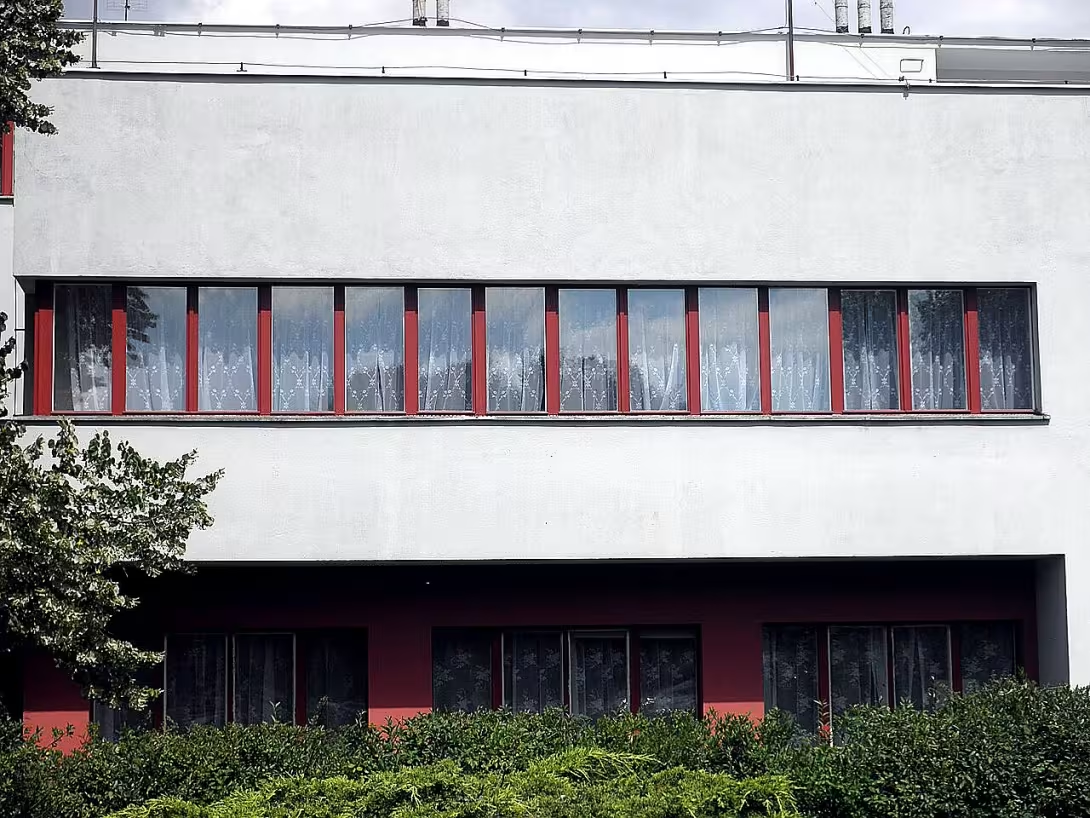
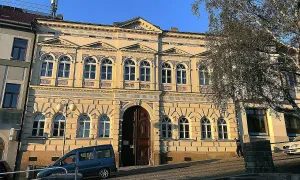
Medova vila, also known as Otakara Meda Villa, is a functional family house located on Tyršov Square in Humpolci. This architectural treasure from 1933-1934 was designed by Josef Gočár for local entrepreneur Otakar Med, who wanted a combination of family house and company headquarters. The villa is remarkable with its clear horizontal lineage, smooth facade and belt windows, which refers to Gočár's style from the colony Baba in Prague.
The emergence of the Meda Villa is closely linked to the architectural search for new forms in Central Europe in the 1930s, when functionalism increased in popularity. Josef Gočár, one of the key personalities of Czech modernism, designed this villa as a combination of housing and operating premises of Otakara Meda. The architecture of the villa is characterized by clean horizontal lines, smooth facade and belt windows, reflecting Gočár's approach to functional design.
The architecture of Honey's villa is typical of functional style. The house is set in a triangular plot and its clean horizontal line, smooth facade and belt windows refer to Gočár's approach to design. The ground floor of the house served operational purposes, contained offices, sample room and warehouse of substances. The entrance to the residential area is guided by a staircase to the 1st floor, where there is a living room with a continuous window, a free-standing reinforced concrete column and a half-open workroom with a library. The lobby connects the stairs to another floor.
After construction in 1933- 1934 Medova vila underwent several changes of owners and purposes. In 1948 the villa was nationalized, which led to partial modification and establishment of medical offices on the ground floor. The Honey family could still live on the top two floors, but she had to pay the rent. In 1992 the villa was restituted to the family and since 1958 it has been protected as a cultural monument. In 2024 the city bought the villa for CZK 24.62 million and since 2025 it has been opened to the public in the form of guided tours.
Medova vila has several attractions. Gočár's assistant Josef Mach also participated in the construction, while part of the furniture was designed by Vladimir Marshal and Kliment Hana garden. Originally, the villa was equipped with pergols, gazebo and pool. Gočár returned to the villa again in 1937 when he was given the task of designing urbanistic modifications to Tyršova Square and finding a suitable place for the monument of T. G. Masaryk by academic sculptor Vincent Makovsky.
Today, Medova vila is open to the public and offers commented tours, allowing visitors to discover its historical and architectural value. Its accessibility and openness make the villa an interesting destination for lovers of architecture and history.
Medova vila is not only a monument to functional architecture, but also a testament to Otakara Meda's life and business. Its historical context and architectural value make it an important part of Humpolce's cultural heritage. Visit this important monument to learn its beauty and understand its historical significance.
Historical milestones
- 1933-1934
- The construction of the villa by Josef Gočár for Otakar Med.
- 1948
- Medova vila has been nationalized, leading to partial modification and establishment of medical practice.
- 1958
- The villa was declared a cultural monument.
- 1992
- The Medova vila was restituted to the original Honey family.
- 2024
- The town bought a villa for CZK 24.62 million.
- 2025
- The villa was opened to the public in the form of guided tours.
Architectural development
The villa was built in 1933-1934 as a functional family house and company headquarters. After nationalization in 1948, there was a partial modification, with doctors' offices established on the ground floor. Architectural elements like belt windows and smooth facades reflect Gočár's style.
Historical events
- 1933-1934
- building of the villa according to the design of Josef Gočár
- 1948
- after nationalisation, partial treatment and establishment of medical practice
- 1958
- protected as a cultural monument
- 2025
- opening the public in the form of comments
Owners
- 1933-1934
- 1948
- nationalisation
- 1992
- restitution to family
- 2024
- the town bought a villa for czk 24.62 million
Points of interest
- Medova vila is also known as Otakara Meda. - It was created in 1933-1934 according to the design of architect Josef Gočár for local businessman Otakar Med, who wanted a combination of family house and company headquarters. - The architecture of the villa is characterized by clean horizontal lines, smooth facade and belt windows, which reflects Gočár's approach to functional design. - After the construction it underwent several changes in owners and purposes; in 1948 it was nationalized, which led to partial modification and establishment of medical offices on the ground floor. - Since 2025, it has been opened to the public in the form of comments.
Guide
Show guide text
This text was created by artificial intelligence and has not been editorially reviewed. It may contain inaccuracies.
Welcome to Humpolci. Right now you're standing in Tyrše Square and your eyes are meeting one of the most important buildings in this city. The Medova vila stands before you. Feel the atmosphere of calm and the untouchable force this building emits. It may seem very clean at first glance, almost steep, but in the simplicity and the way its shapes behave towards the surrounding space, its true beauty lies. Look at her look. There is no unnecessary decoration, no complex carved patterns or decorative columns that distract attention from the very essence of the construction. Instead, you see harmony that consumes you.
Let us now return together to the time when these walls began to emerge from the earth. Imagine a period between a thousand nine hundred thirty-three and a thousand nine hundred thirty-four. This was a time of great change, a time when people began to look into the future with new hope and courage. At that time Medova vila was created, which was built directly for Otakar Med. Otakar Med was not just an ordinary man, he was a successful local businessman, a man with great ambitions. He had a clear idea in his head that he wanted to materialize in this very place. He didn't just want an ordinary family home where his family would live their peaceful lives. He wanted something much more. He wanted a place to serve as his headquarters, as the center of his business. This villa was supposed to be a perfect combination of private housing and a professional working world. This idea, combining work and home into one harmonious whole, was very advanced and courageous at the time.
Now pay attention to what you're seeing right now. Notice how your eyes move around the facade. It's smooth, clean, and very uniform. And then look at those lines. It's the long, horizontal lines that guide your eyes along the entire length of the building. These horizontal lines are the key to understanding the whole purpose. It's not just magic, it's expression of order and modern thinking. And most importantly, it's the windows. They're not just ordinary windows in every wall. They're long, continuous belt windows that seem to be endless. These windows are not just for light, they define the whole face of this building. This method of construction, this style, which focuses on the utility and purity of shape, was designed by one of the largest Czech builders, Josef Gočár. Together with him, Josef Mach participated in this work. If you look at this villa, you can also remember the famous Baba district in Prague, where similar ideas and similar style were born. It is an architecture that believes that every thing must have a purpose and that beauty comes from truth and purity.
But the history of this villa was not just about success and modern lifestyle. It was a journey filled with twists that correspond to the stormy times that our country went through. After a thousand and nine hundred forty-eight, one of the biggest changes came. The villa was nationalized. This means that she stopped being the owner of the Honey family and became the property of the state. At that time, her inner life changed completely. Instead of a business estate and a family home, doctors' offices began to be here. So the villa became the place where people came to heal. Even though her original intention changed, her value as a building remained undeniable. Already in the year one thousand nine hundred fifty-eight the villa was declared a cultural monument, which was a clear signal that it was a work that we must protect for future generations.
But after long years, things have come back to normal. In the year one thousand nine hundred ninety-two the villa was successfully returned to the original family of the Medes. That was the moment of a great joyous return to tradition. And even in the coming years, important events have taken place. The city of Humpolec has decided to purchase the villa in order to preserve it as part of its heritage. A very large sum has been paid for this, over twenty-four million crowns, which shows how valuable this building is for the city and for all of us. And just now, in the year two thousand twenty-five, this villa becomes reaccessible to each of you. It is open to the public through searches that allow you to look inside it.
If you're looking for something that really interests you, think about how visionary this building was at the time of its creation. Imagine Otakar Med standing here in the square looking at his new building. It sees not only its home, but also the symbol of its success and its modern mind. That villa is basically a tangible dream that man can live in a beautiful, functional and clear environment that will serve him at any moment in his life. It's a fascinating combination of personal fate and great art.
Now we will not stop you from exploring this place again. We believe that this brief view of the history and architecture of the villa has brought you new insight and that you will now look at it with a different understanding. Don't forget, the journey does not end here. If you have the opportunity, take advantage of the guided tours and examine every detail this building offers. We thank you for your attention and wish you a wonderful continuation in discovering the beauty of Humpolce. Goodbye.
Tips for visitors
Best time to visit The honey villa is usually spring or autumn season, when the weather is welcoming and the surrounding green of Tyršova Square provides architecture of Josef Gočár on the atmosphere. There are fewer tourists in these months, which allows a peaceful admiration of the family house's functional design.
Transport to Humpolka is possible by car and public transport.
Take comfortable shoes with you, because the surroundings of Tyršov Square and the access routes can be uneven. We also recommend drinking water and light refreshments if you plan a longer walk around the city. For better orientation in the history and architectural details of the villa it is advisable to study the life story of Otakar Med and the work of architect Gočár.
When shooting, focus on the facade of the villa and its connection with the surrounding area of Tyršova Square. The best light for façade images is usually in the morning when the sun lights up details without sharp shadows. Try to capture the contrast between modern functionalist construction and the historical environment of the city.
Since there are no specific places in the area in the background, we recommend to walk around Tyršov Square and its immediate surroundings after the tour of the villa, where other architectural elements of Humpolce can be admired. For families with children the visit is interesting thanks to the visual impression of the building; children can be fascinated by clean lines and modern appearance of a house that differs from traditional architecture.
Frequently asked questions
Can the monument be visited?
This is a residential or farm building, not a museum with opening hours. Please view it from public space and respect the owners' privacy. We have no information about access to the interior.
Where is the monument?
Location: Humpolec, Kraj Vysočina. The map on this page shows the exact spot.
Why is the monument protected?
It is listed in the Central List of Cultural Monuments of the Czech Republic as a cultural monument (register no. 1000141547).
Businesses nearby
Do you run a restaurant, accommodation, shop, museum, rental, wellness or other visitor service near this monument? Show yourself directly to the people heading to it — this is how they will see you in the app and on the web:
Events nearby
Zdroj akcí: otevřená data měst a obcí ČR (Národní katalog otevřených dat) a kalendář akcí Národního památkového ústavu.
Nearby
🏰 Historic sites (105)
- Tomáš Garrigue Masaryk 0.0 km
- Pomník mistra Jana Husa 0.1 km
- HLINÍKárium 0.4 km Havlíčkovo náměstí 91 web
- Věra Metzlová 0.4 km
- JUDr. Otto Metzl 0.4 km
- Anna Mendlová 0.4 km
- Kamila Lüftschitzová 0.4 km
- Eva Mráčková 0.4 km
- MUDr. Viktor Lüftschitz 0.4 km
- Hedvika Lüftschitzová 0.4 km
- Jiří Maršík 0.5 km
- Karel Maršík 0.5 km
- Rudolf Maršík 0.5 km
- Beata Maršíková 0.5 km
- Milan Maršík 0.5 km
- Pamětní deska Rudolfa Mahovského 0.5 km
- Památník Ivana Martina Jirouse 0.5 km
- Pamětní deska Jana J. Sluníčka 0.5 km
- Anna Zaitschková 0.5 km
- Vítězslav Zaitschek 0.5 km
🍽️ Restaurants and dining (101)
- Kozlovna Na Baronce 0.2 km Hálkova 102 +420 704 008 088
- Asiatica 0.2 km Školní 420 +420 704 102 280
- Papa's Garden 0.3 km Školní 1646 +420 720 232 477 web
- Fabrika hotel 0.3 km Školní 511 +420 565 30 20 10 web
- Jídelna Rodinka 0.5 km Husova 391 +420 565 536 522 web
- Istanbul KEBAB 0.5 km Cechovní 150 +420 722 291 177
- Pivnice Na Štokách 0.5 km Jihlavská 1820 +420 565 300 287 web
- Restaurace U Jiřího 0.5 km Jihlavská 493 +420 565 534 512 web
- Kavárna U Janičky 0.5 km Husova 145 +420 602 830 772
- Hotel Kotyza 0.5 km Horní náměstí 5 +420 565 537 351 web
- TURBO PIZZA 0.5 km Horní náměstí 4 +420 728 145 135 web
- Istanbul Kebab 0.5 km
- Restaurace Jirmásek 0.6 km Dolní náměstí 31 +420 565 532 165
- Kebab House Humpolec 0.6 km
- Na Mlýnku 0.6 km Na Kasárnách 448 +420 702 851 041 web
- Kavárna Černý Kůň 0.6 km Dolní náměstí 247 +420 565 532 331 web
- Teráska U Packy 0.6 km +420 776 570 923 web
- Restaurace Na Lázni 0.6 km Příčná 311 +420 565 536 393
- Hospůdka U Ameriky 0.7 km +420 777 333 929
- Altán Stromovka 0.7 km +420 602 830 772
🏨 Accommodation (30)
- Penzion Růže 0.1 km Masarykova 857 +420 565 650 330 web
- Hotel U Jiřího 0.5 km Jihlavská 493 +420 565 534 512 web
- Hotel Na Plovárně 0.6 km Vilová 1638 +420 565 381 461 web
- Hotel Černý kůň 0.6 km Dolní náměstí 247 +420 602 153 347 web
- Penzion Fann 0.8 km Zahradní 710 +420 720 063 463;+420 777 274 749 web
- Autokemp Kachlička 5.9 km
- Motel Velký Rybník 6.4 km
- Mahler Penzion 7.0 km Kaliště 9 +420 737 191 550 web
- Chateau Herálec 7.3 km web
- Chalupa Blatov 8.1 km
- Farma Rybníček 9.1 km web
- Brixen galerie 9.4 km
- Hotel klášter Želiv 10.1 km
- Penzion Element 10.7 km
- Hotel Kouty 11.1 km +420 569 738 121 web
- Chalupa pod Melechovem 11.5 km +420 603495885 web
- Motel Farma 11.7 km
- Hotel Luna 11.9 km +420 569 738 800 web
- Dočkalův mlýn 12.5 km
- Ubytovna u Pípalů 12.9 km
🚲 Rentals and sport (7)
- Elektrokola Humpolec 0.3 km +420 702 525 520 web
- Cyklo sport Zelenka 0.6 km Dolní náměstí 34 +420 606 415 499
- Veloservis Vondrejs 0.6 km
- Koupaliště Žabák 0.6 km Vilová 1637 +420 737 980 848 web
- Autokros Humpolec 1.5 km web
- Rekreační zařízení Ředkovec 12.6 km
- Velosport Valenta 15.0 km
🥾 Hiking and nature (167)
- Park Lnářská 0.3 km
- Park V Brance 0.5 km
- Vyhlídková věž kostela sv. Mikuláše 0.6 km
- Park plicní léčebny 0.6 km
- Stromovka 0.7 km
- V cípku 0.8 km
- Pod Smrťákem 0.9 km
- nemocniční park 0.9 km
- Na Letné 1.1 km
- Šibeniční kopec 1.2 km
- Vodačka 1.2 km
- Zaječí vrch 1.5 km
- U svatého Václava 1.8 km
- Havlův kopec 2.0 km
- Krásná vyhlídka 2.1 km
- Vítkov 2.2 km
- Humpolec - Krasoňov 2.4 km
- Vránův kopec 2.5 km
- V horách 2.5 km
- Kamenka 2.7 km
Accommodation nearby
Themed route
Thematic cruise route around the Honey Villa
1.Medova vila (villa)
Why is worth a visit: This villa is an architectural pearl that attracts its classical elements and history associated with the family of Štampach. It is an ideal place for those who like history and beautifully preserved architectural work.
2. Church of St. Jacob the Greater (parish church)
Why is worth a visit: This church is an important sacral building in Humpolci, which attracts thanks to its historical importance and architectural beauty. It is advisable to visit the ancient interior and to listen to the local organist.
3. Chapel of the Virgin Mary (Chapel)
Why is it worth a visit: This picturesque chapel is a place of peace and shelter where you can enjoy a beautiful view of the surrounding countryside. It's an ideal place for a brief meditation or prayer.
4. Municipal House (historical building)
Why is it worth a visit: This historic building is an important place of public life of the village where various events and meetings took place. It is a suitable place for those who want to understand the history and functioning of the local government today.
5. Memorial of the fallen (memorial)
Why is it worth visiting: This monument is an important monument that reminds the victims of wars and serves as a place of memory and respect. It is an ideal place for a reflective moment and an understanding of the historical context of the region.
This route offers a view of the cultural and historical richness of the village Humpolec, each point having its own unique significance.
Seasonal recommendations
In the spring of September the villa accompanied by the awakening nature and fresh air. The first plants bloom around the building, creating a fresh and optimistic atmosphere. We recommend wearing more layers of clothing because the weather is variable. The best place to visit is in the morning when the air is the cleanest.
The summer season brings intense sun and rich green trees that provide a pleasant shade. The atmosphere is full of energy and bright light. Due to the high season and a larger number of visitors, it is advisable to come right at the opening. Don't forget light summer clothes and plenty of fluids for refreshment.
In autumn, the surroundings of the villa turn into gold and red tones, while morning fog gives the memory a mysterious touch. The light is softer and quieter, which is ideal for walking. It is practical to choose waterproof shoes and a warm sweater. We recommend a visit in the afternoon when leaf colours are the most distinctive.
In winter the villa is cozy, especially if it is covered by a layer of snow and the landscape is quiet. Short days and low temperatures create a contrast between the freezing outside world and internal space. It is necessary to wear very warm clothes and tight shoes. Before travelling, check the opening times which are shortened during this period.
Visualizations and artistic views


The visualisations are generated by artificial intelligence and serve as inspiration.
Photos from the area
Real photos taken near the monument

Zdroj a licence jsou uvedeny u každého snímku.
Tips from visitors
No tips yet. Be the first!
Log in and add your tip.
Sources and literature
Photos: Václav Vlk / CC BY-SA 3.0 — Wikimedia Commons. The author and licence also appear when you hover over the image.
Faktickým podkladem tohoto textu byl článek na Wikipedii, jehož autory jsou přispěvatelé Wikipedie. Článek je dostupný pod licencí CC BY-SA 4.0.
Location on the map


Příběhy a pověsti
Legendy, pověsti a příběhy spjaté s touto památkou

Fotografie návštěvníků
Zatím žádné fotografie. Buďte první, kdo přidá fotografii z návštěvy!
Log in a přidejte svou fotografii nebo hodnoťte.
Za ověřenou návštěvu v aplikaci získáte víc bodů — poznáme podle GPS, že jste na místě.
Reviews and comments