






Měšťanský dům čp. 111/7 House
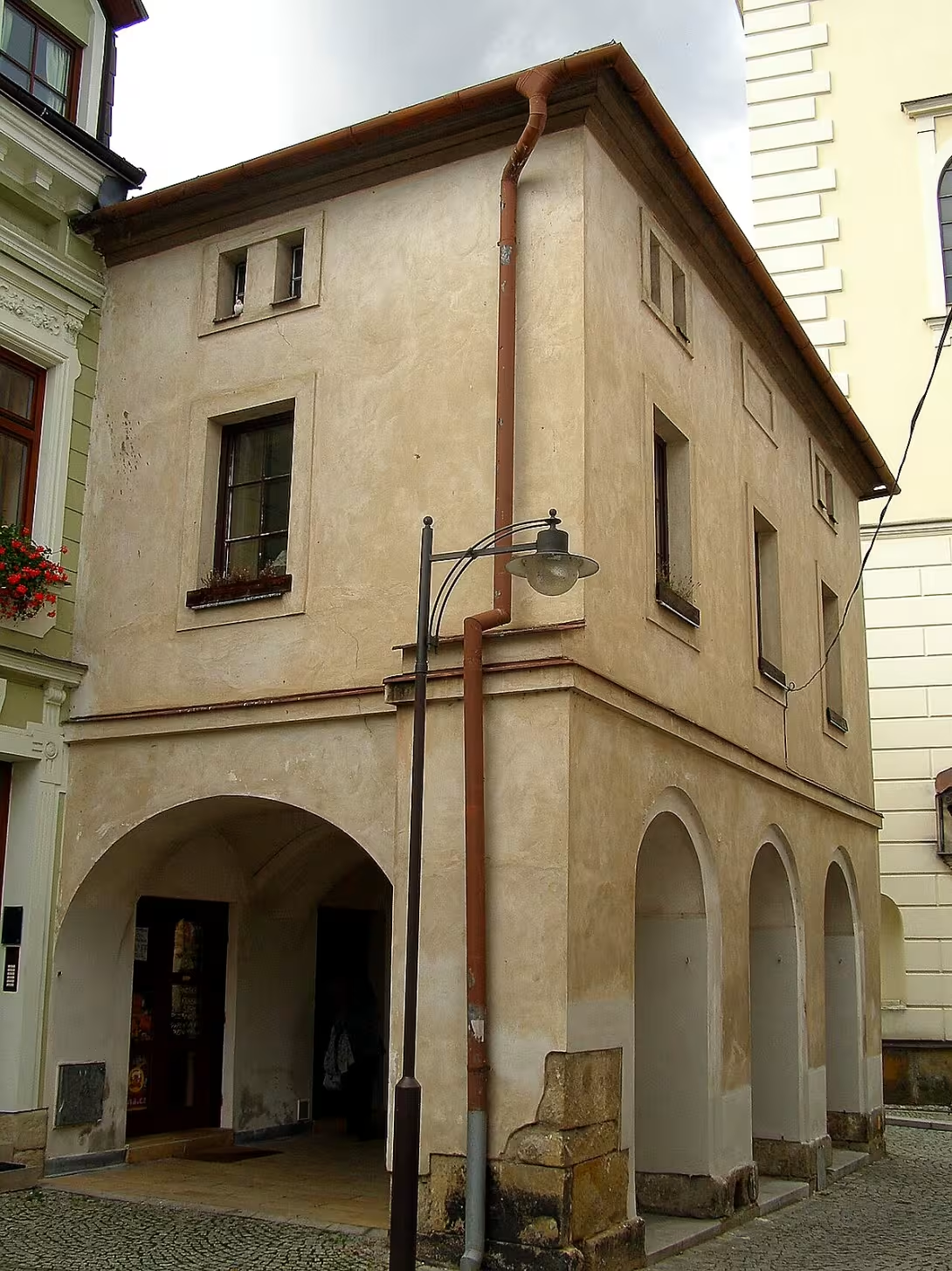
Měšťanský dům čp. 111/7 in Křížkovsky Street in Valašské Meziříčí is a valuable Renaissance monument with a preserved arch, which forms a significant dominant feature of the city building. The building was registered on the list of cultural monuments on 13 November 1975 and represents an important document of historical urban architecture.
The original building was built in the period that brought the flowering of urban architecture and emphasis on the representative appearance of houses in city centres in Czech countries. The specific founders or the exact date of creation have not been kept in more detail, but the Renaissance origin of the building is evident from its basic disposition. During the 19th and 20th centuries, the house went through significant modifications that imprinted its present form.
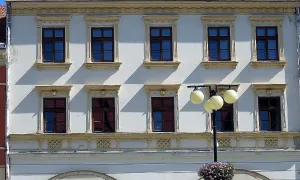
Architecturally, it's a single-storey house with a loft. The characteristic element is the arch with Prussian arches on the belt, into which three arches break from the street. The pair of lateral arches is remarkable by specifically cut edges. The facade is cut horizontally by a cordon ledge separating the ground floor from the floor. The house is turned into the street by three windows with champagne, over which are placed two smaller soil windows. The side facade, oriented towards the Church of the Assumption of the Virgin Mary, is decorated with blind arcades with two grated windows, which visually connects the building to a nearby sacral object.
The interior shows a rich arch. The entrance corridor is covered by Prussian vaults on the belts, in other rooms there are buttons. The staircase to the floor is overarched with a conical vault, with a flat vault above the intermediate floors. There was a room on the floor with a beam ceiling.
This house represents a valuable example of a historical development, which, despite the fundamental reconstruction in the 19th and 20th centuries, preserved its original Renaissance core and specific architectural elements. The visit to the Cross-Žkovsky Street in Valašské Meziříčí offers the opportunity to see this monument in the context of the historical centre of the city and the nearby Church of the Assumption of the Virgin Mary.
Historical milestones
- around 1550
- The creation of the Renaissance name of the house in the era of the flowering of Mestanske architecture
- 1801-1900
- The building modifications of the building in the track of the dematenacte table
- 1901-1974
- Other building modifications of the house in the track of the twenty century
- 1975
- Registration of the object on the list of cultural memories of trinacte November
Architectural development
The building was founded in the Renaissance style, with major building modifications during the 19th and 20th centuries. A characteristic element is the arch with Prussian arches on the belt and a cordon ledge separating the floor from the ground floor. The inner spaces include both arched rooms and a room with a beam ceiling on the floor.
Historical events
on november 13, 1975, the house was listed as a cultural landmark.
Points of interest
- The house is a valuable renaissance monument with a preserved arch, which forms a significant dominant feature of the city building. - The arch has Prussian arches on the belt and is broken into the street by three arches, with side arches specifically cut edges. - The side facade facing the church is decorated with blind arcades with two grated windows. - In the interior there is a rich arches, for example Prussian arches on belts in the entrance corridor or a rolling conical arch above the staircase. - There's a room on the floor of the house with a beam ceiling.
Guide
Show guide text
This text was created by artificial intelligence and has not been editorially reviewed. It may contain inaccuracies.
Welcome to the Valachian Mezirich. Right now, you're standing in a place that carries an incredible depth of time and beauty that may interest you immediately. In front of your eyes is a township house bearing the number of one hundred and one and seven. You're standing on Crožkovsky Street, and this particular object is now the main star body of your view. Feel the weight, the stability, and the presence this house brings to the entire city building. It's not just an ordinary building made of stone and mortar. It is a living monument that has stood here and watched the changing world around it for centuries. Look at his face, his dimensions and how his parts intertwine with the surrounding street. It is a true dominant that immediately catches your sight and brings you to the realization that you are in the heart of history. But in order to truly understand what you are seeing right now, we must, together with your imagination, go back deep into the past. We must return to the time this house was born. Its original core, the oldest and strongest part, which forms the basis of everything you now admire, was created around the year of a thousand and five hundred and fifty. This was the time of the Renaissance, the time when urban architecture flourished and houses were built for rich citizens, for people who formed the economic and social heart of the city. That's when the foundations for future greatness and beauty were laid. But history isn't static, it's constant movement and transformation. This house has never been completed in one form. He evolved along with the city. In the nineteenth century, between the year one thousand eight hundred and one thousand and eight hundred hundred, the object underwent major building modifications. _ These changes gave him a new touch and prepared him for the following era. Subsequently, in the course of the twentieth century, between the years one thousand nine hundred and one and one thousand nine hundred seventy-four, other important work took place. Each of these layers of time, each remodel, added something new to the house and created the present form that you now see. It's like a book that has many chapters and each chapter was written by a different hand in another century. And it is thanks to this rich and rich history that this object on the 13th of November in the year one thousand nine hundred seventy-five was entered on the list of cultural monuments to be protected for future generations. Now, please, give your full attention to the details you have in front of you. The most important and prominent element that brings the house into the street is its arch. Look at these arches. See how the house breaks down into the street? It creates the kind of open space that attracts you to each other with this movement. There are three arcs that create this passage. Notice their edges. The lateral arches have a very specific and interesting shape, their edges are seared, which gives the whole elongated softness, while expressing the precision of the then craftsmen. If you look at the space under these arcs, you can imagine how people have been moving around here for centuries. The inner part of this arch is then crowned by Prussian vaults. These arches that stretch in belts are the technical and aesthetic treasure of this house. These are structures that make it possible to create beautiful and solid ceilings. If you had the opportunity to enter, you would see a rich arch, which includes not only these Prussian vaults, but also the so-called placebo, which are these flat but solid ceilings. But even on the outside, the house is rich in details. Turn aside a little bit and look at the side facade that goes towards the church. There you will see something very interesting - blind arcades. It's these arc shapes that aren't passable, but they serve as a decorative element right on the wall. They provide the facade with depth, rhythm and a beautiful game of light and shadow. The whole house is single storey and above it is situated a soil area with a semi-storey, which gives it its characteristic size and appearance. You may be asking in your mind who shaped this house. Who was the first owner to decide to build his home here in the middle of the 16th century? Who was the craftsman who, with such care, carved the edges of the arches? Even though history in these records has not told us the specific names of the personalities who shaped this house, their presence in every stone and in every arch is felt. These secrets are part of every old monument. Every reconstruction in the nineteenth or twentieth century was the work of someone who wanted to improve this house, keep it going and make it part of his world. These unknown human stories, these silent testimonies of the past, are precisely what gives place to his soul. The house isn't just matter, it's the sum of all the people who moved in it, who built it, who repaired it. There's also something that might interest you when you look at the overall structure. The contrast between the old Renaissance core and the later modifications. It's a fascinating combination of different styles and different times that meet here in one object. Look how the different centuries tried to keep the house modern for its time, while maintaining its basic essence. That's the true power of this place. Now that you've looked at his face and understood his structure, I suggest you continue your walk on Crožkovsky Street. Check out other houses and try to find similar traces of history, similar arches or similar facade details. You may encounter another hidden treasure or interesting element that tells you its own story. Thank you for spending this moment with this monument and paying attention to its beauty. I wish you a beautiful and inspiring continuation of the city.
Tips for visitors
The best time for the tour is in the morning on working days, when the historical centre is quieter and the light hits the front of the house with an arch, which highlights its architectural details.
The house is located right in the heart of the city, where you can easily walk from local public transport stops or park on marked parking lots in the wider vicinity of the historic core; Check the specific connection in the traffic search engine.
It is ideal for photographers to capture the house from the opposite side of the street in order to excel the Renaissance arch; we recommend using soft light during the morning when the sun does not throw too sharp shadows into the arcades.
When visiting with children, take a walk through the historical centre, which is easy and safe; nearby is the Church of the Assumption of the Virgin Mary, whose surroundings offer space for a short rest.
In the immediate vicinity of the monument, you can visit the Church of the Assumption of the Virgin Mary and then explore the entire historical centre of Valashské Meziríčí, which is ideal for walking, thanks to its compactness.
Businesses nearby
Do you run a restaurant, accommodation, shop, museum, rental, wellness or other visitor service near this monument? Show yourself directly to the people heading to it — this is how they will see you in the app and on the web:
Nearby
Kostel Nanebevzetí Panny Marie, historické centrum města Valašské Meziříčí.
Accommodation nearby
Themed route
Thematic cruise route: The historical centre of Valašské Meziříčí
1.Měšťanský dům čp. 111/7 - Type: historical object - Why is it worth a visit: This townhouse is an example of architecture from the Baroque period and classicism. Its unique structure offers a view of the history and life of the inhabitants of the past century.
2. Church of the Assumption of the Virgin Mary - Type: sacral monument - Why is worth a visit: The church is one of the oldest and most important sacral buildings in the village. Its architecture and interior are an example of baroque art, which enriches the historical centre of the city.
3. Historical Center of Valašské Meziříčí - Type: cultural monument complex - Why is it worth a visit: Walk on the streets of the historic centre offers a view of a number of ancient houses and architectural pearls. This area is full of the atmosphere of the past, supplemented by a rich cultural and historical tradition of the city.
This route offers a view of the most significant historical elements of the Valachian Mezirici, enabling visitors to explore the rich past and culture of the region.
Seasonal recommendations
Spring: During the spring, Měšťanský dům čp. 111/7 in Valachian Mezirice appears in its most lively form, when the surrounding nature is full of flowering trees and bushes. The sun rays illuminate the historical architectural complex, creating beautiful light effects on the wall. At this time, the presence of people is often limited due to school holidays and it is recommended to visit the memory in the early afternoon when the temperature is pleasant. Early visits can be suitable for those who want to avoid crowds and enjoy quiet moments.
Summer: In the summer months Měšťanský dům čp. 111/7 in Valašské Meziríčí goes to life when the surroundings are green and flowering. The sun illuminates historical architecture in its full beauty, but long sun days can be too warm. Visitors should prepare for the possibility of high temperatures and recommended clothes suitable for dry weather such as light clothes or sweaters. The best time to visit is an early afternoon or evening when the temperature is milder while avoiding larger crowds.
Autumn: In the autumn months Měšťanský dům čp. 111/7 takes place in the Valaš Region Melancholic beauty when the leaves of trees turn yellow and red. The sunlight illuminates the architectural structure in warm colours, creating handsome contrasts. At this time the weather is usually mild and suitable for long walks around the sights. It is recommended to dress for variable weather such as sweaters or light jackets. The best time to visit is an early afternoon when temperatures are pleasant and often avoid crowds.
Winter: During winter Měšťanský dům čp. 111/7 takes place in Valašské Meziříčí handsome snow cover, which adorns historical architecture and creates magical light effects on sun days. The temperature is usually low and the monument during the day can be illuminated by artificial light, which adds the atmosphere to the historical environment. Visitors should prepare for cold conditions and clothes suitable for winter such as warm jackets and gloves. The best time to visit is usually in the middle of the day when the temperature is milder than in the noon hours, and the monument can be opened for a shorter time.
Visualizations and artistic views

The visualisations are generated by artificial intelligence and serve as inspiration.
Photos from the area
Real photos taken near the monument


Zdroj a licence jsou uvedeny u každého snímku.
Tips from visitors
No tips yet. Be the first!
Log in and add your tip.
Sources and literature
Photos: Michal Kmínek / CC BY-SA 3.0 — Wikimedia Commons. The author and licence also appear when you hover over the image.
Faktickým podkladem tohoto textu byl článek na Wikipedii, jehož autory jsou přispěvatelé Wikipedie. Článek je dostupný pod licencí CC BY-SA 4.0.
Location on the map


Příběhy a pověsti
Legendy, pověsti a příběhy spjaté s touto památkou
Fotografie návštěvníků
Zatím žádné fotografie. Buďte první, kdo přidá fotografii z návštěvy!
Log in a přidejte svou fotografii nebo hodnoťte.
Za ověřenou návštěvu v aplikaci získáte víc bodů — poznáme podle GPS, že jste na místě.
Reviews and comments