






Městské opevnění v Čáslavi Town walls
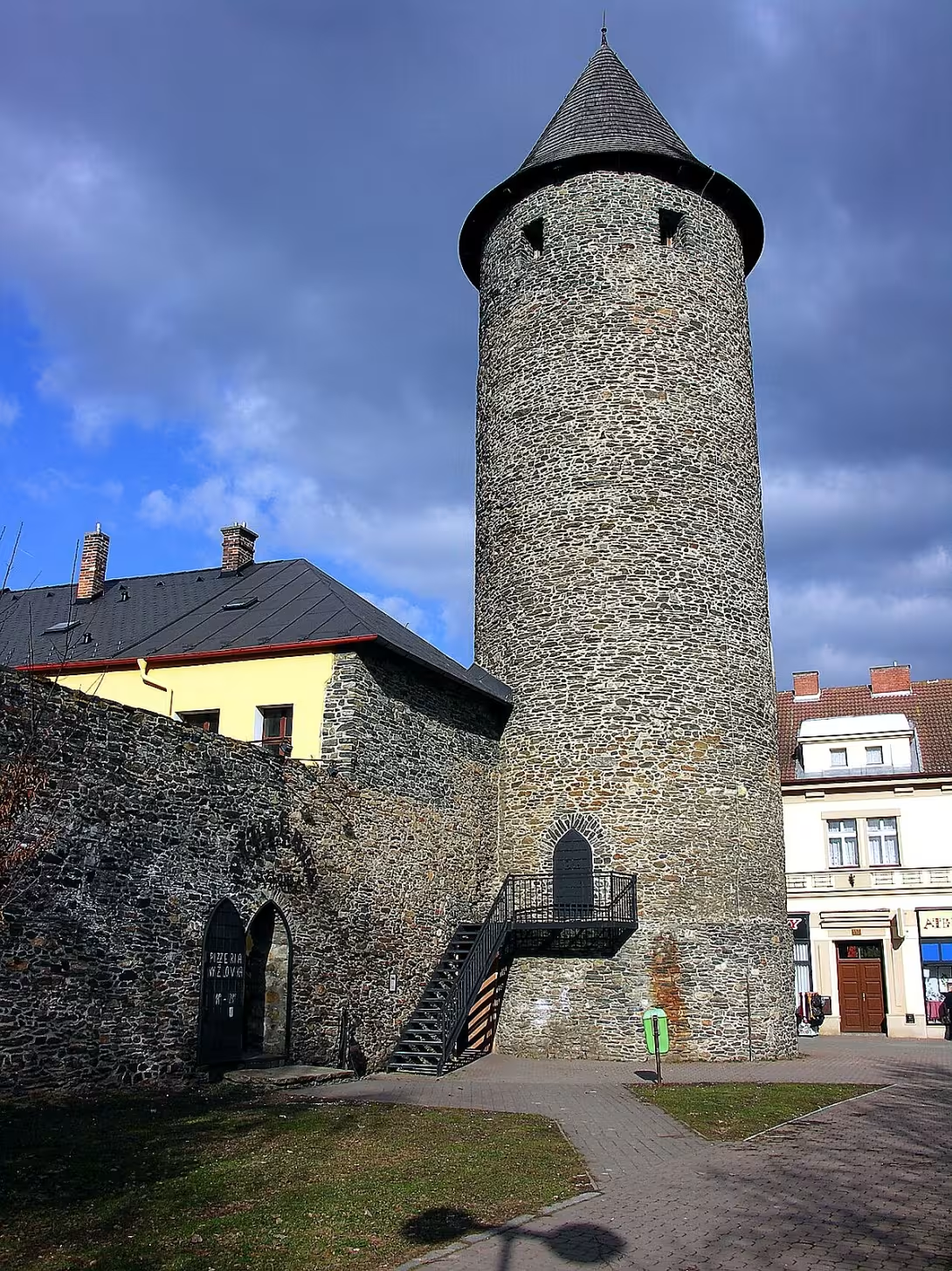
Městské opevnění v Čáslavi is one of the best preserved fortification systems in the Czech Republic and surrounds the historical core of the city. This complex, which dates back to the first half of the 13th century, includes the main and park walls, trenches and walls. To date, they are an important element of urban urban urban urban planning.
The construction of walls was closely linked to the period of the High Middle Ages and the extensive colonization of the Czech countries, when the protection of royal cities and shopping centres was essential. The oldest written mention of fortification dates back to 1307. Archaeological surveys confirm that the main wall was founded in the first half of the 13th century, while the park was established at the turn of the 13th and 14th centuries.
The base of the system was the main wall of quarry stone, reaching up to 250 centimetres thick. The original defensive unit was supplemented by 38 towers and three main gates: Mountain, Chrudim and Brodsky. In front of the main wall there was a 10 to 15 metres wide park, bounded by the outer wall, into which bastions were later inserted. The external protection was provided by a ditch 20 to 25 metres wide and approximately 4 metres deep. On the southwest side of the city, where the terrain falls sharply towards the river Brslence, the outer fortification was unnecessary thanks to the natural protection of the slope.
Over the centuries, the defense system has undergone modifications. Although there is often a claim in literature about strengthening the walls of Jan Zizkou in 1422-1423, this assumption does not support historical written sources. However, probably in Hussite times the walls and baskets were modified. The development of the city and its fortification is also evidenced by written reports from 1502 and a detailed depiction of Jan Willenberg in 1602.
15 towers and large sections of the main wall have been preserved from the original system until today, especially on the west side of the city. One of the most significant parts is the tower of the former Brod Gate, known as Otakarova. At the end of the 20th century, the walls went through a sanitation where the upper parts with the stands died. The exception consists of less than 16 metres of the perimeter wall near the deanery, where the masonry reaches a height of eight meters above the level of the park. In 2023, part of the walls was repaired at the so-called Žižkov Gate, which ensured the stability of the masonry while maintaining historical authenticity.
Today there are best visible sections of the walls in the streets of Fortna, Kozinci, Remysla Otakar II., Komenský Square and Jan Karafiát Street. Čáslav fortification remains a unique proof of medieval construction, which allows you to see the way in which royal cities are protected. Visiting these places offers direct contact with the history that has been preserved in Čáslavi in an unprecedented extent.
Then and now
Drag the slider to compare how the landmark may have looked when it was built with the view today.
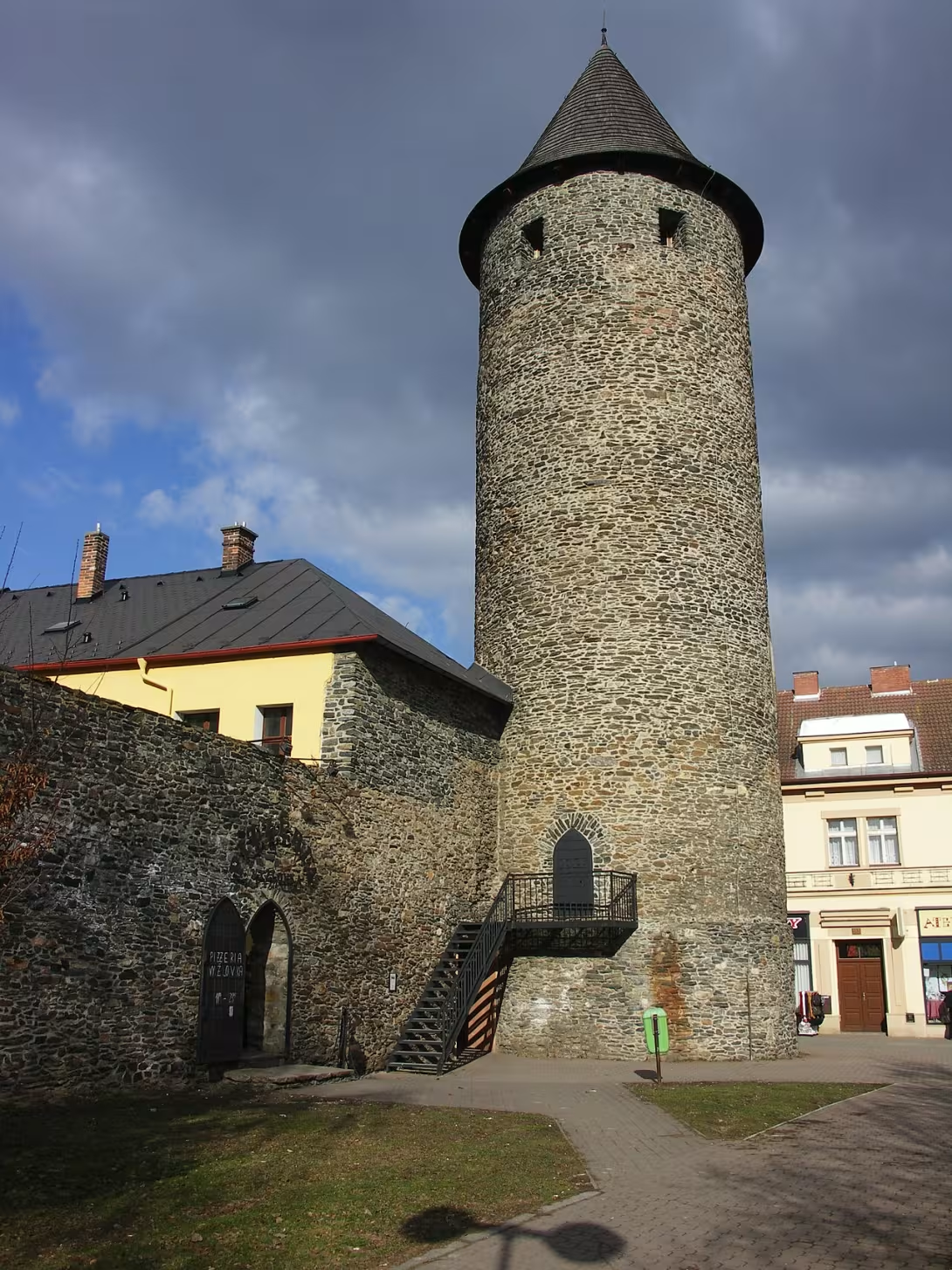
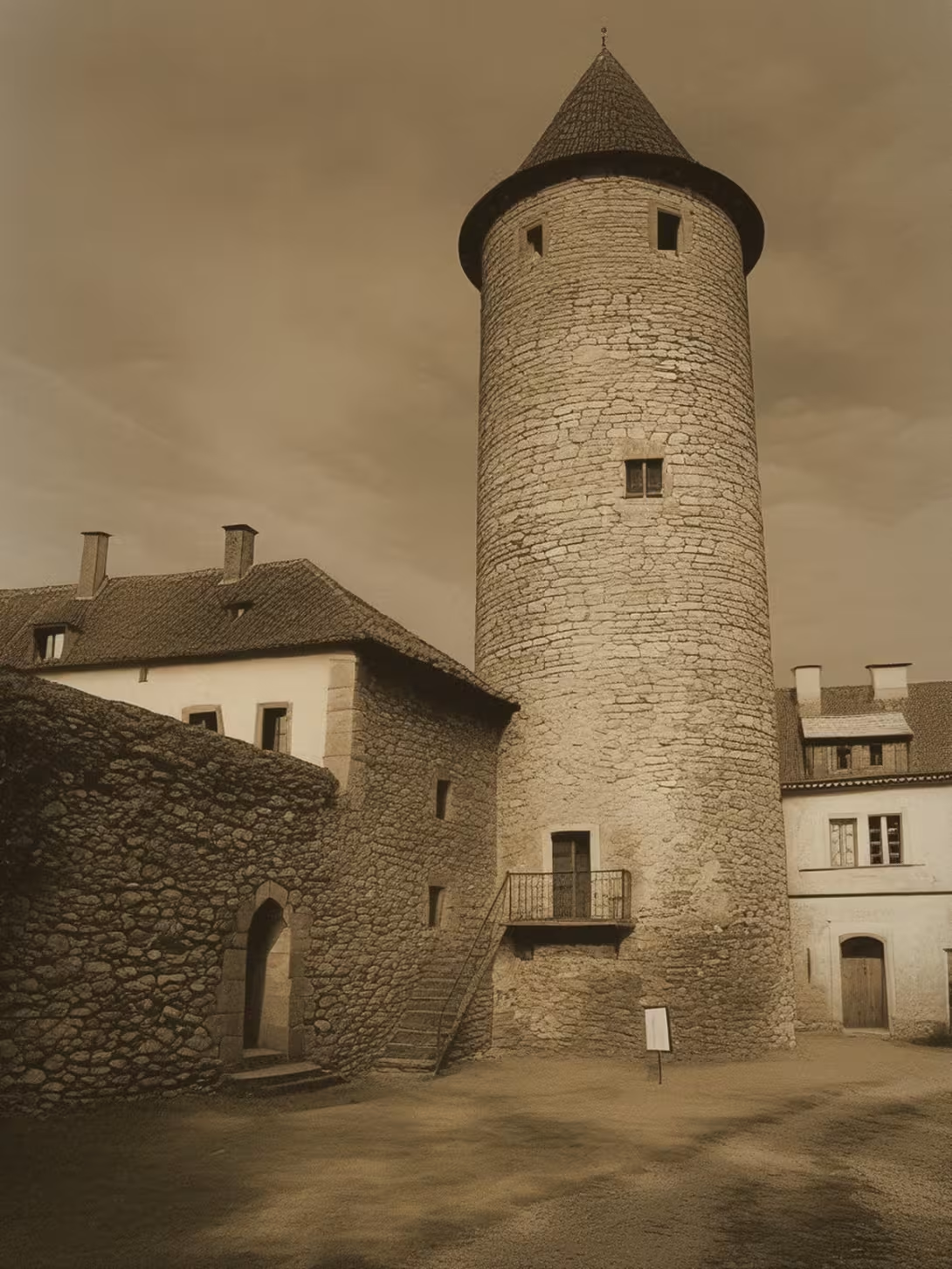
The historical appearance on the left is an AI-generated visualisation and serves as inspiration only.
Historical milestones
- 1307
- The oldest written mention of urban fortification.
- 1417
- Supplied water entrances in the main wall.
- 1602
- The display of the walls on Jan Willenberg.
- 2023
- Repair of part of the walls at Žižek's gate.
Architectural development
The main wall was built from local quarry stone since the first half of the 13th century, the park wall followed the turn of the 13th and 14th centuries. The original system included 38 towers and three main gates, with outside fortifications supplemented by baskets. At the end of the 20th century, the walls went through a sanitation, which destroyed the upper stands.
Historical events
The first written mention of the walls dates back to 1307. In the Hussite period between 1422 and 1423, the fortifications were probably modified. In 2023 part of the walls at the so-called Žižkov Gate was repaired.
Points of interest
- Městské opevnění v Čáslavi is one of the best preserved fortification systems in the Czech Republic. - The main wall was built of quarry stone and was up to 250 centimeters thick. - The original defensive unit included 38 towers and three main gates, which were Mountain, Chrudim and Brodsky. - On the southwest side of the city, the outer fortification was not necessary, because the terrain is falling sharply towards the river Brslence and providing natural protection. - 15 towers and extensive sections of the main wall have been preserved from the original system until today.
Guide
Show guide text
This text was created by artificial intelligence and has not been editorially reviewed. It may contain inaccuracies.
Welcome to Čáslavi. You are standing before something truly extraordinary, a monumental witness of centuries, who has shaped the face of this city and protected its inhabitants for many generations. Before your eyes, there is a massive urban fortification that you see today as part of the historical landscape, but in times of its greatest fame, it was an impervious shield and a symbol of safety. Feel the atmosphere, the weight of history that now surrounds you. Can you feel the power of the stone that's been standing here for centuries? These walls are not only an element of architecture, they are the living chronicle of the city, which tells stories about defense, efforts to survive and the incredible technical skill of the then builders.
Let us move further into the past together to understand why these structures were created here. To understand the nature of this place, we must return to the first half of the 13th century. This is a time when the need for solid and reliable protection has become absolutely crucial for the people of the city. The first written mention of this fortification dates back to 13700, which means that these walls have been part of the city's identity for more than seven centuries. Imagine a world back then, a world of constant dangers and political upheavals, when the city needed a clear, physical boundary between safe internal space and the unknown, often hostile outside world. This system was not built simply, it was a carefully thought-out defense unit that was designed to resist any attempt to penetrate the heart of the city.
Now pay attention to what you see right in front of you and what you can perceive when you look at these structures. What you are seeing today is one of the best preserved urban fortification systems in the Czech Republic. The original defense complex was much more complex and extensive than it might seem. It consisted of several key elements which worked closely together. There was a main wall, a park, moats and walls. These different layers of defense created a deep barrier that the enemy had to overcome, giving him enormous disadvantages. Look at the material from which these walls are composed. It is a quarry stone that gives the whole piece its raw, unruly and authentic beauty. If you look at the structure of these walls, you can realize their incredible mass. The main wall was built to be practically resilient, and its thickness was up to two hundred and fifty centimeters. Imagine the strength of material that had to withstand not only physical attacks, but all elements for centuries.
In the past, this system was even more dense and much more decorated by its functionality. The entire defence circuit was supplemented by towers and gates that provided not only safety, but also control of the movement of people and goods. The original defense unit included a total of 38 towers. Imagine the network of observers who were constantly watching the surrounding countryside from the heights, warning the city of imminent danger. The three main gates served to surround the city, which were key points of communication as well as strategic nodes. It was a mountain gate, a Chrudim gate, and a Brodsky gate. Each of them had a role to play and each represented an important entry into the city's world.
Looking at these walls, it is not possible to mention the name that resonates most strongly in Czech history and which is inseparably linked to this era. Jan Žižka. Although his name is more associated with great battles and military genius, his presence and the era he represented are inherent in these fortifications. Čáslav was an important point in the times of religious wars and these walls had to face unimaginable pressure. Feel the power of the will of the people who kept these walls, repaired them and prevented them from testing them in times of greatest trial.
There is also one fascinating thing that reveals to us how much this system has been thought through in the smallest details. Already in the year fourteen hundred and seventeen the water inputs were documented directly in the main wall. This tells us that the defenders also thought about how to ensure water supply in the event of long siege. This ability to survive in isolation was the key to successfully defending the city. The history of these walls is also captured in art, which allows us to see them through the eyes of people from the past. In the year sixteen hundred and two, this architecture was depicted on Jan Willenberg's well-known science, giving us a unique view of how the walls looked when they were already a solid part of the landscape.
You may also be interested in the fact that we take care of these historical monuments nowadays. It's not just dead stones, it's a living part of our heritage. For example, in the year two thousand twenty-three, an important repair of part of the walls near Žižek's gate was carried out, which proves that even for hundreds of years we are interested in this architecture and want to preserve it for future generations.
Now, however, I will not keep you in one place for too long. These walls invite you to the next road. Walk along them, perceive their structure, look for details in the stone, and let the atmosphere of the city pass through these walls for centuries. Every stone, every gate, and every tower you see on your way has its own story. Čáslav still has something to offer you, so keep exploring and enjoy this trip through history. I wish you a pleasant walk.
Tips for visitors
The best time to visit is during the late afternoon when the sun lights up the walls from the side and highlights their historical structure. At this time, there is a quieter atmosphere in the historical heart of the city, which encourages an undisturbed walk along the fortification.
To Čáslavi can be conveniently reached by train and bus, while the historical centre is within walking distance from the station. If you arrive by car, use public parking near the centre; Check the current parking possibilities and traffic connections in the respective search engines.
For photography we recommend sections near the river Brslenka, where the walls are picturestively mirrored in water. Ideal light for images is obtained at sunset, when stone masonry is beautifully drawn in warm tones.
When visiting children we recommend to join a walk through the walls with a visit around the Suburban pond, where there is enough room for movement. The route around the fortifications is easy and suitable for families who want to enjoy the historic atmosphere of the city.
In the immediate vicinity of the monument, do not miss a walk around the river Brslenky and the Suburban pond, which forms a natural supplement to the historical core of the city. The whole circle around the walls offers a pleasant connection between history and natural elements.
Businesses nearby
Do you run a restaurant, accommodation, shop, museum, rental, wellness or other visitor service near this monument? Show yourself directly to the people heading to it — this is how they will see you in the app and on the web:
Events nearby
Zdroj akcí: otevřená data měst a obcí ČR (Národní katalog otevřených dat) a kalendář akcí Národního památkového ústavu.
Nearby
The river Brslenka, Suburban pond, the historical core of the city Čáslavi.
Accommodation nearby
Trips and activities nearby
Guided tours, tickets and activities nearby from GetYourGuide
Affiliate link: if you buy from the partner, we may receive a commission. The price for you does not change.
Search tours and activities →Themed route
1. Historical core of the city Čáslavi Type: City Why to visit: Explore the original urban architecture and feel the atmosphere of the old town.
2.Městské opevnění v Čáslavi (walls) Type: Monuments Why to visit: The main destination of the trip, which shows the historic defence and fortification of the city.
3. The River Brslenka Type: Water flow Why to visit: Offers a peaceful walk along the shore in the natural environment.
4. Suburban pond Type: Water surface Why to visit: Ideal place to rest by the water at the end of the route.
Seasonal recommendations
Spring brings to Čáslav fresh green and flowering trees that gently cover stone walls. The atmosphere is full of hope and the light is soft, making the monument a pleasant place to walk. I recommend wearing more layers of clothing because the weather is unstable in this period. The best time to visit is in the morning, when the air is the cleanest and the surroundings are quiet.
In the summer months, thick crowns of trees and intense sun dominate the walls, highlighting the texture of the old stone. The city is throbbing with life in the high season and there is a merry rush around the fortifications. Due to high temperatures and larger number of visitors come first morning or at dusk. Don't forget the hat, enough water and light, airy clothes.
The autumn season will turn the surrounding walls into a sea of golden and red leaves that create a nostalgic mood. The morning fog gives the historical wonders a mysterious touch and the light is golden. For comfortable movement in leaves and rain, choose waterproof shoes and a light coat. Ideal is a visit in the afternoon when lighting is the most suitable for capturing the beauty of architecture.
Winter reveals the strict beauty of fortifications when frost and possible snow highlight clean lines of stone wonders. The atmosphere is calm and quiet, allowing for a deeper experience of history without disturbing elements. In Advent time, the area is more cosy, but I recommend watching shorter opening times. It is necessary to have warm clothes, gloves and a firm sole to avoid slipping on the frozen surface.
Visualizations and artistic views


The visualisations are generated by artificial intelligence and serve as inspiration.
Photos from the area
Real photos taken near the monument

Zdroj a licence jsou uvedeny u každého snímku.
Tips from visitors
No tips yet. Be the first!
Log in and add your tip.
Sources and literature
Fotografie: H2k4 / CC BY-SA 3.0 — Wikimedia Commons. The author and licence also appear when you hover over the image.
Faktickým podkladem tohoto textu byl článek na Wikipedii, jehož autory jsou přispěvatelé Wikipedie. Článek je dostupný pod licencí CC BY-SA 4.0.
Location on the map
More monuments – Čáslav
Show all in the municipality
Příběhy a pověsti
Legendy, pověsti a příběhy spjaté s touto památkou
Fotografie návštěvníků
Zatím žádné fotografie. Buďte první, kdo přidá fotografii z návštěvy!
Přihlaste se a přidejte svou fotografii nebo hodnoťte.
Za ověřenou návštěvu v aplikaci získáte víc bodů — poznáme podle GPS, že jste na místě.
Reviews and comments