






Čáslav Hillfort
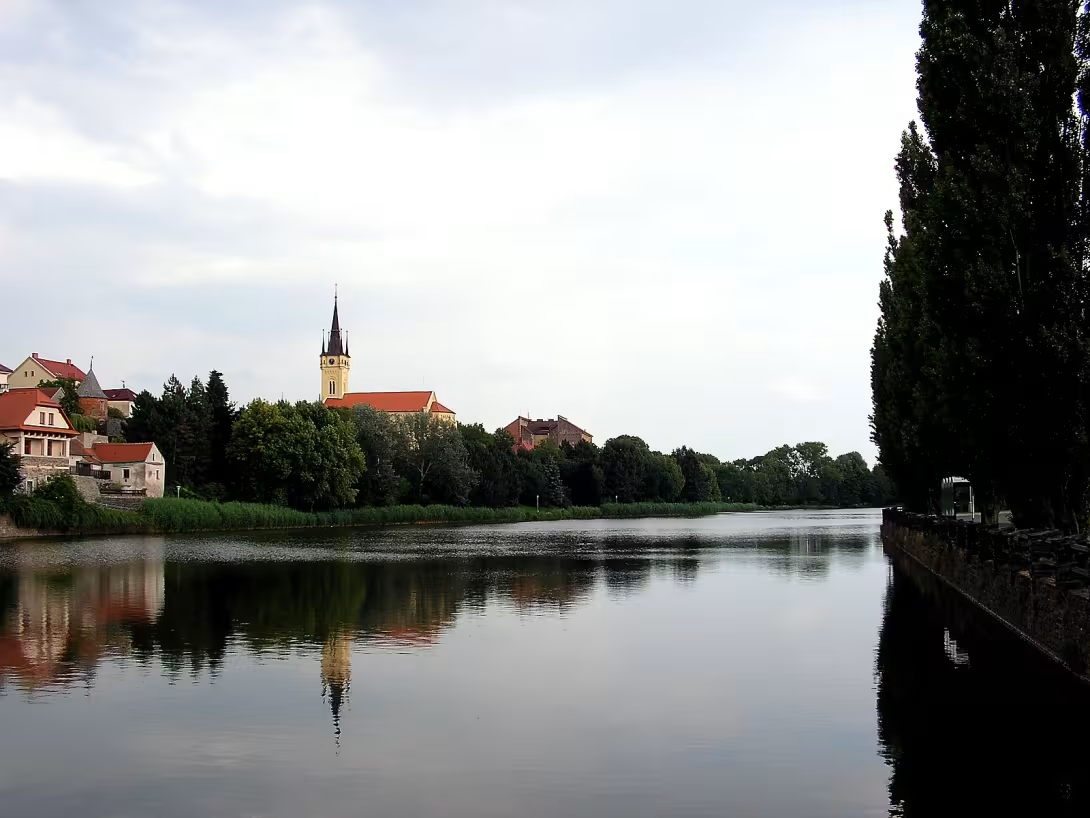
Čáslav archaeological site Hrádek represents an important prehistoric settlement and early medieval castle. It is located on the high rise on the edge of Čáslavi in Kutna Hora district in the Central Bohemian region. The location is remarkable with its role in the Přemysk Castle system and extensive destruction of the terrain in the construction of the highest medieval city in the 13th century.
The settlement of the design between The suburban pond and the confluence of Brslenka with the Žákovské creek goes deep into the past, namely the period of eneolite, the late Bronze period and the period of the Hallatites. The oldest Slavic settlement dates from the 9th to 10th century. In the 11th and 12th centuries, the site became an important administrative center of the Přemyslovské Hrad system, maintaining this importance until the creation of the Supreme Medieval Čáslavi. The historical sources of the site traditionally link with Slavíkovík Čáslav, who was to be one of the sons of the year 995 in Libica.
The appearance of the early medieval administration centre remains largely unclear. Unlike other contemporary sites, Hrádek is very small, lacks a foothold and shows no visible signs of fortification. It is assumed that the sides of the island, protected by steep slopes, could only be secured by light wooden fortification. It is possible that the dam was located in the area of a later town and the access neck between it and the acropolis separated the wall. The premises included the Romanesque Church of the Virgin Mary with a cemetery and two other Romanesque churches stood in the adjacent conurbation.
A fundamental change of location took place in the second half of the 13th century in building a new city. The then construction activity led to massive terrain extraction, which was removed by an estimated 60 000 to 108 000 cubic metres of material. This process is considered the main cause of the absence of preserved traces of the original fortification.
Today, Hrádek is protected as an important cultural monument. For visitors it is a place with a deep historical context, which is evidenced by the process of shaping the Czech state and christianization in the early Middle Ages. Visiting the site offers the opportunity to explore the beginnings of the settlement of the region and to understand the transformation of urbanism over the centuries.
Then and now
Drag the slider to compare how the landmark may have looked when it was built with the view today.
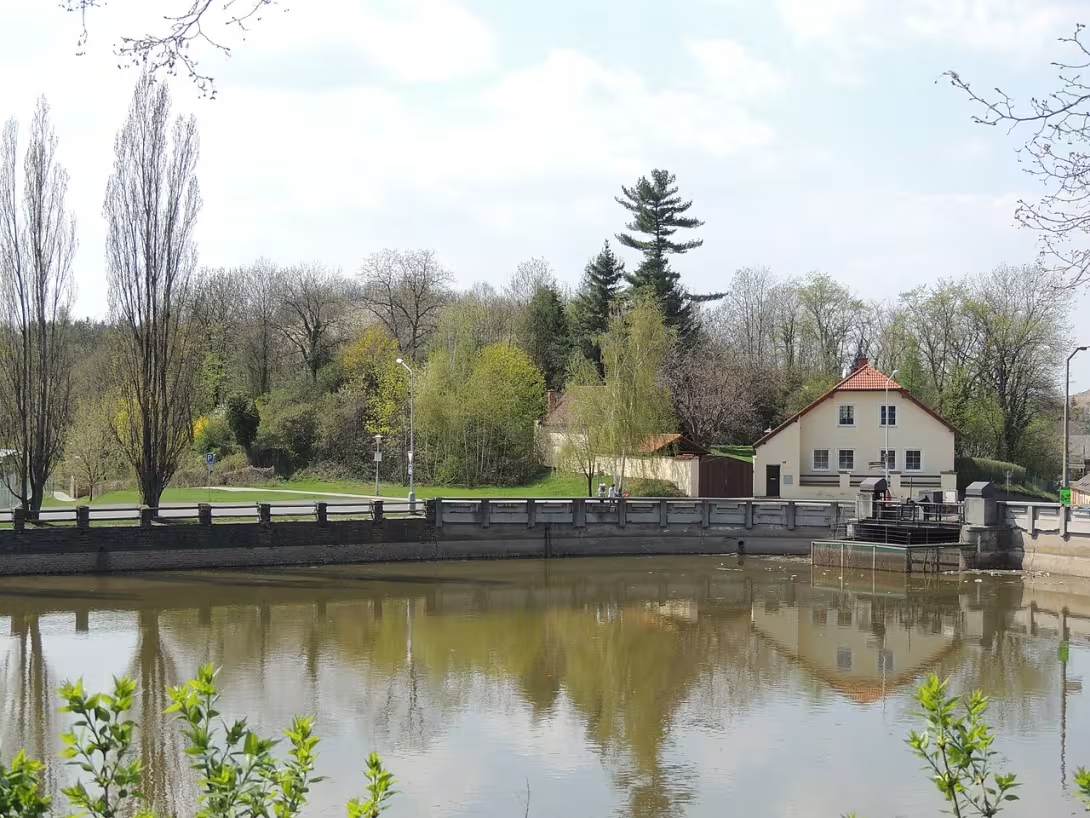
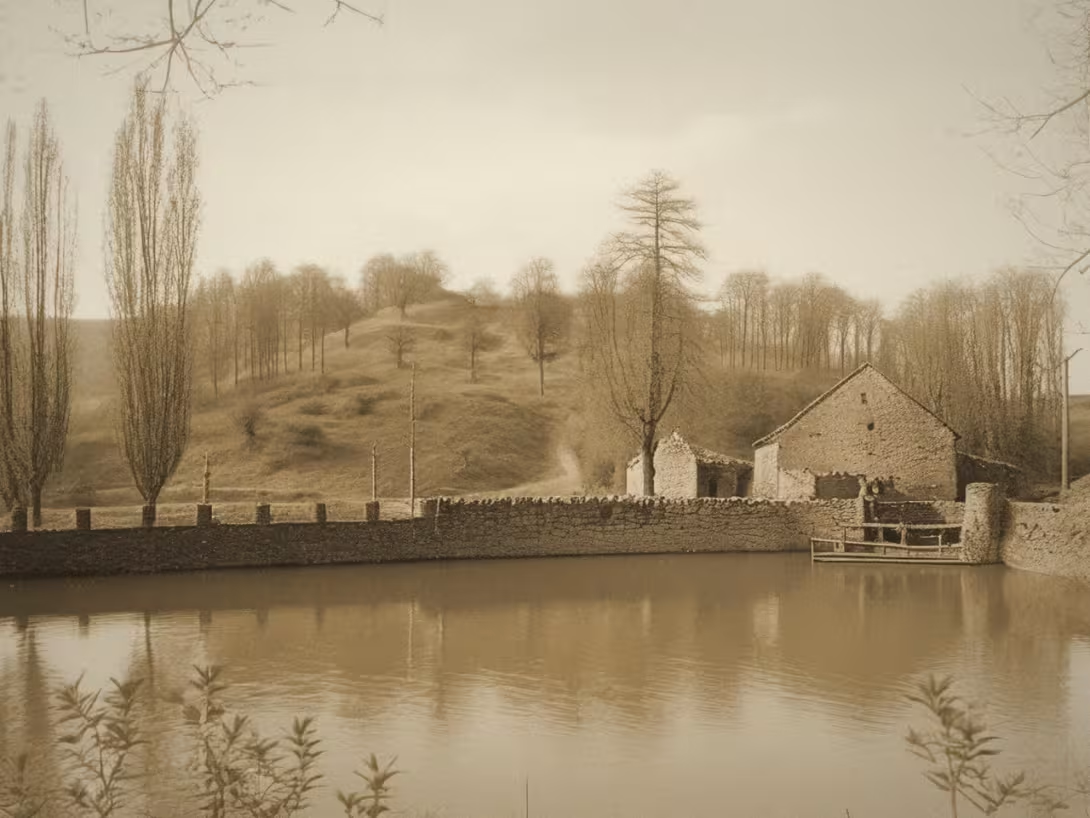
The historical appearance on the left is an AI-generated visualisation and serves as inspiration only.
Historical milestones
- around 3000 BC l.
- The beginnings of the settlement of the site during the period of eneolite.
- 9. to 10th century
- The oldest Slavic settlement in Hrádek.
- 995
- Traditional connection of the location with Slavíkovík Čáslav.
- 11. to 12th century
- The castle works as the administrative center of the imaginary castle system.
- 1250-1300
- Massive terrain extraction during the construction of the highest medieval city.
Architectural development
The original early medieval fortification was lacking significant fortification and a foothold, probably protected only by light wooden fortification on steep slopes. The complex was a Romanesque church of the Virgin Mary with a cemetery. Most of the traces of fortifications were destroyed during urban development in the 13th century.
Historical events
In the 11th and 12th centuries it worked as the administrative centre of the Přemyslovský Hrad system. In the second half of the 13th century, there was an extensive extraction of the terrain in building a new city.
Points of interest
- The castle is an important primordial settlement and early medieval fort, which was in the 11th and 12th centuries an important administrative center of the Přemyslovský Hrad system. - The locality is linked to Slavíkovík Čáslav, who was to be one of the sons murdered in 995 in Libica. - Unlike other contemporary sites, Hrádek is very small, lacks a foothold and shows no visible signs of fortification. - There was a Romanesque church of the Virgin Mary with a cemetery and two other Romanesque churches stood in the adjacent conurbation. - In building a new town in the second half of the 13th century, an estimated 60 000 to 108 000 cubic metres of material was extracted, which is considered the main cause of the absence of preserved traces of original fortification.
Guide
Show guide text
This text was created by artificial intelligence and has not been editorially reviewed. It may contain inaccuracies.
Welcome to the place where the country touches history. You are standing right on the edge of Čáslavi, on a location known as Hrádek. At first glance, this space may seem like a quiet, green place to you, but believe me, under your steps is an incredible layer of time. If you look around now, you'll see a terrain that looks natural, but its shapes are the result of a thousand-year struggle between human will and nature. Feel this atmosphere, feel the silence that exists here, because it is in this silence that it is best to hear the echoes of the past that have taken place here for thousands of years.
Let's go back deep into the past together, to the very beginning of this place. Imagine the year 3,000 BC. It's a period of eneolite, a time of the copper era. Even then, more than 5,000 years ago, people chose this very place. Why? Probably because of the strategic position, outlook and security offered by this elevated position. This site was not just a random place to stop temporarily, but it became a real home where the first foundations of human settlements in this area were built.
But now we must move thousands of years forward. Let's move to the ninth and tenth centuries. This is when the oldest Slavic settlement developed on Hrádek. This is where the identity of this place begins to form, as we know it from our early history. The castle became a fixed point in the landscape, a place where people met, built their houses and formed the foundations of future society.
But at this time, in nine hundred and ninety-five, a darker and very important chapter is being written in history. Traditionally, this place is connected with the character of Slavíkovka Čáslava. History tells us of the tragic events in Libice, when the entire family of Slavíkovice was murdered. Čáslav, which is associated with this site, was one of the sons of these tragically deceased monarchs. Imagine the weight of fate that lies in this place - a place that witnessed the rise and fall of powerful generations that shaped the fate of the whole Czech countries.
Now pay attention to how the importance of the Castle changed over time. In the eleventh and twelfth centuries, this site became something much bigger than just a residential settlement. The castle has turned into a key administrative center within the imaginary castle system. It was not just an ordinary castle, but a heart of administration, a place where the fate of men and territory was decided. It was a centre of power that connected various parts of the country and ensured stability in times when our national territory was formed.
Now if you look at the surrounding terrain and how the slope of the hill changes, notice these tiny irregularities. Even if you don't see tall walls or monumental towers today, you can imagine them in your mind. There used to be a Romanesque church of the Virgin Mary. Although his stones are no longer visible on the surface, his presence still defines the sanctity of this place. Imagine the structure, its quiet power and how it dominated the surrounding region. It's proof of how deep the roots of faith and culture were in this place.
But now I must draw your attention to something that has fundamentally affected what you are seeing in front of you. Today's form of this site is not the result of only natural processes. In the middle of the thirteenth century, between a thousand and two hundred fifty and a thousand three hundred, something fundamental happened. The massive construction of the top medieval city of Čáslav started with the extraction of material. At that time, people needed stone and soil to build their new houses and walls in the lowlands, and so Castle became basically a stone mine. This massive field work directly affected the face of today's archaeological site. So what you see is a combination of the ancient settlement and the medieval expansion of a city that literally grew out of this place.
Here is one of the greatest mysteries of this place. How did it happen that a place that was such an important centre of power and governance had so fundamentally changed its shape over time? It is a fascinating circle of history - a place that was built for protection and stability, in the end it itself served as a basic building material for future generations. This transformation forces us to think about how time continues to flow and how one era is built on the ruins of the previous.
Look at this space not as an empty space, but as a book that has its pages spread deep underground. Every layer of soil you see here is one of the lines of this story. From the first people in the age of the copper era, to the Slavic settlers, to the powerful administrators from the time of the imaginary.
Use this moment to slowly walk around. Feel the atmosphere of this place, feel its peace and its hidden power. Let yourself be carried away by imagination and try to see in every piece of land the traces of those who were before you. Thank you for choosing to explore this history with us. We wish you a pleasant walk and other interesting discoveries around Čáslavi. We'll say goodbye, but the history of this place will accompany you every step of the way.
Tips for visitors
The best time to visit is during spring or autumn months when vegetation is lower and the terrain of the archaeological site is better clear. Avoid days after heavy rains, when the surface in the Hrádek area can be muddy and less viable.
The location is available by car and public transport; current connection to XZ0 Check the ZXi in the search engine. Parking is possible in the adjacent streets of the city, from where it is located within walking distance. We recommend taking advantage of the city parking area and the rest of the way to walk.
For a visit, wear fixed shoes suitable for the field and clothing corresponding to the outdoor stay. Don't forget enough fluids and repellent if you move near the water surface. It is ideal for shooting soft light during the morning or shortly before sunset, when terrain inequalities of the castle stand out.
In the immediate vicinity you can visit the Suburban Pond, which offers a quiet environment for a walk, or go to the confluence of Brslenky with the Žákovský creek. The historical centre of Čáslav is an essential stop for history lovers, which is easily accessible from the site.
For families with children, the location is suitable as a simple trip to nature associated with the discovery of history. Children will appreciate the area of movement in open terrain, but we recommend adult supervision due to the indented surface and proximity of watercourses.
Businesses nearby
Do you run a restaurant, accommodation, shop, museum, rental, wellness or other visitor service near this monument? Show yourself directly to the people heading to it — this is how they will see you in the app and on the web:
Events nearby
Zdroj akcí: otevřená data měst a obcí ČR (Národní katalog otevřených dat) a kalendář akcí Národního památkového ústavu.
Nearby
Suburban pond, confluence Brslenky with the Žákovské creek, historical center of the city Čáslav.
Accommodation nearby
Trips and activities nearby
Guided tours, tickets and activities nearby from GetYourGuide
Affiliate link: if you buy from the partner, we may receive a commission. The price for you does not change.
Search tours and activities →Themed route
1. Suburban pond, natural location. It offers a peaceful walk by the water as an ideal start of the trip. 2. confluence Brslenka with the Příkovský creek, natural interest. You can see two watercourses coming together. 3rd historical center of Čáslav, city zone. This part leads visitors through the old architecture to the main destination. 4. Čáslav (archaeological site), archaeological area. The main destination of the journey, which is the key place for the knowledge of ancient history.
Seasonal recommendations
Spring - In a period of awakening nature above the ruins of Čáslavi spreads a soft, golden light that highlights the stone remains and reveals fine shadows between broken columns. The first flowers bloom around and the birds sing, which gives the place a calm, almost mystical atmosphere. We recommend arriving early in the morning when there are still few visitors and temperatures are pleasantly cold; It is advisable to dress in layered clothes that can be easily adapted to variable weather, and not forget fixed shoes because the soil can be slippery after rain.
Summer - In the summer months the sun illuminates the ruins clearly and in contrast, allowing a detailed view of ancient stone structures. The surrounding forests and meadows are in full bloom, so visitors can look forward to the green background and roar of leaves. In the main summer season there is the biggest attendance, therefore it is convenient to arrive right after opening or late afternoon when the crowds disperse. We recommend light, breathable clothes, a sun hat and plenty of water; If possible, avoid the greatest heat and select the shadow sections below the broken columns.
Autumn - The autumn sun rays hit the rocks with a warm, orange touch, while the leaves around the trees turn into golden and red shades, creating a romantic and quiet atmosphere. In this period, the traffic is milder, which allows for a more peaceful tour. It is practically appropriate to dress in warmer layers, because it can be cold in the morning and in the evening, and carry a waterproof jacket in case of rain. The ideal time is the late afternoon when the light becomes softer and the colors of autumn are the most intense.
Winter - In winter, a cool, clean atmosphere spreads over the ruins; Sun rays are reflected from any snow and create sharp contrasts that underline the historical structure. Opening hours are usually shorter and visitors are less numerous, which provides an intimate experience. We recommend to dress warm - thermal linen, sweater, waterproof jacket and fixed footwear with non-slip sole. Come during the morning when the day is still bright enough, and get ready for a faster tour, because the cold may limit the longer stay outside.
Visualizations and artistic views


The visualisations are generated by artificial intelligence and serve as inspiration.
Photos from the area
Real photos taken near the monument


Zdroj a licence jsou uvedeny u každého snímku.
Tips from visitors
No tips yet. Be the first!
Log in and add your tip.
Sources and literature
Fotografie: Jstojanov / CC BY-SA 3.0 — Wikimedia Commons. The author and licence also appear when you hover over the image.
Faktickým podkladem tohoto textu byl článek na Wikipedii, jehož autory jsou přispěvatelé Wikipedie. Článek je dostupný pod licencí CC BY-SA 4.0.
Location on the map
More monuments – Čáslav
Show all in the municipality
Příběhy a pověsti
Legendy, pověsti a příběhy spjaté s touto památkou
Fotografie návštěvníků
Zatím žádné fotografie. Buďte první, kdo přidá fotografii z návštěvy!
Přihlaste se a přidejte svou fotografii nebo hodnoťte.
Za ověřenou návštěvu v aplikaci získáte víc bodů — poznáme podle GPS, že jste na místě.
Reviews and comments