






městské opevnění v Jevíčku Town walls
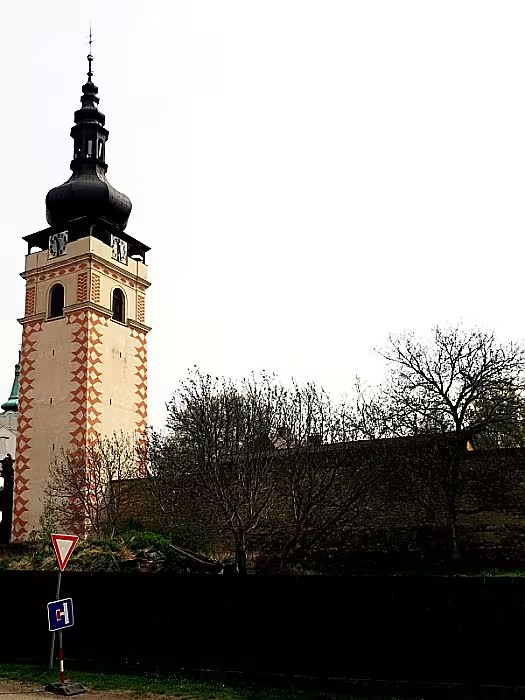
The city fortification in Jevec represents a Gothic castle system, four gates and city towers. The remaining fragments form part of the historical core of the village. This monument, entered in the list of cultural monuments on 3 May 1958, is significant thanks to preserved urban tower and sections of masonry.
The construction of walls began in the Middle Ages in 1368. The city had an elliptical plan, surrounded by a wall with four gates facing the world's sides. The doorman's houses were built at the gates. The gates opened after dawn and closed an hour after sunset, which was in force until 1768.
Architecture is based on Gothic style. The town tower was originally a prismatic building on a square floor plan. Its masonry is more than two metres thick on the lower floors and gradually narrows to 1.7 meters. The tower had five floors separated by clay-filled ceilings, but did not survive. The whole building is closed by a tin pit with a narrow lid. On the top floor there is a clock machine and on the sides there are numbers.
The fate of the gates was different: the southern gate, known as Brno, stood on today's Brno street and was demolished before 1835. The north gate, called Chornic or Jewish, was removed in 1842 from today's Třebov Street. The East Gate, Jaroměřická, was demolished in 1846 on today's Olomouc Street. The last, west gate known as Upper or Svitavska, stood on today's Svitavska Street and was brought down in 1907. In the 19th century, the walls lost meaning and were gradually dismantled.
In 1593 the fortifications were repaired under the leadership of the mayors Beneš Moltoš and Jan Čech. At that time, the tower was raised and transformed into a bell tower, as evidenced by a profiled cordon ledge. On the north facade of the tower are located the alliances of Jan Zakkovsky from the Zákovice and Anežka Bítovská from Slavíkovice, moved from the broken west gate. Above them are the smaller coats of arms of Jiří Žalkovsky of Žalkovice and his wife Eliška Bludovská of Kornic.
The tower is equipped with a rare citral by Jan Beneš from Moravian Trebova. In it are four bells, moved from the destroyed lightning bell tower from 1709. The original bell tower was destroyed in 1711 and the statue of St. Nicholas Tolentinski from 1715 stands in its place. The original bells were preserved only by the largest of the year 1509 weighing 1680 kg, the others were gun shells during the world wars.
Today, masonry fragments are preserved from the original fortification. Some sections are part of the home walls, especially in the southwest part behind the Augustinian monastery and in the northwest part, where they follow the preserved tower. This northwest part was matured to the current height of four meters in recent reconstruction. Other parts of the masonry can be found in the eastern part of the tannery to which the wall was built.
The preserved fragments of the walls and the city tower are an important witness to the medieval development of Jeviček. Visiting this place allows you to see its history through its original defence and architecture.
Then and now
Drag the slider to compare how the landmark may have looked when it was built with the view today.
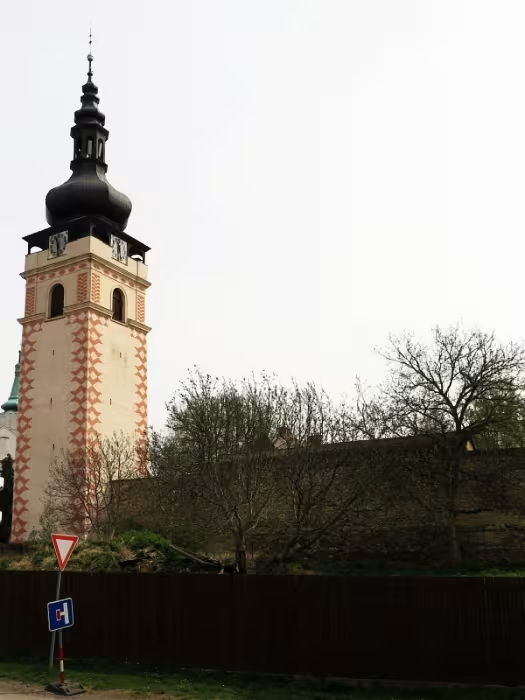
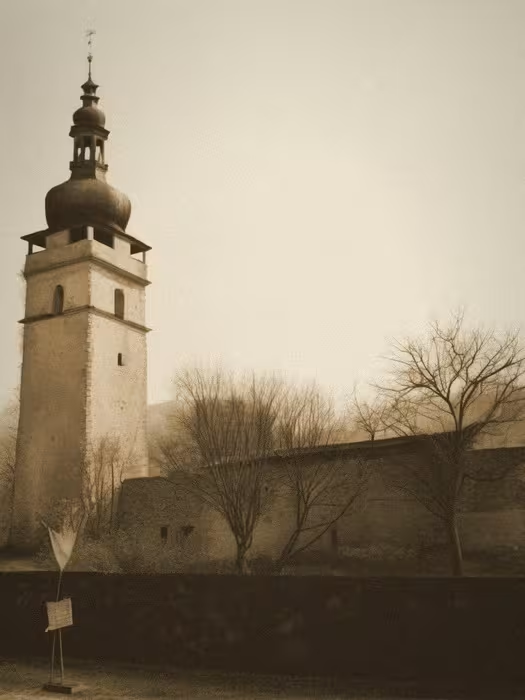
The historical appearance on the left is an AI-generated visualisation and serves as inspiration only.
Historical milestones
- 1368
- The construction of the walls in Yevíček started.
- 1593
- There were repairs to the fortifications and the city tower was increased and transformed into a bell tower.
- 1907
- The last city gate (West / Upper) is broken down.
- 1958
- The town fortifications were included in the list of cultural monuments.
Architectural development
The original Gothic masonry is more than two metres thick on the lower floors of the tower and gradually narrows to 1.7 metres. The tower had five floors separated by clay-filled ceilings that were not preserved. In 1593 the tower was raised and transformed into a bell tower, which separates the profiled cordon ledge. The construction is closed with a narrow lid and bears alliances in the north facade removed from the broken gate.
Historical events
Repairs of fortifications took place in 1593 for caring for Beneš Moltoš and Jan Čech. In the 19th century the walls began to lose meaning and were gradually dismantled. The last gate was destroyed in 1907. The city fortifications were included in the state list of cultural monuments on 3 May 1958.
Points of interest
- The city fortification in Jevec represents a Gothic castle system with four gates and a city tower. - The remaining fragments form part of the historical core of the village and are included in the list of cultural monuments since 3 May 1958. - The building of the walls began around 1368, the city had an elliptical plan with gates facing the world's sides. - Top gothic architecture is visible in the city tower, which has a prismatic structure and a tin pit with a clock machine. - The fate of the gates was varied: the South Gate (Brno) was demolished before 1835, the North (Chornic or Jewish) in 1842, the East (Jaroměřická) in 1846 and the West (Upper or Svitavská) in 1907.
Guide
Show guide text
This text was created by artificial intelligence and has not been editorially reviewed. It may contain inaccuracies.
Welcome to Needle. You're standing right now in a place where history meets the present and where every stone can tell the story of ancient times. Look around you at these remnants of the city walls. Even though these fragments now seem calm and harmonious within the historical core of the city, try to think of them in your mind as part of an impenetrable system that once sealed the whole city. Before your eyes are the remnants of the walls that once formed an impenetrable barrier. Even though they no longer surround the whole city as they did centuries ago, their presence here still gives rise to the sense of security and stability that was so important to the medieval people. Feel this atmosphere of a place that was designed to protect life and property.
Let us now return together deep into the past to understand why and how this fortification was created. This whole story started writing around 1368. At that time, building walls was a prerequisite for the development of every major city. Jevíčko was no exception. The need to have clearly defined boundaries and the ability to repel any attacks has led to the construction of this Gothic fortification. The city wasn't built by chance, but it had a very specific, elliptical plan. This shape choice was not random, but was aimed at effectively encircling the populated area while facilitating defence. The whole system was supplemented by four gates that were strategically deployed in the direction of the world. In this way, the city was to control every move towards its borders and ensure that no one penetrated without control.
Now pay attention to what is right in front of you and what you can see in the area. Notice these remaining parts of the walls. If you move on, you can encounter the most significant fragments that have survived especially in the southwest and northwest parts of the city. It is here that you can best perceive the ancient geometry and strength of medieval construction. And look up now, the city tower that dominates this place. It's a fascinating element that has evolved in many ways. Originally this tower was a prismatic building with a square plan. It was a purely defensive structure, firm and relentless, used to observe the surroundings. However, history is constantly evolving. In 1593, extensive repairs took place in the city, and it was during this period that the tower was increased and its function changed substantially. Instead of a mere defensive tower, it became a bell tower. Imagine the contrast - instead of being silent and vigilant when looking at danger, the tower began to spread a sound that informed the population of time, of important events, or of danger, making it the heart of communication throughout the city.
However, the history of these walls is not only the history of stone and Maltese, but, above all, the history of the people who lived in this city ruled it or cared for its protection. Looking at these remnants, you can imagine the characters whose names have been written down in the history of Yelik. By the time the walls peaked, there were people like Jan Žalkovský ze Žalkovic or Jiří Žalkovský ze Žalkovic. Their presence in the history of the city suggests the importance and political weight that Jevíčko had at the time. Let us not forget about women who have shaped social life like Anežka Bítovská ze Slavíkovic or Eliška Bludovská z Kornic. Even names such as Beneš Moltoš, Jan Čech or Jan Beneš z Moravské Třebové are firmly linked to this region and to the period when these fortifications were built and maintained. Each of these people was part of the living organism of the city, which protected these walls and which they themselves defined.
You might find one interesting thing that shows how much the city has had to change over the centuries to continue to grow and modernize. Even though the walls have been a symbol of security for centuries, over time they have become an obstacle to the expanding city and modern transport. It happened that it had to decide between preserving the past and the need for the future. In 1907, one of the most important moments occurred in the modern history of the city, when the last city gate, the Western one, was demolished, popular as the Upper Gate. Imagine the moment when the city opened up for the first time in centuries to a wider world without this physical barrier. Although some parts of the walls had disappeared, the rest was valued as a great treasure. This is why this city fortification on 3 May 1958 was officially included in the list of cultural monuments, thereby ensuring its protection for future generations.
Now that you have learned more about the origin, the architecture and the people who shaped this place, I suggest you continue your next walk. Take a look at the remnants of the walls in other parts of the historical core of the village and try to build a picture of the entire ellipse circuit, which once surrounded the whole city firmly. Feel every part of this place and let yourself drift through the atmosphere of the historic Star. Thank you for joining us on this short journey through time. We wish you a pleasant further discovery of all the secrets this city offers.
Tips for visitors
The best time to visit is morning or late afternoon hours, when soft light hits the wall, creating ideal conditions for photography. To capture the best images we recommend focusing on the city tower and details of the medieval masonry.
You can reach Ječíčka by car and public transport; We recommend checking the current connection and parking options in the internet search engine. Comfortable shoes suitable for historical surfaces are necessary for walking around the city fortification.
Families with children can make their journey more comfortable by interactive search for four historic gates that were part of the city's defence. A walk along the city's elliptical perimeter is suitable for all ages.
In the immediate vicinity of the walls we recommend visiting Augustinian monastery, local tannery or statue of St. Nicholas Tolentinski from 1715, which complement the historical character of the site.
Businesses nearby
Do you run a restaurant, accommodation, shop, museum, rental, wellness or other visitor service near this monument? Show yourself directly to the people heading to it — this is how they will see you in the app and on the web:
Nearby
Augustinian monastery, tannery, statue of St. Nicholas Tolentinsky from 1715.
Accommodation nearby
Themed route
Thematic cruise route: City fortification in Ječík
1. City fortifications in Yevíček (walls) - Type: Historical landmark - Why is it worth a visit: Visit the city fortification, which is a unique example of historical defence structures. These walls bear witness to the rich past of Yevíčka and offer a wonderful perspective on the development of the city.
2. Augustinian Monastery - Type: Historical monastery complex - Why it is worth a visit: The monastery is an important cultural monument which represents the spiritual and architectural heritage of the village. Its history goes back to the past and offers a view of the life of monks in the region.
3. Leather - Type: Historical industrial object - Why is it worth a visit: Tannery is a reminder of the former industry in Yevíček. It is interesting to explore how furs were processed and how this industry had on the economy of the municipality.
4. Statue of St. Nicholas Tolentinsky from 1715 - Type: Historical statue - Why is it worth a visit: This statue is not only a work of art but also a cultural symbol. Its history and architectural value attract many visitors every year.
This route offers a view of the diverse history of Yevíček, from its defensive structures to spiritual and industrial monuments.
Seasonal recommendations
Spring: The awakening nature and the lush green surrounding the old stone walls create a fresh and optimistic atmosphere. The lighting is delicate during this period, which is ideal for capturing the details of architecture. We recommend choosing layered clothes because the weather can be variable. The roads are still quiet at this time and without large crowds, which allows a relaxing tour.
Summer: The summer season is characterized by intense sun and warm air, which is reflected from historical stone. The atmosphere is very lively, which is typical of the high summer season. Due to a higher number of visitors and heat, it is best to arrive early in the morning to avoid the biggest groups of people and unpleasant heat. Don't forget the protective headgear and plenty of fluids.
Autumn: Autumn brings a nostalgic and calm mood to the city fortification, often accompanied by morning fog and golden colours of leaves. Low sun creates interesting shadows that highlight the structure of the walls. It is advisable to wear fixed shoes and waterproof layers because moisture can cause slippery surfaces. The best time to visit is clear afternoon hours.
Winter: In winter, the walls are very raw and majestic, especially in cold days or snow. The atmosphere is quiet and lonely, which offers space for quiet contemplation. Due to low temperatures it is necessary to wear very warm clothes, including gloves and hats. The opening time is shorter in advent time and during freezing, so check ahead of time.
Visualizations and artistic views


The visualisations are generated by artificial intelligence and serve as inspiration.
Photos from the area
Real photos taken near the monument


Zdroj a licence jsou uvedeny u každého snímku.
Tips from visitors
No tips yet. Be the first!
Log in and add your tip.
Sources and literature
Fotografie: Sovicka169 / CC BY-SA 4.0 — Wikimedia Commons. The author and licence also appear when you hover over the image.
Faktickým podkladem tohoto textu byl článek na Wikipedii, jehož autory jsou přispěvatelé Wikipedie. Článek je dostupný pod licencí CC BY-SA 4.0.
Location on the map


Příběhy a pověsti
Legendy, pověsti a příběhy spjaté s touto památkou
Fotografie návštěvníků
Zatím žádné fotografie. Buďte první, kdo přidá fotografii z návštěvy!
Přihlaste se a přidejte svou fotografii nebo hodnoťte.
Za ověřenou návštěvu v aplikaci získáte víc bodů — poznáme podle GPS, že jste na místě.
Reviews and comments