



Městský dům (Vidnava, 1000141938) House
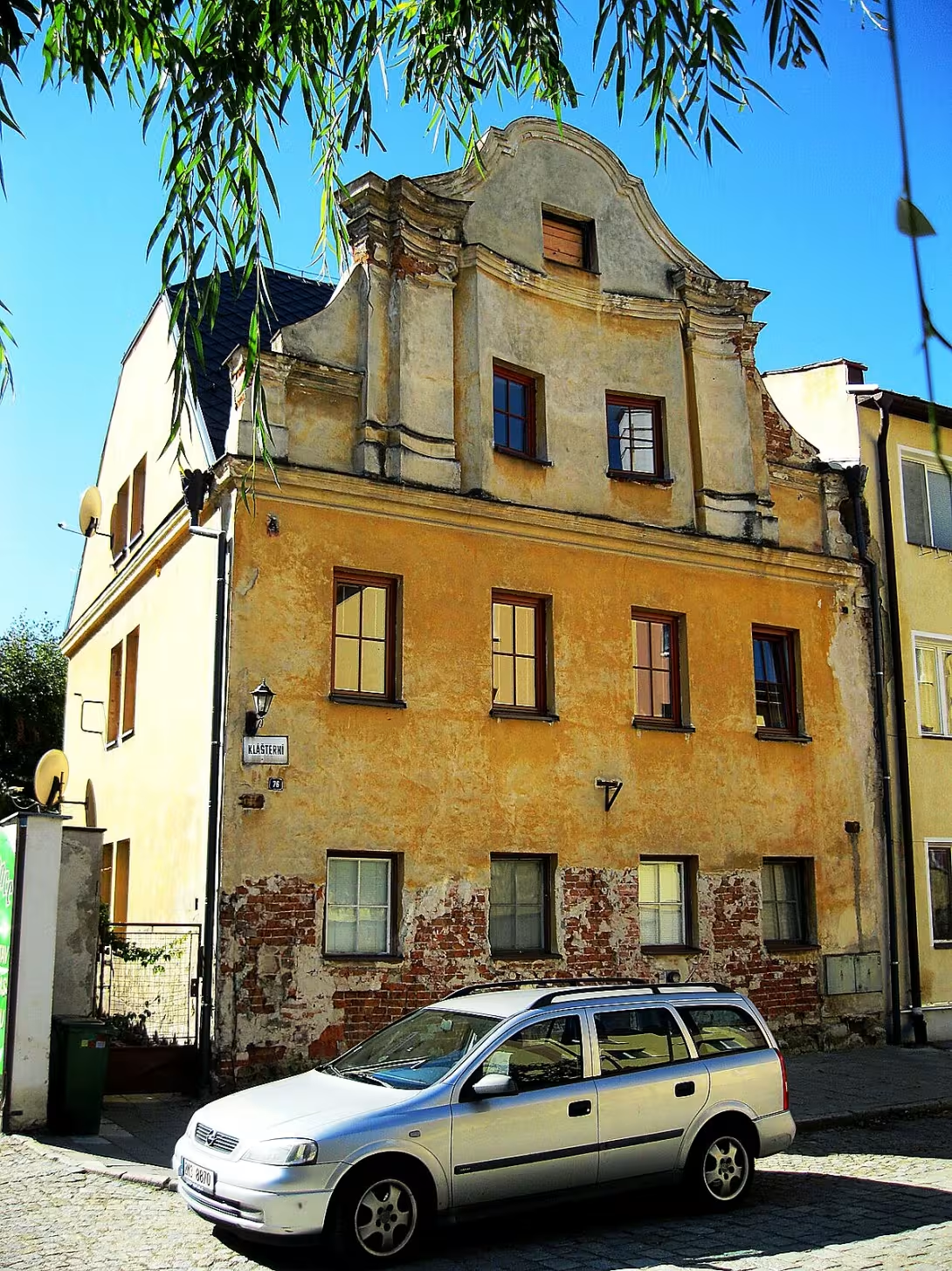
The town house No. 76 in Vidnava in Jesenick is a corner one-storey building on the Peace Square. The building built on medieval foundations bears significant features of late Baroque architecture and is part of the urban monument zone announced in 1992.
The history of the Vidnavia building is closely linked to the urban development of the city, which culminated in the mid-16th century. Over the centuries, the city has repeatedly suffered fires that have necessitated successive reconstructions. After the devastating fire in 1574, a Renaissance renewal took place, another fundamental transformation in the spirit of the Dolnosley Baroque followed the fire in 1713. The house No. 76 itself has been modified many times over the centuries, yet it has retained its medieval core.
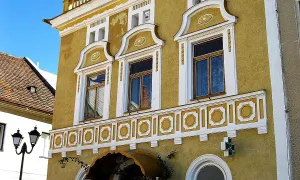
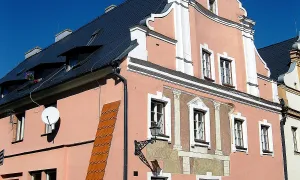
The architectural representation of the building corresponds to the late Baroque style. The four-axis house is covered by a saddle roof, and its main dominant feature is a concave shield. It decorates on the sides of a double Pillastra and ends the attics with Roman pillars. Above the main ledge is a half-circle tympanone lined with a ledge and one window. The interior of the building has flat ceilings.
The fate of the house is part of the wider development of Vidnava, which in the past benefited from the flowering of canvas. While in the 19th century the city experienced development associated with the construction of major institutions such as the new town hall, gymnasium and railway, in the 20th century a number of valuable townhouses were lost and demolished. House No. 76 was preserved as part of the historical core thanks to the declaration of the monument zone in 1992.
Today, this house is an important example of the building development of Vidnava and its Baroque form. It offers visitors the opportunity to visit the historical centre of the city, which includes other monuments such as the City Hall from 1867 or the Church of Saint Francis from Assisi. The building is a valuable part of the urban complex, the protection of which is crucial for preserving the historical identity of the region.
Historical milestones
- 1574
- After a nickel fire, the Renaissance renewal went through.
- 1713
- Another fundamental transformation in the spirit of the Dolnosley Baroque.
- 1867
- The position of St. Francis Church of Assisi.
- 1992
- Monument zone announced.
Architectural development
The original medieval core was gradually modified in the Renaissance and subsequently Baroque style. The facade and shield show signs of late Baroque architecture. The building is covered by a saddle roof and divided by four axes.
Historical events
In 1574 the city was hit by a fire that affected the Renaissance reconstruction. During the Thirty Years' War in 1632, the city burned down and was subsequently restored. After the fire in 1713, further reconstruction took place in the spirit of the Dolnosley Baroque.
Points of interest
- The house stands on medieval foundations, which he has preserved despite numerous modifications over the centuries. - The construction has significant features of late Baroque architecture and its main dominant feature is a shield with concave deflection. - The building is part of an urban monument zone that was declared in 1992 and helped preserve the house. - The interior of this house has flat ceilings. - The house is an important example of the building development of the city and its Baroque form.
Guide
Show guide text
This text was created by artificial intelligence and has not been editorially reviewed. It may contain inaccuracies.
Welcome to the beautiful city of Vidnava. You have just stopped at the Peace Square and before your eyes one of the most significant buildings in this place is standing. You're standing right in front of the Town House, bearing the number seventy-six. Look at his location. It is a corner building that, by its presence, controls this corner of the square and defines its face. It is a one-story building that may seem modest at first sight, but its appearance and richness of detail immediately reveal its deep and rich history. Feel the atmosphere of historic buildings intertwining with today's city life. This house is not just a wall and a roof, it's a living story that has been told for centuries and that you can experience right now.
To understand what you're watching right now, we need to go back deep into the past with you. This house doesn't just have its present face. Its roots are much older than it might seem. This whole building was built right on the medieval core. This means that beneath the walls you are now seeing, there are foundations and structures from a time when the city of Vidnava has yet to form its true identity. But the history of this place has not always been a peaceful course of time. In fifteen hundred seventy-four, the city had to deal with a great test - a devastating fire. This event was very difficult for the people at the time, but it also brought new hope. This fire was followed by a Renaissance renewal, which gave the house a new feel and a more modern form for the time being.
Another big and fundamental change came much later. In the year seven hundred and thirteen, the building went through a transformation that left a trail that you can see today. During this period, the spirit of the lower Silesian Baroque school was imprinted in the architecture of the house. It is thanks to this that the construction has acquired its present, very elegant and noble form. If you look at the surrounding area now, you can remember that in the year one thousand eight hundred sixty-seven St. Francis of Assisi was built nearby, which further deepened the religious and historical character of this whole place.
But now I want to ask you to take your eyes above. Pay full attention to what lies above your heads. What you are looking at right now is probably the most distinctive and beautiful feature of the whole house - the late Baroque shield. Look at its shape. It's not just a straight line or a simple geometric shape. He has this strange, beautiful flop that experts call a concave twist. It's like the upper part of the house is coming back slightly together, creating such a gentle and deep movement in architecture that attracts the eyes of every bystander. Note also vertical elements that decorate his face. They're double pilasters. These flat shapes that resemble columns add rhythm, depth and feeling of grandeur to the facade. And just above them, at the top of this shield, you'll see a semi-circular shape that we call a tympanone. These details together create a harmonious whole, which is a typical sign of baroque art and can create a sense of real art.
Although the house appears to be very rich and decorated from the outside, its inner spaces are dealt with differently. The interiors are designed as flat ceilings, which gives home some purity, lightness and peace. It's a very interesting contrast between a rich and dynamic exterior and a quiet inner space.
Although our records do not mention the names of the particular architects who designed this house, nor the names of the people who lived there for centuries, their presence is perceived through every line carved and every stone. We can only imagine the owners who invested in this beautiful Baroque reconstruction in the eighteenth century, so that their house excels in the square and expresses their position.
You may wonder what this house has survived in its lifetime. It's really fascinating. Although he was changing for centuries, he went through numerous reconstructions and transformed his appearance from Renaissance to Baroque, he still retains his integrity and importance. One of the most important things you should realize is that this house is an inherent part of a protected urban monument zone. This zone was declared in the year one thousand nine hundred ninety-two and it was this protection that helped preserve this unique object in its present, beautiful form. Without this decision, the house could be lost in the modernization of the city and its historic soul would be forgotten forever.
Now, I just want to ask you to take a deep breath and feel this beauty for a while longer. You're standing right in front of a piece of living history. The city house is not just a building built of stones and mortar, it is the memory of the city Vidnava. I hope that this short journey has pleased you over time and that this view of the Baroque shield and medieval foundations has brought you a new perception of this place. Continue to walk along the Peace Square, admire the other sights that await you here, and enjoy the atmosphere of our city. Thank you for your attention and I wish you the rest of the day.
Tips for visitors
For the tour of the square and the facade of the house I recommend the morning hours when the sun illuminates the facade of the building from the eastern side, which is ideal for observing architectural details.
Vidnava can be transported by car or public transport.
Take comfortable shoes for a walk on the historical core. For photography is the best corner view from the square, which best captures the historical form of the house.
In the immediate vicinity, I recommend visiting the historical core of the city, the town hall from the year eighteen hundred and sixty-seven, the church of Saint Francis of Assisi and the building of the former gymnasium.
Walk around the square is easy and suitable for families with children who can discover historical elements on the facades of houses in a quiet environment of the city.
Frequently asked questions
Can the monument be visited?
This is a residential or farm building, not a museum with opening hours. Please view it from public space and respect the owners' privacy. We have no information about access to the interior.
Where is the monument?
Location: Vidnava, Olomoucký kraj. The map on this page shows the exact spot.
Why is the monument protected?
It is listed in the Central List of Cultural Monuments of the Czech Republic as a cultural monument (register no. 1000141938).
Businesses nearby
Do you run a restaurant, accommodation, shop, museum, rental, wellness or other visitor service near this monument? Show yourself directly to the people heading to it — this is how they will see you in the app and on the web:
Nearby
V blízkosti se nachází historické jádro Vidnavy, radnice z roku 1867, kostel svatého Františka z Assisi a budova bývalého gymnázia.
Accommodation nearby
Themed route
1. The historical core of Vidnava (area) - Walk through the centre of the village will allow you to feel its ancient atmosphere. 2. City Hall from 1867 (building) - An important administrative object that testifies to the history of the local administration. 3. City house (monument) - The main point of the visit, which represents unique architecture. 4. Former Gymnasium Building (Building) - A place resembling educational traditions in the village. 5. Church of St. Francis of Assisi (Temple) - Spiritual center and architectural dominance of the surroundings.
Seasonal recommendations
Spring brings freshness and first green colors to the surroundings of the city house. The light in this period is very clean and pleasant for the observation of architecture. We recommend you take layered clothes because the morning temperatures may still be low. It is an ideal time to visit, because visitors are not yet as overwhelmed as in the next months.
In the summer months, the surrounding area is full of life and sun. The days are long and the air is warm, which creates ideal conditions for walking. Due to the increased attendance, we recommend that you arrive early in the morning or just before sunset to avoid the largest groups of people. Don't forget light substances and sun protection.
Autumn offers soft, golden light and the colorful beauty of the surrounding nature. The atmosphere is calmer and makes a very relaxing impression. It's good to have a waterproof jacket and shoes ready to get wet. The best time to visit is afternoon hours when the sun shines at an angle that beautifully highlights the shapes of the house.
Zimą is surrounded by peace and quiet, which is supplemented by a short day and cold. If snow falls, the building looks very picturesque. It is necessary to dress thoroughly in warmer clothes and have firm shoes. Plan a visit in the early hours to use the remaining daylight before dark.
Visualizations and artistic views


The visualisations are generated by artificial intelligence and serve as inspiration.
Photos from the area
Real photos taken near the monument

Zdroj a licence jsou uvedeny u každého snímku.
Tips from visitors
No tips yet. Be the first!
Log in and add your tip.
Sources and literature
Photos: Lehotsky / CC BY-SA 3.0 — Wikimedia Commons. The author and licence also appear when you hover over the image.
Faktickým podkladem tohoto textu byl článek na Wikipedii, jehož autory jsou přispěvatelé Wikipedie. Článek je dostupný pod licencí CC BY-SA 4.0.
Location on the map
Příběhy a pověsti
Legendy, pověsti a příběhy spjaté s touto památkou
Fotografie návštěvníků
Zatím žádné fotografie. Buďte první, kdo přidá fotografii z návštěvy!
Log in a přidejte svou fotografii nebo hodnoťte.
Za ověřenou návštěvu v aplikaci získáte víc bodů — poznáme podle GPS, že jste na místě.
Reviews and comments