






Městský dům (Vidnava, 1000146405) House
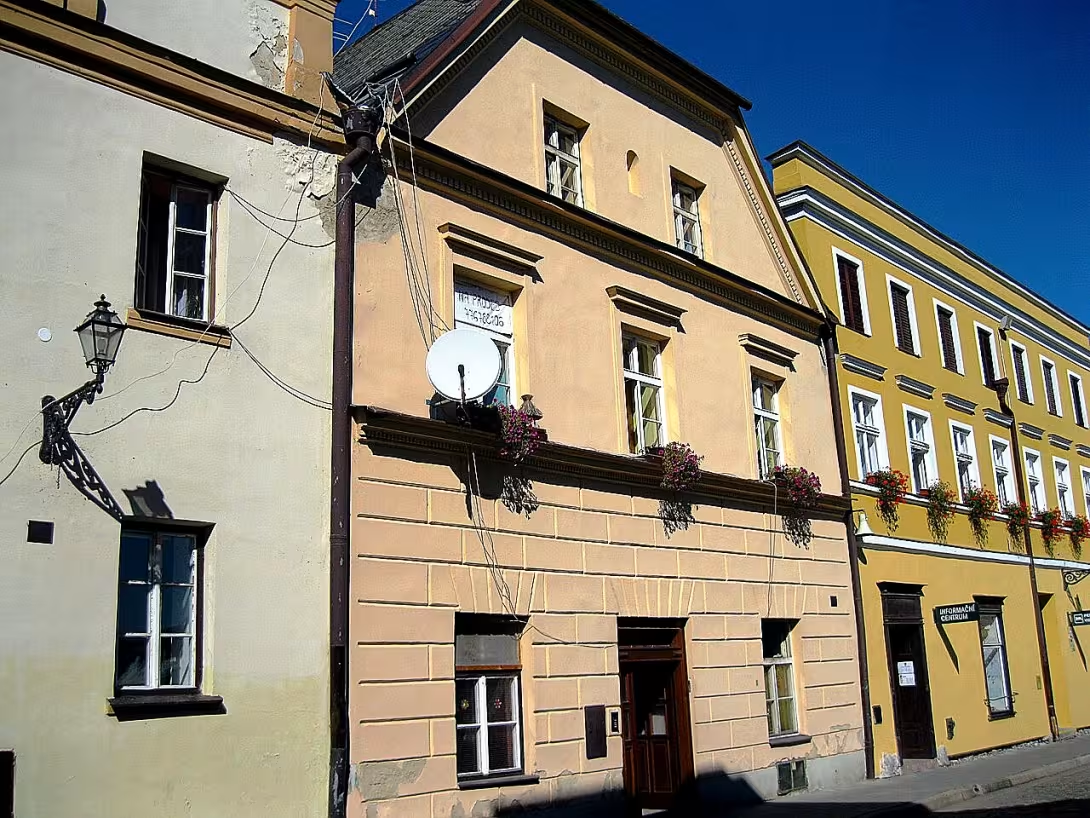
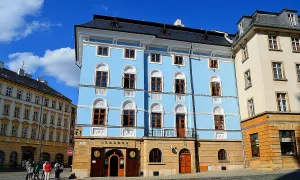
The town house No. 85 in Vidnava, the village in the district of Jeseník, is a key monument to the local historical core. This Empire building built on the medieval core in the first third of the 19th century belongs to the city monument zone Vidnava and attracts attention with its architecture and historical context.
The history of Vidnava is rich in events that shaped its appearance and structure. At the turn of the 15th and 16th centuries there was significant urban development, culminating in 1551 with the construction of the Renaissance Town Hall. After the fire in 1574, the city was rebuilt in the style of the Dolnosleze Baroque, which was the result of another fire from 1713. The 30-year war and the subsequent reconstruction affected the urban development of Vidnava. In the first third of the 19th century, when the city house was built, the whole process of modernization and building development took place in Bohemia.
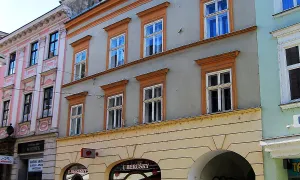
Architecturally, the city house is a one-story three-story building with a saddle roof and a half-wall, which is typical of the Empire style of the time. The front of the house is decorated with a cordon and crown ledge, while the barefoot ground floor contains a portal and windows decorated with rustic. On the floor there are simple window shambles with mantelpiece. Above the main ledge is a trapezoidal (Valb) shield with two windows and a niche for the statue, which gives the construction a characteristic character.
The town house No. 85 was reconstructed in 1975 to meet modern needs and preserve historical character. In 1992, the Vidnava City Monument Zone was declared, leading to consolidation of the historical core of the city. This initiative was key to protecting and maintaining the cultural heritage of Vidnava.
Today the city house is open to the public as part of the monument zone, allowing visitors to explore not only the building itself, but also the overall historical context of Vidnava. The view of this house offers insight into the history of the city and its architectural development. Visiting this place is not only a way into history, but also an opportunity to appreciate the wealth of the cultural heritage of the Czech Republic.
The town house No. 85 in Vidnava is therefore not only an architectural monument, but also a witness of many historical events and changes that shaped the city. His visit offers a unique view of the past and recalls the importance of protecting cultural heritage for future generations.
Historical milestones
- Registration in the list of cultural monuments of the Czech Republic before 1988
Architectural development
The house was built on the medieval core in the first third of the 19th century in the style of empirism and reconstructed in 1975.
Historical events
- 1975
- Reconstruction of the house
- 1992
- Announcement of the urban monument zone and consolidation of the historical core
Points of interest
- Town House No. 85 in Vidnava is a key monument to the local historical core. - This empire building built on the medieval core in the first third of the 19th century belongs to the urban monument zone Vidnava. - The town house was reconstructed in 1975 to meet modern needs and preserve historical character. - In 1992, the city monument zone Vidnava was declared, leading to consolidation of the historical core of the city.
Guide
Show guide text
This text was created by artificial intelligence and has not been editorially reviewed. It may contain inaccuracies.
Welcome to the heart of the historic Vidnava. You've just stopped in front of one of the most important building elements of our city, the city house that carries the number 80. You're standing right on Town Hall Street, in a place where the city's everyday life meets its rich past. When you look at this building as a whole, you're probably immediately interested in its peaceful, balanced and very dignified presence. It is not just an ordinary house, but a fixed point in the architecture of this historic core, which in its form and order is very harmonious throughout its surroundings. Please feel the atmosphere of the place where time has stopped and allow yourself to drift by the images of what this place looked like decades ago.
Now let's go back deep into the past together to understand what's under these walls. Although today's appearance of the house seems to be firm and immutable, its roots extend far beyond what can be seen at first sight. This object was built on a medieval basis. This means that under the current walls and under the pavement of this street are traces of much older history, perhaps even from when Vidnava was still a medieval town with narrow streets and other structures. However, the current form of the house you are currently seeing has formed in the first third of the nineteenth century. At this time, a style called Empire has spread throughout Europe. This style brought to the urban environment the need for order, symmetry and elegance. The townhouse was seen in this period as a symbol of the rise and stability of the local township, which wanted to paint its homes in the modern, noble spirit of the time.
Now pay attention to the details that form the face of this building. Look at its overall structure. It is a three-axis building with one floor which is crowned by a saddle roof with a half-size. This roof construction provides a specific profile for the house, which is perfectly incorporated into the city building. Notice how it is drawn up on the front. It is very richly decorated with a cordon and crown ledge. These horizontal lines are not just decoration, but they serve to optically separate individual parts of the house and give the facade depth and structure.
If you look at the ground floor now, you'll see a very interesting element. The whole part is decorated with barefoot, or rustic. This technique creates a texture on the walls that looks robust and firm, as if the house had very strong and stable foundations. In this part there is also a main portal, i.e. the entrance gate to the house, and windows which are also decorated with this rustic. This contrast between the rugged surface of the ground floor and the smoother areas of the higher floors is a characteristic of the effort for aesthetic diversity at the time.
Let's look a little higher, first floor. Here the style is a little easier and more airy. The windows are surrounded by shamrans, which are supplemented with mantelpiece. This moderate decoration does not burden the eye, but complements the overall harmony of the house and underlines its empirical character. And now, please look up to the very top of the facade. There's a trapezoidal shield above the main ledge. It is a very distinctive element, which optically extends the house and gives it its nobility. The shield contains two windows and also a niche. Although there may not be a statue in it right now, this niche was originally designed for this very purpose in order to gain an even greater artistic and spiritual dimension. This whole composition, from the robust ground floor to the decorated shield, creates a perfect whole.
Although historical records do not directly mention the names of the particular architects who would design this house or the famous personalities who would live here, its existence tells us a very strong story. It's a story about anonymous residents, craftsmen, shops, and everyday life that's been going on here for centuries. This house was part of a living organism of the city. Every detail you see right now was the work of people who wanted to do their work with respect for the craft and the desire for beauty. Even though their names may have disappeared into the sinks of time, their visions and their work here are still alive and allow us to look at the past today.
You might find one interesting thing that connects ancient history to modern times. This house went through a thousand nine hundred seventy-five thorough reconstruction. The aim was not only to repair the old walls, but above all to ensure that the building fully meets the modern needs of today's life while maintaining its historical integrity. It's a fascinating example of how we can protect our heritage and let it live and serve people in every century. It is thanks to these interventions that we can stand here today and admire the state that is so loyal to its original idea.
I hope this brief view of the Municipal House has helped you better understand its meaning and beauty. Before you go on your journey, I suggest you stop for a while and just feel the atmosphere of this place. Look at the details you may have missed at first glance, and try to imagine life in this house 200 years ago. Vidnava has many other hidden treasures waiting for you. Continue to walk through the historical core and be carried away by the beauty of our architecture. Thank you for your attention and I wish you a pleasant continuation in discovering our city.
Tips for visitors
The best time to visit this empirical townhouse in Radník Street is the spring or autumn period, when the weather is friendly for a walk through the historical centre of Vidnava and the light is soft, which will highlight the details of the facade. Since the state of the monument is listed as unknown and there are no other specific places to visit in the vicinity, I recommend focusing on architectural elements of the building itself, such as the barefoot ground floor and cordon ledge, which are visible from the street.
Transport availability is ensured by car and public transport, the current connections and departure times need to be verified in the traffic information search. Parking in the historic centre of Vidnava is usually limited, therefore it is advisable to look for vacancies in the immediate vicinity of Radnice street or use the parking near the square if available.
When visiting, take comfortable shoes for a walk along paved streets and in case of rain an umbrella, because the facade with half-wall and saddle roof is better visible in clear weather. There is no special equipment you should take, but a camera or a mobile phone with a good camera will help you capture details of the Empire style.
Photography is best performed in the morning or afternoon light, which hits the facade at an angle and highlights the texture of the bossing and roms. The best views are from the opposite side of Town Hall Street, where you can capture the entire three-axis composition of the building with one-story floors and a saddle roof. Avoid shooting in the sharp midday sun, which can create hard shadows and reduce contrast details.
Since there are no specific places in the area within 30 minutes of walking on the ground, I recommend to explore only the immediate vicinity of Radní street and possibly ask the locals about other attractions in the centre of Vidnava. For families with children, this monument is suitable as a short stop while walking, where children can observe historical architectural elements, but without the need for long standing or admission if the monument is not open to the public.
Businesses nearby
Do you run a restaurant, accommodation, shop, museum, rental, wellness or other visitor service near this monument? Show yourself directly to the people heading to it — this is how they will see you in the app and on the web:
Nearby
🏰 Historic sites (91)
- Dr. Eduard Schön von Engelsberg 0.1 km
- sv Jan Nepomucký 0.2 km
- Road III / 4539 July-Vidnava reconstruction 0.3 km
- Kamen 3.0 km
- 1945 4.7 km
- Column Holy Trinity 4.9 km
- Pomnik poległych w I wojnie światowej 5.3 km
- Castle Black water 6.8 km
- Marie Kamen 7.1 km
- Monument Victims of Wars and Utilities 7.2 km
- Vápenky 8.0 km
- Vápenky 8.0 km
- Friedrich von Schiller 8.1 km
- Pałacyk myśliwski w Zwierzyńcu 8.1 km
- Kaltenstejn 8.8 km
- Frýdberk 9.1 km
- Mogiła więźniów KL Auschwitz 9.1 km
- Dwór w Trzeboszowicach 9.1 km
- Kamenické muse 9.2 km web
- Marian Columns 9.3 km
🍽️ Restaurants and dining (86)
- Na Rynku 0.1 km web
- Café u Verči 0.1 km
- Jannis 0.1 km
- Blue deer 0.1 km
- Recreation Centre Habina 2.6 km + 420 584 436 034
- Na Rozcests 4.8 km
- Old kino 5.8 km
- Fishing bastion 6.5 km + 420 739 668 982
- Lehna U Kaštánka 7.1 km
- Trail House 7.2 km
- No Brake Bike Bistro 7.2 km
- Guesthouse at the border 7.4 km
- Guesthouse at the crossroads 7.7 km + 420 724 246 387
- Refreshments on Stezce 7.8 km
- Restaurant Black Voda 8.0 km web
- Bike café 8.0 km web
- Radost 8.2 km
- Fawilla 9.2 km
- Guesthouse U Railway station 9.3 km Railway station 74
- Hossovka U Potokax 9.3 km
🏨 Accommodation (66)
- Guesthouse Vidnava 0.0 km + 420 725 636 457 web
- Tourist hostel KČT 0.0 km
- Apartments 0.0 km web
- Blue deer 0.1 km + 420 739 063 806 web
- Cyclokemp Black Potok 2.4 km + 420 727 902 347 web
- HabinA 2.6 km Great Krash 441 + 420 584 436 034; + 420 603 584 765 web
- Accommodation Na statku 4.2 km
- Accommodation Under the mill 6.2 km + 420739703422 web
- Accommodation on Old Faroe 7.0 km + 420 702 062 064 web
- Rychleb trails - Hostel 7.2 km web
- Nigra Aqua Bike Pension 7.2 km web
- Black perla 7.3 km + 420734 544 176 web
- Agroturystyka Niebieski Domek 7.3 km
- Accommodation Na Stezce 7.8 km + 420 723 659 478 web
- Hotel Fast 8.0 km + 420 606 128 290 web
- Kemp u Base 8.0 km web
- Guesthouse U Gladiše 8.1 km + 420 721 647 688 web
- Radost 8.1 km
- AHR accommodation 8.4 km
- Accommodation Daniel 9.3 km Railway station 190 + 420603936218
🚲 Rentals and sport (14)
- Summer swimming pool Great Kraš 1.9 km
- Lane park 11.1 km
- Klub Closing date 12.5 km web
- Przystań żeglarska 12.5 km
- Sportservice Tomše 12.7 km + 420 775 608 705 web
- Climbing wall Javornick 12.9 km
- Indoor swimming pool Javornick 12.9 km
- Sports and breeding equipment 13.2 km
- Swimming pool 13.7 km
- Polski Związek Hodowców Gołębi Pocztowych koło Nysa 14.1 km
- Sport centrum 14.4 km Priessnitzova 1351 / 43a
- Pool 14.6 km
- Motocars Javornick 14.7 km + 420 588 886 644 web
- Hala Sportowa II PANS 14.7 km Otmuchowska 74 + 48 77 5444150
🥾 Hiking and nature (195)
- Park Vidnava 0.5 km
- Exposure of delusional boulders 1.6 km web
- Sandy top 2.6 km
- Stromovka 3.3 km
- Sheep above 3.5 km
- Decisive 4.1 km
- Liberda 4.3 km
- Strawberry 4.5 km
- Smooth top 4.8 km
- Venus bowls 4.8 km
- Kostels 4.8 km
- Chose 5.5 km Kobylla 35 737475273
- Złota Góra 5.5 km
- Guard top 6.3 km
- Plane top 6.5 km
- Stone kopec 6.8 km
- Apla 6.9 km
- PP Black water - cultural house 7.1 km
- Salt kopec 7.2 km
- Silver top 7.2 km
Accommodation nearby
Themed route
Thematic cruise route from Vidnava
1. City House (Vidnava) * Type: * Historical object * Why is it worth visiting: * The town house in Vidnava is an architectural pearl that represents the history of the city. Its elegant Baroque facade and rich interiors are a testament to the history of this village. It is an ideal place for those interested in historical architecture and local history.
2. Church of St. Gilji (Vidnava) * Type: * Religious object * Why is it worth a visit: * The Church of St. Jilji is one of the oldest sacral buildings in Vidnava. Its Gothic elements and history, which dates back to the 14th century, attract visitors who want to know more about the spiritual life of the area.
3. Memorial of the fallen (Vidnava) * Type: * Memorial * Why is it worth a visit: * This monument is dedicated to those who sacrificed their lives here during the wars. It is a place of peace and reflection that resembles the importance of historical events and their impact on the local community.
4. Square (Vidnava) * Type: * Public Square * Why is it worth visiting: * The town square in Vidnava is the center of local life, where residents and tourists meet. Its historical character and friendly atmosphere offer the ideal environment for relaxing and knowing everyday life in this picturesque village.
This route offers a view of Vidnava's key historical and cultural points, allowing visitors to explore its rich past and present.
Seasonal recommendations
In the spring nature awakens the surroundings of the city house to life and fresh green creates a pleasant contrast with the historical facade. Soft spring light is ideal for observing architectural details of the building. We recommend to dress in layered clothes because the weather is getting unstable, and schedule a visit in the morning when crowds of visitors are still mild.
The summer season brings intense sunlight that highlights the colors of the house and surrounding gardens are in full bloom. The atmosphere is playful and energetic. To avoid the biggest groups of people and the heat of the morning, it's best to arrive first thing in the morning. Don't forget light, breathable clothes and plenty of fluids.
Autumn covers the memory with golden leaves and morning fog gives the place a mysterious, melancholy mood. The low sun hits the walls at a sharp angle, creating interesting shadows. Moisture-resistant shoes and a visit in the afternoon, where the surroundings are quieter than in the high season.
In winter, the city house is quiet and cosy, especially if the roof is covered by a layer of snow. Short days and freezing air create contrast with the inner heat of the object. It is necessary to choose warm thermal clothing and to verify in advance the shortened opening hours, which are common in advent time.
Visualizations and artistic views

The visualisations are generated by artificial intelligence and serve as inspiration.
Photos from the area
Real photos taken near the monument


Zdroj a licence jsou uvedeny u každého snímku.
Tips from visitors
No tips yet. Be the first!
Log in and add your tip.
Sources and literature
Fotografie: Lehotsky / CC BY-SA 3.0 — Wikimedia Commons. The author and licence also appear when you hover over the image.
Faktickým podkladem tohoto textu byl článek na Wikipedii, jehož autory jsou přispěvatelé Wikipedie. Článek je dostupný pod licencí CC BY-SA 4.0.
Location on the map
Příběhy a pověsti
Legendy, pověsti a příběhy spjaté s touto památkou
Fotografie návštěvníků
Zatím žádné fotografie. Buďte první, kdo přidá fotografii z návštěvy!
Přihlaste se a přidejte svou fotografii nebo hodnoťte.
Za ověřenou návštěvu v aplikaci získáte víc bodů — poznáme podle GPS, že jste na místě.
Reviews and comments