






Městský dům (Vidnava, 1000139406) House
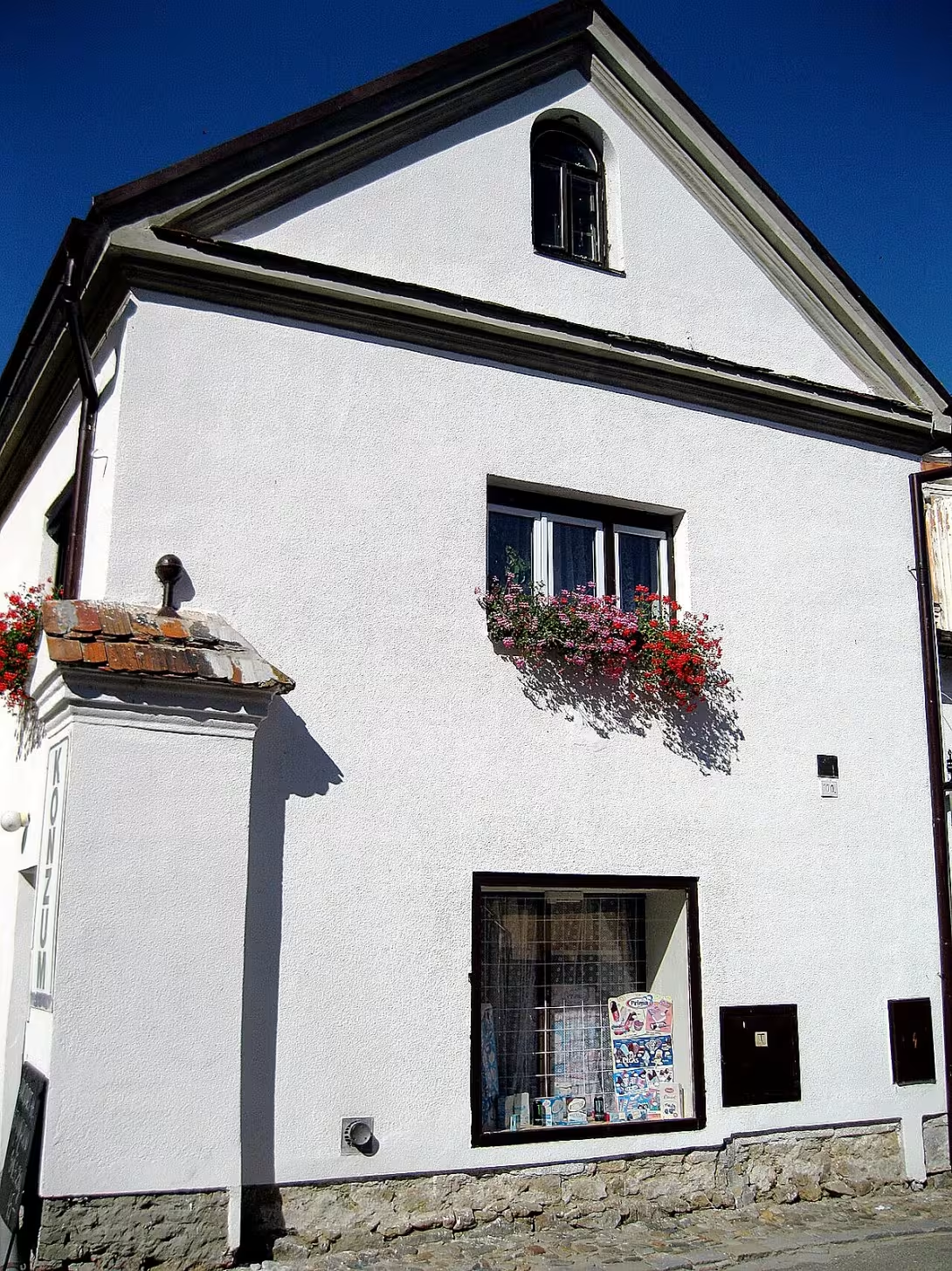
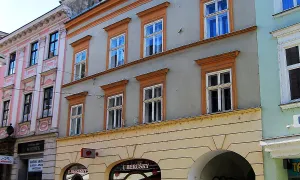
The Městský dům is a well-preserved row house in Vidnava, Jeseník region, dating back to the 18th century. Its unique architecture and rich history make it a significant historical monument.
Origin and Historical Context Built on an old medieval wall site, the Městský dům has roots in the Middle Ages. The Renaissance period saw urban development in Vidnava, with the construction of the town's first city hall in 1551. However, fires in 1574 and 1713 had a devastating impact, leading to decline in the following centuries.
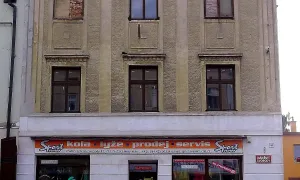
Architecture and Artistic Form The building has undergone renovations, including an Empirical-style makeover in 1866. It features a low-sloping roof with a triangular gable, smooth façade with three-part division on the sides, and a rectangular entrance. The interior spaces have flat ceilings.
Ownership, Administrators, Fortunes Throughout its history, the Městský dům has been restored and renovated multiple times. Although ownership and administrative changes are limited in information, it is clear that the building has undergone significant transformations.
Key Events and Curiosities A fire occurred in Vidnava in 1574, followed by another devastating blaze in 1713. The Thirty Years' War had a profound impact on the city, leading to decline in the following centuries.
Today The Městský dům is an important historical monument offering visitors a glimpse into Vidnava's rich past. Despite renovations and restorations, the building retains much of its original charm. Visitors can explore the unique architecture and learn about history at the site.
Historical milestones
- 1551
- Construction of the town's first city hall
- 1574
- Fire in Vidnava
- 1713
- Another devastating fire in Vidnava
- 1866
- Empirical-style makeover of the building
Architectural development
The building has undergone several renovations, including an Empirical-style makeover in 1866. It has been restored and renovated multiple times.
Historical events
- 1574
- A fire occurred in Vidnava
- 1713
- Part of the city was destroyed by a fire
Points of interest
– The Městský dům is a well-preserved row house dating back to the 18th century.
– The building has undergone renovations, including an Empirical-style makeover in 1866.
– A fire occurred in Vidnava in 1574, followed by another devastating blaze in 1713.
– The Thirty Years' War had a profound impact on the city, leading to decline in the following centuries.
– Despite renovations and restorations, the building retains much of its original charm.
Guide
Show guide text
This text was created by artificial intelligence and has not been editorially reviewed. It may contain inaccuracies.
Welcome to Vidnava. As you stand here in the heart of this historic town, take a moment to simply breathe and observe your surroundings. You are standing directly in front of the Městský dům, a building that serves as a profound testament to the endurance and the evolving character of this community. As you look at the structure before you, you are seeing more than just a row house; you are looking at a survivor. Notice its steady, grounded presence within the streetscape. The building presents a well-preserved face to the world, characterized by its classic row house form. Your eyes might first be drawn to the roofline, where the low-sloping roof meets the sky, providing a sense of understated stability. Above this, the triangular gable rises, adding a geometric elegance that breaks the horizontal lines of the surrounding architecture. It is a structure that does not shout for attention with grand towers or ornate decorations, but rather commands respect through its balance and its quiet, enduring strength.
To truly appreciate what you see, we must travel back through the layers of time, moving away from the present moment and into the deep history of Vidnava. The story of this site is inextricably linked to the very foundations of civic life in this town. Imagine, if you will, the year 1551. During this era, the site where you are standing held a position of immense importance, as it was the location of the town's very first city hall. This was the heartbeat of local governance, the place where the laws were discussed and the future of the community was shaped. However, the history of the Městský dům is not merely a story of political importance, but one of incredible resilience in the face of catastrophe.
The passage of centuries brought great trials to Vidnava. In 1574, a massive fire swept through the town, threatening the very existence of its structures and its people. The community faced another devastating blow in 1713, when another great fire struck, leaving much of the town in ruins. Yet, time and again, the people of Vidnava chose to rebuild. They did not abandon their streets; they reinforced them. This building, in its various iterations, has risen from the ashes of those historical tragedies, embodying the spirit of a town that refuses to be erased by disaster.
Now, let us bring our attention back to the physical details of the building as it stands in the light of the present day. As you scan the façade, notice the texture and the composition of the walls. The façade is notably smooth, providing a clean and composed appearance that allows the architectural lines to speak for themselves. Pay close attention to how the building is organized; there is a rhythmic, three-part division on the sides that lends the structure a sense of mathematical order and classical proportion. This symmetry is a key element of its visual appeal. Moving your gaze toward the center of the building, you will find the entrance. It is a straightforward, rectangular doorway, positioned centrally to anchor the entire composition. It is a simple element, yet it serves as the essential threshold between the public life of the street and the private history held within the walls.
While the building’s origins reach back to the mid-16th century, much of the aesthetic character you are observing today is the result of a significant transformation that occurred much later. In 1866, the Městský dům underwent a major makeover in the Empirical style. This was a period when architectural tastes were shifting toward a sense of refined, disciplined classicism. This makeover was not merely a repair, but a reimagining of the building for a new era. The Empirical influence is what gives the house its sense of poise and its structured, harmonious appearance, bridging the gap between its medieval roots and the modern world.
As you stand here, you might find yourself wondering about the people who shaped this place. Who were the hands that laid these stones? Who were the craftsmen who rebuilt after the fires of 1574 and 1713? Unfortunately, the names of the architects and the specific individuals who lived and worked within these walls have been lost to the currents of time. We do not know the names of the masters who designed the 1866 makeover, nor do we know the personal stories of the families who called this row house their home through the centuries. Yet, in a way, this anonymity adds to the building's mystery. The Městský dům does not belong to a single famous person; it belongs to the collective history of Vidnava. It is a monument to the unnamed many—the builders, the survivors, and the citizens who contributed to the fabric of this town.
There is a fascinating duality to this place that is worth reflecting upon. On one hand, you have a building that has been shaped by destruction—by the fires that threatened to consume the town. On the other hand, you have a building that has been shaped by intentional beauty and the desire for progress, as seen in the 19th-century updates. It is a place where the scars of the past have been smoothed over by the elegance of the Empirical style, creating a seamless blend of survival and sophistication.
As you prepare to continue your journey, take one last look at the Městský dům. Let the triangular gable and the smooth, divided façade serve as a reminder that history is not just something found in books, but something that stands right in front of us, tangible and real. Every stone and every line tells a story of a town that has faced the flames and emerged stronger, more refined, and more beautiful.
Thank you for joining me for this brief moment of reflection. Vidnava still has many more secrets to share and many more stories waiting to be uncovered. I invite you to continue your walk, to look up at the rooftops, to wander down the narrow streets, and to discover the many layers of history that define this remarkable place. Enjoy the rest of your exploration.
Tips for visitors
The best time to visit the Městský dům is during spring or autumn when the weather is mild and sunny, making it ideal for photography.
Parking is available near the Městský dům, and visitors can also use public transportation. The nearest bus stop is a short walk away.
When visiting the Městský dům, be sure to bring comfortable shoes and a camera to capture its unique architecture.
The best spots for photography are around the triangular gable and the smooth façade, with soft morning or afternoon light providing ideal conditions.
For families with children, consider bringing a picnic lunch to enjoy in the nearby park. The surrounding area is also stroller-friendly.
Businesses nearby
Do you run a restaurant, accommodation, shop, museum, rental, wellness or other visitor service near this monument? Show yourself directly to the people heading to it — this is how they will see you in the app and on the web:
Accommodation nearby
Themed route
1. Městský dům – Entrance Hall – *Architectural interior* Begin your walk in the grand entrance hall, where original wooden beams and decorative plasterwork showcase the building’s early 20th‑century civic pride. A brief look at the commemorative plaque introduces the house’s role in Vidnava’s community life.
2. Městský dům – Courtyard – *Open space* Step out into the enclosed courtyard, a quiet oasis framed by historic façades. The paved walkways and mature trees provide a pleasant spot to pause and absorb the atmosphere of the town’s central gathering place.
3. Městský dům – Exhibition of Vidnava History – *Exhibition space* Inside a dedicated gallery, a rotating display of photographs, documents, and artifacts tells the story of Vidnava from its medieval origins to the present day. The concise panels make the local heritage accessible to all visitors.
4. Městský dům – Garden – *Green area* Conclude the route in the modest garden surrounding the house, where seasonal flower beds and a small memorial bench invite reflection. The garden’s layout mirrors the building’s symmetrical design, tying the natural and architectural elements together.
Seasonal recommendations
Spring – As the surrounding gardens awaken, soft morning light filters through the newly leafed trees, casting a gentle glow on the façade of Městský dům. Arrive mid‑week after 10 a.m. to avoid the modest influx of school groups, and wear a light jacket in case of lingering cool breezes.
Summer – The long daylight hours highlight the intricate brickwork, while the town’s leafy avenues provide pleasant shade. Because the main summer season draws both locals and tourists, aim for an early‑morning visit (around 9 a.m.) and bring a hat and sunscreen for the occasional heat.
Autumn – Golden foliage frames the house, creating warm, amber tones that enhance the historic atmosphere. The post‑harvest period sees fewer crowds; a late‑afternoon stroll (around 4 p.m.) lets you enjoy the crisp air, so dress in layers and comfortable shoes for uneven cobblestones.
Winter – In the advent time, the building is illuminated by subtle, festive lighting that accentuates its elegant silhouette against a quiet, snow‑dusted backdrop. Opening hours are shorter, so plan to arrive right at opening, bundle up in a warm coat, gloves, and sturdy boots, and expect a tranquil, almost empty interior.
Visualizations and artistic views


The visualisations are generated by artificial intelligence and serve as inspiration.
Photos from the area
Real photos taken near the monument


Zdroj a licence jsou uvedeny u každého snímku.
Tips from visitors
No tips yet. Be the first!
Log in and add your tip.
Sources and literature
Fotografie: Lehotsky / CC BY-SA 3.0 — Wikimedia Commons. The author and licence also appear when you hover over the image.
Faktickým podkladem tohoto textu byl článek na Wikipedii, jehož autory jsou přispěvatelé Wikipedie. Článek je dostupný pod licencí CC BY-SA 4.0.
Location on the map
Příběhy a pověsti
Legendy, pověsti a příběhy spjaté s touto památkou
Fotografie návštěvníků
Zatím žádné fotografie. Buďte první, kdo přidá fotografii z návštěvy!
Přihlaste se a přidejte svou fotografii nebo hodnoťte.
Za ověřenou návštěvu v aplikaci získáte víc bodů — poznáme podle GPS, že jste na místě.
Reviews and comments