



Městský dům katův House
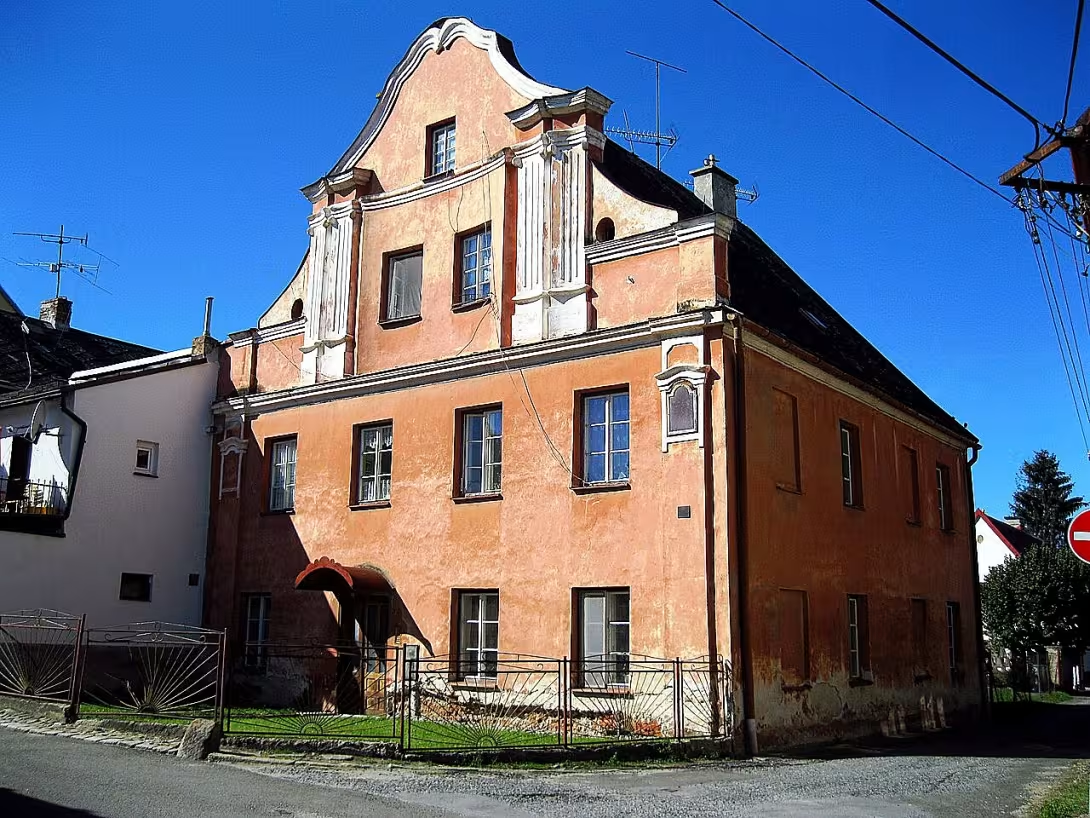
Městský dům katův v Vidnava v okrese The Jeseník is a corner one-story building from the late 18th century, built on the medieval core. The object shows signs of late Baroque and is protected as a cultural monument. It is an important part of the town monument zone of Vidnava.
The oldest history of the building is not well documented, but it is known that the house was built on the medieval core. He gained his present Baroque form in the late 18th century, which was a period of transition from Baroque to Classicism and the development of Enlightenment, and in Czech countries there were reforms of Josef II. The city of Vidnava underwent several stages of development and restoration after fires in 1574, 1632 and 1713.
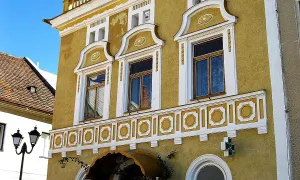
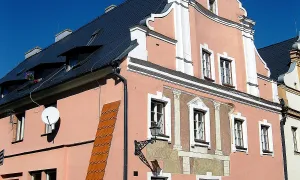
The monument is a one-story four-axis building with a saddle roof. The facade is decorated with corner pilasters with niche for pictures under the crown ledge. The entrance, covered with a tin cap, is on the second axis from the left. Above the main ledge grows a full aetika with associated pilasters connected by the ledge between their heads. Among the pilasters is a concave bent shield with two windows, while the wings above the atics are volute. The ensemble closes the tympanone lined with a ledge with a wound into the volume and ended with a vase; There's a window in the tympanone. The side facade is four-axis, flat-rolled. The interior includes an entrance corridor with a vaulted vault and five-sided lunettes, a corridor in the courtyard with a vaulted vault and rooms with flat ceilings.
The house was registered as a cultural monument on April 10, 1964 and in 1992 it became part of the famous town monument zone of Vidnava. In the second half of the 20th century, several valuable townhouses were destroyed, replaced by panel buildings, but the historical core of the city was later restored.
Today the house of the executioner together with the Renaissance Town Hall, the church of St. Francis of Assisi and other historical objects form the core of Vidnava. The construction is an example of Baroque architecture and urban development of the region.
The object is a unique example of the late Baroque style with a characteristic full atics. The visit allows you to see the history of local township and appreciate architectural details from the end of the 18th century.
Historical milestones
- around 1400
- The formation of the original medieval core of the construction
- end of 18th century
- Getting the present baroque form
- 10 april 1964
- Registration of cultural monuments
- 1992
- Classification into the urban monument zone
Architectural development
The construction was built on the medieval core and was completed in the late Baroque style at the end of the 18th century. The facade is decorated with candied pilasters, volutes and tympanone. The interior contains rolled vaults with lunettes in the corridors and flat ceilings in the rooms.
Historical events
In 1964 the house was registered in the state register of cultural monuments. In 1992 it became part of the declared urban monument zone Vidnava.
Points of interest
- Městský dům katův in Vidnava is a corner one-story building from the end of the 18th century. - The object shows signs of late Baroque and is protected as a cultural monument. - The house was built on the medieval core and gained its present form during the transition from Baroque to Classicism. - It was registered as a cultural monument on April 10, 1964 and is part of the town monument zone of Vidnava announced in 1992. - The house and other historical objects form the core of Vidnava.
Guide
Show guide text
This text was created by artificial intelligence and has not been editorially reviewed. It may contain inaccuracies.
Welcome to Vidnava, a place where history meets the present in every corner. Stop now for a moment and focus fully on the building that stands right in front of you. You stand in front of the City House of the executioner, a building that immediately attracts attention by its location and appearance. It's a corner, one-storey house that defines the space that you are currently in with your stability and character. The first impression that radiates from the building is a sense of endurance and calm, but if you look closely, you'll find that this house has layers of time that go much deeper than it might seem.
Let us go back in time together in spirit to understand how this building was created and why it is so important to Vidnava. Although the house looks as you see it today, its story does not begin in the Baroque era. If we could see through the walls, we would find the house standing on the medieval core. This means that the basic axis and the foundation of the construction was created around the year one thousand forty. So imagine that people were living and working in this place when Europe was a completely different world, when knights and early urban flourishing. But after centuries, the need for modernization came and the house went through a major change. The end of the eighteenth century brought the construction its present form. It was during this period that the house was remodeled to fit the taste and aesthetics that gave it a look that we admire today.
Now, I would like to ask you to pay full attention to the architecture of the house. Look at his facade. The building bears clear features of the late Baroque, which was a style that emphasized dynamics, but at the same time began with a skid to the larger order. Notice how the facade is divided. It's not just a smooth wall, but it has a well-thought-out structure in it. Focus your view on the corner of the house. Do you see the so-called corner pilasters? These are vertical elements that look like flat columns glued to the wall. These pilasters are not just for decoration, but optically hold the whole structure and give it a sense of monumental and strength.
If you look up, above the windows and the roof, notice the full atmosphere. Attica is the top end part of the wall that covers the roof and creates a flat, decorative edge of the building. It is this combination of pilasters and atics that makes the house a typical representative of the transitional period. The architecture here does not end in pure Baroque, but we already feel the arrival of Classicism, which has brought more moderation and balance. It's a fascinating moment in the history of art, when the baroque's stormy emotions begin to calm down into harmonious lines.
And now we stop at what's most fascinating about this house and at the same time a little mysterious. The name Městský dům katův immediately gives us ideas. In every medieval and modern city, Kat was a person absolutely necessary, but socially isolated. He was the man who performed the toughest laws of the state and the city, and that is why he was often forced to live on the outskirts of society, although his house could be in the center of the city. Imagine how people must have felt when they walked past this house. Kat was perceived as someone unclean, someone people were afraid of, but at the same time they showed him special respect. Even though we don't know the specific names of the people who lived here in the past, the very name of the house tells us the story of power, fear and loneliness. It is a silent testimony about how society has been organised in the past and what roles the individuals have played in it.
This house is not just an old building, it's a real monument that deserves protection. In the year one thousand nine hundred sixty-four, exactly ten April, he was officially entered into the records of cultural monuments. That was the moment the state recognized that this building had irreplaceable value for our history and culture. A little later, in the year one thousand nine hundred ninety-two, the house was placed in the town monument zone of Vidnava. This means that the house is not only seen as a separate object, but as a key element of the entire historical city centre. It helps us understand what Vidnava looked like, how it developed and what layers of history it carries.
Now if you look at this one-story house again, you don't just see walls and plaster anymore. You see the bridge between the Middle Ages and the New Age. You see the transition from baroque expansion to classical calm. and feel the presence of people who lived here hundreds of years ago. It's a place where everyday life meets great history.
Thank you for escorting me to this brief glance into the past of the town house of the executioner. I hope you're interested in this building and that you found something in it that interested you. Now I encourage you to walk around the house again slowly, try to observe it from different angles and perceive the atmosphere of this unique place. Vidnava still has many other secrets waiting to be revealed. So come on in and explore the beauty of this city and be inspired by its history. I wish you a pleasant continued journey and many new discoveries. Goodbye.
Tips for visitors
The best time to visit the City House of Katov in Vidnava is in summer months when the weather is favourable and sunny. This period offers the best conditions for exploring historical buildings and exploring the surrounding Renaissance core of the city.
Public transport is easy to reach Vidnava; you can find specific connections and time schedules using a public transport search engine.
When visiting, bring protective clothing such as shoes or sandals suitable for walking on stone paths. An additional element can be a pocket with drinking water and an umbrella, especially if you plan to spend more time outside.
Photography of the City House of Katova offers the best possibilities in the early morning or evening, when light is softer and shadow effects add interest to images. Also remember to include in your photo album the surrounding Renaissance Town Hall and St. Francis Church of Assisi.
For families with children, Vidnava is an ideal destination where they can not only explore historical monuments, but also immerse themselves in the atmosphere of an ancient city. Local parks and green spaces offer opportunities to play outside.
Frequently asked questions
Can the monument be visited?
This is a residential or farm building, not a museum with opening hours. Please view it from public space and respect the owners' privacy. We have no information about access to the interior.
Where is the monument?
Location: Vidnava, Olomoucký kraj. The map on this page shows the exact spot.
Why is the monument protected?
It is listed in the Central List of Cultural Monuments of the Czech Republic as a cultural monument (register no. 1000157301).
Businesses nearby
Do you run a restaurant, accommodation, shop, museum, rental, wellness or other visitor service near this monument? Show yourself directly to the people heading to it — this is how they will see you in the app and on the web:
Nearby
V blízkosti se nachází renesanční radnice, kostel svatého Františka z Assisi a historické jádro města Vidnava.
Accommodation nearby
Themed route
Thematic cruise route: The historical core of Vidnava
1.Městský dům katův - Type: Historical building - Why is it worth a visit: This house is an example of architecture from when people of different religious and cultural traditions could meet in Vidnave. It's a key point for understanding the history of the village.
2. Renaissance Town Hall - Type: Historical building - Why is it worth a visit: This town hall is an important monument to the Renaissance, which testifies to the rich history of city government and architectural art. Her beautiful facades are an essential part of the painting of Vidnava.
3. Church of St. Francis of Assisi - Type: Religious object - Why is it worth visiting: This church is not only a spiritual centre but also an architectural pearl with a rich history. Its interior and artistic elements attract lovers of history and art.
4. Historical core of the city Vidnava - Type: Cultural area - Why is it worth visiting: Walk on the streets of the historic core offers a view of ancient architecture and atmosphere of past times. Every step leads to new discoveries that enrich understanding of local heritage.
This route offers visitors the opportunity to explore the rich history and architecture of Vidnava. Each of the above points is connected to another, allowing comfortable walking within the city centre.
Seasonal recommendations
Spring: In the spring season Městský dům katův in Vidnave appears in its most beautiful glow when flowering shrubs and trees add colored accents to the environment. Sun rays illuminate architectural details, creating ideal conditions for photography. When visiting, it is advisable to wear a playback or a short coat because the morning and evening may appear cooler winds. The best time to visit is the afternoon when the sun is not yet too hot and the crowds are usually less.
Summer: During the summer season, Městský dům katův becomes a popular destination for visitors who enjoy warm sun and quiet time. The atmosphere is full of life, especially in the main summer season when people gather for a walk or relaxation in the surrounding greenery. Today's visitors should come early in the afternoon to enjoy the memory before the crowd begins to accumulate. Don't forget the protective glasses and enough drinking water because the temperature can be high.
Autumn: In the autumn period Městský dům katův in Vidnave offers otherwise engaging experiences. Tree leaves are turned into living shades and the lighting is milder, which allows you to explore the historical house in a more peaceful environment. This period is not as demanding on temperature as summer, but it is still advisable to wear a short coat or plaid on any cool winds. The best time for a tour is again in the afternoon, when the crowd decreases and the atmosphere remains calm.
Winter: In winter Městský dům katův in Vidnave offers unique views under snow cover, when architectural elements appear in new light. The atmosphere is calm and the room is usually warmer due to limited outdoor access. Due to shorter daylight lighting and possible snow heating, it is advisable to visit the monument at noon when the best light is for photography. Don't forget to wear warm clothes, shoes with resistant soles and perhaps an umbrella if you are going to snow.
Visualizations and artistic views


The visualisations are generated by artificial intelligence and serve as inspiration.
Photos from the area
Real photos taken near the monument


Zdroj a licence jsou uvedeny u každého snímku.
Tips from visitors
No tips yet. Be the first!
Log in and add your tip.
Sources and literature
Photos: Lehotsky / CC BY-SA 3.0 — Wikimedia Commons. The author and licence also appear when you hover over the image.
Faktickým podkladem tohoto textu byl článek na Wikipedii, jehož autory jsou přispěvatelé Wikipedie. Článek je dostupný pod licencí CC BY-SA 4.0.
Location on the map
Příběhy a pověsti
Legendy, pověsti a příběhy spjaté s touto památkou
Fotografie návštěvníků
Zatím žádné fotografie. Buďte první, kdo přidá fotografii z návštěvy!
Log in a přidejte svou fotografii nebo hodnoťte.
Za ověřenou návštěvu v aplikaci získáte víc bodů — poznáme podle GPS, že jste na místě.
Reviews and comments