






Mírová 18 Tenement house
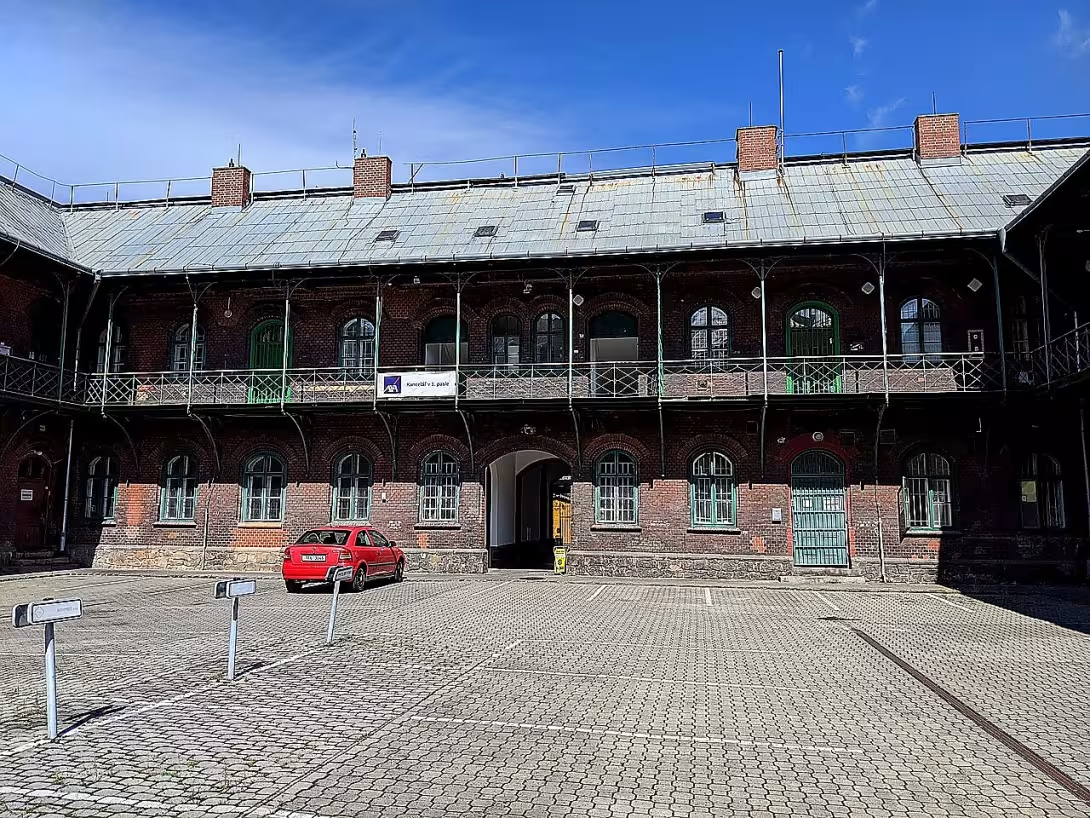
The U-house on Mírová street no. 98 / 18 in Vítkovice is a rental house from 1882-1884, which represents a typical example of historism. The building was built for the employees of Vítkovické ironworks and is part of the cultural monuments of the Czech Republic.
The creation of the building was part of the so-called Nové Vítkovice, a project influenced by Paul Kupelwieser, General Director of Iron Works since 1876. The aim was to improve housing for workers and their families. The house was built according to the original regulatory plan during intensive industrialization, when Vítkovice became the key centre of metallurgy.
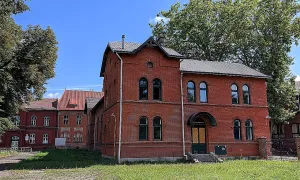
The monument is a one-story building with a U-shaped floor plan, walled from a red brick wall. The roof is made of metal-covered halves. The facade divides the two-axis central risalite into two four-axis parts. The surface is decorated with moldings, profiled sides and metal or carpenter elements; The windows and doors have a half-circle envelope. Rizalite is decorated with a rake.
The yard area is surrounded by an iron continuous platform, accessible by a two-arm staircase from the central passage. In the basement and ground floor there are segmental vaults arched in traverses. The houses included one room, two room and three room apartments for workers and officials; Some units shared an entrance, a hallway and a toilet. The ground floor was multipurpose; One house contained a shop, another library with a reading room. For the needs of the inhabitants, the building was used in the courtyard.
In 1988 the house was registered in the Central List of Cultural Monuments of the Czech Republic and in 1993 the City of Ostrava included it in the protection zone in Vitkovice. St. Paul's Church and other similar steeple house are located nearby.
The building is an important example of the urban development of the industrial centre and social conditions of the end of the 19th century, representing historical architecture in the urban monument zone.
This building offers a view of the planned construction of the workers' colonies and is suitable for a tour of the architecture of Nové Vítkovice.
Then and now
Drag the slider to compare how the landmark may have looked when it was built with the view today.
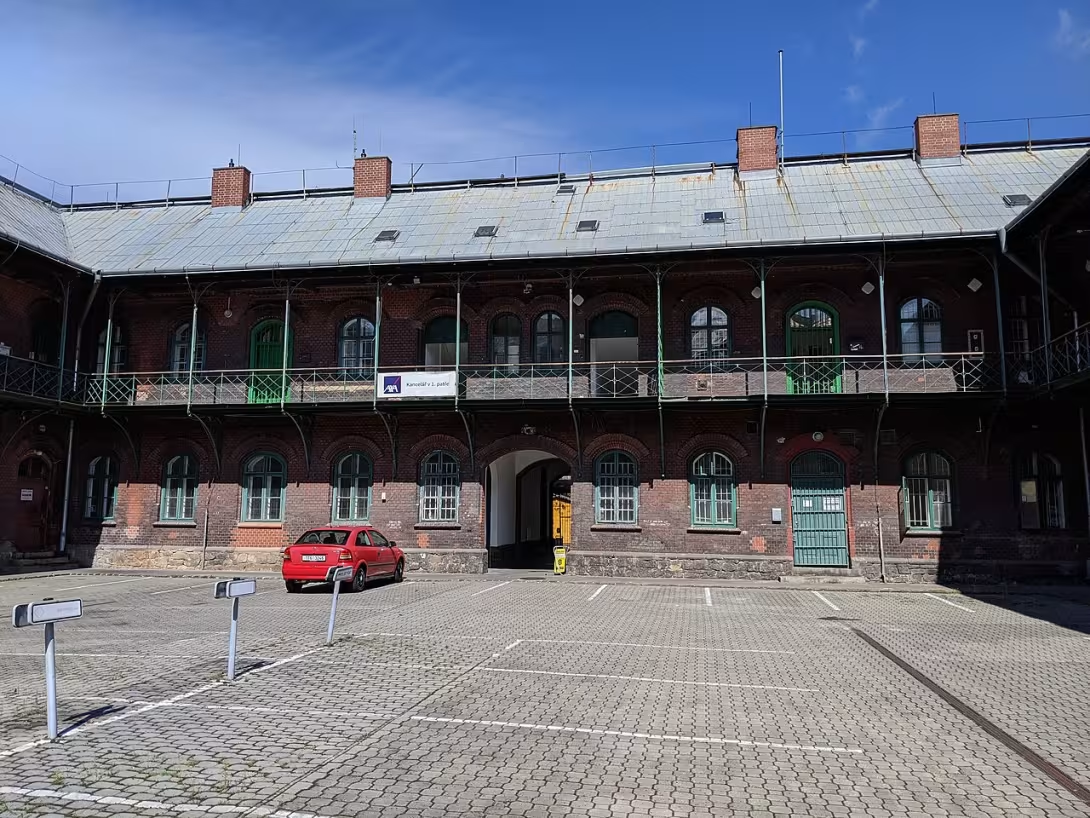
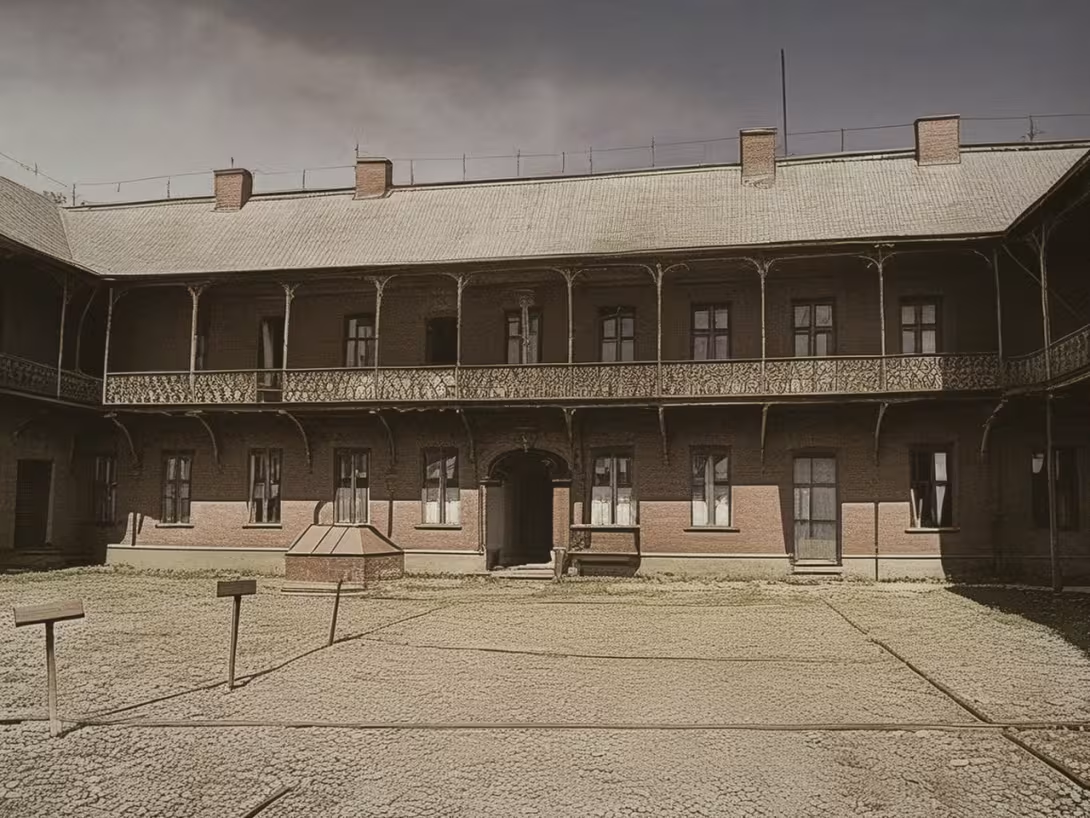
The historical appearance on the left is an AI-generated visualisation and serves as inspiration only.
Historical milestones
- 1882-1884
- Construction of the house within the project Nové Vítkovice
- 1988
- Writing to the Central List of Cultural Monuments of the Czech Republic
- 1993
- Announcement of the conservation zone in Vitkovice
Architectural development
The building is walled from a red brick wall with a halibut tin roof. The facade is divided by moldings and profiled arches, while the central risalite is decorated in the shield with railing. The yard part is surrounded by a covered iron continuous bed.
Historical events
In 1988 the house was entered in the Central List of Cultural Monuments of the Czech Republic. In 1993 it was included in the historical protection zone in Vítkovice.
Points of interest
- The U-house on Mírová street no. 98 / 18 in Vítkovice is a rental house from 1882-1884, which represents a typical example of historism. - The building was built for the employees of Vítkovických ironworks and is part of the cultural monuments of the Czech Republic. - The house was built according to the original regulatory plan during intensive industrialization, when Vítkovice became the key centre of metallurgy. - In 1988 the house was registered in the Central List of Cultural Monuments of the Czech Republic and in 1993 the Municipality of Ostrava included it in the protection zone in Vítkovice. - This building offers a view of the planned construction of the workers' colonies and is suitable for exploring the architecture of Nové Vítkovice.
Guide
Show guide text
This text was created by artificial intelligence and has not been editorially reviewed. It may contain inaccuracies.
Welcome, distinguished visitors. Please stop for a moment, put on your headphones and take a deep breath. Right now, you're standing outside the building on Peace Street under 18. Look ahead. You see a house in front of you that resembles a capital letter "U." It's a building that seems calm at first glance, but it carries the story of thousands of people who once lived and worked here. Feel the atmosphere of this place where the history of industrial expansion meets the everyday life of ordinary people. This house is not just an ordinary brick and mortar building, it is a living witness to the era when Vítkovice turned into one of the most important industrial centers in the region.
Let us now return together in time more than 140 years ago. Imagine the end of the nineteenth century, namely 1882 to 1884. The construction of the so-called New Vítkovice took place here at that time. It was an ambitious project, not only to expand production capacity, but to create a whole new urban organism. Vítkovice ironworks grew at an incredible rate and the number of employees who came here from different parts of the country to find a job and a better future for their families. However, there has been an urgent need to provide these people with decent housing. That's why this house was built. It wasn't a palace for rich owners, it was a rental house for workers and loved ones. The goal was to create conditions that would be better than in the then crowded hostels, and to provide families with safe shelter near their workplace.
Now pay attention to the architecture itself. If you look at the overall composition of the building, notice its characteristic shape. As I mentioned earlier, this is a U-shaped house. This spatial design was not random, but it was used to better organise space and provide light and air for all apartments. Check the front of the house. The building is a typical representative of the so-called historical style. This means that architects, even though we don't know their names today, drew inspiration from earlier epoch to give the building some dignity and aesthetic value, even if it was a house for workers.
The key element to focus on is the stove. The pavor is the open pavement that connects the individual front door to the apartments. It was a very common element of rental houses at the time. Imagine how these campers were boiling in life. It was a place of informal meetings where neighbors exchanged news from workshops, where children played games and where laundry was done. Parvac wasn't just a road to the apartment, it was part of the community's social life. Feel this space available and try to imagine the noise, laughter and the everyday rush that lay out here in the late afternoon when people came back from hard work in ironworks.
Each place is accompanied by specific human destinies. Although the names of architects are forgotten, the name Paula Kupelwieser appears in the annals of this place. It's a character that's connected to the history of this space. Although we may not know every detail of her life today, the very presence of such names in the records reminds us that behind every descriptive number was a real person with his dreams, hopes and concerns. This house witnessed generations of families who grew up here, who rejoiced in the birth of children and who overcame the difficult times of industrial crises.
Now let you enjoy one interesting thing that may not be visible at first sight, but it is essential to understand this place. This house didn't come from random or chaotic. It was built according to the original regulatory plan. This means that the entire district of Nové Vítkovice has been carefully thought out as one large system. Every street, every house and every square had their designated place within the wider development of the territory. This system shows how modern urban planning was at that time.
Another important milestone in the life of the building was 1988. It was then that the house was entered in the Central List of Cultural Monuments of the Czech Republic. That's a very significant recognition. It means that the state recognised the value of this house not only as ordinary buildings, but as a monument to working culture and architecture. A few years later, in 1993, a conservation zone in Vítkovice was announced, which further strengthened the protection of this unique area. By protecting the house, it ensures that future generations can see what housing looked like during the industrial revolution.
If you're standing in front of this building today, you might be wondering why it's so important to keep a house for workers. The answer is that history is not only made up of kings, generals or famous artists. History is also made up of people who went to work every day in hot iron halls, who built this city with their hands and sweat. This house is a monument to their work and their daily struggle for a better life. It is tangible proof of how social conditions changed and how companies tried to look after their employees to keep them close.
Take one last look at the total silhouette of the house. Feel its stability and simplicity, which at the same time emits a certain rhythm. It's the rhythm of work, the rhythm of machines, and the rhythm of human life that's been blending around here for decades. This house on Peace Street is like an open book telling us about the ambitions of the nineteenth century, the development of technology and the need for a human home.
Now I'm slowly saying goodbye. I hope this short trip to history has helped you see more than just old walls in this building. I encourage you to look around in peace now, walk the surrounding streets and try to see the clues of the past in other details of this fascinating industrial territory. Vítkovice has many hidden stories waiting to be discovered. I wish you a pleasant further walk and many new experiences in discovering our common monuments. Goodbye.
Tips for visitors
The best time to visit this historic building is spring and autumn days, when the weather is mild and the surrounding greenery give the building a peaceful atmosphere. The morning clock is ideal for quiet walks without a larger crowd, which allows better appreciation of architectural details of the house from the end of the nineteenth century.
Access to the monument is provided by a road network in the cadastral territory of Vítkovice. If you go by car, look for a parking lot in the immediate vicinity, as it is a residential and historical zone. For passengers by public transport, the location is available, specific connections and departure times are recommended, however, to verify in the current timetable or in the search engine as they can change.
For a comfortable tour take with you fixed shoes suitable for pavement and possibly uneven surfaces. Although it is an exterior monument, it is advisable to have a light jacket with you, because the stoves and open spaces can be windy. We also recommend adding more drinks if you plan to stay longer around.
The best light for photographic images is in the morning or late afternoon hours, when the sun falls at an angle and emphasizes the texture of the facade and the depth of the steeple corridor. Try looking at the angle that captures the characteristic U-shape of the building. Since there is a church of St. Paul and another similar building, you can include these objects in a composition to compare architectural elements of the same era.
For families with children, the surroundings are suitable for short walks as it is a relatively quiet zone. Children can observe historical elements such as wooden balconies and windows. Since the church of St. Paul and the second similar steeple house are located in the immediate vicinity, you can explain to children the differences and similarities between these structures, which is an interesting educational activity without the need for long travel.
Businesses nearby
Do you run a restaurant, accommodation, shop, museum, rental, wellness or other visitor service near this monument? Show yourself directly to the people heading to it — this is how they will see you in the app and on the web:
Events nearby
Zdroj akcí: otevřená data měst a obcí ČR (Národní katalog otevřených dat) a kalendář akcí Národního památkového ústavu.
Nearby
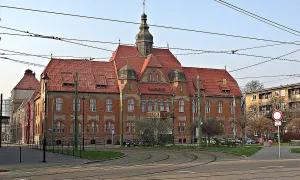
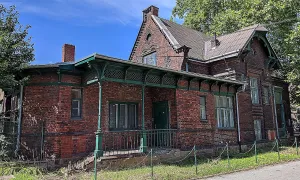
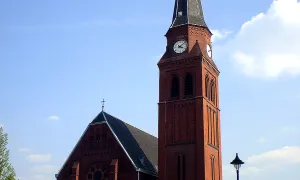
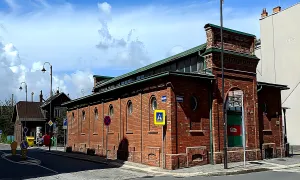
V bezprostřední blízkosti se nachází kostel sv. Pavla a druhý podobný pavlačový U-dům.
Accommodation nearby
Themed route
Thematic cruise route from Vítkovice
1.Mírová 18 - Type: Historical and industrial heritage - Why is it worth a visit: Mírová 18 is a unique example of the historic working estate that reflects the life and culture of the industrial era. Visit this place to understand the importance of industry for the region and its heritage.
2. St. Paul's Church - Type: Religious and architectural monument - Why is it worth a visit: St. Paul's Church is an important element of local architecture with its unique partridge design that attracts attention to its historical and aesthetic values. It's a place of calm and reflection near industrial monuments.
3. Second stump U-house - Type: Historical building - Why is it worth a visit: A similar church of St. Paul, this steeple house represents architectural innovation and the history of living conditions in the industrial era. This is another example of how workers' housing was designed for efficiency and community.
This route offers a view of the history and architecture of Vítkovic, showing links between industrial development and local culture.
Seasonal recommendations
Spring: During the spring season, Mírová 18 excels with its lighting, when the sunlight penetrates between buildings and illuminates architectural details. Flowers begin to bloom around the monument, which adds a colored element to the environment. The atmosphere is full of recovery and hope. It is recommended to visit in the semicolon when the sun illuminates the entire area but be careful of sudden chills. A good outfit is a warm shirt and a short jacket that can be postponed once the sun heats up the air.
Summer: Summer at Peace 18 brings long days full of light and warmth. The atmosphere is revived by the activities of people in quiet areas around the monument, making the visit ideal for relaxation. More visitors may appear this season, so it is advisable to come at early dawn or later in the evening to explore the site without unnecessary waiting. Don't forget your sunglasses and UV cream.
Autumn: In autumn Mírová 18 becomes a place with melancholy but comfortable atmosphere. Leaves falling from trees add a colored element and create fine patterns on the road. The sun is hiding earlier, so it is advisable to visit the place in the middle of the day to be able to fully explore the memory at best lighting. It is recommended to wear layered clothes that allow adjustment to the temperature.
Winter: Winter visit to Peace 18 offers a unique atmosphere where rooms and outdoor environments add moisture and cold to their character. Sunbeams shining through the clouds give the building a romantic look. The monument is less visited, which allows a peaceful tour. Visit her early in the morning or later in the evening because the opening hours are shorter. Remember warm clothes and moisture protection.
Visualizations and artistic views


The visualisations are generated by artificial intelligence and serve as inspiration.
Photos from the area
Real photos taken near the monument


Zdroj a licence jsou uvedeny u každého snímku.
Tips from visitors
No tips yet. Be the first!
Log in and add your tip.
Sources and literature
Photos: MartinVeselka / CC BY-SA 4.0 — Wikimedia Commons. The author and licence also appear when you hover over the image.
Faktickým podkladem tohoto textu byl článek na Wikipedii, jehož autory jsou přispěvatelé Wikipedie. Článek je dostupný pod licencí CC BY-SA 4.0.
Location on the map
Příběhy a pověsti
Legendy, pověsti a příběhy spjaté s touto památkou
Fotografie návštěvníků
Zatím žádné fotografie. Buďte první, kdo přidá fotografii z návštěvy!
Log in a přidejte svou fotografii nebo hodnoťte.
Za ověřenou návštěvu v aplikaci získáte víc bodů — poznáme podle GPS, že jste na místě.
Reviews and comments