



Mnichovice Fortress
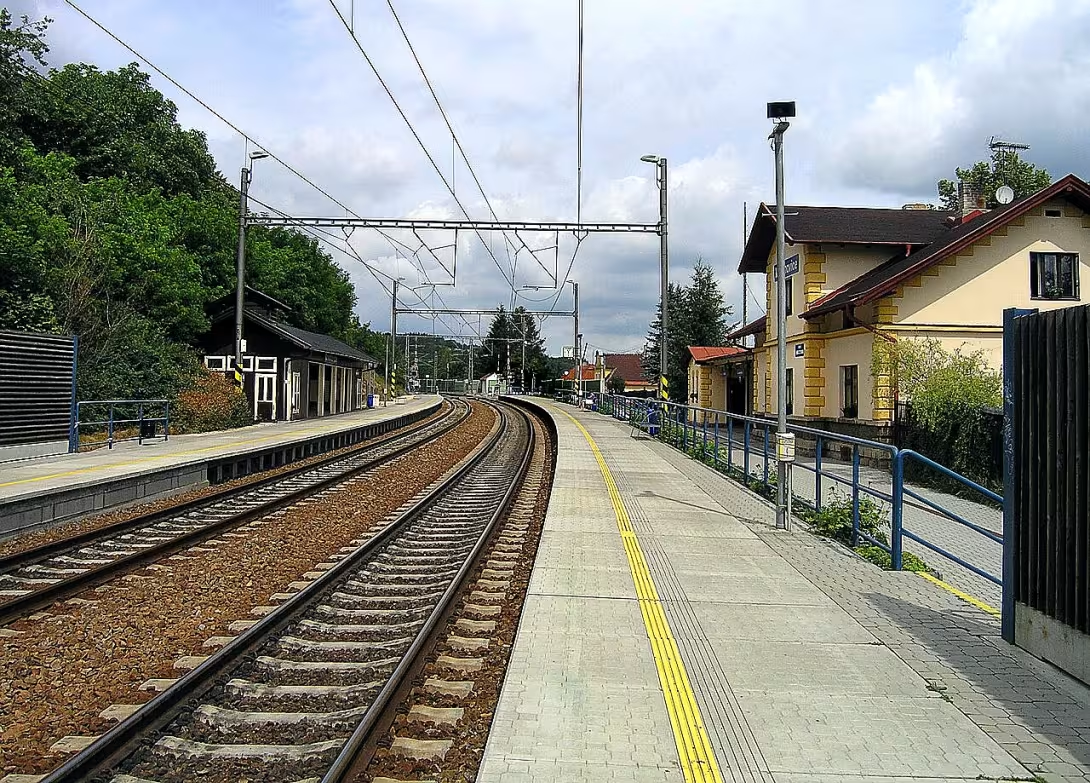
Mnichovice, also known under local name On Valech or Valy, there's a dead tower fort. It lies on the eastern edge of the village of the same name southeast of Market Stephen in Benesov district. This medieval monument is today protected as a cultural heritage. It is a document of a small aristocratic residence which has been swallowed up by modern buildings over the centuries.
The foundation of the fort dates back to the 14th century, that is, the period of the blooming of the Czech state under the rule of Luxembourg. There was an intensive settlement of the countryside and the building of small nobles. The first written mention of the owners dates back to 1379. At that time, Havel and Boten, who had military duty to the chateau in Market Stephen, were reminded.
The building was classified as a tower fortress. The fixing of the site was a double wall and moat. The historian August Sedláček states that in the past he was fed water from the adjacent Munich pond. There was also a grafted round well. It was preserved on the property of house No. 73 until 1960 when it was buried. Today the original form of the fortress is largely hidden under family houses No 70 and 73.
After the initial blossom, the seat function of the fortress collapsed at the end of the Hussite wars. In 1436 he acquired the village for the security of Mikuláš Trčka z Lípy, which managed it from Vlashimi. They belonged to the own estate Mnichovice until 1547. That's when Jindřich Kekule ze Stradonic bought them together with Křevsoudov Chateau and other villages. In written sources from 1550 and 1622, the object is already explicitly mentioned as desolate.
Location On Valech today is an important reminder of the medieval history of the region, even though the original building left only the terrain signs in the form of parts of the waves and moats. For those interested in the history of the Czech countryside, this place represents an opportunity to recognize the defunct form of aristocratic settlements whose significance gradually faded over the centuries. Visiting the site offers you the opportunity to think about changes in the landscape and how modern construction has transformed the original historical space.
Historical milestones
- 1379
- First written mention of the chateau owners.
- 1436
- The village was pawned by Mikuláš Trčka z Lípy.
- 1550
- For the first time, the fortress is marked as desolate in written sources.
- 1960
- The flood of the historical grafted well on the property of house No. 73.
Architectural development
The fort was tower-type and its fortification formed a double wall and moat, which was probably powered by water. There was a grafted round well, which was only covered in 1960. Today the location is built houses no. 70 and 73.
Historical events
1379 first written mention of owners, 1436 acquisition of the fortress by Nicholas Trčka from Lipa, 1550 first mentioned as desolate.
Owners
Havel and Boten (1379), Mikuláš Trčka z Lípy (from 1436), Hlashim Manor, Jindřich Kekule ze Stradonic (from 1547).
Points of interest
- The fort is also known under local name Na Valech or Valy. - The fortification of the site was a double wall and moat that had been fed in the past by water from a nearby pond. - There was a grafted round well which was preserved on the property of house No. 73 until 1960. - The original form of the fortress is today largely hidden under family houses no. 70 and 73. The first written mention of the owners, Havel and Brenen, dates back to 1379.
Guide
Show guide text
This text was created by artificial intelligence and has not been editorially reviewed. It may contain inaccuracies.
Welcome to Munich. Stop for a moment, take a breath and feel the silence of the surrounding countryside. You are standing in a place that may at first glance look like a common meadow or a slightly wavy terrain, but beneath your feet and in the surrounding area a fascinating history. In front of you, a location known as the Na Valech Fortress is spreading. It is a place where a tower fortress once stood, the seat of the people who lived here, fought and raised the country at a time when the Czech landscape was much more dangerous and divided than today. Even if you don't see any tall walls or grave towers today that dominate the horizon, the landscape itself tells you its story. Note the landscaping and atypical earth inequalities. These are the silent witnesses to the existence of this desolate nobility.
Let us now return together in time, deep into the 14th century. Imagine the time when the first scrubs and walls began to rise here. The fortress of Munich was probably founded at this very time as a typical residence of small nobles. At the time, it was not just a representative housing, but a functional object. The owners of these small chateaux had a clearly defined obligation, which was military service. They were knights and nobles who, if necessary, had to be prepared to go to battle for their master or king. The first written mention of the owners of this place dates back to three hundred seventy-nine. Names such as Havel z Mnichovic or Boten z Mnichovic are now just records in archives, but at that time they were people who decided the fate of the village and raised the surrounding territory.
Now pay attention to what surrounds you. Even though the fort as a building has died, its defense system is still visible in the field. Look at the surrounding space and perceive the line of hills and deepening. The fortification of this site was a very clever system of double wall and deep trench. Imagine what these moons looked like at the time of their greatest glory. It wasn't just piles of dirt, but carefully built barriers that were supposed to make it impossible for the enemy to have easy access to the main building, the tower fort. What is truly fascinating, however, is the way in which the moat was maintained. In the past, he was fed water from a nearby pond. The water was one of the best defensive weapons at the time. Introduce yourself as an assailant who must overcome a muddy, filled with water moat and then try to cross off a steep wall while being seen from a height by armed men from a fortress. This combination of water and land made Munich a safe haven for local nobles.
But the history of this place is full of breakthroughs. The key period was the Hussite wars that shook the whole Czech kingdom. It was at this time that the fort began to lose its original function. Military technology was changing, the nobility's needs developed, and the small tower strongholds could no longer provide such protection as before. In the year of the thousand and four hundred and thirty-six there is an interesting figure of Nicholas Trček from Lipa, who won the village for collateral. The Trčkovsky were a powerful family at the time, and their presence here shows the strategic or economic value of this place. Later, the name Henry Kekule from Stradonice was connected to the location. Each of these men brought to Munich a different story, different ambitions and different visions.
But over time, fate has changed. After joining the Hlashim estate, Mnichovice lost its role as a separate residence. The fortress was no longer needed as a military support point or as an administrative centre. In a thousand and five hundred and fifty, for the first time, a devastating sign appears in the written sources that the fortress is desolate. It was the beginning of a long process of extinction. The walls began to crumble, the wood rotted, and nature slowly began to take back what man had taken from her centuries ago. What you see today as a slight ripple of terrain is actually just the remnants of a once proud mansion that was consumed by time and oblivion.
But in order not only to see the emptiness, let me tell you about one interesting thing that brings us back to modern times. There was a grafted round well in the fortress area. The well was the heart of every mansion, the source of life, and in case of siege, the only way to survive. This particular well was a fascinating link between the Middle Ages and our time. It was located on the property of the house with the number seventy-three, and was preserved here until the year one thousand nine hundred sixty. Imagine people in the year one thousand nine hundred sixty could still see and touch something that probably existed here from the beginning of the fort. Unfortunately, however, the well was filled in that year. It's a sad reminder of how easily we can lose the physical traces of our history if we don't give them enough attention.
Today the Na Valech site is protected as a cultural monument. It's a place to think about the fleeting power and material things. You're standing here in a place where the fates of the petty nobles clash, where orders for military service were made, and where the dream of an inescapable fortress disappeared quietly. Even if you can't see the walls anymore, feel the atmosphere of this place. Try to imagine the sound of the hooves of horses, the noise of water in the ditch and the view of the surrounding landscape from the top of the tower that once stood here.
Now, I encourage you to take a slow look around and try to find out for yourself in the field for traces of the waves and ditches. Go around, see the shape of the earth, and think about the people who walked here centuries ago on the same paths as you. The Munich fort may have disappeared physically, but her spirit remained in the landscape. Thank you for joining me on this short journey in time. I wish you a pleasant exploration of this silent witness history and a happy continuation of your travels through our beautiful landscapes. Goodbye.
Tips for visitors
The best time to visit is spring or autumn, when vegetation is not so dense and ruin can be better explored. In the summer months, the building can be overgrown and less accessible.
The location is most easily reached by car on local roads in the vicinity of Market Štěpánov.
We recommend fixed shoes for the field and long pants because you move in the area of ruins and adjacent green. Remember the repellent and plenty of fluids, there are no services at the site.
The best light to capture the remains of the tower fort is during the golden watch just before sunset. Focus on the details of the masonry in contrast to the surrounding nature.
In the vicinity you can visit the Munich pond or go to Krovsoudov Chateau. For families with children the trip is more suitable as a short stop when traveling through the countryside, the terrain is not suitable for prams.
Frequently asked questions
Can the monument be visited?
This is a ruin. Such sites are often freely accessible, but some can only be visited with a guide or are closed for safety reasons. We have not verified the current situation – take care and respect any restrictions.
Where is the monument?
Location: Středočeský kraj. The map on this page shows the exact spot.
Why is the monument protected?
It is listed in the Central List of Cultural Monuments of the Czech Republic as a cultural monument (register no. 1000131538).
Businesses nearby
Do you run a restaurant, accommodation, shop, museum, rental, wellness or other visitor service near this monument? Show yourself directly to the people heading to it — this is how they will see you in the app and on the web:
Nearby
Trhový Štěpánov, Mnichovický rybník, hrad Křivsoudov.
Accommodation nearby
Themed route
1. Market Stephen (city) - The trip begins in the historic centre with a beautiful square. 2. Munich pond (water area) - A place to relax and walk in nature near the fortress. 3. Mnichovice (fortress) (monument) - The main item of the program, which represents a unique example of a fortified mansion. 4. Křivsoudov Chateau (Chateau) - Final stop at the vast ruins of the medieval chateau.
Seasonal recommendations
In the spring the hardening of Munich will surround the awakening nature and the lush green, which creates a gentle contrast with the grey stone of ruins. The atmosphere is full of hope and light is soft, which is ideal for walking. We recommend moisture-resistant shoes for wet journeys and a visit in the morning before the sun burns.
The summer season brings rich green trees and sharp shadows that highlight the structure of the remaining walls. The air shakes the heat and the monument acts in full sun very monumentally. To avoid the biggest crowds in the season, come first thing in the morning. Don't forget light clothes and plenty of fluids.
The autumn turns the surroundings into a sea of gold and red colors, which, combined with fog, give the ruins a mysterious and melancholy touch. It's the best time to capture dramatic images in the setting sun. Due to the variable weather, choose layered clothes and a warm sweater.
In winter, Mnichovice is coiled under a layer of snow, which will lower the surroundings and highlight the geometry of the ruins. The landscape is a mess and quiet. Pay attention to warm clothes and solid shoes with anti-slip sole. Count on a shorter opening time and we recommend a visit in the morning when the most light is.
Visualizations and artistic views


The visualisations are generated by artificial intelligence and serve as inspiration.
Photos from the area
Real photos taken near the monument

Zdroj a licence jsou uvedeny u každého snímku.
Tips from visitors
No tips yet. Be the first!
Log in and add your tip.
Sources and literature
Faktickým podkladem tohoto textu byl článek na Wikipedii, jehož autory jsou přispěvatelé Wikipedie. Článek je dostupný pod licencí CC BY-SA 4.0.
Location on the map





Příběhy a pověsti
Legendy, pověsti a příběhy spjaté s touto památkou

Fotografie návštěvníků
Zatím žádné fotografie. Buďte první, kdo přidá fotografii z návštěvy!
Log in a přidejte svou fotografii nebo hodnoťte.
Za ověřenou návštěvu v aplikaci získáte víc bodů — poznáme podle GPS, že jste na místě.
Reviews and comments