






most Miloše Sýkory Bridge
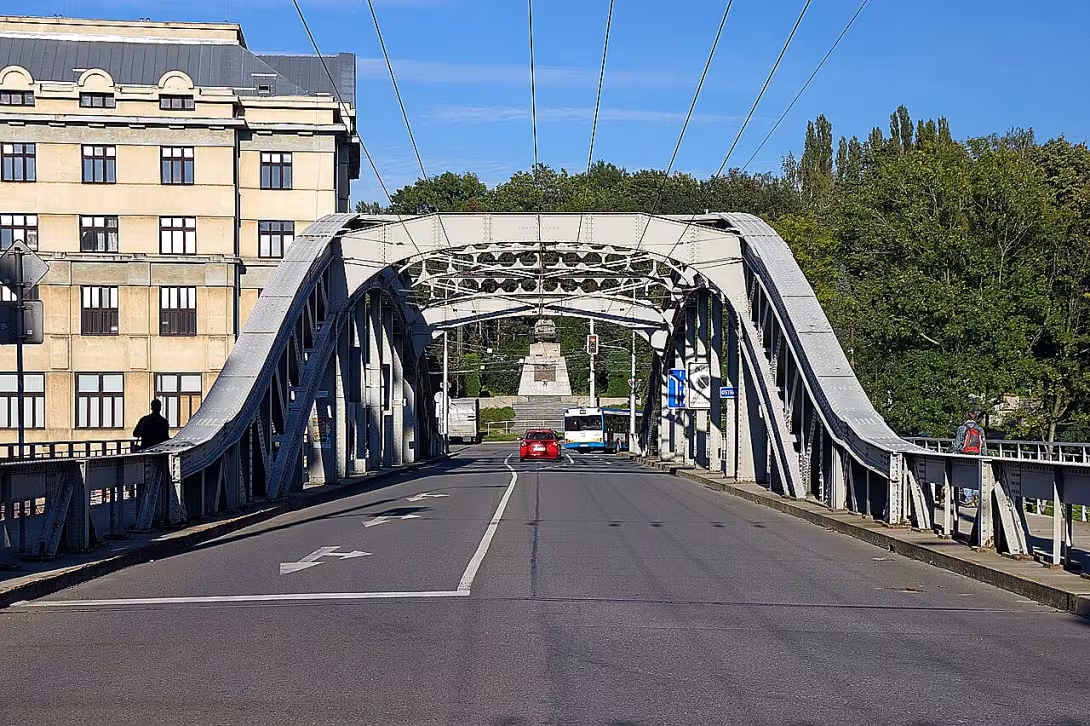
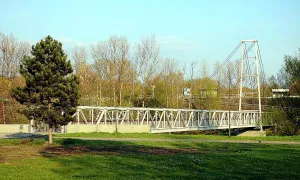
Milos Bridge Sýkora is a steel riveted arch bridge with a lower bridge which crosses the river Ostravice and connects both Moravian and Silesian parts of Ostrava. This technical object in the village Slezská Ostrava, in the district of Ostrava-město, Moravian-Silesian Region, was built in 1912-1914 and is an important historical monument of the region.
Imagine the time before the railway: the key road was the Reich road connecting Opava to Těšín. The first mention of crossing via Ostravica dates back to 1450. In the 1930s, a wooden bridge was built on eight goats, but it required exchange for one year. Between 1851 and 1886, a chain bridge designed by Josef Seifert was served here, made in the Kleinovsky ironworks in Sobotín. The construction was run by Antonín Lerch, but floods caused delays. This bridge was destroyed in an accident in 1886, when its construction, under the influence of the movement of shvadrones, shrunk and collapsed, which required four human lives. It followed the steel Reichsbridge, which after diverting traffic in December 1912 was stolen.
The current construction, also known as the Reichsbridge, was built by Mostarna Vítkovické ironworks according to the design of engineer B. Hermann from Friedrich Bleicher's design office. It's a steel riveted arc bridge with a bottom bridge. The total length of the bridge is 92 metres and the width including the pavements is 16 metres. The wagon has a width of 10 metres, while the sides are located walkways with a width of 2,5 metres. The main steel lattice arch has a range of 60.7 meters and a 7 meter rise. During the installation of the structure, riveting took place manually using pneumatic hammers.
Construction took place in 1912-1914. In order to maintain operation, a temporary wooden bridge of 80 metres long with 10 pillars was built during the construction, which was sufficient for heavy goods vehicles. In July and August 1913, floods in Ostrava caused damage to the dug pits and tore down half of the temporary pedestrian pavement. The installation of the iron supporting structure was completed in 14 assembly weeks, followed by another three weeks for completion work on the pavement and railings.
The object received its current name according to the legend of Milos Sykor. According to one version, which was promoted primarily by the postwar communist government, this turning machine and member of the communist youth saved the bridge on 30 April 1945. At that time, the tanks of the 1st Czechoslovak independent tank brigade drove into the city centre while the Nazis conquered the bridge to prevent the advance of the Red Army.
The bridge underwent a total reconstruction in 1979 and other extensive repairs took place in 2002 from May to August. Today, it is an important connecting element between the two parts of the city, witnessing the industrial history of the region and its technical value is worth an attentive view.
Then and now
Drag the slider to compare how the landmark may have looked when it was built with the view today.
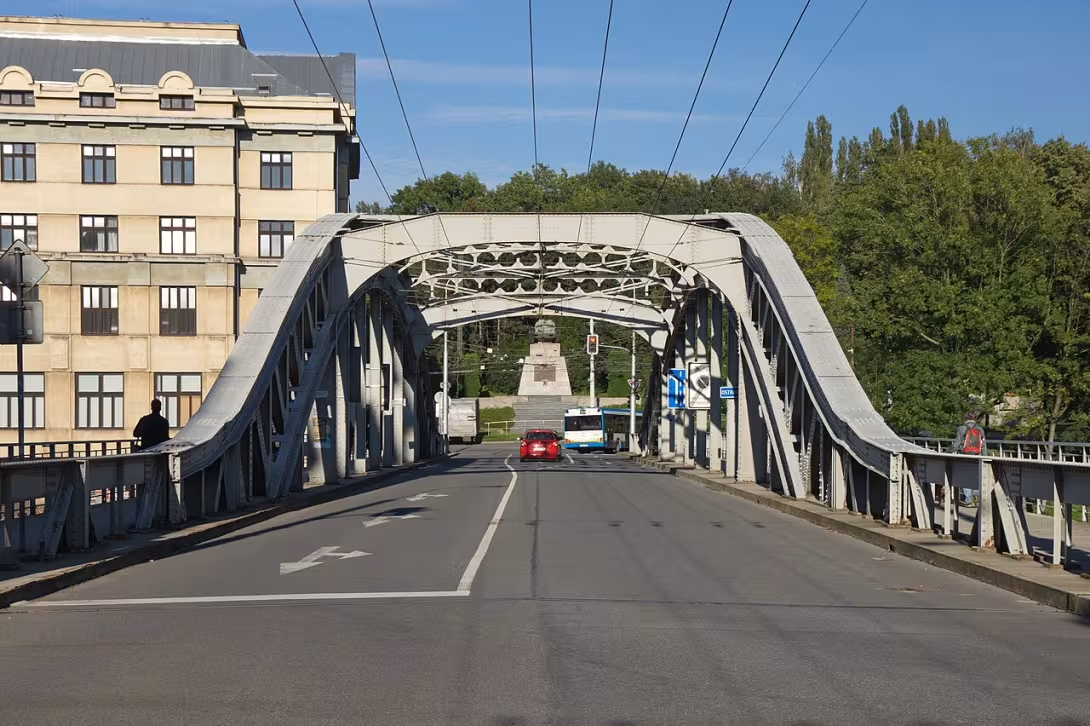
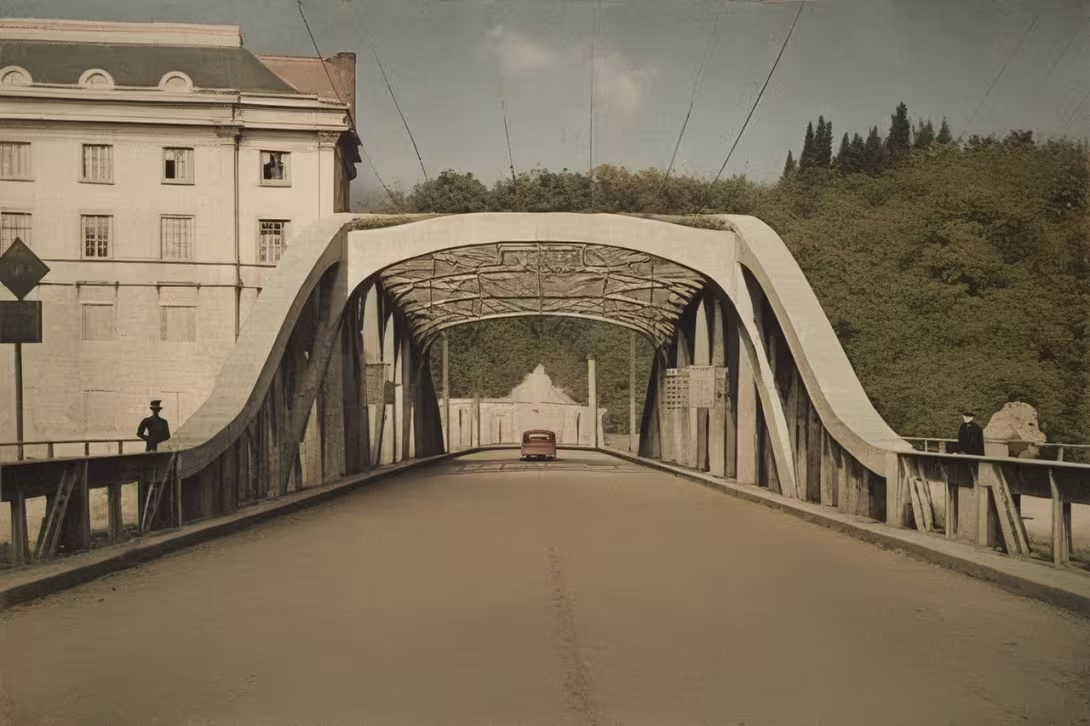
The historical appearance on the left is an AI-generated visualisation and serves as inspiration only.
Historical milestones
- 1886
- The destruction of the chain bridge.
- 1912
- Divert traffic through the old steel Reichsbridge.
- 1979
- Total bridge reconstruction.
- 2002
- Another bridge reconstruction.
Architectural development
The bridge was built on the basis of the project Ing. B. Hermanna and Friedrich Bleicher. Its construction took place in 1912-1914, when the riveting technique was used to connect the steel structure.
Historical events
- 1851
- The position of the chain bridge (Kettenbrücke), which was destroyed in 1886.
- 1912
- Divert traffic through the old steel Reichsbridge.
- 1979
- Total bridge reconstruction.
- 2002
- Another bridge reconstruction.
Owners
The sequence of owners with years if available, otherwise zero.
Points of interest
- It is a steel riveted arc bridge with a lower bridge which was built in 1912-1914. - Between 1851 and 1886 there was a chain bridge, which was destroyed in 1886 in an accident caused by the movement of redfish. - The total length of the bridge is 92 meters and its main steel lattice arch has a span of 60.7 meters. - The object got its name according to the legend of Milos Sykor, who, according to one of the versions, saved the bridge from Nazi rendition on April 30, 1945. - During the assembly of the structure, riveting took place manually using pneumatic hammers.
Guide
This guide is narrated by a synthetic voice generated by artificial intelligence.
Show guide text
This text was created by artificial intelligence and has not been editorially reviewed. It may contain inaccuracies.
Welcome to Milos Sýkora Bridge. You are standing in a place that is absolutely crucial to the city of Ostrava because it is not just a common link between two shores, but a real bridge between two historical worlds. Look at the monumental steel structure that stands before your eyes. Feel the weight and stability this steel colossus radiates. It is here, at this point, that the Moravian part of the city meets the Silesian part. This steel curve, which floats above the surface, is a symbol of a connection that had to cross not only the river, but also time and many technical obstacles. Can you feel the power of the material that resists all the weather and constant movement of the city? This bridge is not just a transport point, it is a living witness to the industrial era that shaped the face of our entire region.
Now let's go deeper into time and understand why this bridge looks like this. To understand its current form, we must return to the period when Ostrava began to become an industrial centre. The history of this place is much more stormy than it might seem. In the middle of the nineteenth century, there was a completely different type of connection - a chain bridge that was a modern way to overcome the water flow. But in 1886 there was an event that changed everything fundamentally. The old chain bridge was destroyed in an accident that was caused by the movement of huIans. This event required an immediate solution and transport had to be carried through the then steel Reichsbridge. It is this need to establish a permanent, solid and modern connection between the Moravian and Silesian parts of the city that has led to the construction that you are now observing in 1912 to 1914. This bridge was therefore born out of the need for stability and progress, so that historical city casings could better connect in a rapidly growing urban environment.
Now pay attention to what's right in front of your eyes. Take a look at the details that are absolutely characteristic of this. It is a steel riveted arc bridge with lower bridge. If you look closer at the connection of individual steel elements, you'll see thousands of rivets. Each of them was the result at the time of precise manual work, a symbol of the then top technology that required great skill and patience. This bridge was not built randomly; His creators, engineer B. Hermann and Friedrich Bleicher, designed the construction to be not only functional but also technically perfect for its time. Notice the elegant geometry. The main steel lattice arch has a range of sixty-seven metres, which is an impressive technical performance at the time of its creation. The total length of the bridge is 92 meters. Notice how the steel curve is floating above the water, and the road itself is located below the main arc. This method of construction creates a unique silhouette, which can be recognized from a great distance and which gives the whole area its specific industrial character.
And now I'm telling you something that remains hidden in these steel elements, but that gives this place its unique atmosphere. Imagine the dramatic scene from 1886. Imagine a group of riders in their rich uniforms, chandrons of hulans, passing through this place. Imagine the sound of their hooves, the weight of their gear, and the unexpected moment when the old chain bridge under them began to collapse. It's fascinating how one unfortunate accident, caused by the simple movement of horses and soldiers, managed to destroy the connection at the time and force engineers to find new, much more resilient solutions. So this bridge that is standing today is in some sense the answer to the chaos at the time. It is a monumental monument to how humanity learns from mistakes and how technology develops to be able to handle even the least predictable situations.
Even though this bridge seems indestructible, we need to realise the care it requires to continue serving. This steel giant has passed many trials over time. It was not just a passive element in the landscape, but a living part of the city that had to face increasing traffic and constant wear. In order to maintain his integrity and security, he had to undergo major changes. In 1979 the whole construction went through a complex reconstruction, which was to restore its original strength and stability. Another important phase came in 2002, when further extensive intervention was carried out so that the bridge could safely serve modern generations and modern traffic. It's proof that even steel, even though it's so solid, needs a human hand and technical care to keep connecting people and parts of the city.
Now that you have learned the basic story of this steel giant, I suggest you continue your walk. Feel the atmosphere of this place where history meets the daily movement of Ostrava. Maybe the next time you look at the rivets and the massive arc, you'll see yourself in a completely different light. Feel the connection between the past and the present that is going on here, under your feet, every second. Thank you for spending this moment with us and for being interested in the details of our city's soul. We're going to brighten you up and look forward to seeing more interesting places around. I wish you a beautiful continuing journey.
Tips for visitors
The best time to visit Miloš Sýkora Bridge is in the spring or autumn season when the weather is pleasant and fewer people. This time of the season also offers the most beautiful lighting conditions for shooting the bridge, especially at dawn or in the evening when the sun is lower and illuminates the arc of the bridge in a special way.
Parking in the vicinity of Miloš Sýkora bridge can be limited, therefore we recommend using public transport. The best way to get there is to use bus or tram connections that can easily be found using an online search engine. If you're using a car, look for a parking lot near Ostrava.
When visiting the Miloš Sýkora Bridge, remember suitable shoes and clothes. It may be useful to carry sun or rain protection, depending on the weather. Photographers should take a camera and maybe even a tripod for better photos.
There's a lot to see around Milos Sýkora Bridge. Within 30 minutes you can visit the historical center of Ostrava, where you can find many cultural monuments and restaurants. For families with children it is also possible to visit some amusement parks or museums in the surroundings.
Frequently asked questions
Is most Miloše Sýkory open to the public?
Yes, most Miloše Sýkory is open to the public. There are special tours for groups and schools.
How do I get to the place by car / public transport?
Milos Bridge Sýkora is available by car and public transport. You will find it near the centre of Moravian Ostrava, so it is easy to get there by bus or tram.
How much is the entrance fee and is it paid on the spot?
Admission is paid on site, the current price list can be found on the official site of the sights.
Is the tour suitable for children and seniors?
Yes, the Miloš Sýkora Bridge tour is suitable for all ages. There are special tours for families with children and seniors.
How long does the tour take?
The length of the tour depends on the number of visitors, but usually lasts around 30 minutes.
What are the opening times and booking is required?
The opening times of the Miloš Sýkora Bridge vary according to the season. You will find up-to-date information on the official site of the sights.
What's interesting in the immediate vicinity?
In the immediate vicinity you will find other historical monuments of Moravian Ostrava, such as the church of St. Wenceslas or the building of the Town Hall.
For kids
A fascinating adventure on the bridge of Milos Sykora!
112 years ago, in 1914, Milos Sýkora Bridge was built as one of the most modern bridges in the country. It was a steel riveted arch bridge with a lower bridge connecting the Moravian and Silesian parts of Ostrava.
At that time there were many people around the river Ostravice who used the bridge to cross over to the other side. They were people who worked in the mines, agriculture or industry. The city was full of life energy and movement.
Businesses nearby
Do you run a restaurant, accommodation, shop, museum, rental, wellness or other visitor service near this monument? Show yourself directly to the people heading to it — this is how they will see you in the app and on the web:
Events nearby
Zdroj akcí: otevřená data měst a obcí ČR (Národní katalog otevřených dat) a kalendář akcí Národního památkového ústavu.
Nearby
🏰 Historic sites (215)
- Memorial of Miloš Sýkora 0.1 km
- Petr Bezruč 0.1 km
- Memorial Liberation of the Red Army 0.1 km
- Museum Kelticek blacksmith 0.2 km
- sv Jan Nepomucký 0.2 km
- Hermine Wechsberg 0.2 km
- Otto Pick 0.2 km
- Memory plate of Ostrava Synagogue 0.2 km
- Greta Pick 0.2 km
- Karel Kryl 0.3 km
- sv Florian 0.3 km
- Marian Columns 0.3 km
- Masaryk 0.4 km
- Ostrava Museum 0.4 km
- Rozena Schönfeld 0.5 km
- Adolf Rix 0.5 km
- Bedřiska Rixová 0.5 km
- Zborová memorial 1st and 2nd foreign trade fair 0.6 km
- _ 0.6 km
- Jos. Gregora 0.6 km
🍽️ Restaurants and dining (898)
- Čajna U Sýkor mostu 0.1 km 28 October 2 + 420596120105
- Garden of Eden 0.1 km 28 October 102 / 1 + 792 685 039
- Lajka lives 0.1 km 28 October 572 / 4
- Dock 0.1 km
- Cafe Trieste 0.1 km
- Ibo Kebab 0.1 km
- BUMBUM 0.1 km Havlíček's waterfront 101 / 28
- Crispy Frank 0.1 km
- Cafe no. 10 0.2 km
- Hogo Fogo bistro 0.2 km Sokolská Class 6 + 420 774 854 665
- Mama's Bistro 0.2 km + 420 737 049 245
- MD restaurant 0.2 km Sokolská Class 2657 / 3
- Shambal Bar 0.2 km
- Mamasita Tapas Bar 0.2 km
- Malö kafe 0.2 km
- Happy sandwich 0.2 km Masaryk Square 24 / 13
- Milky bar NAPROTI 0.2 km
- Minikina kavárna 0.3 km
- Babetti Ristorante 0.3 km + 420 722 131 211
- Conception - Bistro & Bar 0.3 km Na Hrad 546 / 8 + 420 608 385 834
🏨 Accommodation (78)
- Hotel Imperial 0.6 km Tyršova 211 / 4 + 420 599 099 099
- Hotel Mercure Ostrava Centr 0.6 km
- Hotel Maria 0.6 km
- Kampus Palace 0.7 km + 420 777 101 615
- Hotel Best 0.7 km Keltickova 1297 / 60
- Hotel Brioni 0.8 km
- Polish house 1.0 km Poděbradova 1152 / 53
- Hotel Na Kafkové 1.4 km Kafkova 1380 / 15
- Nikolas 1.6 km + 420 596 134 000
- Quality Hotel Ostrava City 2.1 km + 420 595 195 000
- city-city 2.1 km
- Jan Maria 2.2 km
- Hotel Max Šimek 2.3 km Railway station 839 / 186
- Student Residence Silesia, a.s. 2.5 km + 420555558231
- Accommodation Center Exhibition 2.6 km
- VP1 2.6 km
- Harmony Club Hotel Ostrava 2.6 km + 420 596 652 111
- Cheap accommodation Ostrava 3.1 km Overhead 285 / 35a + 420 777 708 447
- 69 3.1 km Nightingale 657 / 8
- Hotel Taurus 3.2 km Teschen 1382 / 260
🚲 Rentals and sport (125)
- HUDYsport 0.3 km + 420596115176
- Joma 0.4 km Na Hrad 1161 / 5
- D-Sport Outlet 0.4 km
- D-Sport 0.4 km
- Bang bang 0.5 km + 420 734 876 767
- Cargo Bike Daddy 0.5 km Sokolskaya Class 318 / 39 + 420 721 573 679
- Via ferrata Bazaly 0.7 km
- Alpsport 0.7 km
- Cycles. cz 0.8 km Railway station 385 + 420 773 594 957
- Husky 0.8 km
- Swimming centre 1.0 km
- A3 SPORT 1.0 km
- Intersport 1.0 km
- Swimming pool 1.0 km
- Kilpi 1.1 km
- D-Sport 1.1 km
- Čapkova sokolovna 1.2 km
- Bonver Arena 1.2 km
- Trojhalí Karolina - Central 1.2 km
- SC Ostrava 1.2 km
🥾 Hiking and nature (218)
- Farska Garden 0.3 km
- orloj 0.5 km
- Rovnin Boulders 0.5 km
- Golik's sad 0.5 km
- New Radnice 0.6 km
- All-Held Sad 0.7 km
- Park Czechoslovak flyers 0.7 km
- View for the whole Ostrava 0.7 km
- Water plant Hladnov 0.8 km Non-edible 1844 / 14
- Park Ernsta Kornerax 0.8 km
- Tylova sad 0.8 km
- Bezručová sad 0.9 km
- Chakharov prospect 1.0 km
- Garden presence 1.1 km
- Comenius orchards 1.3 km
- 306 1.3 km
- Halda Ema 1.3 km
- halda Ema 1.4 km
- Park War veterans 1.5 km
- Flamination 1.8 km
Accommodation nearby
Themed route
Thematic cruise route: Milos Sýkora Bridge and surroundings
1. Milos Sýkora Bridge (bridge) * Why is it worth a visit: * This bridge is not only an important transport connecting part, but also a monument to modern engineering. It was created as part of the development of local infrastructure and bears the name of the distinguished architect Miloš Sýkora.
2. Park by the bridge * Why is it worth a visit: * The park adjacent to the bridge offers a beautiful opportunity for relaxing and walking in a quiet green garden. It's an ideal place to relax after exploring the bridge itself.
3. Local Market * Why is it worth a visit: * Market near the bridge is a living center of the local community where regional products and food can be discovered. It's a great way to dive into the local spirit and atmosphere.
4. Historical street in Silesian Ostrava * Why is it worth a visit: * Walk on the historic streets of the village offers a view of architecturally interesting buildings and houses that tell about the rich past of Silesian Ostrava.
5. Cultural Center * Why is it worth a visit: * Cultural center offers diverse programs and events that are open to both local and travellers. It's a great way to learn more about the cultural life of the area.
This route will guide you not only through Miloš Sýkora bridge, but also through other interesting and cultural surroundings.
Seasonal recommendations
Spring brings freshness and awakening nature to the region of Silesian Ostrava, which begins to take green shades around the bridge. Lighting is soft and pleasant in this period, which creates an optimistic atmosphere for walks. We recommend a visit in the morning when the air is the cleanest. It is advisable to prepare layered clothes because the morning temperatures may still be low, even if the sun is already shining.
In the summer months the atmosphere is the most lively and the days are the longest, allowing observation of the monument even in the late evening. The sun shines intensively, highlighting the details of the structure, but can also cause unpleasant heat. Due to increased movement of people and high temperatures, it is best to come early in the morning or just before sunset. Don't forget light summer clothes and plenty of water.
Autumn is characterized by fog and golden colors of surrounding vegetation, which gives the place a calm and a little nostalgic touch. The lighting is lower in this period and the colors are more rich, which is ideal for photo lovers. At this time there are fewer visitors than in the high season, so you can enjoy the memory in greater privacy. Prepare for wind weather and get dressed in waterproof and wind-proof jackets.
Winter turns the surroundings into a cold and quiet landscape where snow or frost can create fascinating, albeit freezing, views on the bridge construction. The light is very limited and the days are short, so it is best to plan a visit around noon. Due to low temperatures and open water space, it is necessary to wear very warm clothes, including caps and gloves, and to choose fixed shoes in case of ice.
Visualizations and artistic views


The visualisations are generated by artificial intelligence and serve as inspiration.
Photos from the area
Real photos taken near the monument


Zdroj a licence jsou uvedeny u každého snímku.
Tips from visitors
No tips yet. Be the first!
Log in and add your tip.
Sources and literature
Photos: Hons084 / CC BY-SA 4.0 — Wikimedia Commons. The author and licence also appear when you hover over the image.
Faktickým podkladem tohoto textu byl článek na Wikipedii, jehož autory jsou přispěvatelé Wikipedie. Článek je dostupný pod licencí CC BY-SA 4.0.
Location on the map
Příběhy a pověsti
Legendy, pověsti a příběhy spjaté s touto památkou
Fotografie návštěvníků
Zatím žádné fotografie. Buďte první, kdo přidá fotografii z návštěvy!
Log in a přidejte svou fotografii nebo hodnoťte.
Za ověřenou návštěvu v aplikaci získáte víc bodů — poznáme podle GPS, že jste na místě.
Reviews and comments