






most na Veslařský ostrov Bridge
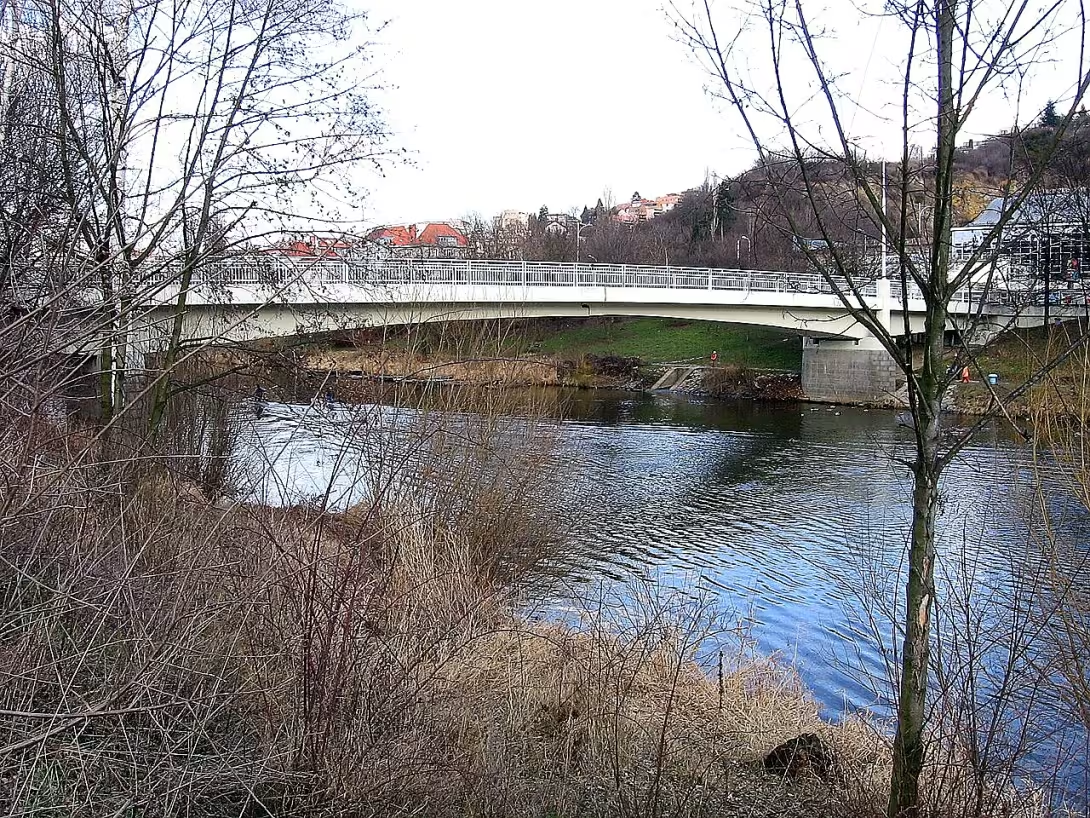
The bridge was built between 1956 and 1958 and allows for walking and car access from the Podolsky waterfront on the right bank of the Vltava to the Vallar Island. As the first construction of its kind in Czechoslovakia, the summer concrete method was first used here, which proved to be an effective way to quickly create bridge structures without the need for extensive supports.
The construction consists of three fields of different ranges. The outer parts of the bridge are 12.75 metres and 12.55 metres, while the central field is 45 metres. The total length of the bridge is 70.4 metres. The technical solution was separate. The outer field was concreted monolithic on the pane, which is a solid support on the shore. On the other hand, the two main components of the central field were built gradually, after each piece of length 2,3 or 3 metres, thus achieving flexibility in the construction process.
He participated in the project Research Institute of Construction, which tested new methods and procedures here. The success of this construction had a long-term impact on Czech construction. The knowledge gained from the construction of the bridge on the Věslářská island was used in the design and implementation of larger and more technically demanding bridge works, especially in the construction of the famous Nuslání Bridge, which also draws on these experiences.
Today the bridge serves as an important transport link and at the same time it became a witness to the figure of Czechoslovak technology of the 1950s. The visitor can see here a unique example of the application of modern building solutions when architects and engineers tried to find new ways to bridge obstacles with the least effort and maximum efficiency.
Then and now
Drag the slider to compare how the landmark may have looked when it was built with the view today.
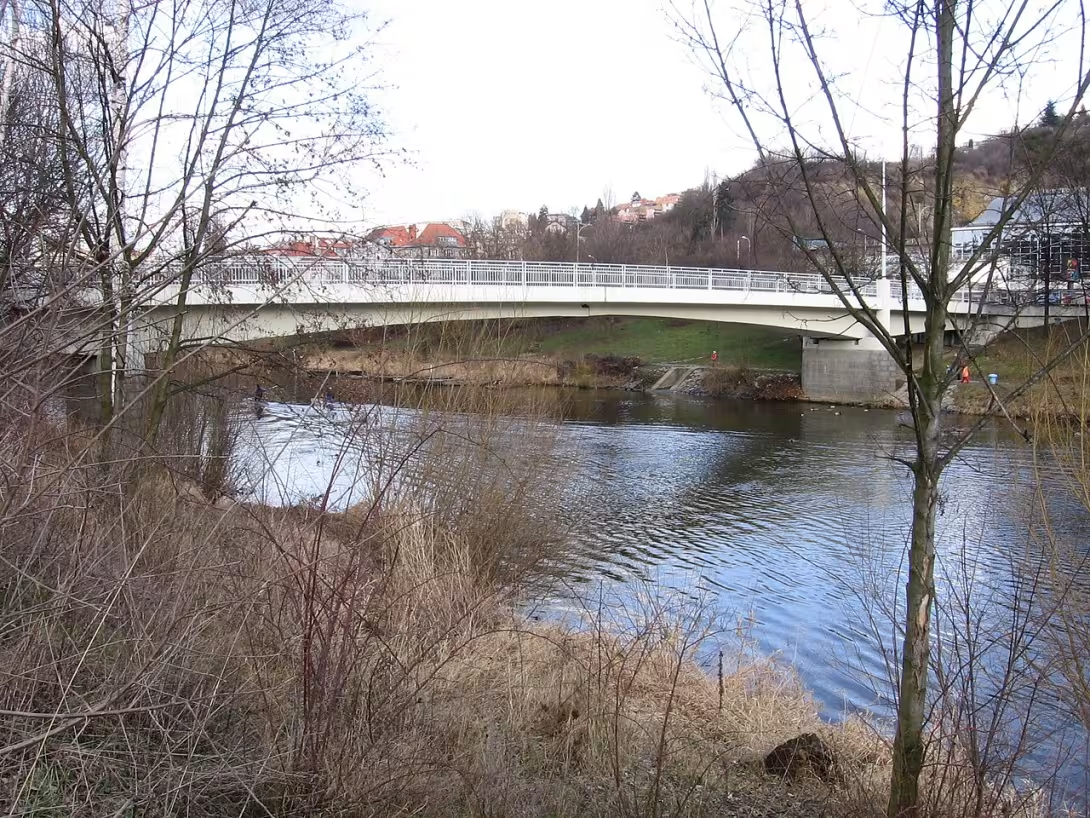

The historical appearance on the left is an AI-generated visualisation and serves as inspiration only.
Historical milestones
- 1956-1958
- Opening of the bridge construction on the Veslařská island, the first Czechoslovak building with the metód of summer concrete.
- 1958
- The completion of the bridge, which allowed pedestrian and vehicle access from the Podolské waterfront to the oars island.
- around 1958
- The research institute of construction production tested the innovative concrete method which influenced Czech bridge construction.
- 1960-1970
- Experience from the bridge used to build other ma
Architectural development
The bridge was built as a steel construction with concrete elements. The mid-field was concreted gradually after parts of a length of 2.3-3 m, while the outer field was concreted monolitically on the pane. The technology of summer concrete was new in Czech bridge construction and influenced other projects.
Historical events
- 1956
- The beginning of the construction of the bridge on the Vestřská island as a breakthrough project in Czech bridge construction.
- 1958
- Complete the bridge and put it into service.
Points of interest
- The bridge was built between 1956 and 1958 and was the first construction of its kind in Czechoslovakia, where the method of summer concrete was first used.
- The bridge consists of three fields with different ranges: two extreme measures of 12.75 and 12.55 metres, the centre is 45 metres, the total length is 70.4 metres.
- The middle field was concreted gradually in parts of 2.3 or 3 metres long, while the outer field was monolithic concrete on the pantry.
Guide
This guide is narrated by a synthetic voice generated by artificial intelligence.
Show guide text
This text was created by artificial intelligence and has not been editorially reviewed. It may contain inaccuracies.
Welcome to the beautiful Prague Podolí, a place where the city meets the calm level of the Vltava and where you can forget for a moment the hustle and bustle of the city. Right now, you're standing in front of a construction site that may seem subtle at first glance, but it is a real milestone for the construction world. Look before you at the bridge that connects the Podolské waterfront to the OVSC. It is a link that will now open your way to the green island, but it is also a monument to courage, experiment and technical progress.
Stop for a moment and feel the atmosphere of this place. In front of you is a structure that was built in 1956 and completed in 1958. To understand why this bridge is so special, we need to move back a few decades in time. Imagine the 1950s. It was a time when engineers tried to find new and more effective ways to overcome the water flows and valleys without having to build complex and expensive support in the river bed. It is here, in Podolí, that it has decided to try something that has never been done in Czechoslovakia before.
Now pay attention to the structure itself. The bridge you see is steel, but its true secret lies in the method it was established. Notice its shape and the way it relies on its pillars. This bridge was the first Czech construction where the so-called technology of summer concrete was used. Maybe this term sounds foreign to you, but imagine it as a process in which the bridge grows gradually, piece by piece, from support to space, as if it were floating in the air. The concrete carrying of the beams took place gradually, which enabled the construction without the need to install massive formwork under the entire length of the bridge. It was an entirely innovative solution at that time that made this little bridge a real open-air laboratory.
If you look at the bridge up close, try to divide its length in your mind. The entire bridge is 70 and four decimals, over 70 meters. It consists of three fields, which are the individual sections between the supports. If you look at the extremes, you'll see two shorter fields. One of them has a range of twelve and three quarters of a meter and the other has twelve and one half of a meter. They're stable anchors holding the bridge on both sides. But now look in the middle. This is where you'll find the most interesting. The median field is 45 metres. It is the dominant part of the bridge that demonstrates the strength and precision of engineering at the time. It was in this long central section that the method of summer concrete was most visible and it was she that made it possible to overcome the distance so elegantly.
This bridge was not built just so that people and vehicles could easily get to the oars island. It was mainly a scientific experiment. In 1958, the Research Institute of Construction tested its latest theories here. The engineers here have tried how the material behaves, how it responds to the load and whether this new method is really reliable. Imagine those people in white coats and with blueprints in their hands, who were watching with tension to see if the construction would behave exactly as they calculated in the offices.
It is here that we come to why this bridge is important for the rest of Prague. The experience gained in Podolí has not become a forgotten archive. On the contrary, they have become a valuable basis for future generations of builders. In the decade from the 1960s to the 1970s, knowledge from this small bridge was used to build much larger and more complex projects. One of the most important examples is the famous Nusel Bridge. If not courage and experiments here, in Podolí, the construction of some of Prague's works might have taken place quite differently or lasted much longer. So this little bridge was actually a teacher for those big bridges that we see today as a matter of course the urban landscape.
It is fascinating to think that what we see today as simple access to the island was once the cutting edge of technology. It is a reminder that great progress often starts with small steps and bold tests in places where no one would have expected it. Although today we do not know the names of the particular architects who designed this project, their signature is in every inch of this steel and concrete construction. Their work survived for decades and continues to function, connecting the waterfront to the island's nature.
When you are now preparing to cross the bridge, try again to look at its total silhouette. Feel the contrast between the strength of the material and the lightness the concrete has brought to the building industry. It is a bridge that carries the history of Czechoslovak technology and ambition of people who wanted to push the boundaries of the possible.
We now invite you to cross the bridge. Can you feel that slight tingle under your feet? That's the heartbeat of an engineering piece from the '50s. As soon as you reach the other side, you'll find yourself on oars island. Take a moment of peace, walk in his green and forget about concrete and steel. But when you return to the waterfront, look at the bridge again. You will see not only the road but a symbol of a technological triumph that helped build a modern Prague.
Thank you for spending time with us at this fascinating place. We wish you a pleasant continuation in discovering the beauty of Podolí and the entire capital. Enjoy your stay on the island and be inspired by the history that surrounds us at every step. Goodbye.
Frequently asked questions
Is most na Veslařský ostrov open to the public?
Yes, most na Veslařský ostrov is open to the public. The current bridge was built in the years 1956-1958 and allows access from the Podolsky waterfront on the right bank of the Vltava to the oars island.
How do I get to the place by car / public transport?
The nearest metro stop is Charles Square, from which you can reach bus No. 4 or 15 to the Podolské waterfront. By car you can park on the surrounding streets.
How much is the entrance fee and is it paid on the spot?
Access to the bridge does not exist, it is free of charge to the public.
Is the tour suitable for children and seniors?
Yes, most na Veslařský ostrov should be visited with children or seniors. Passing the bridge is barrier-free.
How long does the tour take?
A tour of the bridge takes no time effort, it can be visited at any time of day.
What are the opening times and booking is required?
The bridge to the Oar Island is open to the public 24 / 7, so no reservation is needed.
What's interesting in the immediate vicinity?
In the immediate vicinity you will find other historical monuments such as Old Town or Charles Square. You can also walk the surrounding streets and see local architecture.
For kids
Imagine you go back 68 years, until the bridge on Oval Island wasn't built yet. The rowing island was then an isolated place where people met to row and sport competitions.
There were people here who lived for a living in fishing and agriculture. They were friendly people who liked to talk about their adventures on the water. The rowing island was a place full of life and energy.
Businesses nearby
Events nearby

Zdroj akcí: otevřená data měst a obcí ČR (Národní katalog otevřených dat) a kalendář akcí Národního památkového ústavu.
Nearby
In the vicinity of the bridge there is a rowing island with recreational areas, sports facilities and natural elements such as Vltava. There is also a Podolské waterfront with historical buildings and other transport links.
Accommodation nearby
Trips and activities nearby
Guided tours, tickets and activities nearby from GetYourGuide
Affiliate link: if you buy from the partner, we may receive a commission. The price for you does not change.
Search tours and activities →Themed route
Thematic cruise route: Boarding island and Podolská waterfront
1. Bridge to the Oars Island * Type: * Traffic and recreational connections. The bridge is modern and practical for cyclists and pedestrians, who can get to the Oars Island. Its architecture is functional and fits well into the surrounding environment.
2. The rowing island - recreational areas * Type: * Free time background. Here you will find beaches, grills and picnic areas near Vltava. Ideal for relaxing, grilling or relaxing in the sun.
3. Podolské waterfront - historical buildings * Type: * Architecture and history. A walk along the Podolsky waterfront offers a view of the older buildings and the historical nature of the area. Some buildings have cultural significance.
4. Sports areas on the island * Type: * Activities. There are tennis courts, a football field and other sports facilities on Oval Island. Suitable for active spending time.
* Recommended order: * Start at the bridge, continue to the island, check the waterfront and finish at sports facilities. Everything is close to each other, so you can walk the whole route or bike.
Seasonal recommendations
Spring Spring on the bridge on the Veslační island brings a gentle change of nature, when after winter wet lawns and young leaves are awakened on trees. The sun shines milder than in summer, but its rays reflect off the Vltava, which creates fine shadows and shiny reflections on the rocks of the bridge. The atmosphere is full of air full of the fragrance of flowers and wet wood, which comes from nearby parks. In this period, the bridge is surrounded by blooming apple trees and cherries that are still developing in the spring, and their white and pink flower creates contrast with the dark stone blocks of the bridge. The ideal time for a visit is early in the morning, when it is still cold and the crowd is minimal. Light clothing is recommended, but with the possibility to add a layer because the morning temperatures can be cold, especially when the wind from the Vltava. The best time for walking is between 9: 00 and 11: 00, when the light is pleasant and nature is in full bloom.
Summer The summer on the bridge on the Rowing Island offers a unique combination of sunlight and refreshing wind from the river. The sun shines more intensively than in other parts of Prague, and therefore the bridge is often a popular place to relax and relax. The water in Vltava is warm and therefore it is often met by rowers and canoists whose movement gives a place of dynamics. The atmosphere is full of life, with an echo of rowing charms and a splash of water. In the summer months, however, large crowds must be counted on, especially in the high season, when families and tourists come here. It is recommended to come as early as possible in the morning to avoid the hottest and busiest hours. Suitable is light, airy clothes and sunglasses, or a hat to protect itself from the sun. Remember also enough water, because temperatures often exceed 20 degrees.
Autumn Autumn on the bridge on the Ostrich Island brings a magical atmosphere where leaves on trees turn into colors from yellow to brown and red. The sun is no longer so high up in the sky, which is why longer shadows are created on the bridge, which give the place a mysterious mood. The air is colder and saturated with the scent of fallen leaves and moist soil. The water in Vltava is getting colder and therefore there are no more boaters, but instead photographers often come here to catch the beauty of autumn colours. The atmosphere is calmer than summer, but still attractive to nature lovers. For visiting is the ideal time in the morning when the light is softer and the crowds less. Warmer clothes are recommended because temperatures are falling, and waterproof shoes, because fog and moisture are often formed on the bridge. Remember also the comfortable shoes, because autumn leaves can be slippery.
Winter The winter on the bridge on the Voslářská island offers a quiet and slightly mysterious atmosphere, where fog and ice crusts on the bridge rocks often form over Vltava. The sun shines weaker here, and its rays reflect off snow and ice, creating beautiful, silver reflections. The air is cold and clean, which is why winter lovers and photographers often meet here. The atmosphere is calm and quiet, except for the splashing of ice and air currents that float over the river. In winter months the bridge is often less visited, which allows a peaceful walk. Hot and waterproof clothing, including wool gloves and hat, is recommended to protect against cold. The best time to visit is at noon, when the light is brightest and the fog often disperses. Remember also the comfortable shoes, because the ice on the bridge can be slippery. In advent time, there are often little Christmas lights that provide even more magic.
Visualizations and artistic views


The visualisations are generated by artificial intelligence and serve as inspiration.
Photos from the area
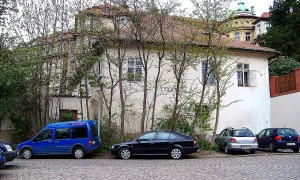
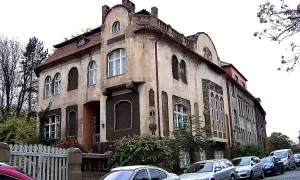
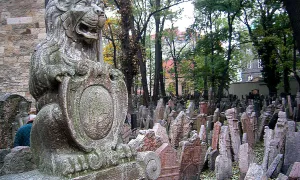
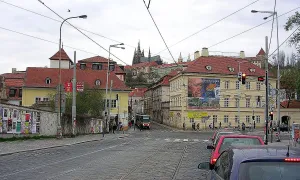
Real photos taken near the monument

Zdroj a licence jsou uvedeny u každého snímku.
Atmosphere of the place
This atmospheric visualisation of the place and period was generated by artificial intelligence. It is not real footage of the location.
Tips from visitors
No tips yet. Be the first!
Log in and add your tip.
Sources and literature
Fotografie: Jvs / CC BY-SA 3.0 — Wikimedia Commons. The author and licence also appear when you hover over the image.
Faktickým podkladem tohoto textu byl článek na Wikipedii, jehož autory jsou přispěvatelé Wikipedie. Článek je dostupný pod licencí CC BY-SA 4.0.
Location on the map
Příběhy a pověsti
Legendy, pověsti a příběhy spjaté s touto památkou

Fotografie návštěvníků
Zatím žádné fotografie. Buďte první, kdo přidá fotografii z návštěvy!
Přihlaste se a přidejte svou fotografii nebo hodnoťte.
Za ověřenou návštěvu v aplikaci získáte víc bodů — poznáme podle GPS, že jste na místě.
Reviews and comments