



most silnice II/503 přes Labe v Nymburce Arc bridge
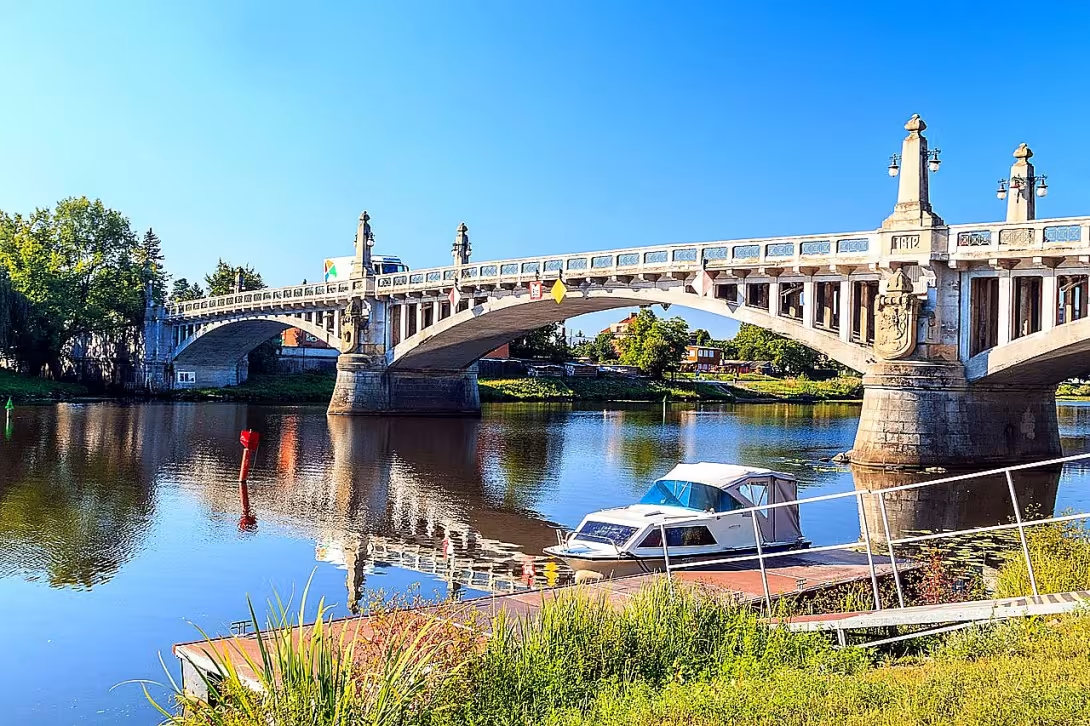
The road bridge over the Elbe in Nymburca is a technical cultural monument with rich late Art Nouveau decoration and history dating back to 1912. This reinforced concrete structure, which replaced the original wooden structure, serves as a key transport hub connecting the historical core of the city to the Zalabi section. It is one of the oldest concrete bridges over the Elbe, the author of which is the Prague firm Ing. Karel Herzán according to the design of architect František Roith.
The history of the place dates back to the founding of the ford on the old Zittau road. A wooden bridge appeared after the town was established, the existence of which has been documented since the beginning of urban development. There have been several changes over the centuries; In 1640 it was destroyed by Swedish troops. After the destruction of the city of Saxony in 1634 and other damage caused by floods and ice floods, it was necessary to restore it.
The current iron concrete bridge was completed in 1912. It has a total length of 118 metres and a bridge width of 8,5 metres. It consists of three fields with woven iron concrete arches; The extremes have a range of 35 metres and a mean of 40 metres. The building is decorated with block tiles of pillars, shields with motifs of Czech lions and decorative pylons. In 1965 the bridge was included in the list of cultural monuments.
The construction survived a number of interventions, including the repair and extension of the bridges in 1967 and the reconstruction in 1998. In 2018, a side footbridge was pulled down after the crash. Although the pedestrian bridge is inaccessible, its architectural and historical value remains unquestionable.
Today, the bridge represents a groundbreaking monument linking the past to modern construction. These structures are not only technical achievements, but also witnessing history and culture. The Nymburk bridge over the Elbe is therefore an important monument, which is worth visiting every interested person in Czech history and architecture.
Then and now
Drag the slider to compare how the landmark may have looked when it was built with the view today.
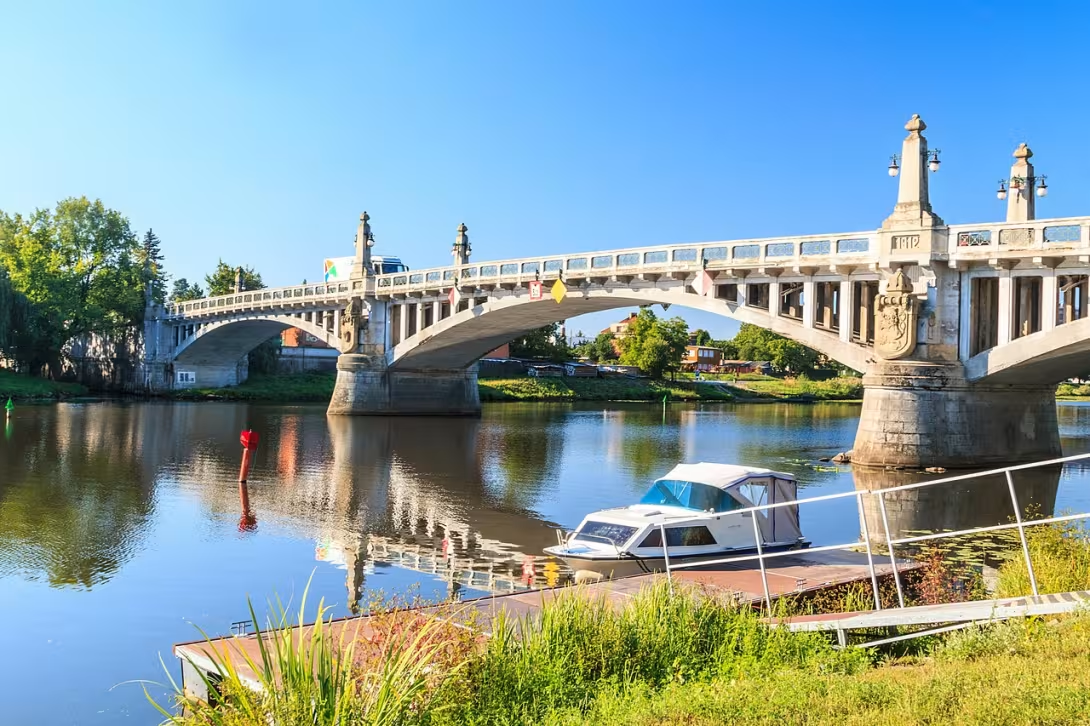

The historical appearance on the left is an AI-generated visualisation and serves as inspiration only.
Historical milestones
- 1640
- Burning the wooden bridge with Swedish troops
- 1912
- Completion of the construction of a new reinforced concrete bridge
- 1965
- Registration of technical cultural monuments
- 1967
- Correction and extension of the foothills
- 1998
- Bridge reconstruction
- 2018
- Pulling down a side footbridge after its crash
Architectural development
A new reinforced concrete structure with three fields was built at the site of the original wooden bridge in 1912. In 1967 there was an extension of the bridges and in 1998 a reconstruction took place. The whole building uses woven arches and is supplemented with decorative pylons and block tiles of pillars.
Historical events
In 1640, the original wooden bridge was burned by Swedish troops. In 1912 the construction of the current iron concrete bridge was completed. In 1965 the building was registered as a technical cultural monument.
Points of interest
- It's a technical cultural monument with a rich late Art Nouveau decoration. It's one of the oldest concrete bridges on the Elbe. - The current iron concrete bridge was completed in 1912. - The building is decorated with block tiles of pillars and shields with motifs of Czech lions. - In 2018, a side footbridge was pulled down after the crash.
Guide
Show guide text
This text was created by artificial intelligence and has not been editorially reviewed. It may contain inaccuracies.
Welcome to this historic place, where we are today in front of the II / 503 bridge across the Elbe River in Nymburk. Under your feet is a reinforced concrete structure that is not only a technical success but also a beautiful work of art. This bridge is known for its rich late Art Nouveau decoration and is one of the first concrete bridges in this area.
Let's dive into his history. Today you see before you a work that was completed in 1912. Before that, there was a wooden bridge that was burned by Swedish troops during the 30-year war. The new bridge was to replace this ancient passage and served as a link for rapidly developing areas around Nymburk. Architect František Roith, known for his innovative ideas, designed this construction, which was realized by Prague firm Karel Herzán.
Look up at the arches of the bridge and notice the block tiles of the pillars. These details are not only functional, but also aesthetic. You can see the motifs of Czech lions in the shields, which give the impression of national pride and artistic elegance. This bridge is a real pearl of late Art Nouveau, which was very modern at the time.
Although we know little about the specific personalities involved in its creation, it is clear that it was a project full of ambition and technical championships. The bridge has become a key part of local infrastructure and since 1965 it has been protected as a technical cultural monument.
The interesting thing about this place is that the bridge survived for several decades and even after the accident of the side footbridge for hikers in 2018 it remained functional. This suggests a firm design and sophisticated design.
Now that you know more about this historic bridge, you could decide to explore other parts of Nymburk. The city offers many other attractions and every step here is like a view of the past. I hope this guide inspired you to explore this and other historical sites. Thank you for your attention and have a nice day!
Tips for visitors
The best time to visit is spring and autumn months, when the landscape around the Elbe River offers the most beautiful colors. In this period, the details of the late Art Nouveau decoration of the bridge stand out best.
The location is available by car and by public transport; Check the current connection in the search engine. With us we recommend taking comfortable shoes for walking around and a photographic machine for capturing architectural elements from 1912.
For the best photos we recommend arriving in the morning or evening light, which will highlight the plastic shapes of embedded arches. Ideal points of view are from the banks of the Elbe River.
In the vicinity we recommend visiting The plaza of the Přemyslians or take a walk in the Zalobi district. It is ideal for families with children to walk along the river Elbe.
Frequently asked questions
Can the monument be visited?
This is a structure in a public space that can usually be seen from outside free of charge. We have not verified that this particular one is freely accessible.
Where is the monument?
Location: Nymburk. The map on this page shows the exact spot.
Why is the monument protected?
It is listed in the Central List of Cultural Monuments of the Czech Republic as a cultural monument (register no. 1000128289).
Businesses nearby
Do you run a restaurant, accommodation, shop, museum, rental, wellness or other visitor service near this monument? Show yourself directly to the people heading to it — this is how they will see you in the app and on the web:
Nearby
Náměstí Přemyslovců, čtvrť Zálabí a tok řeky Labe.
Accommodation nearby
Themed route
Bridge II / 503 via Elbe - transport construction. It is impressed by a massive steel arch, which offers a wide view of the water surface and the historical core of the city.
Přemyslovice Square - historic square (about 200 m from the bridge). After crossing the bridge you will find yourself in the heart of Nymburka where you can admire preserved Renaissance houses and the atmosphere of the old market.
Zálabí district - residential district (about 300 m from the square). A short walk along a series of terraced houses along the shore shows peaceful urban life in close proximity to the river.
River Elbe flow - natural water flow (about 150 m from Zálabí). You can watch slowly flowing water along the shore, suck up the sound of splashing and enjoy the green shores that complement the historic environment.
Seasonal recommendations
Spring: In spring, the bridge across the Elbe in Nymburk is oddly charming thanks to the awakened nature and the first flowers that begin to bloom around the river. Sun rays illuminate the bridge in warm colors, which gives the atmosphere a romantic touch. During the tour it is advisable to wear light clothes with the possibility to add a layer for winter, because spring weather can be variable. The best time to visit is in the early afternoon when the temperature is most pleasant and the crowds usually smaller.
Summer: For years, the bridge across the Elbe in Nymburk is a popular place to relax in the sun. The river turns into a cool shelter where you can enjoy a beautiful view and a quiet environment. The sunlight joins the bridge in full, increasing its historical beauty. We recommend wearing light, long sleeves of clothes and sunglasses to protect from UV radiation. The best time to visit is morning or evening, when the temperature is not so high and the crowds are less dense.
Autumn: In autumn, the bridge across the Elbe in Nymburk becomes melancholic beauty due to coloured leaves around the river. The sunlight is finer and long shadows provide the atmosphere with nostalgia. It is advisable to wear warmer clothes during the tour because the temperature is falling and the winds may intensify. The best time to visit is when the sun is highest and provides enough light for photography.
Winter: The Winter Bridge over the Elbe in Nymburce offers a unique view with the possibility to see the ice crust on the river. The sunlight illuminates the freezing landscape, making the tour attractive even in the cold. We recommend wearing a warm coat and protective shoes against snow or cloud. The best time to visit is at noon, when the sun is above your head and provides enough light for the photograph, while the evening corridor can be pleasant due to calm and icy view.
Visualizations and artistic views


The visualisations are generated by artificial intelligence and serve as inspiration.
Photos from the area
Real photos taken near the monument


Zdroj a licence jsou uvedeny u každého snímku.
Tips from visitors
No tips yet. Be the first!
Log in and add your tip.
Sources and literature
Photos: Petr1888 / CC BY-SA 4.0 — Wikimedia Commons. The author and licence also appear when you hover over the image.
Faktickým podkladem tohoto textu byl článek na Wikipedii, jehož autory jsou přispěvatelé Wikipedie. Článek je dostupný pod licencí CC BY-SA 4.0.
Location on the map
Příběhy a pověsti
Legendy, pověsti a příběhy spjaté s touto památkou
Fotografie návštěvníků
Zatím žádné fotografie. Buďte první, kdo přidá fotografii z návštěvy!
Log in a přidejte svou fotografii nebo hodnoťte.
Za ověřenou návštěvu v aplikaci získáte víc bodů — poznáme podle GPS, že jste na místě.
Reviews and comments