



Mottlův dům Tenement house
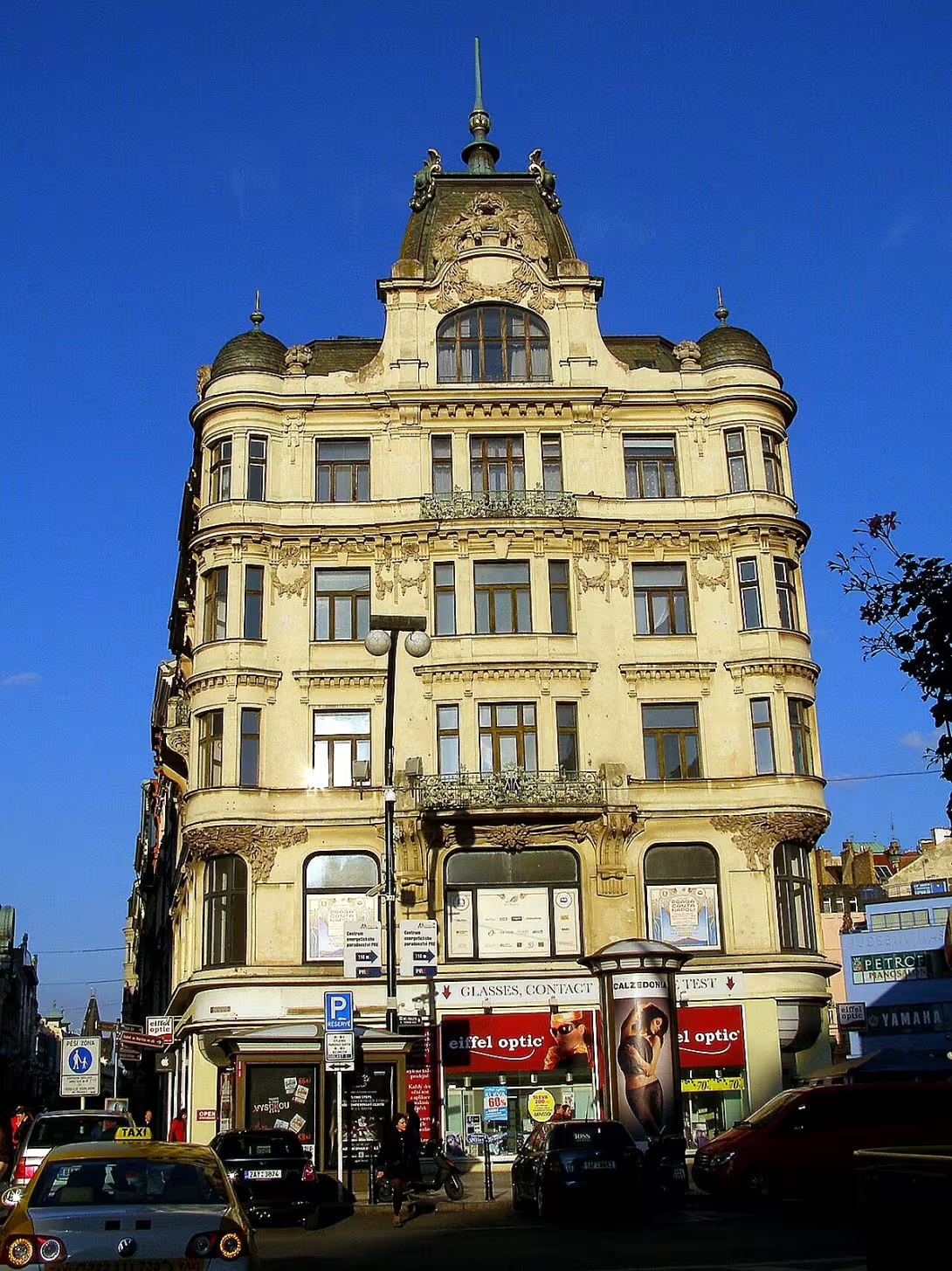
Mottlův dům is a secessionist-renaissance rental building in Praha 1 on Jungmannově náměstí. It was built between the years 1905 and 1906. Originally, it served as a multifunctional commercial palace with retail spaces and offices. It is notable for its architecture and history of a revolutionary advertising device.
On the site of today's building originally stood a two-story baroque corner house U Zlatého věnce. Here resided the Prague tailor and hatmaker Vendelín Mottl. Due to the frequented location at the junction of 28. října street and Jungmannovo náměstí, a modern building with large displays for new commerce was constructed. The project was undertaken by Karel Mottl, son of Vendelín and professor at the Prague School of Applied Arts. Construction was completed between 1905 and 1906.
The building combines elements of secessionism and renaissance architecture. It is a basement four-story structure with a ground floor and mansard roof. The construction is specific: the lower part is supported by pillars with iron beams, while the upper floors are brick-built. The layout consists of three two-winged wings surrounding a large atrium and staircase in the shape of an anchor. The exterior is adorned with rich secessionist stucco and sgraffito decoration. On the southern wall, there is a plaque with the name of the builder. In the ground floor, you can find monograms VM and KM on lattice metalwork, and at the height of the fourth floor, there is a stucco bust of Vendelín Mottl. In 1908 and 1913, Karel Mottl further modified the building, for example, by adding a spiral staircase connecting the floors.
The building was named after Vendelín Mottl, a tailor and textile entrepreneur. He operated a commercial house and tailor's salon here. Besides him, the Czech Graphic Union and Central Bank of Czech Savings also had their headquarters here. After 1948, the building was nationalized. It returned to private ownership only after the Velvet Revolution in 1989. This was followed by a long period of disuse. This ended with an extensive reconstruction completed in 2019, which respected the original form of the structure.
An important technical feature was the pneumograph. Installed in 1914 into the upper window space of the facade facing Ferdinandova třída, this electromechanical device was designed by technician František Janeček, founder of the Jawa factory. It allowed for creating white text and graphics on a black background. This was a revolutionary alternative to contemporary advertisements painted directly onto facades. Among the tenants of this space were companies such as Laurin & Klement, photographic studio F. Vojta, wine chocolate manufacturer A. Maršner, commercial house J. Novák, or image magazine Český svět. The device was also used for advertising football match results. However, its further development was halted by the outbreak of World War I.
The building has been protected as a cultural monument since 1958. Thanks to recent reconstruction, it represents an authentic example of the development of modern architecture and commercial palaces in the early 20th century in the center of Praha 1.
Mottlův dům is a valuable testament to Prague's commercial boom and technical progress of its time. We recommend visiting it during a stroll through Nové Město and paying attention to details on its facade.
Then and now
Drag the slider to compare how the landmark may have looked when it was built with the view today.
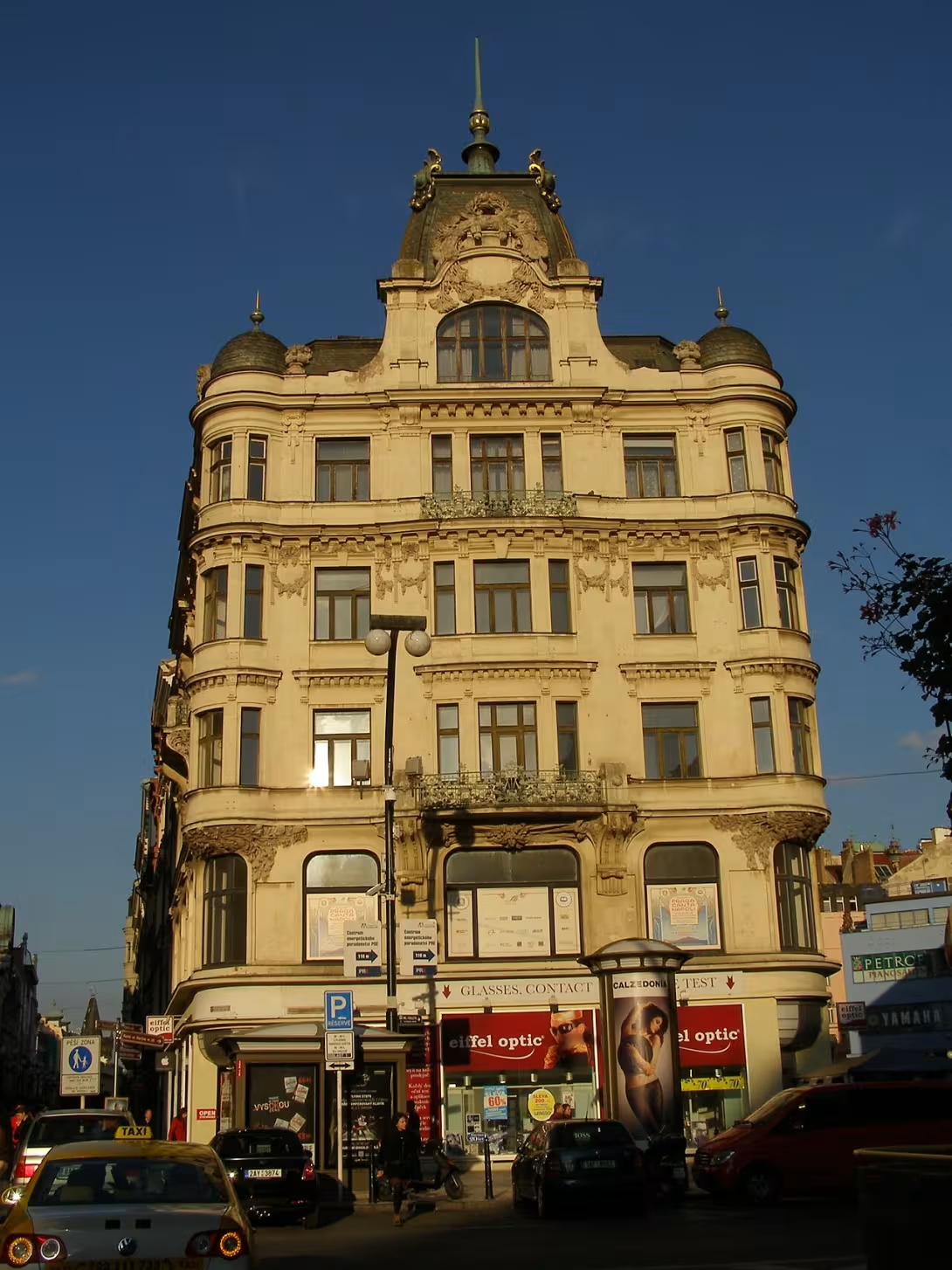
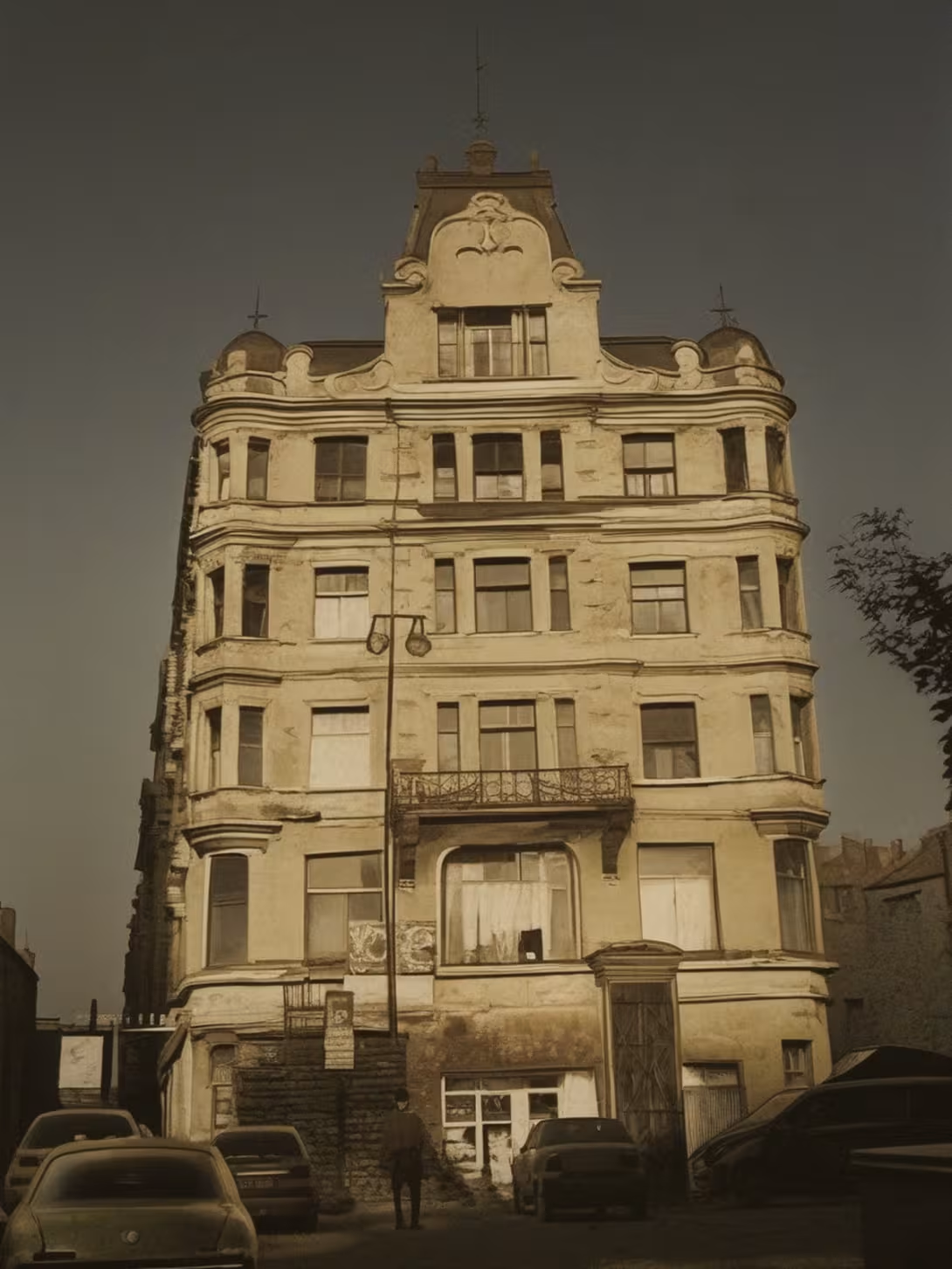
The historical appearance on the left is an AI-generated visualisation and serves as inspiration only.
Historical milestones
- 1914
- Installing a pneumograph on the upper window space of the facade.
Architectural development
The house was built between 1905 and 1906 according to the design of Karl Mottl. In the years 1908 and 1913 there were construction modifications which included, for example, installation of a spiral staircase. In 2019, a large reconstruction was completed respecting the original design of the building.
Historical events
- 1905
- The beginning of the construction of Mottle's house, according to Karl Mottl's design.
- 1914
- Installing a pneumograph on the upper window space of the facade.
- 1958
- Maintaining the object as a cultural monument.
Owners
Vendelín Mottl (early 20th century), Central Bank of Czech savings banks and Czech graphic union, nationalized after 1948, returned to private property after 1989
Points of interest
- In 1914, a pneumograph was installed in the building by František Janeček, founder of the Jawa factory. The device made it possible to create white inscriptions on the black background and to advertise the results of football matches. - The lower part of the building is carried by pillars with iron carriers, while the upper floors are walled. The stairwell has the shape of an anchor. - There is a stucco bust on the fourth floor. On the ground floor there are monograms of VM and KM on the grid fittings. - There was originally a two-storey Baroque corner house at the Golden Wreath. - The project of the building was created by Karel Mottl, who was the son of Vendelín and professor of the Prague School of Arts.
Guide
Show guide text
This text was created by artificial intelligence and has not been editorially reviewed. It may contain inaccuracies.
Welcome to the unique monument, which stands as a testament to rich history and architectural art at Jungmann Square in the heart of Prague. In front of you is Mottlův dům, a masterpiece combining elements of Art Nouveau and Neo-Renaissance style. This rental house, which immediately affects you with its elegance and historical depth, was built in the early 20th century as a modern multifunctional palace.
Let's dive into its creation. In 1914 Mottlův dům was completed when architect Karel Mottl together with Vendelín Mottle carried out an ambitious project to bring a new period of business and cultural activity to Prague. This house was designed as a modern multifunctional space where sales areas were intertwined with offices, which is a reflection of the city's dynamic growth at that time.
Look up at the facade and see how the architecture of this house penetrates your attention. It is a combination of Art Nouveau and Neo-Renaissance style that is characteristic of the early 20th century. This blend allows you to feel both modernity and return to classical roots, giving the building its unique identity.
Now let's focus on the key personalities associated with this monument. Vendelín Mottl, businessman and architect Karel Mottl were the main forces behind the creation of this house. Their vision was to create a place where they could encounter business with cultural experience. This house is also connected with František Janek, founder of the Jawa factory, which in 1914 introduced a pneumograph on the upper window space of the facade. This device was then an innovative tool for creating white inscriptions on the black background and used to advertise the results of football matches.
The interesting thing to mention is the installation of a pneumograph. At the time, this instrument was a step forward and was a new form of communication with the public. Note also the design detail: the lower part of the building is supported by pillars with iron carriers, while the upper floors are walled. This architectural element not only provides stability but also contributes to the aesthetics of the whole.
I invite you to explore this fascinating place, which offers many layers of history and architecture. Mottlův dům is indeed a unique example of how Art Nouveau and Neo-Renaissance style can create a harmonious whole. I hope you enjoyed this guide and will continue to discover the beauty of Prague. I say good-bye to the rich impressions, and I hope we meet again at this place.
Tips for visitors
The best time to visit Mottle's house is early in the morning, just after opening, when fewer visitors and sunlight hit the Art Nouveau facade from the east, which allows you to take a good picture of the details. In the afternoon, it gets busier because of work.
The house is easily accessible by car and by city transport.
Take comfortable shoes, water bottle, camera or mobile with a good camera and possibly an umbrella or raincoat if the forecast is variable.
Photography in Mottle's house stands out in several places: in front of the main entrance, where you can capture a combination of Art Nouveau ornaments and Neo-Renaissance elements; on Jungmann Square, where it provides urban light and shadows interesting contrasts; and the evening when the building is lit, which creates a romantic atmosphere.
In the area within 30 minutes walk you will find other historical attractions: Wenceslas Square with its monumental buildings, the National Museum, St. Nicholas Church and the Old Town Square with the clock. For families with children, short walks along the surrounding parks and the possibility of relaxing in cafés, where children can refresh themselves after the tour.
Frequently asked questions
Can the monument be visited?
This is a residential or farm building, not a museum with opening hours. Please view it from public space and respect the owners' privacy. We have no information about access to the interior.
Where is the monument?
Location: Praha 1, Hlavní město Praha. The map on this page shows the exact spot.
Why is the monument protected?
It is listed in the Central List of Cultural Monuments of the Czech Republic as a cultural monument (register no. 1000156846).
Businesses nearby
Do you run a restaurant, accommodation, shop, museum, rental, wellness or other visitor service near this monument? Show yourself directly to the people heading to it — this is how they will see you in the app and on the web:
Events nearby

Zdroj akcí: otevřená data měst a obcí ČR (Národní katalog otevřených dat) a kalendář akcí Národního památkového ústavu.
Nearby
Dům se nachází v centru Prahy, nedaleko Václavského náměstí a dalších historických památek Nového Města. Okolní oblast je bohatá na kulturní dědictví.
Accommodation nearby
Trips and activities nearby
Guided tours, tickets and activities nearby from GetYourGuide
Affiliate link: if you buy from the partner, we may receive a commission. The price for you does not change.
Search tours and activities →Themed route
Thematic cruise route: Mottlův dům and surroundings
1. Mottlův dům (rental house) Type: Historical rental house Why it is worth a visit: Mottlův dům is a unique monument to the modern period in Prague, which represents architectural innovation and the history of the city. The house was built in the early 20th century for the famous conductor Václav Mottl and is known for its unique construction.
2. Wenceslas Square (historical square) Type: Historical Square Why it is worth a visit: Wenceslas Square is one of the most famous places in Prague, which witnessed important historical events. The square is surrounded by prestigious buildings and monuments such as the National Theatre and the monument of T.G. Masaryk.
3. Vodičková Street (historic street) Type: Historical aisle Why is worth a visit: Vodickov Street is one of the most beautiful and famous streets in New Town. It is famous for its elegant houses, which resemble the Baroque and Renaissance, and offers a view of the historical architecture of Prague.
4. Old Town Hall (Town Hall) Type: Historical Town Hall Why is worth a visit: Old Town Hall is one of the most important monuments in Prague, famous for its Gothic architecture and astronomical ball. It is the center of Old Town history and offers a view of the Old Bohemian administration.
5. Old Town Square (Historical Square) Type: Historical Square Why is it worth a visit: Old Town Square is the heart of Old Town and famous for its Týn, Mariana Chapel and antique market. The square is full of historical stories and architectural pearls.
This route will guide you through the centre of Prague, where you will meet the rich history and architecture of the city.
Seasonal recommendations
In the spring the surroundings awaken and the soft sun beautifully highlights the details of the facade. In nearby parts of town, trees are beginning to bloom, creating a fresh and green atmosphere. We recommend to dress in layers because the weather can quickly change between cold and heat. It's a great time to visit, because tourists are still relatively few.
During the summer season, the first Prague dzielnice has the greatest excitement and great crowds of people. The sun shines very intensively and the city streets can be hot. It is best to come as early as possible in the morning to avoid the largest gathering of visitors and heat. Dress very lightly and don't forget to drink.
Autumn offers golden lighting and a calmer, melancholy mood. Leaves change colors, and morning fog makes the surroundings mysterious. It is ideal to visit a place in the afternoon when the light is the most beautiful. Prepare a tighter coat because windy and wet days can be unpleasant.
Zimą days are short and the atmosphere is rather quiet and sober. In advent time, the city can be very cozy thanks to the lighting. It is necessary to wear very warm clothes, including scarves and hats. Due to the cold and shorter day, watch out for any changes when the object is accessible.
Visualizations and artistic views


The visualisations are generated by artificial intelligence and serve as inspiration.
Photos from the area
Real photos taken near the monument


Zdroj a licence jsou uvedeny u každého snímku.
Tips from visitors
No tips yet. Be the first!
Log in and add your tip.
Sources and literature
Photos: Michal Kmínek / CC BY-SA 3.0 — Wikimedia Commons. The author and licence also appear when you hover over the image.
Faktickým podkladem tohoto textu byl článek na Wikipedii, jehož autory jsou přispěvatelé Wikipedie. Článek je dostupný pod licencí CC BY-SA 4.0.
Location on the map
More monuments – Praha 1
Show all in the municipality

Příběhy a pověsti
Legendy, pověsti a příběhy spjaté s touto památkou

Fotografie návštěvníků
Zatím žádné fotografie. Buďte první, kdo přidá fotografii z návštěvy!
Log in a přidejte svou fotografii nebo hodnoťte.
Za ověřenou návštěvu v aplikaci získáte víc bodů — poznáme podle GPS, že jste na místě.
Reviews and comments