



Mrázkův mlýn Mill
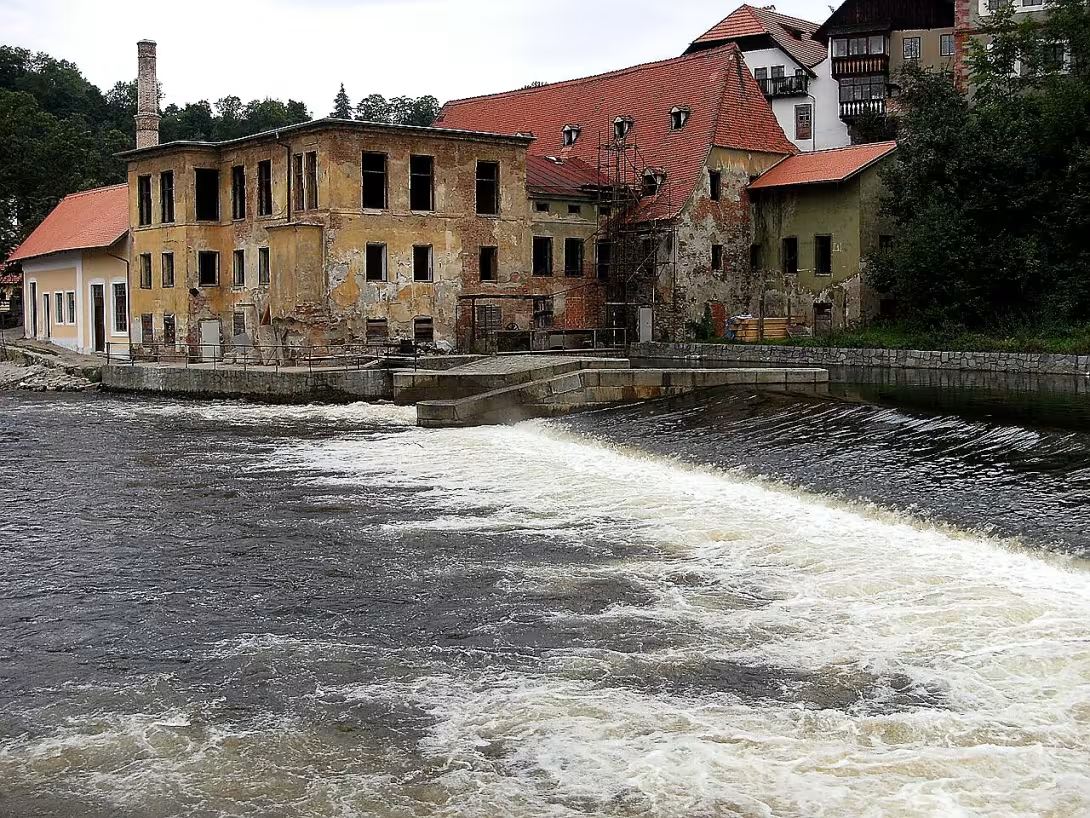
Mrázkův mlýn, located in the centre of Český Krumlov in Vltava, is a water mill with rich history and architectural significance. This building, protected as a cultural monument of the Czech Republic, represents a fascinating chapter of the local industrial heritage and architecture. The mill is remarkable by its long history since the 14th century, when it was first mentioned, to several significant reconstructions that reflect cultural changes in the Czech Republic.
The first mention of the Mzák Mill dates back to 1347. This historical figure indicates that it was already an important place for the population of Český Krumlov. In 1613-1614 a Renaissance reconstruction of the mill took place, which included its transformation into a paper mill. This development reflected wider cultural and industrial changes taking place in the Czech Republic at the time.
The Mrázkův mlýn has shown itself to several stages of development. After the Renaissance reconstruction, a house was added to it, reflecting the diversity of industrial activities carried out on the spot. A reconstruction of the Valcha was carried out in the 18th century and a further modification of this element was made in 1791-1798. In 1869 there was a new construction of the dye plant, which was later redesigned in 1880. These changes point to constant development and adaptation of the mill to the needs of the time.
The ownership and management of the Mrazkov mill may have changed over the years, but specific historical records of owners are not documented in detail. However, it is known that the object has undergone several stages of development and modification, suggesting regular administration and investment in maintaining it.
Among the key events in the history of the Mzakov Mill include not only its reconstruction, but also technological innovation. In 1930, the Francis turbine was installed with specifications 2,85 m ³ / s, 1,3 m drop and 39 HP output. This modernization reflected progress in the hydroenergy technology.
Today Mrázkův mlýn is not only a monument of historical significance, but also a place attractive to visitors. Its location in the centre of Český Krumlov and proximity to Vltava make it an ideal destination for those who want to discover the local heritage. Although Mrazkov's food presents a danger to the watermen and there have been many fatal cases, the mill stands as a witness to the historic adaptation of people to their environment.
Mrázkův mlýn is not only a monument with rich history and architectural significance, but also a place that offers visitors the opportunity to explore the past of Český Krumlov. Its history and adaptation to changes over the years make it an interesting object worth visiting.
Historical milestones
- 1347
- First mention of the mill.
- 1613
- Renaissance reconstruction and conversion into a paper mill.
- 1869
- New construction of the paint shop.
Architectural development
The mill has undergone several phases of significant building development. In the Renaissance period, it was rebuilt and converted into a paper mill, and later it was joined by a dyeing house. During the 18th century there was a reconstruction of the Valcha and in 1869 a new dyeing plant was built.
Historical events
- 1347
- The mill is first mentioned.
- 1613
- Renaissance reconstruction and conversion into a paper mill.
- 1869
- New construction of the paint shop.
Points of interest
The first mention of the mill dates back to 1347. - In 1613-1614 a Renaissance reconstruction took place, which included conversion into a paper mill. - After the Renaissance reconstruction, the house was added to the building. - In 1869 a new construction of the dye plant took place. - The mill is located in the centre of Český Krumlov in Vltava.
Guide
Show guide text
This text was created by artificial intelligence and has not been editorially reviewed. It may contain inaccuracies.
Welcome to the heart of the historical Český Krumlov. You're standing in front of one of those places that makes up the real soul of this city and that carries the mast of centuries. The Mrázkův mlýn stands before your eyes. Before we embark on his fascinating history, please pay attention to your surroundings for a moment. Listen to the constant, soothing sound of water. This is the Vltava that flows right around you. This river is not just a set for this view, it is the engine itself that has driven the life of this place for generations. The water flowing under the building has always been the main actor of everything that happened here. Look at the building that rests on the banks of this river, and try to perceive the constant connection between the element of water and human labor.
Now let's go back to the past together to understand how this object began its journey. In order to truly understand the meaning of this place, we need to move back many centuries in our minds to a time when the world was much different. The first mention of this mill appears in our historical records in 1347. Imagine the medieval atmosphere. It was a period when cities had just settled in their present form and when water was an absolutely irreplaceable source of power for every craft. At that time, this mill was probably a simple, functional place for grinding grain that supplied the surrounding humanity. It was a place of hard work, noisy and constantly moving, just like the river below. This mill was then the cornerstone of the local economy and a symbol of survival.
But now look at the building as a symbol of constant transformation. History tells us this object was never static. It was not a building that remained the same throughout its long duration, but an organism that had to adapt to the new needs of the world and the new knowledge of humanity. The key moment that completely changed the direction of this place was the reconstruction in the Renaissance period, namely in 1613 and 1614. In this short, but crucial period of time, something completely revolutionary happened. The mill stopped serving only for grinding and was converted into a paper mill.
Consider what this change meant to the company at the time. The paper was at that time a technological miracle, a bearer of new ideas, science, culture and legal documents. Turning the mill into a paper mill meant that this place became part of a much wider cultural stream. It was not only about providing basic food, but about creating information, about the font and about the history that began to be written on the leaves produced here, thanks to the relentless power of water flowing under the roof. This renaissance reconstruction gave the building a new character and new features that defined its existence for many centuries.
Notice how the space around the mill gradually expanded and how the various activities in this place connected. After the significant Renaissance reconstruction, a colorist house was added to the main building. This new part of the building shows us how various crafts in this place interconnected in symbiosis. The dyeing of substances required not only the enormous patience and knowledge of materials, but also the specific background that this place was able to offer directly at the water. Water was necessary for all processes that took place in the dye shops.
But history did not stop in later times, when the world began to change at a much faster pace. If you look at the development of this whole complex, you'll see another important layer of history. In 1869 there was another significant change when a new dye factory was built. This year, it carries us to a time when the world began to turn into the rhythm of the industrial revolution. The old, traditional craft had to deal with new methods and more modern production requirements. So this mill and its diverse parts are not just a pile of stone and wood, but they are a living witness of humanity moving from medieval space to the era of industry.
Now pay attention to one interesting thing, which carries a certain melancholy and fascination. Although this object is today protected as a valuable cultural monument and is one of the objects with numbers 56 and 58, in its history, there are certain empty places that no one has told us. You might wonder who designed all these walls. Who were the masters who led the workers in 1613 or 1869? Who was the first person to see the great potential of this place by the river here in 1347? The names of architects and prominent personalities that were directly linked to this mill have not been passed on to us by history. And that's where his greatest secret and beauty lies. Mrázkův mlýn is not a story of a great hero or a famous name, but of thousands of unknown hands who worked here, thousands of people who made their living here and built their lives. It's the story of the place itself and its relentless changes that go on, even though people's names have long gone missing.
You are standing in front of a building that has survived for centuries, which has seen the coming of Renaissance light and the advent of an industrial era. It is a place where the untamed force of nature merges together with the constant human striving for progress and improvement of life. Before you go further along the paths of the historical Český Krumlov, stop for a while and feel the overall atmosphere of this place. Listen to the noise of the Vltava and imagine all the generations of people standing here exactly where you're standing right now.
Thank you for spending this moment with us and paying attention to this memory. We wish you a beautiful and inspiring tour of the rest of our city and many other experiences in discovering its hidden treasures. Enjoy your journey.
Tips for visitors
The best time to visit the Freezer Mill is in the spring or autumn season when vegetation is around the most beautiful and fewer people. This time of the year also offers pleasant temperatures for a comfortable walk.
What to take with you: It is recommended to bring an umbrella, protective clothes against rain and plenty of drinking water. If you are interested in photography, do not forget the quality camera or mobile phone with good photo options.
Photography: The best places for photos are along Vltava, where it is possible to get a beautiful view of the mill and surrounding landscape. Sunny morning or late afternoon offers ideal lighting conditions for photography.
What to visit in the surroundings: Near the Freezek Mill there are other historical monuments such as castle Český Krumlov and its castle. These places are ideal for those who like history and architecture.
Tips for families with children: The mill offers the opportunity to explore water technology and understand its function. Children can also enjoy a nearby natural environment where you can play or immerse yourself in nature.
Frequently asked questions
Can the monument be visited?
This is a technical monument. Some are open as exhibitions, others are out of use or on private land. We have not verified whether this one is accessible.
What are the opening hours and admission?
We have not verified the opening hours or admission. Current information is published by the operator.
Where is the monument?
Location: Český Krumlov, Jihočeský kraj. The map on this page shows the exact spot.
Why is the monument protected?
It is listed in the Central List of Cultural Monuments of the Czech Republic as a cultural monument (register no. 1000124583).
Businesses nearby
Do you run a restaurant, accommodation, shop, museum, rental, wellness or other visitor service near this monument? Show yourself directly to the people heading to it — this is how they will see you in the app and on the web:
Events nearby
Zdroj akcí: otevřená data měst a obcí ČR (Národní katalog otevřených dat) a kalendář akcí Národního památkového ústavu.
Nearby
🏰 Historic sites (129)
- sv. Jan Evangelista 0.1 km
- sv. Juda Tadeáš 0.1 km
- Muzeum voskových figurín 0.1 km Kájovská 68 web
- sv. Kajetán z Tiene 0.1 km
- sv. Šebestián 0.1 km
- sv. František Xaverský 0.1 km
- sv. Roch 0.1 km
- Panna Maria Neposkvrněná 0.1 km
- sv. Vít 0.1 km
- sv. Václav 0.1 km
- svatý Jan Nepomucký 0.1 km
- MUDr. František Kovařík 0.1 km
- Muzeum útrpného práva 0.1 km náměstí Svornosti 1 web
- Sochy sv. Jana Evangelisty a Panny Marie 0.1 km
- Salomatova 0.1 km Panská 16 +420 723 662 114 web
- Film legends muzeum 0.1 km Šatlavská +420 773 729 055 web
- domovní znamení 0.1 km
- Muzeum vltavínů 0.2 km Panská 19 +420 734 174 130 web
- Galerie 0.2 km Horní 155
- Jiří Bílek z Bilenberka 0.2 km
🍽️ Restaurants and dining (257)
- Friendly Market 0.0 km Kájovská
- Trdelník 0.0 km web
- venkovní bar U Mrázků 0.0 km
- Hanoi memories 0.0 km Kájovská 175 +420 725 139 090 web
- Barvírna 0.0 km Kájovská
- coffee to go 0.0 km
- Rud´s Pizza 0.0 km Hradební 63
- Gelateria Monnalisa 0.0 km Hradební 57
- Restaurant Bohemia 0.0 km Kájovská 64 +420 602 212 022 web
- Cafe retro 0.1 km +420 775 641 008 web
- Don Julius 0.1 km Kájovská +420 380 712 310 web
- Zlatý Anděl 0.1 km náměstí Svornosti 10 +420 380 712 310 web
- U Hroznu 0.1 km +420 380 712 088 web
- Authentic Cafe Restaurant 0.1 km náměstí Svornosti 8 +420 380 711 558 web
- Authentic Cafe 0.1 km náměstí Svornosti 9 +420 380 711558 web
- Na Louži 0.1 km +420 380 711 280 web
- Restaurace Petr Vok 0.1 km náměstí Svornosti 11 web
- El Diablito Bistro 0.1 km Kostelní 164
- Pizza Cafe 0.1 km
- Music Cocktail Bar 0.1 km náměstí Svornosti 11 web
🏨 Accommodation (302)
- Pension U Mrázků 0.0 km Kájovská 175 +420 775 197 881 web
- Merlin 0.0 km Kájovská
- Linden 0.0 km Kájovská 62 +420 723 981 995 web
- Hostel Merlin 0.0 km
- Penzion U Náměstí 0.0 km Kostelní 166 +420 721 129 175
- Hotel Mini Abraka 0.0 km Kájovská 64 +420724043355 web
- Abraka 0.0 km
- Zlatý Anděl 0.1 km
- Zlaty Andel 0.1 km Svornosti
- Na Louži 0.1 km +420 380 711 280 web
- Pension Marie 0.1 km Kájovská 67
- Meandr 0.1 km Rybářská 1 +420 606 891 311 web
- Pension Wok 0.1 km Rybářská 2 +420 777 776 332 web
- Leonardo Garni 0.1 km
- Old Inn 0.1 km náměstí Svornosti 12 web
- Leonardo I 0.1 km Soukenická 33 web
- Hotel Švamberský dům 0.1 km Soukenická 35 +420 734 578 509 web
- Penzion U Hada 0.1 km Rybářská 37 +420 731 563 601 web
- Pension U Galerie 0.1 km Rybářská +420 380 711 829 web
- Hotel Krčínův dům 0.1 km Kájovská 54 web
🚲 Rentals and sport (43)
- Vltava sport service 0.0 km +420 380 711 988 web
- molo 0.3 km
- Rafting a voroplavba Maleček 0.3 km +420 602 744 074 web
- Voroplavba 0.3 km Parkán 1 +420 605 218 018 web
- E - Půjčovna lodí 0.6 km +420 799 512 193 web
- Rafting Krumlov 0.6 km Pod Sv. Duchem 271 web
- Surfsport 0.6 km +420 775 959 404 web
- Zimní stadion 0.7 km Chvalšinská web
- Všesportovní hala 0.8 km Chvalšinská 111 web
- Potápka 0.8 km U Sáňkařské dráhy 408 +420 775 938 250 web
- Tenisová hala 0.8 km
- Atletický stadion 0.8 km
- Tenis centrum ČK 0.8 km
- FK Slavoj Český Krumlov 0.9 km
- SK Vltava Český Krumlov 0.9 km 5. května
- půjčovna kol 1.0 km web
- H.M. Sport 1.0 km 5. května 338 web
- FIT klub Kolín z.s. 1.2 km +420 602 259 965 web
- Coolsport 1.2 km Chvalšinská 234 +420 601 359 735 web
- Plujeme s Mailou 1.2 km +420 731 923 731 web
🥾 Hiking and nature (165)
- bývalý Mrázkův mlýn 0.0 km
- Vyhlídka u kostela 0.1 km
- Městský pivovar 0.1 km Široká 71
- Gotický sál 0.2 km
- Prokyšův sál 0.2 km web
- Seminární zahrada 0.2 km Horní
- Městská zbrojnice 0.2 km Na Ostrově 86
- Městský park 0.3 km
- Mincovna 0.3 km
- Václavské sklepy 0.3 km
- Červená brána 0.4 km Zámek
- Lvíček 0.4 km
- Jelení zahrada 0.5 km web
- Špitál svaté Alžběty 0.6 km
- bývalá Papírna 0.8 km web
- Věncová hora 0.8 km
- Ptačí hrádek 1.0 km
- Křížová hora 1.0 km
- Městský vrch 1.6 km
- Dobrkovický hamr 1.7 km
Accommodation nearby
Trips and activities nearby
Guided tours, tickets and activities nearby from GetYourGuide
Affiliate link: if you buy from the partner, we may receive a commission. The price for you does not change.
Search tours and activities →Themed route
Thematic cruise route around the Grass Mill
1. Ice mill (mill)
Why is it worth a visit: This historic mill is one of the oldest in the Czech Republic and offers a view to the past of how industrial activity in the area worked. It's the perfect place for those who want to know the history of the local industry.
2. Old Square
Why is it worth a visit: This central square in Český Krumlov is full of architectural pearls and offers a beautiful view of the surrounding buildings that resemble the history of the city. It is an ideal place for a short break after visiting the mill.
3. Krumlov Castle
Why is it worth visiting: Even if it is not in the surrounding list, it is a necessary place for everyone visiting Český Krumlov. Its historic interiors and beautiful gardens are a wonderful addition to the local industrial heritage.
4. Krumlov Town Hall
Why is it worth a visit: This historic building is famous for its unique Gothic architecture and beautiful interior, which includes an exhibition with local history. It's a great example of medieval governance and art.
5. Krumlov Waterworks
Why is worth a visit: This water plant is not only an important part of the local industry, but also provides a beautiful view of the river Vltava and surrounding green spaces. It's a place where you can relax and look at living water.
This route offers a combination of historical and industrial attractions of Český Krumlov, which makes it possible to understand both the cultural and technological development of the area.
Seasonal recommendations
Spring: During the spring season, Mrázkův mlýn excels itself with its reviving nature, when flowering gardens and trees green the surrounding landscape. The sunny days offer ideal lighting for the photograph of historic buildings, creating a charming contrast between the newly growing greenery and ancient stones. Visitors should come dressed appropriately for mild weather, because the temperature can change quickly. The best time to visit is in the morning or late afternoon when the crowds are minimal and the atmosphere is calm.
Summer: During the summer season Mrázkův mlýn becomes a popular destination for visitors who enjoy long sunny days and warm weather. The intense sun illuminates historic buildings in full beauty, but can also be the cause of large crowds, especially in the main summer season. Visitors should arrive early in the morning or later in the evening to avoid the main doses of tourists and enjoy a quieter tour. It is also important not to miss the forgotten umbrella and water, especially during hot days.
Autumn: In autumn, Mrázkův mlýn offers a unique atmosphere with colourful leaves of trees that provide a beautiful background for historical monuments. Sundays are strangely attractive due to warm light and mild temperatures, which is an ideal time to walk around the surrounding countryside. Visitors should be dressed in several layers because autumn temperatures can change rapidly. The best time for a tour is an early afternoon when the lighting is optimal and the crowds are less.
Winter: Winter visit to the Freezer Mill offers a quiet atmosphere where historic buildings look dramatic under the snow cover or in the cold light. Lighting is usually less intense and sun days are rare, which creates a romantic mood. Remember warm clothes because winter weather can be cold, especially in rainy times. The mill is usually open for a shorter time, so it is advisable to look at the current times before visiting and plan a tour during daylight.
Visualizations and artistic views


The visualisations are generated by artificial intelligence and serve as inspiration.
Photos from the area
Real photos taken near the monument


Zdroj a licence jsou uvedeny u každého snímku.
Tips from visitors
No tips yet. Be the first!
Log in and add your tip.
Sources and literature
Photos: Mark Ahsmann / CC BY-SA 3.0 — Wikimedia Commons. The author and licence also appear when you hover over the image.
Faktickým podkladem tohoto textu byl článek na Wikipedii, jehož autory jsou přispěvatelé Wikipedie. Článek je dostupný pod licencí CC BY-SA 4.0.
Location on the map


Příběhy a pověsti
Legendy, pověsti a příběhy spjaté s touto památkou
Fotografie návštěvníků
Zatím žádné fotografie. Buďte první, kdo přidá fotografii z návštěvy!
Log in a přidejte svou fotografii nebo hodnoťte.
Za ověřenou návštěvu v aplikaci získáte víc bodů — poznáme podle GPS, že jste na místě.
Reviews and comments