



Negrelliho viadukt Railway bridge
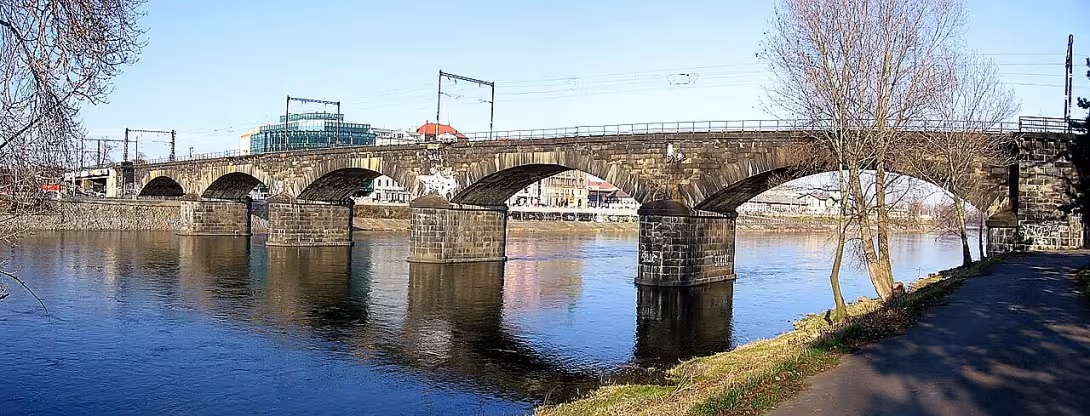
Negrelliho viadukt, also known as the Karlín viaduct or formerly as the viaduct of the State Railways Society, is the first railway bridge in Prague and the second oldest preserved crossing the Vltava. This important building connects the Masaryk railway station with the Drums through the island of Štvanice, which ensures key transport connections in Prague. With a length of 1120 metres it is the longest railway bridge in Central Europe and the fourth longest bridge in the Czech Republic.
The creation of the viaduct was a key part of the North State Railways project, which linked Olomouc to Prague and further to Dresden. The construction started in 1846 following a decision of the Railway Directorate of State of 1842. The project was originally to be entrusted to Jan Perner, but he died tragically before the work was completed. The construction was led by the engineer Alois Negrelli, after whom the bridge named. The Viaduct was completed in 1849 and put into operation on 1 June 1850.
Architecturally, the viaduct is originally equipped with 87 stone arcs, of which eight granite segment arches above the river's shoulders and 76 sandstone semi-circular arches stand out. The construction material was brought in by water from the area of Kamýka nad Vltavou, which underlines technological advances at the time when steam lifting machines were first used on a larger scale. Viaduct is now listed in the State List of Real Cultural Monuments.
After its completion, the viaduct became not only a technical but also an urban obstacle in the development of the city. In 1871 it was supplemented by a Karlin connecting viaduct for better connection of Drum and Libna without the need to drive to the station. This addition also included steel structures which have been replaced over the years by more modern materials.
In the 19th century, arches under the bridge developed arches of artisan workshops and spediteur companies, reflecting the growth of industry in the region. During time, construction modifications were also made, such as replacing the original stone railing with steel and modernization of bridge fields.
Viaduct underwent several reconstructions, the most important was between 2017 and 2020. This repair included a reduction in train noise, bridge construction and safety equipment.
Today Negrelliho viadukt is not only a technical monument, but also an important element of Prague's infrastructure. Its history and architecture represent an important contribution to the development of rail transport in Central Europe. Visiting this bridge offers not only a view of the technical skill of past generations, but also the dynamics of urban development and its challenges.
Negrelliho viadukt is therefore more than a mere bridge; It is a testament to historical progress and urban changes that shaped Prague. His visit offers a unique opportunity to explore not only the technical aspects of rail transport, but also the cultural and historical context in which this bridge was created.
Then and now
Drag the slider to compare how the landmark may have looked when it was built with the view today.
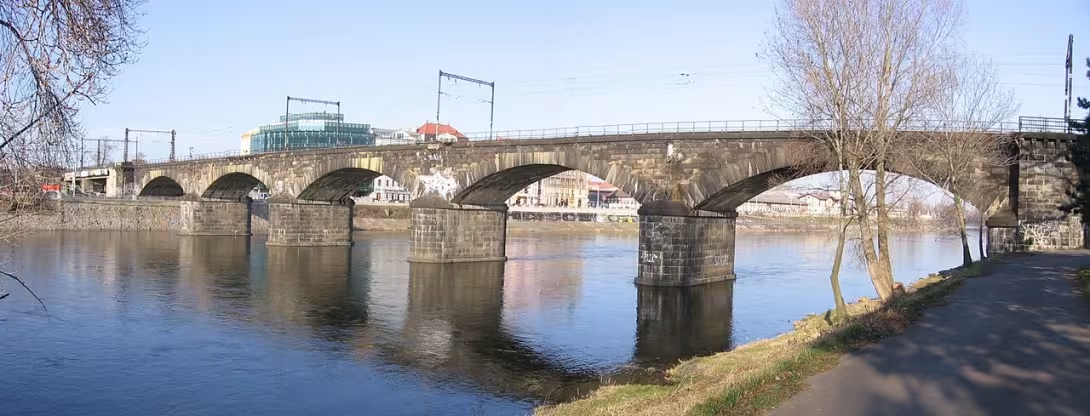

The historical appearance on the left is an AI-generated visualisation and serves as inspiration only.
Historical milestones
- 1846
- Start of construction of the viaduct
- 1850
- Opening of the bridge
- 1871
- Complement of the Carolina connecting viaduct
Architectural development
The original construction contained 87 stone arches of granite and sandstone. Steam lifting machines were used for the first time in the construction. Over time, adjustments were made to the flow of the Vltava and some fields were replaced by steel structures.
Historical events
The construction of the viaduct began in 1846. In 1850 the bridge was successfully put into operation. In 1871, the Karlinian connecting viaduct was added for direct connection.
Points of interest
- Negrelliho viadukt is the first railway bridge in Prague and the second oldest crossing through Vltava. - The Viaduct connects Masaryk Railway Station with the Drums via the island of Štvanice, which ensures key transport connections in Prague. - It is the longest railway bridge in Central Europe and the fourth longest bridge in the Czech Republic. - The Viaduct is now listed in the State List of Real Cultural Monuments. - After its completion, the viaduct became a technical and urban barrier, which led to the construction of the Karlín connecting viaduct for better connection of Buben and Libna.
Guide
Show guide text
This text was created by artificial intelligence and has not been editorially reviewed. It may contain inaccuracies.
Welcome to Bubeneči. You're standing right where history meets the constant movement of a modern city. Look in front of you and pay attention to the monumental piece that stretches right before your eyes. This massive unit that you see today as a solid part of Prague's landscape is Negrelliho viadukt. Perhaps at first glance you were impressed by its incredible length and how hard this bridge has worked into the structure of the whole city. Do you feel the weight of time and the importance that this place emits? It is not just an ordinary design for trains, it is a symbol of the great changes that have brought the age of railways and that have forever changed the way people travel and how our metropolis grows.
Now, I want to invite you to join me on a short journey to the past so we can understand why this place is so special. In order to understand the importance of this construction, we have to go back deep into the middle of the nineteenth century. More than a hundred and seventy years ago, the world was in a process of huge transformation. It was then, in 1846, that a construction was to be a key pillar for the development of transport throughout the region. This project was not random; It was a vital part of a wider plan called the North State Railroad. The aim was to create a connection that would connect different parts of the country and allow goods and people to move quickly. After years of hard work, which required huge amounts of human strength and technical knowledge, the bridge was finally put into operation in 1850. Since then, for more than a century and a half, it serves as an indispensable connecting element. Later, in 1871, the construction was further supplemented by a Karlinian connecting viaduct, which further deepened and strengthened the entire network of connections.
Now let's focus on what you see right now and what makes this unit so special in terms of its dimensions. Notice how this bridge stretches along the landscape. If you tried to estimate its length, you would find it's an incredible dimension. The total length of this work is over one thousand hundred twenty meters. This makes it the longest railway bridge in the entire central part of our Europe. It's a real record that proves how ambitious the vision at the time was. Within the Czech Republic, this viaduct is the fourth longest bridge ever. It's a really impressive scale. This bridge is not just a passive structure, it's an active artery of the city. It connects the Masaryk railway station with the Drum area and leads through the island of Štvanice. This connection ensures key transport through the heart of Prague, making it one of the most important transport points in the city.
When you look at this structure, you have to realize that behind every meter of this structure is human genius and courage. I want you to meet the people behind this vision. The first name you need to know is Alois Negrelli. It was he who was the architect of this magnificent work. His name today bears this whole viaduct, which is the greatest recognition such a significant building can get. Negrelli wasn't just a theorist, he was a man who could translate visions into a massive reality. Next to it was also Jan Perner, a character whose influence on the development of the railway connection was immense. These men were not only builders, they were pioneers who, when the technique was born, were able to plan and implement a work that resisted the trials of time and remained operational for modern generations.
Perhaps you are now interested in one really interesting thing that you can realize when you look at this bridge. Although it may seem to us today as a normal part of the urban environment, it is actually one of the rarest elements of our history. Negrelliho viadukt is the second oldest preserved bridge that surpasses Vltava in Prague. This means that while many other buildings from that time have been replaced by more recent or have disappeared as a result of the development of the city, this bridge has remained solid and functional. It's living proof of the technical level and the ability to build things that are supposed to last centuries. Every sound of the train you can hear now is in some sense an echo of the first machines that drove here in the middle of the nineteenth century.
Now I won't hold you any longer. I just want to invite you to continue your walk and feel the atmosphere of this place. Take a look around, see how this historical unit is drinking into the modern Prague landscape and connecting various parts of the city. Let yourself be carried away by the feeling that you are moving in a place where history touches everyday life. Thank you for spending this moment with us and I wish you a beautiful and inspiring exploratory journey through this important place.
Tips for visitors
Best to visit Negrelliho viadukt in the early morning hours or in the evening when there are fewer people and the light is ideal for photography. This time also allows you to enjoy the peaceful nature of the surrounding territory.
When visiting, it is advisable to bring with you shoes for walking on stones, because the path around the viaduct can be uneven. Also remember the protective sunglasses and plenty of drinking water.
The best place for the photo is right under the bridge, where you can capture both the viaduct itself and the panoramic shore of the Vltava. This light is best used in early mornings or in the evening when the sun is low.
In the vicinity of the viaduct you can visit the island of Štvanice, which offers beautiful walks and places to relax. For families with children it can be fun to walk past the Drums where there are also parks and playgrounds.
Frequently asked questions
Can the monument be visited?
This is a structure in a public space that can usually be seen from outside free of charge. We have not verified that this particular one is freely accessible.
Where is the monument?
Location: Bubeneč, Hlavní město Praha. The map on this page shows the exact spot.
Why is the monument protected?
It is listed in the Central List of Cultural Monuments of the Czech Republic as a cultural monument (register no. 1000159906).
Businesses nearby
Do you run a restaurant, accommodation, shop, museum, rental, wellness or other visitor service near this monument? Show yourself directly to the people heading to it — this is how they will see you in the app and on the web:
Events nearby

Zdroj akcí: otevřená data měst a obcí ČR (Národní katalog otevřených dat) a kalendář akcí Národního památkového ústavu.
Nearby
Vltava, ostrov Štvanice, Masarykovo nádraží, Bubny, Karlín, Florenc.
Accommodation nearby
Trips and activities nearby
Guided tours, tickets and activities nearby from GetYourGuide
Affiliate link: if you buy from the partner, we may receive a commission. The price for you does not change.
Search tours and activities →Themed route
Thematic cruise route around Negrelliho viadukt
1. Negrelliho viadukt (bridge)
Type: Historical monument, bridge
Why is it worth a visit: This railway bridge is an architectural work of the 19th century and represents an important part of the history of Czech railway. Its elegant structure from a stony continuous arch is considered one of the most beautiful on its kind in Europe.
2. The Island of Štvanice
Type: Island, holiday place
Why is worth a visit: Located in the middle of Vltava and offers beautiful rooms for relaxation. It is ideal for picnics or swimming in the summer months, with the opportunity to explore the natural park and its green zones.
3. Masaryk Railway Station
Type: Historical railway station
Why is it worth a visit: This station is not only an important transport hub, but also an architectural monument. Its history and significant 19th century construction attract many tourists and historians.
4. Drums
Type: Historical location, park
Why is it worth a visit: Drums are famous for their 17th century master court and surrounding green spaces offering beautiful views of Vltava and the city. The park is an ideal place for relaxing and walking.
5. Florence
Type: Historical Quarter, Square
Why is it worth a visit: Florence is one of the oldest residential districts in Prague with rich history and architecture. Florenc Square offers beautiful views of old houses and is the center of local life.
This route offers a combination of historical monuments, natural experiences and cultural tours in Prague.
Seasonal recommendations
In the spring, life wakes up around Negrelliho viadukt stone jewels. The trees start to green and the light is softer, which beautifully highlights the surface of the old masonry. It's an ideal time to observe nature in an urban environment. I suggest you take several layers of clothing because the wounds are still cold. The best is to come early in the morning when the air is fresh and there are not many people around.
In the summer months it is very sunny and the stone parts of the building can emit heat. The day is long and the atmosphere is full of urban excitement. Due to high temperatures and larger crowds, it is best to plan a visit for early morning hours. Dress light and don't forget to drink. The shadow under the structure gives you a pleasant refreshment during the hot noon.
Podzim přináší do oblasti Bubeneče zlatavé barvy a často i ranní mlhu, která dodává celku tajemnou podobu. Slunce je níže, což vytváří dlouhé a zajímavé stíny na stěnách. Je vhodné mít na sobě nepromokavou bundu a pohodlnou obuv, protože chodníky mohou být vlhké. Odpolední světlo je pro fotografování nejvhodnější, ale pozor na rychle stmívající se nebe.
Zimą makes this building very raw and peaceful. It can be that the rocks remain frozen or snow, which creates an interesting look. Days are short, so plan to visit around noon to use maximum light. A warm winter jacket, hat and gloves are necessary.
Visualizations and artistic views


The visualisations are generated by artificial intelligence and serve as inspiration.
Photos from the area
Real photos taken near the monument

Zdroj a licence jsou uvedeny u každého snímku.
Tips from visitors
No tips yet. Be the first!
Log in and add your tip.
Sources and literature
Photos: Jvs / CC BY-SA 3.0 — Wikimedia Commons. The author and licence also appear when you hover over the image.
Faktickým podkladem tohoto textu byl článek na Wikipedii, jehož autory jsou přispěvatelé Wikipedie. Článek je dostupný pod licencí CC BY-SA 4.0.
Location on the map


Příběhy a pověsti
Legendy, pověsti a příběhy spjaté s touto památkou
Fotografie návštěvníků
Zatím žádné fotografie. Buďte první, kdo přidá fotografii z návštěvy!
Log in a přidejte svou fotografii nebo hodnoťte.
Za ověřenou návštěvu v aplikaci získáte víc bodů — poznáme podle GPS, že jste na místě.
Reviews and comments