






Nespery Fortress
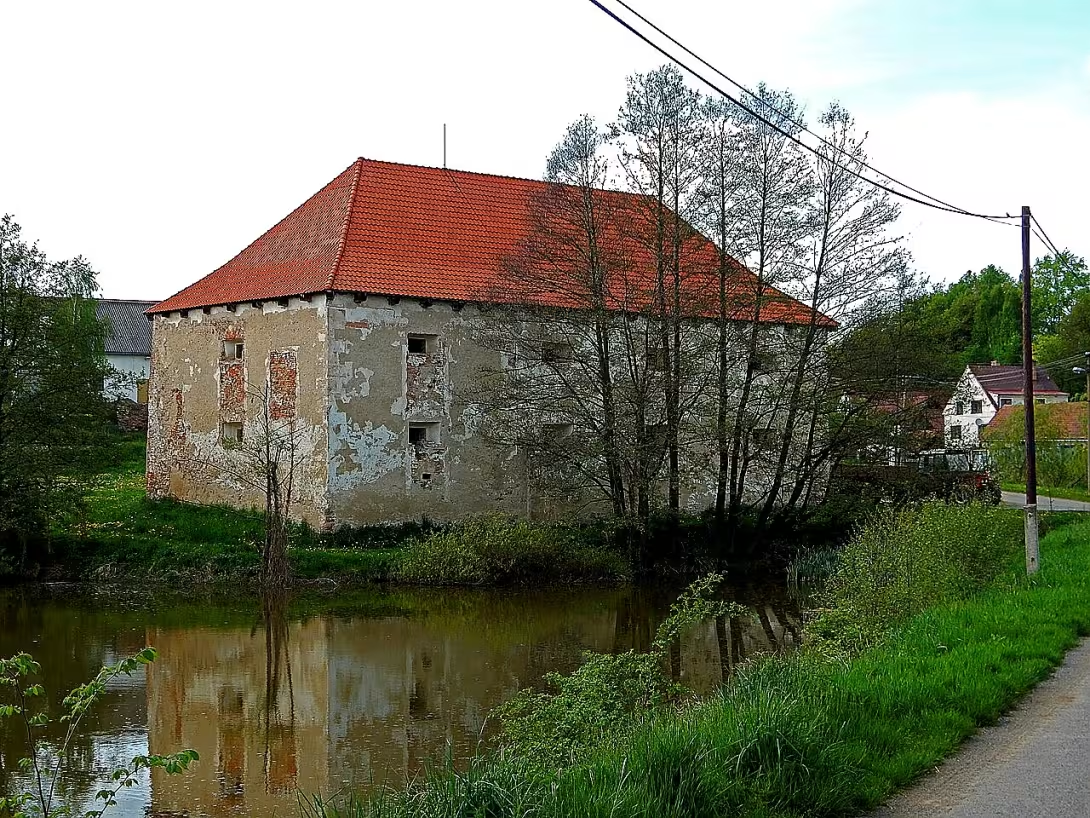
Nespery are a partially preserved medieval fortress in a settlement near the village of Veliš in Benesov district in Central Bohemia. Originally it served as a seat of the family of non-Persian flags and later the Octopus of Ostředek. Today the memorial is represented by the granary building and the historical cellar.
Only indirect reports are known about the oldest history of the fortress. The first written mention dates back to 1483, but the Vladyk were already based here at the beginning of the 14th century. Zdislav Nesper is mentioned here in 1318. From 1348 to 1377 his descendant Držek worked here, who in 1361 cooperated with the Patronage Law to the Church of St. Vavřice in Bedřichovice. In the next decades, many people referred to Nespery, such as Ondřej in 1384 or Jan in 1407. Other representatives of the family were Jan Bebta, Jan Olešák and his son Držek and Jan, who participated in the conquest of Prague by Jiří z Poděbrad in 1448.
At the end of the 15th century, ownership changed. After the death of Absolon from Polipes in 1483 he acquired the farm of Jan Řepa from Neveklov and was then bought by the brothers Alexander and Petr Chobotský from Ostědek. The Chobotsky family expanded its mansions about Tehov, Kobot and in 1530 about the Chotys. From 1571 to 1591 Jan Chobotský lived in Nesperi. After his death, the property was divided between the sons and Nespery fell to Adam. Historical sources differ in his destiny. August Sedláček mentions his death in 1615, while Tomas Shimek links him to the state uprising and subsequent confiscation of property. The farm eventually remained in the possession of William's son. The Nespery in 1681 sold Jan to Chejka from Olbramovice. In 1693, however, the dowry was sold to Count Halmhart of Wissenwolf as a result of family disputes and payment.
The fort was originally fortified by walls and moats, but they did not preserve. Only the residential building, which František Kashička describes as a square tower with a section of adjacent wall, remained in the complex. Later, it was converted into a granary. The area probably also included a deep cellar, which is a torsion of another medieval or early modern building.
Once connected to the Hlashim manor, the fortress lost its function as a superstructure and gradually became desolate. In the 19th century, the said rebuilding took place on the granary. This building, the adjoining cellar and the corresponding land are today protected as a cultural monument. The cellar was used by a local single agricultural cooperative in the second half of the 20th century.
The fortress Nespery represents a valuable fragment of medieval residence in the region of Vlašima. Her visit allows us to look into the history of the royal way of life and the administration of the estate.
Then and now
Drag the slider to compare how the landmark may have looked when it was built with the view today.
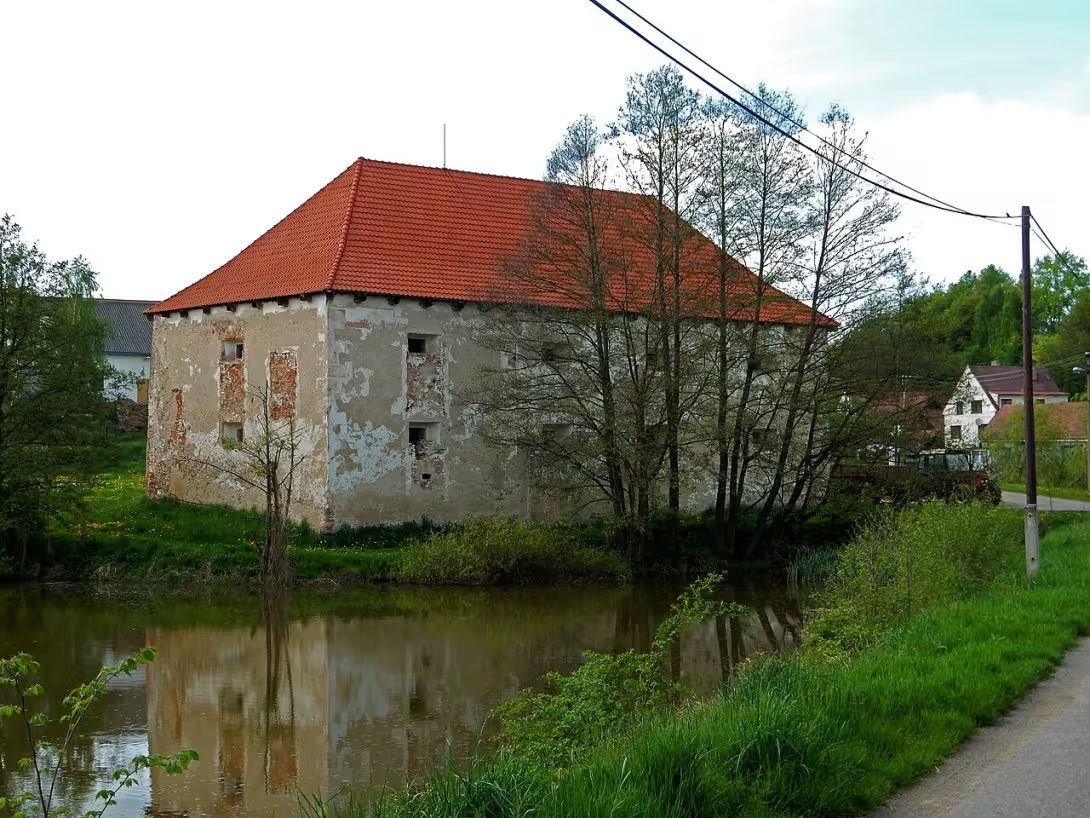
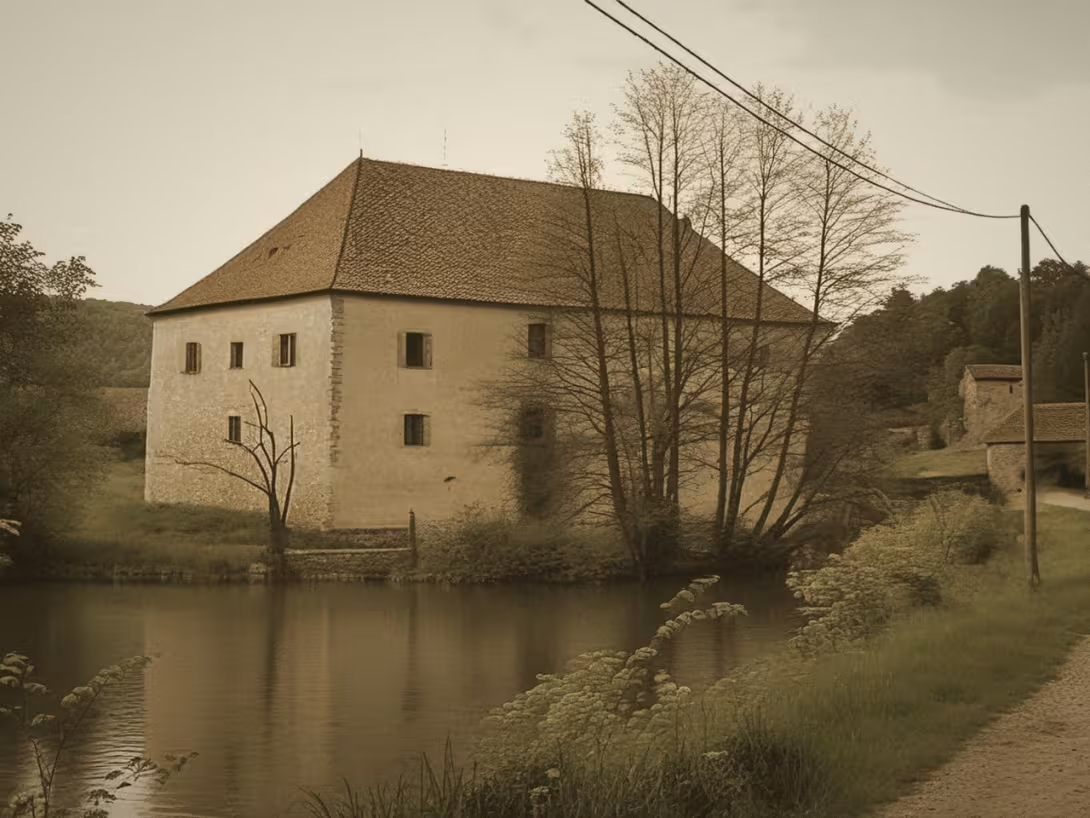
The historical appearance on the left is an AI-generated visualisation and serves as inspiration only.
Historical milestones
- around 1300
- Seat of the genus of the non-Persian flag
- 1318
- The mention of Zdislav Nespero
- 1483
- First written mention of the fort
- 1530
- Extension of the estates of the Octopus family by the Chotys
- 1681
- Sale of Jan Čejka's fortress from Olbramovice
- 19th Century
- Rebuilding of the granary building
Architectural development
The fortress consisted of walls and moats that were not preserved. A residential building was preserved from the cattle, which was later converted into a granary.
Points of interest
The memorial is today represented by the granary building and the historical cellar. - The first written mention dates back to 1483, but the Vladyk were based here at the beginning of the 14th century. - Jan, one of the leaders of the family, participated in the conquest of Prague by Jiří z Poděbrad in 1448. - The fort was originally fortified by walls and trenches, but they did not preserve themselves. - The residential building was later converted into a granary and the cellar was used by a local single agricultural cooperative in the second half of the 20th century.
Guide
Show guide text
This text was created by artificial intelligence and has not been editorially reviewed. It may contain inaccuracies.
Welcome to village Veliš. You're standing right in front of a place that doesn't have to act as a monumental chateau or a magnificent chateau, but whose walls carry the incredible weight of centuries. There is a building in front of you, which you see today as a granary, but believe me, under this seemingly simple and utilitarian form is the true history of the non-Persian fortress. Feel this atmosphere, the calm of this place, and try to imagine what this neighborhood looked like hundreds of years ago, when it was not just the farmers who lived here, but the powerful gentlemen who built their headquarters and their power.
Let us now move together in time deep into the past to understand why this place was created. The story of the Neper fortress begins at a time when power in the land was divided among a number of noble generations. As early as 1300, there were non-Persian flags, a layer of nobility that had a significant influence in the region. If you would like to touch the roots of this place, we need to look at 1318, when the name of Zdislav Nespero first appears in the historical records. He was a man who probably laid the foundation of the family tradition here. This fortress was not only a home, it was symbolic and practical expression of the strength of this family.
But over time, the fate of the place changed. Other generations joined power, and under noble ties, the fortress became part of the wider manor. Later, Chobotsky of Ostřeček began to rule here, who gradually expanded their power in this area. In 1530, for example, their estate was extended to Chotys, which shows how dynamic and variable the political environment at that time was. This era was a period in which the fort was still fulfilling its function as a significant seat, but at the same time it became part of the complex links between the various empires.
Now pay attention to what you see right in front of you. You may be asking why a building that stands before your eyes looks like it does. It's the result of a fascinating process of transformation. What you see today as a granary is the result of a major reconstruction that took place in the nineteenth century. At that time, the fort had already lost its original military and political function and had to adapt to a new age that required practical spaces for agriculture rather than fortified seats for nobles. Yet, even if you see a building with a different designation, in its foundations and in its structure it still smells the spirit of the original fortress. If you look at its overall form, you realize that this building is essentially the new cover of the old self. If you had the opportunity to explore the area, remember that this fort was originally much more fortified. It had to be protected by walls and trenches that created a barrier between the inner world of nobility and the outside world. Although these elements are no longer so obvious today, their shadow still hangs over this place.
However, in order to fully understand the importance of this place, we must focus on the people who lived here, made decisions and often fought. Names like Zdislav Nesper, Držek z Nesper or Jan Bebta z Nesper are not just empty words in chronicles. These were the people of flesh and blood who formed the history of their region here. For example, Jan of the Nesperski family is a very interesting figure. This man was incredibly connected to the great history of our country. In 1448 he participated in a significant conquest of Prague under the leadership of Jiří z Poděbrad. Imagine the contrast between today's peace of Veliš and the stormy world of the fifteenth century, when the fate of the kingdom was decided in battles and when people from this small place were part of the largest political movements in the Czech Republic.
Next, Chobotský of Ostřeček entered the history of the fortress. Their names, like Alexander, Nicholas, or William, appear in the records as symbols of the time when the fort became part of a wider estate and gradually lost its independence. Then, when the fort joined the Hlashim estate, her role as a superintendent began to fade. Gradually, year after year, its importance diminished, until finally the fortress as a fortified mansion disappeared and left only this building and the historical cellar, which still resembles its deep roots.
If you are looking for something unexpected in this place, pay attention to one interesting thing that may raise questions. Although we know that the flags were already based here at the very beginning of the fourteenth century, the first clear written mention of the fortress itself dates back to 1483. This means that for nearly two hundred years this construction existed and was an important point in the landscape without a more detailed record of it in the documents preserved. This gap in history makes us wonder how many other stories and events have happened here, but it has remained forgotten in the fog of time. It's the invisible layer of history we feel when we look at these old walls.
Today this monument is perceived primarily through its present form of granary, but its soul remains in those ancient times. It's a fascinating story about how power turns into utility, how fortified fortress turns into an agricultural building, and how the names of powerful masters become part of the history that we explore today.
We now invite you to further explore the area. Take a walk around the village Veliš, feel the atmosphere of this place and try to connect the pieces of this puzzle in spirit. Every stone and every building here has a story waiting for you. Thank you for the journey through time and reading this guide. We'll brighten up a pleasant continuation of your visit.
Tips for visitors
For the best experiences of the visit we recommend choosing spring or autumn, when the surrounding landscape is the most beautiful and weather for walking around ruins the most pleasant.
Nespery fort can be reached by car and public transport; please check the current traffic connections and parking options in the search engine or on the carrier's official website.
Since this is a partially preserved ruin, it is necessary to bring with you comfortable shoes to move in uneven terrain and plenty of drinking water.
The most suitable moments for photo lovers are just before sunset, when deep shadows and warm light best underline the historical architecture of the remains of the fortress.
Families with children can benefit from the visit as an adventurous survey of historical ruins, but care must be taken for the status of the monument. No other specific places to visit are listed in the area.
Businesses nearby
Do you run a restaurant, accommodation, shop, museum, rental, wellness or other visitor service near this monument? Show yourself directly to the people heading to it — this is how they will see you in the app and on the web:
Nearby
XXXHistorical monuments (56)
- Castle Ratmetery 5.0 km
- Castle Libouň 5.2 km
- Muzeum Podblanicka 5.8 km
- Jan Dismas Zelenka 5.9 km
- Menhir Friend 6.2 km
- Farine Museum 6.3 km
- Castle Odlochovice 6.4 km
- menhir 6.5 km
- Memorial of Václav Klaus output 6.6 km
- Czech Angel 6.6 km
- Hradby 6.8 km
- Blanick 6.9 km
- Vlastík Želivské 7.0 km
- New Castle Jemništ 7.2 km
- Chapel of St Magdalena 7.2 km
- New castle Jemnists 7.2 km web
- Castle Chotysany 7.3 km
- Vlashim Chateau - Podblanicka Museum 7.5 km Chateau 1
- Jan Očko z Vlašimi 7.5 km
- Memorial November 17, 1989 7.6 km
© Restaurant and catering (52)
- Castle Libouň - restaurant, accommodation 5.2 km
- _ 5.6 km
- Jankovské FARM 5.8 km Na square 14
- Restaurant under Blanik 5.8 km
- Castle Restaurant 5.8 km
- U Matthew 6.2 km + 420 317 843 086
- Chateau cafe 6.4 km
- Blanick 6.8 km + 420 731 803 327; + 420 736 670 169
- Restaurant Domashín Gate 7.0 km Benešovská 99 + 420604202672 web
- Restaurant on Dairy 7.2 km Blanic 816 web
- Silvie 7.4 km
- _ 7.5 km Chateau 1 + 420732878238 web
- Sympl 7.6 km
- Admiral bar (aka U Ládík) 7.6 km
- Restaurant On Vývoji 7.7 km
- Plzenka 7.7 km
- Stop CaffexZ4ZX 7.8 km
- Asian Gourmet Bistro 7.8 km
- Chinese Restaurant 8.0 km Circular
- Hossovka Under the dam 10.5 km
Accommodation (18)
- ChalupBlaník 5.3 km + 420 603 155 215
- Silvie 7.4 km web
- Na Vývoji 7.7 km
- Sporthotel 7.7 km web
- Resort Green Valley 8.2 km Chotys 16 + 420 777 218 614 web
- Statek Otradovice 9.9 km
- Štamberk 9.9 km
- Chaps Nest 10.6 km web
- Wellness 11.5 km America 24 + 420 724 973 922 web
- Travel inn Old Sv 11.6 km web
- U Páva 12.1 km
- Hojšín 12.4 km + 420 724 695 700 web
- Pilot Club 12.9 km
- Tábor settlement Miličin 13.9 km Milicín
- Hotel Benica 13.9 km + 420 317 725 611 web
- Amber Hotel Konopiště 13.9 km
- Hotel Atlas 14.0 km + 420 317 724 771 web
- Majka am See 14.2 km
▶ Rental and Sport (9)
- Sportisimo 7.9 km
- Na Justice 8.0 km
- Velo Fox 11.2 km
- Vlashim 12.7 km
- Swimming pool Pilar Votice 13.1 km
- Flat track Divišov 13.1 km
- Swimming pool 13.2 km
- Kineziotaping Benešov 14.0 km Masaryk Square 157 / 23 + 420606230788 web
- Sokolovna 14.1 km
© Tourism and Nature (68)
- Kups Rock 3.0 km
- Sv Anna 4.8 km
- U mill 5.8 km
- Vashim 6.0 km
- Blanic well 2 6.1 km web
- Krasovická hrora 6.3 km
- Blanic well 6.5 km web
- Big Blanick 6.8 km + 420 720 280 055
- U Brodce 6.8 km web
- Big Blanick 6.8 km
- White top 6.8 km
- Chicken Rock 6.9 km
- Chinese pavilion 7.0 km
- Small Blanick 7.2 km
- Vinice 7.4 km
- _ 7.4 km
- Lohovka 7.4 km
- White Hora 7.5 km
- ParaZOO 7.6 km Platenik 264 + 420317845169 web
- Křížovská hrora 7.7 km
Accommodation nearby
Themed route
Thematic cruise route: Nespery and surroundings
1.Nespery (fortress) - Type: Historical fortress - Why it is worth a visit: Nespery is one of the oldest and best preserved Gothic strongholds in Bohemia. Its history dates back to the 13th century, making it a fascinating place for lovers of history and architecture.
2. St. Jilji Chapel - Type: Chapel - Why is it worth visiting: This chapel is part of the Nespery fortress and represents an important historical and cultural element. Its simplicity and architectural details are interesting for visitors who are interested in medieval sacral architecture.
3. The Court - Type: Historical building - Why is it worth a visit: The Nespery Manor is an example of a rural Baroque house, which served as the mansion of the fortress. Its interior and historical elements offer a view into the life of the hard people.
4. Castle Park - Type: Park - Why is it worth a visit: Castle Park in Nespers is an ideal place to relax and walk after exploring the fortress. Its green environment offers a peaceful time to enjoy the nature and beauty of the rural region.
5.Veliš (municipality) - Type: Municipal centre - Why it is worth a visit: Visit the village Veliš allows you to know local culture and traditions. It may be appropriate to visit local markets or events if they take place, which will provide a view of the life of the inhabitants of this part of the Czech Republic.
This route offers a comprehensive experience of the history and culture of the region around Nesper.
Seasonal recommendations
In spring, ruins Nesper is awakened along with the surrounding vegetation, which begins to green and soft to surround stone walls. The light is very fine in this period, which creates ideal conditions for shooting details of the ruins. I recommend a visit in the morning when the air is fresh and the tourist burden is minimal. Dress well, because the morning temperatures near the ruins can still be cold.
The summer season brings intense sunlight and high temperatures that bounce off stone structures. The atmosphere is the most lively in these months, but at the same time the most challenging for hydration. Due to the increased number of people in the main summer season, it is best to arrive right after opening to enjoy a more peaceful tour. Don't forget the headgear and plenty of fluids because there's no natural shadow in the open.
Autumn turns the surroundings of Veliše into a color spectrum, when orange and brown shades of leaves give the ruins a melancholy touch. The morning fog surrounding the ruins creates a mysterious and magical atmosphere that is ideal for this type of monument. It's the best time for those who seek solitude and peace. However, prepare for higher humidity and do not forget the quality waterproof shoes for walking on uneven terrain.
In winter, Nespery acts raw and dramatic, especially when trees are around the monument without leaves and reveal its entire outline. The atmosphere is quiet and remote, allowing you to perceive the history of the monument in its purest form. In advent time or during freezing days it is necessary to wear very warm clothes and robust shoes, because the stone parts and roads to the fortress can be very slippery.
Visualizations and artistic views


The visualisations are generated by artificial intelligence and serve as inspiration.
Photos from the area
Real photos taken near the monument


Zdroj a licence jsou uvedeny u každého snímku.
Tips from visitors
No tips yet. Be the first!
Log in and add your tip.
Sources and literature
Fotografie: Hattrich / Public domain — Wikimedia Commons. The author and licence also appear when you hover over the image.
Faktickým podkladem tohoto textu byl článek na Wikipedii, jehož autory jsou přispěvatelé Wikipedie. Článek je dostupný pod licencí CC BY-SA 4.0.
Location on the map
More monuments – Veliš
Show all in the municipality
Příběhy a pověsti
Legendy, pověsti a příběhy spjaté s touto památkou
Fotografie návštěvníků
Zatím žádné fotografie. Buďte první, kdo přidá fotografii z návštěvy!
Přihlaste se a přidejte svou fotografii nebo hodnoťte.
Za ověřenou návštěvu v aplikaci získáte víc bodů — poznáme podle GPS, že jste na místě.
Reviews and comments