






Nová obřadní síň u Starého židovského hřbitova v Praze-Josefově Museum
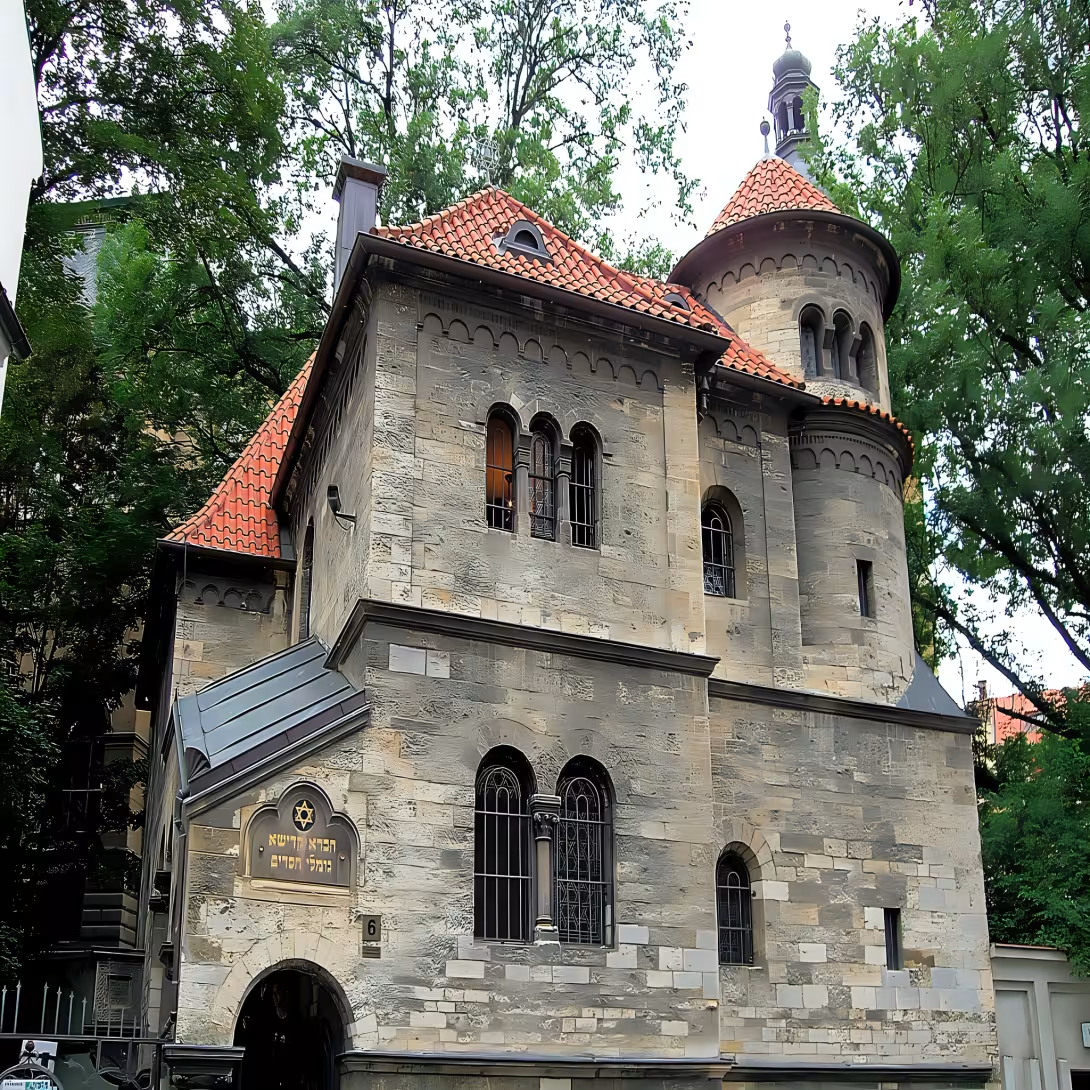
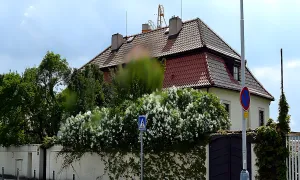
The new ceremonial hall stands in Prague Josefov right next to Klaus' synagogue, right next to the Old Jewish cemetery, with which it is protected as part of the national cultural heritage. Construction in the New Romanesque style was designed by architects J. Gerstel and A. Gabriel, who built it on the site of the older building of the funeral fraternity between 1906 and 1908. This created a new building for the last service of the deceased members of the Jewish village.
The architects consistently applied the New Romanesque style in all details - from the heels and heads of the columns to the forged grate and oak doors. The building has been exposed from the outhouse. The original functional division was preserved inside: there was a morgue in the basement, a room on the first floor for cleaning the deceased, and a federal room on the second floor for the funeral fraternity. The main hall on the first floor had a mosaic floor and walls lined with marble that decorated wall paintings. A direct entrance to the cemetery between the synagogue and the ceremonial hall was newly built.
But the building served its original purpose only until the First World War. Later, the funeral fraternity no longer used the building for burial. In 1926 it was rented to the Jewish Museum in Prague, which opened its first exhibition and which still maintains it. After the restaurant in 1997, there was a new exhibition dedicated to Jewish ceremonies over the deceased, local history and funeral habits in Judaism. This exposure continues on a thematic basis following exposure to Klaus Synagogue. From 1997 to 2024 there was an exhibition on Jewish burial practices.
An important part of the museum collection is the cycle of 15 paintings from around 1772, which captures the ceremonies and customs of the funeral brotherhood. The paintings were made to order the board of directors from an unknown painter. Although the tradition of baroque painting is still there, they have already pointed to enlightened ideas - they should have highlighted the important social role that the funeral brotherhood has played for centuries. As a historical source, they tell of the last stage of burial in the Old Jewish Cemetery.
The building is currently undergoing extensive reconstruction. Its aim is to return the ceremonial hall to its original form and to make new exposures available in it. The monument thus continues the tradition of serving as a place of education on Jewish history and culture in the heart of Prague Josefova.
Historical milestones
- 1906
- Starting construction of a new ceremonial hall at the site of an older funeral fraternity building.
- 1908
- Completion of construction and entry into service as final parting point.
- 1926
- Renting the building to the Jewish Museum in Prague and beginning its use for museum purposes.
- 1997
- Restoring and opening an exhibition about Jewish burial.
Architectural development
The building was built in a new Romanesque style with emphasis on detailed processing such as foot and head posts, forged grate and oak doors. In the interior there was a morgue in the basement, a room for cleaning the dead on the first floor and a federal room on the second floor. The main hall had a mosaic floor and marble-lined walls with mural paintings. The reconstruction was carried out in 1997- 2024 in order to restore the original appearance.
Historical events
- 1906
- The beginning of construction of the new ceremonial hall according to the design of architects J. Gerstela and A. Gabriela.
- 1926
- The building was rented to the Jewish Museum in Prague, which opened the first exhibition.
- 1997
- Restoration of the building and opening of the exhibition of Jewish burial practices.
Owners
Jewish Museum in Prague
Points of interest
- The construction was built between 1906 and 1908 in the New Romanesque style on the site of an older funeral fraternity building.
- The building was built from the optics and the interior had mosaic floors, marble walls and wall paintings.
- There was a morgue in the basement, a room on the first floor to clean the deceased, and a fraternity lounge on the second floor.
- In 1926 it rented the Jewish Museum in Prague, which has since maintained the exhibition.
Guide
This guide is narrated by a synthetic voice generated by artificial intelligence.
Show guide text
This text was created by artificial intelligence and has not been editorially reviewed. It may contain inaccuracies.
Welcome to the New Ceremonial Hall at the Old Jewish Cemetery in Prague-Josefov. You are standing here in a place that has and still bears deep meaning - not only as an architectural work, but as a witness to centuries of Jewish life, sadness and memories. In front of you is a building that looks like the time on it has slowly blossomed. Her face is calm, but full of stories - stories about the last farewell, about tradition and how people tried to keep order and dignity even at difficult times.
Let's go back to 1906 for a while, when there was an older funeral home building. It was the time when the Jewish community in Prague decided to build a new place for ceremonies that would fit their needs and notions of decency. The new ceremonial hall was to replace an older building that was no longer suitable. The architects Josef Gerstel and Adolf Gabriel designed a building in the New Romanesque style, which at the time was one of the favorites, especially for sacral and representative buildings. This style may remind you of medieval churches with their massive arches, decorated with facades and the typical "rough" stone that gives you a sense of strength and durability. And that is what this building is like - built from a spade, with marble details that provide the interior with a sense of grandeur.
Look carefully at the facade. Do you see how the arches rise above the entrance and how the stone shines in some places? Those are the marble elements that the architects placed where they were supposed to work most. And when you step inside - and I hope you do it soon - you realize that every detail has been thought out. In the main hall you will be welcomed by the mosaic floor, which with its pattern and colors creates an atmosphere of peace and respect. Notice how light falls through the windows and reflects from the marble walls. This space was originally intended for a common farewell, but also for the preparation of the body of the deceased - there was a morgue in the basement, a room for cleaning on the first floor, as they called it, and in the upper floors, common spaces where the members of the village met.
Now pay attention to how this building served not only its original purpose, but also other generations. After 1926, when the Jewish Museum rented it in Prague, it became a place where history and present met. In 1997 she passed a large restaurant and since then you have been accompanied by an exhibition dedicated to Jewish burial - a tradition that dates back to the Middle Ages. Here you will find out what Jewish sorrows looked like in the past, what the rules had and how they evolved with time. And it is this exhibition that will help you better understand why this building is so important not only for the Jewish community but also for the whole of Prague.
Stop for a moment and imagine what everyday life was like here. The sounds of footsteps, the whispers, the preparation for the ceremonies - it all happened between these walls. And even though she serves another purpose today, her soul remains unchanged. It's a place where sadness meets respect, tradition meets modern history.
In front of you lies the opportunity to explore not only this building but also the entire Josefov - a place that is like an open book full of stories. When you walk through his alleys, notice how the tombstones are arranged, how they differ and how each one carries the name, date and story. And when you come back here, in front of the New Ceremony Hall, remember that you were witnessing not only architecture, but also how people were trying to find peace in the most difficult times.
Thank you for taking the time to visit this place. May not only be accompanied by the sounds of our guide, but also by the silent memories of everyone who has ever been here. Let this moment bring you not only knowledge, but respect for the history that has taken place here. Good trip and when we meet again in another corner of Prague.
Tips for visitors
{'text': 'The best time to visit is early in the morning or in the afternoon when fewer visitors are in place. In these times you can see the New Romanesque architecture of the ceremonial hall in peace and without disturbing crowd. If you want to experience the atmosphere of the place at sunset, a visit in the evening is recommended, when light illuminates the facade of the building and creates picturesque shadows.'}
{'text': It is advisable to use public transport when visiting the sights, since parking in the centre of Prague is often difficult. The location is well accessible by car and by bus or tram. Check the current connection in the traffic search engine. If you arrive by car, find a parking lot near the Old Jewish Cemetery where it is possible to unload the vehicle and then reach the ceremonial hall on foot. '}
{'text': 'When visiting, wear comfortable shoes and suitable clothes because the tour includes a walk around the historic cemetery. In the winter months bring warm clothes because it can be cold in the cemetery. Next, prepare your laptop or mobile phone if you want to record information about the history of the site that is often available in the exposition.'}
{'text': 'Photography is allowed, but it is advisable to respect the sensitivity of the site. The best places for photographs are the facade of the ceremonial hall and surrounding cemetery in sunny weather, when light creates contrasting shadows and illuminates the details of architecture. When shooting in the cemetery, avoid disturbing other visitors and make sure that your images do not disturb a quiet environment.'}
{'text': 'In the vicinity of the monument there are several other interesting places worth visiting. For the first stop you can choose the Old Jewish cemetery, which is one of the oldest Jewish cemeteries in Europe. Another interesting feature is Klaus' synagogue, which is known for its Gothic style and rich history. You can also see the Old Synagogue, which is the oldest preserved synagogue in Prague. '}
{'text': 'If you are visiting a memory with children, prepare some activity that is focused on history and culture. It is possible to visit interactive exhibitions in the museum nearby. Children can see the models of historical objects and learn about the life of the Jewish community in Prague. It is interesting for older children to explore the cemetery and its symbolism, while for young children it can be interesting to play with stones and graves.'}
Frequently asked questions
Is Nová obřadní síň u Starého židovského hřbitova v Praze-Josefově open to the public?
Yes, the new ceremonial hall is open to the public. The tour takes approximately 30 minutes.
How do I get to the place by car / public transport?
The nearest parking lot can be found in Široká Street or in Peace Square. You can also use the city transport - the Republic Square Metro Station is a 5-minute walk from the monument.
How much is the entrance fee and is it paid on the spot?
It's paid right inside the monument.
Is the tour suitable for children and seniors?
Yes, the new ceremonial hall is suitable for families with children and seniors. The tour takes approximately 30 minutes and is not demanding on physical activity.
How long does the tour take?
The tour takes approximately 30 minutes.
What are the opening times and booking is required?
The memorial is open from Tuesday to Friday from 10: 00 to 5: 00. Sundays and public holidays are closed. Reservation is not necessary, but we recommend making it in advance for group visits.
What's interesting in the immediate vicinity?
In the vicinity of the monument you will find the Old Jewish cemetery, Klaus Synagogue and other historical buildings. You can also visit the nearby Square of Peace or the street Široká.
For kids
Imagine going back to when Praha was a small town with a dense Jewish population. It's been years since the Crusaders went to war and the Jews had to escape the fierce. And yet, at that very time, on the top of the Josefov, the Old Jewish cemetery was built, where today you will find a hall that has many secrets.
Businesses nearby
Events nearby

Zdroj akcí: otevřená data měst a obcí ČR (Národní katalog otevřených dat) a kalendář akcí Národního památkového ústavu.
Nearby
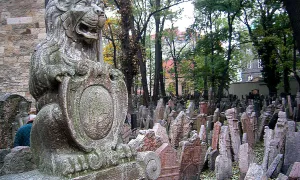
The surrounding area is the Old Jewish cemetery (ruins of the 15th century Jewish cemetery) and Klaus' synagogue (Gothic synagogue from 16th century), which are also protected as national cultural monuments. There are also other historical buildings in Prague Josefova, such as the Old Synagogue.
Accommodation nearby
Trips and activities nearby
Guided tours, tickets and activities nearby from GetYourGuide
Affiliate link: if you buy from the partner, we may receive a commission. The price for you does not change.
Search tours and activities →Themed route
Thematic cruise route to Prague-Josefova
1. Old Jewish cemetery - Type: Historical ruins - Why is it worth a visit: The old Jewish cemetery is one of the oldest and largest European Jewish burial grounds founded in the 15th century. Its historical value lies in hundreds of tombstones with Hebrew inscriptions and artistically expressed epitaphias, which testify to the rich cultural tradition of the Jewish community in Prague.
2. Klaus' Synagogue - Type: Gothic Synagogue - Why is it worth a visit: Klaus' synagogue, founded in the 16th century, is the oldest synagogue preserved in Central Europe and the world's first Gothic synagogue. It is an architectural object with rich history and artistic elements that reflect the life and faith of the Prague Jews.
3. Old Synagogue - Type: Historical Synagogue - Why is it worth visiting: The old synagogue is the oldest synagogue in Prague, built at the end of the 13th century. This is key evidence of Jewish settlement in the city and evidence of historical survival and adaptation of the Jewish community in Prague.
4. New ceremonial hall at the Old Jewish cemetery - Type: Museum - Why is it worth a visit: The new ceremonial hall is part of a museum located near the Old Jewish cemetery. It is a place where you can discover the rich history and traditions of the Jewish community in Prague through interactive exhibitions and impressive stories about their fate.
This route offers visitors the opportunity to explore the historical and cultural heritage of the Jewish community in Prague-Josefov, from old cemetery monuments to architecturally interesting synagogues to modern museum spaces.
Seasonal recommendations
Spring: In spring, the New Ceremonial Hall at the Old Jewish Cemetery in Josefov is transformed into a place full of hope and new beginnings. The sun rays illuminate historical architecture, while the blooming trees around the cemetery add colored shine to the atmosphere. Visitors can expect mild temperatures and frequent sunny days, which is ideal for walking around the nearby cemetery. It is recommended to visit in the early afternoon when fewer visitors and temperature are manageable. Put on a sweater or a cloak for any cooler moments.
Summer: The New Ceremonial Hall becomes a popular destination for visitors looking for cultural entertainment in the centre of Prague. Sunny days and warm night peace bring a lively atmosphere, but also a higher number of visitors. It is advisable to visit the early afternoon or Sunday when there are slightly fewer people and temperatures are still comfortable. Don't forget to take your sunglasses and plenty of drinking, because the summer sun can be intense.
Autumn: In autumn, the New Ceremonial Hall in Josefov is transformed into a place with melancholy beauty. The leaves of the trees in the cemetery go into golden and red shades, which gives the atmosphere romance and peace. The temperatures are softer, but the springs often appear, so it is advisable to bring blankets or coats with you. The best time to visit is at noon, when the sun still lights up space and the crowds are less.
Winter: In winter, Nová obřadní síň u Starého židovského hřbitova v Praze-Josefově offers a unique atmosphere. Freezing air and snow sheets add romance to the historical space, while light seems less intense due to shorter days. It is important to visit the hall in warm clothes and with protective shoes on cold soil. The best time to visit is early afternoon when many people have already left and nature offers a peaceful view.
Visualizations and artistic views


The visualisations are generated by artificial intelligence and serve as inspiration.
Photos from the area
Real photos taken near the monument

Zdroj a licence jsou uvedeny u každého snímku.
Tips from visitors
No tips yet. Be the first!
Log in and add your tip.
Sources and literature
Fotografie: Jim Linwood / CC BY 2.0, rozlišení zvýšeno umělou inteligencí — Wikimedia Commons. The author and licence also appear when you hover over the image.
Faktickým podkladem tohoto textu byl článek na Wikipedii, jehož autory jsou přispěvatelé Wikipedie. Článek je dostupný pod licencí CC BY-SA 4.0.
Location on the map

Příběhy a pověsti
Legendy, pověsti a příběhy spjaté s touto památkou
Fotografie návštěvníků
Zatím žádné fotografie. Buďte první, kdo přidá fotografii z návštěvy!
Přihlaste se a přidejte svou fotografii nebo hodnoťte.
Za ověřenou návštěvu v aplikaci získáte víc bodů — poznáme podle GPS, že jste na místě.
Reviews and comments