



Nové Adalbertinum Track
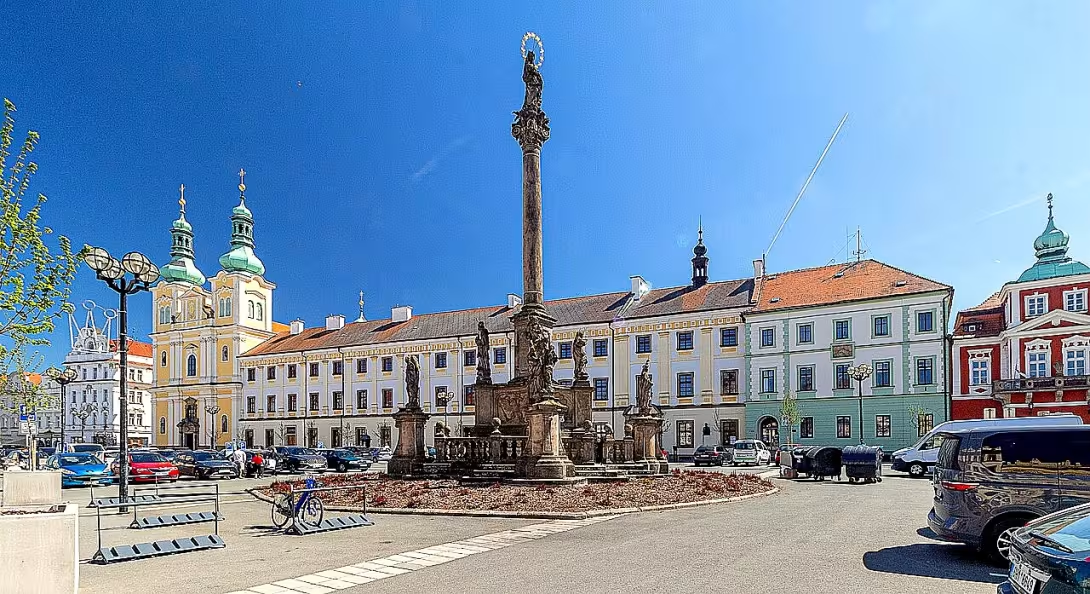
Nové Adalbertinum is a Baroque building on the south side of the Great Square in Hradec Králové, which attracts the attention of many visitors with its history and architecture. Originally built as a Jesuit college on the turn of the 17th and 18th centuries, it underwent various stages of exploitation that reflect the variable history of the city of Hradec Králové.
The history of New Adalbertinum dates back to 1627, when the basis for its creation was laid. The idea of Jesuit college appeared after the donation of the house and the manor of the Frogs by Friedrich of Oppersdorf, which allowed the Jesuits to invest in the construction of the track. Despite the agreement of the city of Hradec Králové and the emperor with its foundation, the construction was affected by the 30-year war which postponed the plans for implementation. The base stone was laid only in 1644, but financial difficulties and disputes with the local magistrate caused further delays. Finally, the construction was completed in 1710, when the Jesuits began to move into the building.
Architecturally, Nové Adalbertinum is the work of Pavel Ignác Bayer and represents the peak of baroque art. The building is two storey with one-storey wing on the southeast side, has a saddle roof and contains two inner yards. The main facade is headed for the Grand Square and is divided by Tuscan Pilasters and Triglyphs, while the south facade is easier. All the rooms are arched, which adds interior elegance to the building.
The ownership of New Adalbertinum has changed several times over the years. After the abolition of the Jesuits in 1773, the building was nationalized and converted into a barracks. In the 19th century she served as a gymnasium where important Czech writers such as Václav Kliment Klicpera, Josef Kajetán Tyl, Alois Jirásek and Karel Čapek taught and studied. After several further changes, it was handed over in 1992 to the church, which carried out its overall reconstruction.
Key events in the history of New Adalbertinum include a fire during the invasion of Prussians in 1762 and a festive visit to Pope John Paul II in 1997 when the name Nové Adalbertinum was re-awarded to the building. In 2003 a statue of John Paul II was placed on the square, which reminds us of the importance of this event.
Today, Nové Adalbertinum is the property of the royal castle bishop and serves various purposes. Part of the space is used by the church for study, library and other activities, while another part is rented to commercial organisations as a convention centre, pension and restaurant. This combination of religious and commercial activities makes Nové Adalbertinum a unique place in Hradec Králové.
Nové Adalbertinum is not only an architectural monument but also a witness to the rich history of the city and its inhabitants. Its variable use from the track to the barracks and gymnasium to the current state reflects the dynamics of Czech history. For visitors it offers not only beautiful architecture, but also the possibility to immerse yourself in the history of the city Hradec Králové.
Nové Adalbertinum is therefore an important monument worth visiting. Its rich history and architectural beauty attract many people from around the world who want to discover the unique past of Hradec Králové.
Historical milestones
- 1997
- The consecration of New Adalbertinum by Pope John Paul II.
Architectural development
The building was built according to Pavel Ignác Bayer's design as a Baroque structure. After the fire in 1762 and the abolition of the Jesuits, several reconstructions took place, including conversion to barracks and gymnasium. Recently it has been reconstructed for current use.
Historical events
- 1644
- The building of the track has begun.
- 1710
- Completion of the construction of the college and the priesthood seminar.
- 1762
- The building burned down during the Prussian invasion.
- 1997
- Pope John Paul II visited Hradec Králové and consecrated Nové Adalbertinum.
Owners
- 1627
- 1773
- 1992
Points of interest
- Nové Adalbertinum is a Baroque building built as a Jesuit college at the turn of the 17th and 18th centuries. - The foundation for its creation was laid in 1627, but the base stone of the track was laid only in 1644 because of the 30-year war. - Architecturally it is the work of Pavel Ignác Bayer and represents the peak of Baroque art with a two-story structure, one-story wing and a saddle roof. - After the abolition of the Jesuits in 1773, the building was nationalized and converted into a barracks; later served as a high school where important Czech writers taught and studied. - In 1997 Nové Adalbertinum visited Pope John Paul II, which was associated with the ceremonial award of the building name Nové Adalbertinum.
Guide
Show guide text
This text was created by artificial intelligence and has not been editorially reviewed. It may contain inaccuracies.
Welcome to Hradec the King. You are standing in front of one of the most important building units in this city, in front of a building that carries walls full of stories, silence and voices of the past. Nové Adalbertinum. While you're looking at its massive form, try to stop for a moment just seeing stones and shapes and begin to perceive the incredible weight of time that radiates from this place. This building is not just part of the urban landscape, it is a living witness to the events that shaped our history. Feel the atmosphere of peace floating here, even though we know how many storms this space must have crossed.
To understand why this building looks like you see it, we must go back deep into the past together, to a time when the maps of Europe were rewritten in the fire of wars. More than 300 years ago, in 1627, the first foundations began to be laid here. Imagine the uncertainty, tension and constant fear that rules people in times of great conflict. It is this era, this devastating 30-year war, that has become the biggest obstacle. The construction couldn't continue at the pace it deserved. She had to wait, she had to survive the worst storm before it was possible to lay the very cornerstone of this Jesuit college in 1644. It's fascinating how even the greatest architecture must subordinate its rhythm to the chaos that controls the world.
This building was born as a Jesuit college, a place for study, prayer and spiritual growth. The Jesuits here shaped the minds and built the bases of their influence. But history has its own plans and is constantly changing. In 1773, a crucial turning point came when the order of Jesuits was abolished. Since then, the role of this place has been constantly changing. The building must have been able to accommodate completely different lives and purposes. At different times, she served as a barracks where there was a sound of the pounding of soldiers and the footsteps of men in uniform, and later as a gymnasium, where again the voice of students seeking knowledge. This ability of the building to adapt, survive and still serve society is one of its greatest forces. Today, it is used by the Church and also by various commercial activities, which is another layer of its constant transformation.
Now pay attention to the very form of the construction that is surrounding you. Look at her shapes and see the Baroque aesthetics. This place represents the peak of baroque style, its monumentality and richness. This whole architectural project is the work of the master who was Pavel Ignác Bayer. Even if you can't touch every detail, feel the harmony and the strength that baroque architecture brings. It's a style that's supposed to create emotions that impress a person and make them feel higher. When you look at the facade and the overall structure of the building, remember how Bayer managed to create a work that dominates the surroundings while acting naturally.
When you look at these walls, remember that there were people in this town and in its vicinity whose names are now in history books. These places are interwoven with shadows and the lights of their lives. There are traces of personalities like Fridrich z Oppersdorfu or Rudolf Ferdinand z Vinoře. There are also names that will imprint the words and images of our culture. Imagine Václav Kliment Klicper, Josef Kajetan Tyl, or the great literature like Alois Jirásek and Karel Čapek. Although their paths may not always face every stone of this building, their spirit and their influence on Czech language and thinking are inextricably linked to this place and this city. They're people who have shaped how we see the world around us today.
And if you think history ends in ancient times, allow me to reveal one very important and modern event that gives this place a new sanctity. In 1997 a moment took place here, which for many was the peak of spiritual life. Nové Adalbertinum was ordained by Pope John Paul II himself. Imagine the presence of a world leader, the weight of the moment when the old Baroque building meets the modern history of the Church. It was a moment that redefined this place and showed that even though its foundations are hundreds of years old, it is still able to accept great events and be the center of the world's attention.
Now that you've gone through this journey of time, from the war years of the Thirty Years' War, to the Jesuit era and the Baroque peak, to the modern age, you may see this building differently. It is no longer just an object of stone and mortar, but a complex story about adapting, about human efforts to create beauty even in difficult times and about the constant movement between what was and what is.
I firmly believe that this view of Nové Adalbertinum has helped you better understand its meaning. But don't stop at this one place. Hradec Králové has many other secrets and beauty for you to discover. So keep walking, perceive the atmosphere of this city and let it take you by its history. Thank you for your journey and I wish you a wonderful continuation in discovering this place. Goodbye.
Tips for visitors
The best time to visit New Adalbertinia is spring and autumn, when the weather is mild and the trees around the building are picking up colors, which contrasts beautifully with the Baroque facade. It may be hot in Hradec Králové in summer, so choose the morning or evening clock when the light is softer and less dazzling. In spring, the budoba is surrounded by flowering greenery, creating an idyllic atmosphere for walking.
When planning a trip, wear comfortable shoes, as the surrounding area can be slightly uneven, as well as enough drinking mode. If you are planning a longer stay in Hradec Králové, consider taking a light jacket with you because temperatures can change, especially in transition periods. We also recommend taking a small bag with refreshments if you do not plan to visit any of the restaurants nearby.
It is ideal for photography in the morning or late afternoon when the sun shines at an angle and creates long shadows that highlight architectural details of the Baroque building. The best views of Nové Adalbertinum can be obtained from the opposite side of the street, where you can capture the entire facade without disturbing elements.
Since there are no specific places in the area within 30 minutes in the background, we recommend focusing on the monument itself and its immediate surroundings. Walking the streets of Hradec Kralove, which are full of historical buildings, is interesting in itself. You can enjoy the city's atmosphere and discover other architectural jewels located in the immediate vicinity of New Adalbertinia.
For families with children, Nové Adalbertinum is interesting in its historical context, which can be explained to children by simple stories about Jesuits and Baroque times. Children can enjoy a walk and observe the details of the building such as windows, doors and statues.
Frequently asked questions
Can the monument be visited?
We have not verified whether this monument is accessible. Please ask the owner or operator, or the local municipal office.
Where is the monument?
Location: Hradec Králové. The map on this page shows the exact spot.
Why is the monument protected?
It is listed in the Central List of Cultural Monuments of the Czech Republic as a cultural monument (register no. 1000126685).
Businesses nearby
Do you run a restaurant, accommodation, shop, museum, rental, wellness or other visitor service near this monument? Show yourself directly to the people heading to it — this is how they will see you in the app and on the web:
Nearby
🏰 Historic sites (335)
- Jesuitská kolej 0.0 km
- Bývalý Jesuitský Seminář 0.0 km
- Kostel Nanebevzetí P. Marie 0.0 km
- Mariánský sloup 0.1 km web
- Dům "U Špuláků" 0.1 km
- Muzeum české lékárny 0.1 km Velké náměstí 29/39
- Judr. Josef Tausik 0.1 km
- Klára Tausiková 0.1 km
- Galerie moderního umění 0.1 km
- Ofelie 0.1 km Klicperova
- Karel Rokitanský 0.1 km
- P. Stanislav Vydra (Cordatus Bohemius) 0.2 km
- Bílá Věž 0.2 km +420734711142 web
- Havlův dvoreček 0.2 km
- Josef Liboslav Ziegler 0.2 km
- Galerie Václava Havla 0.3 km
- Václav František Červený 0.3 km
- Adolf Černý (Jan Rokyta) 0.3 km
- Památník padlým legionářům 4. střeleckého pluku Prokopa Velikého. Jan Gayer (1885 - 1918) 0.3 km web
- Pomníka Ladislav Jana Pospíšila 0.4 km
🍽️ Restaurants and dining (397)
- Archway 0.1 km Velké náměstí 144 +420773905875 web
- Restaurace Mexita 0.1 km Velké náměstí 148/11 +420 495 51 21 51 web
- Dhaba Beas 0.1 km web
- U Zlatého Lva 0.1 km Velké náměstí 29/39
- Pasta Cook&Look 0.1 km web
- Localis bistro 0.1 km web
- EMOI 0.1 km Špitálská 150/10 +420 730 199 999 web
- Sport Café 0.1 km Velké náměstí 151/10 +420 495 514 202 web
- Cup Bab Korean Bistro 0.1 km Velké náměstí 153/9 +420 608 812 259 web
- Pivovarské Domy 0.1 km
- Hendrix Café 0.1 km Velké náměstí 153/9 +420 491 611 402 web
- Pedro Bar 0.1 km
- Na hradě 0.1 km Špitálská 175/5 +420 603 873 667 web
- Pivnice U Pražského Groše 0.1 km Tomkova 178
- Restaurace Mustang U Děravýho Kotle 0.1 km
- Alen Bakery 0.1 km Velké náměstí 165/2
- Putna 0.1 km Tomkova 139/140
- The Royal Maharaja 0.1 km Velké náměstí 22 +420491617572 web
- Sachi 0.1 km
- Bohemia Sekt Club 0.1 km
🏨 Accommodation (52)
- Nové Adalbertinum 0.0 km Velké náměstí 32/40
- U České koruny 0.1 km
- Hotel Pod Věží 0.1 km
- Hnízdo snů 0.2 km +420608024616 web
- Hotel U Královny Elišky 0.3 km Malé náměstí 117/10 +420 495 518 052 web
- Tereziánský dvůr 0.3 km +420495505111 web
- Penzion Amátka 0.3 km Malé náměstí 120/13 +420 606 776 795 web
- Hotel Grand 0.3 km +420 491 514 999 web
- Hotel Stadion 0.3 km web
- Hotel Okresní dům 0.3 km Palackého 6 +420 495 054 300 web
- Hotelový dům Academic 0.8 km +420 495 511 175 web
- Penzion Pupendo 1.4 km
- Penzion MAR 1.5 km
- Penzion - Ubytovna U Mlejna 1.5 km Zámostí 261/19
- Černigov 1.5 km
- Alessandria 1.6 km
- Sasanka 1.7 km web
- Koloťuk 1.7 km +420 774 716 339 web
- Stulík 1.7 km web
- Hertz 2.0 km Kydlinovská 335/46a
🚲 Rentals and sport (167)
- Nextbike 0.1 km web
- Nextbike 0.2 km web
- Nextbike 0.2 km web
- Nextbike 0.3 km web
- Nextbike 0.3 km web
- Zimní Stadion 0.3 km
- Nextbike 0.4 km web
- Nextbike 0.4 km web
- Kostka 0.4 km
- Nextbike 0.4 km web
- Nextbike 0.4 km web
- Nextbike 0.5 km web
- Nextbike 0.5 km web
- Nextbike 0.5 km web
- Nextbike 0.5 km web
- Nextbike 0.5 km web
- MOJEKOLO 0.5 km
- Sokol 0.6 km
- HZS cvičná věž 0.6 km
- Cyklospeciality 0.6 km
🥾 Hiking and nature (200)
- Radnice 0.1 km
- Žižkovy sady 0.3 km
- Kavčí plácek 0.3 km
- Vrcholek batarda 0.4 km web
- Vrcholek batarda 0.5 km web
- pevnostní patníky 0.5 km web
- Pevnostní koridor 0.5 km web
- pozůstatky pontonové lávky 0.6 km web
- Jiráskovy sady 0.6 km
- Vonešovy sady 0.6 km
- Kubištovy sady 0.7 km
- náměstí Václava Havla 0.7 km
- Poterna 0.7 km web
- Šimkovy Sady 0.8 km
- Sady architekta Lisky 0.9 km
- Bidlův park 0.9 km
- Sady architekta Lisky 1.0 km
- Hraniční patníky pevnosti 1.0 km web
- Vila Václava a Luisy Tesařových 1.1 km web
- Park Skleněnka 1.2 km
Accommodation nearby
Themed route
* * 1. Main entrance hall - entrance area The first stop will welcome you with an impressive entrance hall where you can get basic information about the history and function of New Adalbertina. The walk here starts the atmosphere of the whole complex.
* * 2. Historical tower - architectural element The tower offers views of the inner courtyard and surrounding city panorama. In addition, you can admire preserved stone details that resemble the original building style.
* * 3. Exposition of new crafts - exhibition In this section are shown contemporary craft techniques that complement historical contexts of the building. Interactive demonstrations allow visitors to test traditional skills.
* * 4. Ambient garden - garden The garden surrounding the main building offers a quiet sitting between ancient statues and flowering bushes. It is an ideal place to relax after a tour and soak up the atmosphere of the place.
Seasonal recommendations
Spring
Green nature has awakened from the snow breath, and the landscape is gaining the vivid colors of flowering trees and bushes, creating a harmonious background for visiting. In this period it is advisable to prepare light clothes with the possibility to add layers because temperatures can be variable. The best time for a tour is in the morning or in the evening when you avoid crowds and enjoy a quieter atmosphere.
Summer
The summer visit to New Adalbertinuma offers long days with long sunny rays that illuminate architectural elements of the building in full beauty. In this period nature is around the most lively and green, which gives space to life energy. It is advisable to choose the healing clothes and protective sunglasses to protect yourself from the strong sun. The best time for a tour is in the dark hours of the morning or late afternoon when temperatures are lighter and fewer people.
Autumn
In autumn, Nové Adalbertinum is transformed into gold, orange and red because of temporary trees that make a beautiful background for historical monuments. Soon the sun is hiding behind the horizon, creating a calm and slightly melancholy atmosphere. In this season it is advisable to prepare your clothes with more layers, as temperatures may fall rapidly. The best time for a tour is on clear and dry days in the morning or in the evening when it is quieter and fewer people.
Winter
During winter, Nové Adalbertinum turns to darker light and snow breathes add magic to the historical environment. Winter can bring cold but often clear days when the surrounding landscape can be seen in all its winter colours. It is necessary to choose warm clothes and protective shoes to protect yourself from cold. The best time for a tour is on bright days in the morning when the light is the most beautiful and fewer people.
Visualizations and artistic views

The visualisations are generated by artificial intelligence and serve as inspiration.
Photos from the area
Real photos taken near the monument


Zdroj a licence jsou uvedeny u každého snímku.
Tips from visitors
No tips yet. Be the first!
Log in and add your tip.
Sources and literature
Photos: VitVit / CC BY-SA 4.0 — Wikimedia Commons. The author and licence also appear when you hover over the image.
Faktickým podkladem tohoto textu byl článek na Wikipedii, jehož autory jsou přispěvatelé Wikipedie. Článek je dostupný pod licencí CC BY-SA 4.0.
Location on the map
More monuments – Hradec Králové
Show all in the municipality
Příběhy a pověsti
Legendy, pověsti a příběhy spjaté s touto památkou
Fotografie návštěvníků
Zatím žádné fotografie. Buďte první, kdo přidá fotografii z návštěvy!
Log in a přidejte svou fotografii nebo hodnoťte.
Za ověřenou návštěvu v aplikaci získáte víc bodů — poznáme podle GPS, že jste na místě.
Reviews and comments