



Obecní dům (Semily) Hotel building
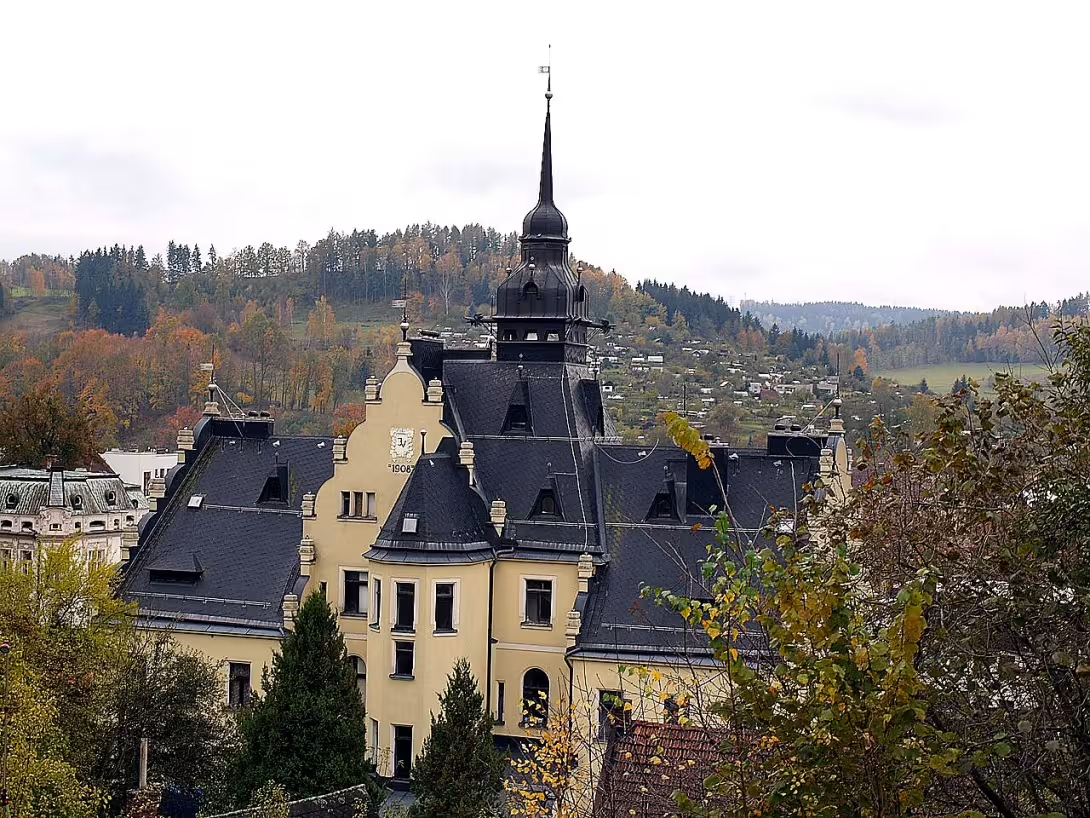
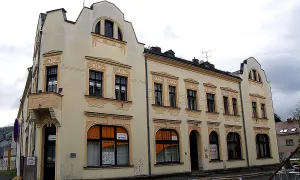
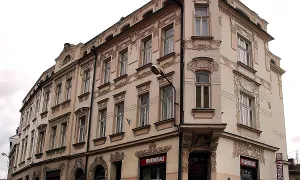
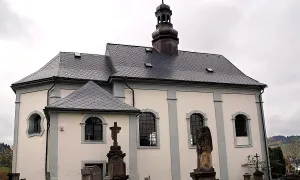
The Municipal House in Semilech is an exhibition building from 1907-1908 in Husova Street. Together with the church of St. Peter and Paul, it is a dominant town and is registered as a cultural monument.
The building was created during the flowering of historism and the development of urban infrastructure in Austria-Hungary. A 1904 fire started the building. He set off from the brewery spills and destroyed several houses on the main Semil class at the time. The city has thus solved more problems at once, as the city was lacking offices and a brewery of refrigerators and cellars. The project was developed by architect Jan Vejrych, who designed the building and its interior. Construction work was carried out by Josef Košák and Josef Brodský of Semil under the supervision of the authorized builder Karl Andrejsek.
From the point of view of architecture it is a four-story building with a characteristic turret. The building's shield is decorated with a Venetian glass mosaic with a city emblem designed by Jano Köhler. At the time of its inception, the house was equipped with electric lighting and central heating was installed on the ground floor. It was conceived as a multifunctional space. The basement was used as a brewery cellar with a fridge that was connected to the brewery tunnel under the street. The ground floor was hosted by a large and small restaurant and spaces of the city savings bank. The first floor was intended for apartment officials, offices and meeting rooms. The second floor served for innkeeper rooms and attic for staff, hotel tenants and student dormitory.
The history of the property is complicated and linked to the financial problems of the city. The original budget of CZK 76 226 was significantly exceeded and the final price was CZK 259 792. Due to the debt, the house was transferred to the district committee in April 1914 and was renamed the District House. It was later purchased for CZK 700,000 by the husband Milos and Vlasto Kvapil. In February 1948 the property was taken from the family and in 1960 it became state property under the administration of Restaurants and Dining Rooms in Turnov. After 1989, there was restitution in favour of Milos Kvapil Jr.. Subsequently, the building changed several owners, including ŠIMI s.r.o. and Simon Stergiu, before it became the property of Semily.
In November 1998 the building was declared a cultural monument. It was reconstructed by TOPEX 99 in 1999 and was reopened under the original name Municipal House in December 2000. There's been another change at the moment. Since 1st May 2024, the new owner is the Municipal House Semily s.r.o., which has ended the hotel operation and is converting the building into an apartment house. The building is currently undergoing extensive reconstruction.
The municipal house represents an important example of non-orenesance architecture and is proof of the city's ambitions in the early 20th century. His facade and history are a valuable addition to Semil's urban face. Visitors are advised to observe the building from the outside as one of the main city dominance.
Then and now
Drag the slider to compare how the landmark may have looked when it was built with the view today.
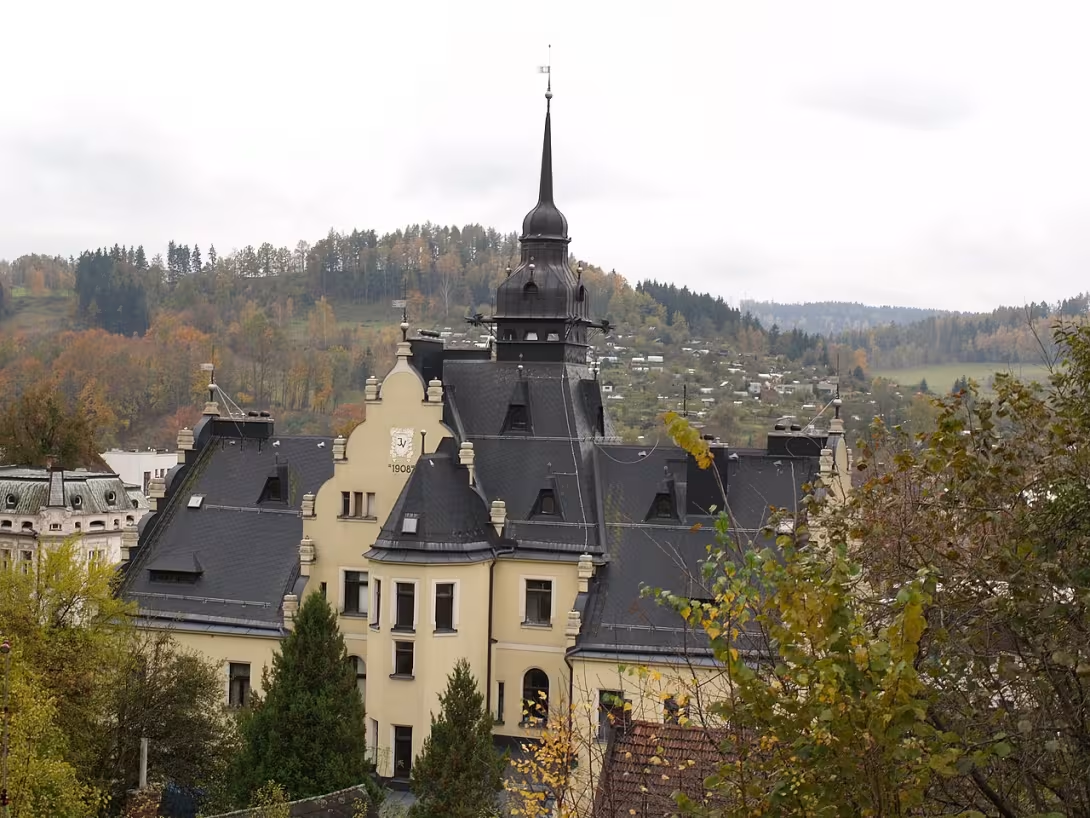
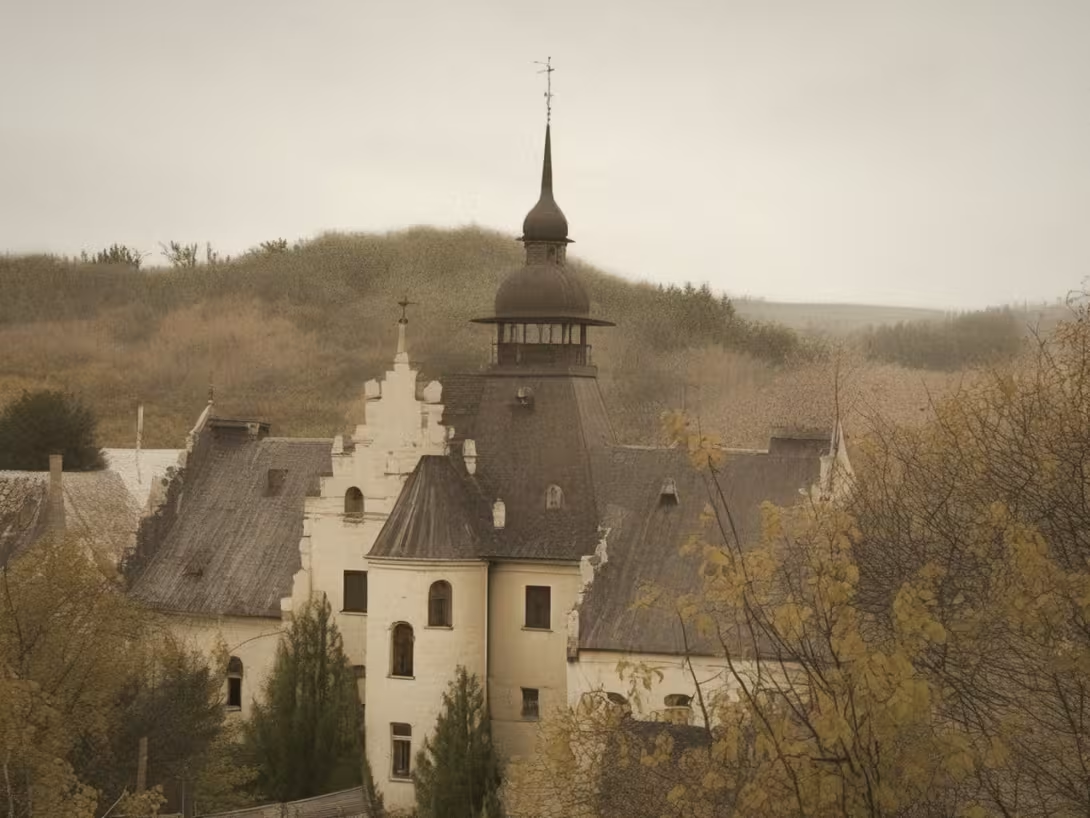
The historical appearance on the left is an AI-generated visualisation and serves as inspiration only.
Historical milestones
- 1907
- construction start
- 1913
- building approval
- 1999
- reconstruction by TOPEX 99
- 2000
- reopening under the name Municipal House
Architectural development
The building was built in a neoRenaissance style according to the design of Jan Veirhu. Central heating was installed on the ground floor and the house had electric lighting. The building's shield is decorated with a Venetian glass mosaic with a city emblem.
Historical events
1904: The fire in brewery spils made room for building the house. 1998: Declaration of the building for a cultural monument. 2024: Termination of hotel operation and change of function to apartment building.
Owners
city Semily (until 1914), District Committee (since 1914), married to Milos and Vlasta Kvapila, State / RaJ Turnov (since 1960), Miloš Kvapil ml. (since 1991), company ŠIMI s.r.o., Simon Stergiu, town Semily, Municipal House Semily s.r.o. (since 1.5.2024)
Points of interest
- A building in a neoRenaissance style was built in 1907-1908 after the fire of 1904 destroyed several houses. - The building's shield is decorated with a Venetian glass mosaic with a city emblem. - At the time of its creation the house had electric lighting and central heating on the ground floor. - The cellar served as a brewery cellar with a refrigerator and was connected with a brewery tunnel under the street. - The original budget was significantly exceeded, the final price was CZK 259 792.
Guide
Show guide text
This text was created by artificial intelligence and has not been editorially reviewed. It may contain inaccuracies.
Welcome to Semilos. Right now, you're standing in front of one of the city's most striking faces. In front of you stands the exhibition building of the Municipal House, which with its size and appearance immediately attracts the attention of anyone who accedes to this square. If you look at it, you'll see a structure that emits stability, dignity and a certain amount of optimism back then. Together with the nearby church of St. Peter and Paul, this house is the main dominant part of the city, which determines the rhythm of the whole area. It is a place where history meets the daily lives of residents and visitors.
Let us now stop at how it was created. Imagine we're going back more than a hundred years. The city of Semily in a thousand and nine hundred and four suffered a major accident. There was a fire that destroyed several houses and left empty spaces in the heart of the city. It is this tragic event that has become the impetus for the creation of the construction that you are facing today. Between a thousand and nine hundred and seven and a thousand and nine hundred and eight, construction of this house began to fill the space after the burned buildings and bring to the city a new standard of modern housing and administration. The project was taken up by architect Jan Vejrych, who chose the style of neoRenaissance. The building was subsequently collapsed in the year one thousand nine hundred and thirteen.
Now pay attention to the architecture itself and the details that you can observe right in front of you. Look up at the building shield. If you get a little attention, you'll notice a mosaic of Venetian glass depicting a city emblem. It's a delicate but valuable detail that gives the house a unique character. Note also the characteristic turret, which stands out above the roof and gives the whole object an elegant silhouette. The whole appearance of the building is designed to be representative. At the time of its creation, it was not just an ordinary house, but a real symbol of progress.
When we think about what happened in these walls, we have to realize that the Municipal House has been designed from the beginning as a multifunctional space. It wasn't just an administrative building. Imagine that in one place the city offices were concentrated, where important citizens' issues were addressed, but at the same time there was a refuge of the traveler in the hotel and the locals in the restaurant. Important people, such as Milos and Alois Kvapil, were connected to the building, who left their mark in the history of this place. Over the years, the building has undergone various changes in ownership and names, including the time it has been under government, reflecting the wider history of our countries in the last century.
Now I want to impress you with something that doesn't have to be seen at first sight, but that at the time of construction must have been a real charm. Try to imagine what contrast it was in the year one thousand nine hundred and seven. While most of the neighborhood was still traditional, this house was the cutting edge of technology. At the time of its creation it had electric lighting and central heating was installed on the ground floor. It was at that time an incredible luxury that made this house one of the most modern places in the region. And if you could look deep beneath your feet, you would get into a vast cellar. These places served as brewery cellars, where in the cold ice was kept a ticket to cool in the form of beer.
The history of the house did not stop at the time of its creation. The building has declared its value even in the newer times. At the end of the last century, namely in the year one thousand nine hundred ninety-nine, it underwent a major reconstruction, carried out by Topex ninety-nine. Thanks to this care, the house in the year two thousand could be reopened under the name of the Municipal House today, so that it could serve other generations in full glory.
Today, when you're looking at this unorthodox work, consider it a bridge between the past and the present. It's a building that survived changes in modes, technical development, and time trials. It is a reminder of how Semily evolved and how to live and work in the city. It is a place where the practical administration of the city has joined with hospitality of the hotel and restaurant.
Now that you know the story of this house, I suggest you observe it from different angles for a while. Notice how the building is aligned with the surrounding space and how dominant the view of the square is. You can try to think about how many people have walked through this door over the last hundred years, how many important decisions have been made in the offices and how many happy meetings have taken place in the restaurant.
Thank you for a short journey together through the history of the Municipal House in Semily. I hope that this story has enriched you and that you will receive a pleasant impression from this beautiful Neo-Renaissance building. It is now up to you whether you will continue to discover the other beauties of this city or whether you will enjoy the atmosphere of this historic centre. I wish you a pleasant rest of the day and a pleasant journey to explore the surroundings.
Tips for visitors
The best time to visit is during bright days when the sun fully illuminates the neoRenaissance facade of the building from 1907-1908. For photo lovers we recommend to watch the light game on the details of the outdoor coat, especially in the morning.
Since it is a building in operation, we recommend that we carry only basic things and respect the peace of the office or school.
In terms of visual experience, we recommend focusing on architecture from the outside. In the immediate vicinity is the Church of St. Peter and Paul, which is an ideal addition to walking around the city centre.
A short walk around the building is suitable for families with children, during which you can look together for decorative elements on the facade and talk about how the building served as a hotel, restaurant and brewery area.
Frequently asked questions
Can the monument be visited?
The building is in use (offices, a school, shops and the like). The interior is generally accessible only during operating hours and tours are not usually offered; we have not verified the details. You can see the exterior from the street. According to the heritage register restoration is under way, so access may be restricted.
Where is the monument?
Location: Semily. The map on this page shows the exact spot.
Why is the monument protected?
It is listed in the Central List of Cultural Monuments of the Czech Republic as a cultural monument (register no. 1000162818).
Businesses nearby
Do you run a restaurant, accommodation, shop, museum, rental, wellness or other visitor service near this monument? Show yourself directly to the people heading to it — this is how they will see you in the app and on the web:
Nearby
Kostel sv. Petra a Pavla
Accommodation nearby
Trips and activities nearby
Guided tours, tickets and activities nearby from GetYourGuide
Affiliate link: if you buy from the partner, we may receive a commission. The price for you does not change.
Search tours and activities →Themed route
Here is a proposal for a short walk around the city:
1. Church of St. Peter and Paul - religious building. It's an important temple that dominates the local landscape. 2. Obecní dům (Semily) - administrative building. The main destination of the trip, where you can admire the architecture and history of the local administration.
Seasonal recommendations
In spring, the surrounding area of the building awakens into colours and first trees bloom. The light is soft and pleasant, which helps to observe the outside details of the facade. We recommend light but laminated clothing and a visit in the morning when the air is the cleanest.
Summer brings intense sun and rich green nature in the surrounding city. The building stands out in bright daylight with its size and architecture. It is advisable to choose breathable substances, a hat against heat and set off rather early in the morning or evening to avoid the most temperatures.
The autumn changes the landscape of Semil in red and yellow shades, creating a melancholy atmosphere. The lighting is golden and less sharp. It is practical to carry a waterproof coat or shoes suitable for wet weather and choose days with bright skies.
Zimą is the area surrounding the monument covered by snow and there is a quieter mood. The building in winter's shrub is monumental, especially at the time of the Advent. Hot clothes, thermo-pads and tight shoes with anti-slip soles are essential to keep the walk safe.
Visualizations and artistic views


The visualisations are generated by artificial intelligence and serve as inspiration.
Photos from the area
Real photos taken near the monument


Zdroj a licence jsou uvedeny u každého snímku.
Tips from visitors
No tips yet. Be the first!
Log in and add your tip.
Sources and literature
Photos: Luděk Kovář – ludek@kovar.biz / CC BY-SA 3.0 — Wikimedia Commons. The author and licence also appear when you hover over the image.
Faktickým podkladem tohoto textu byl článek na Wikipedii, jehož autory jsou přispěvatelé Wikipedie. Článek je dostupný pod licencí CC BY-SA 4.0.
Location on the map

Příběhy a pověsti
Legendy, pověsti a příběhy spjaté s touto památkou
Fotografie návštěvníků
Zatím žádné fotografie. Buďte první, kdo přidá fotografii z návštěvy!
Log in a přidejte svou fotografii nebo hodnoťte.
Za ověřenou návštěvu v aplikaci získáte víc bodů — poznáme podle GPS, že jste na místě.
Reviews and comments