



Obecní dvůr Building complex
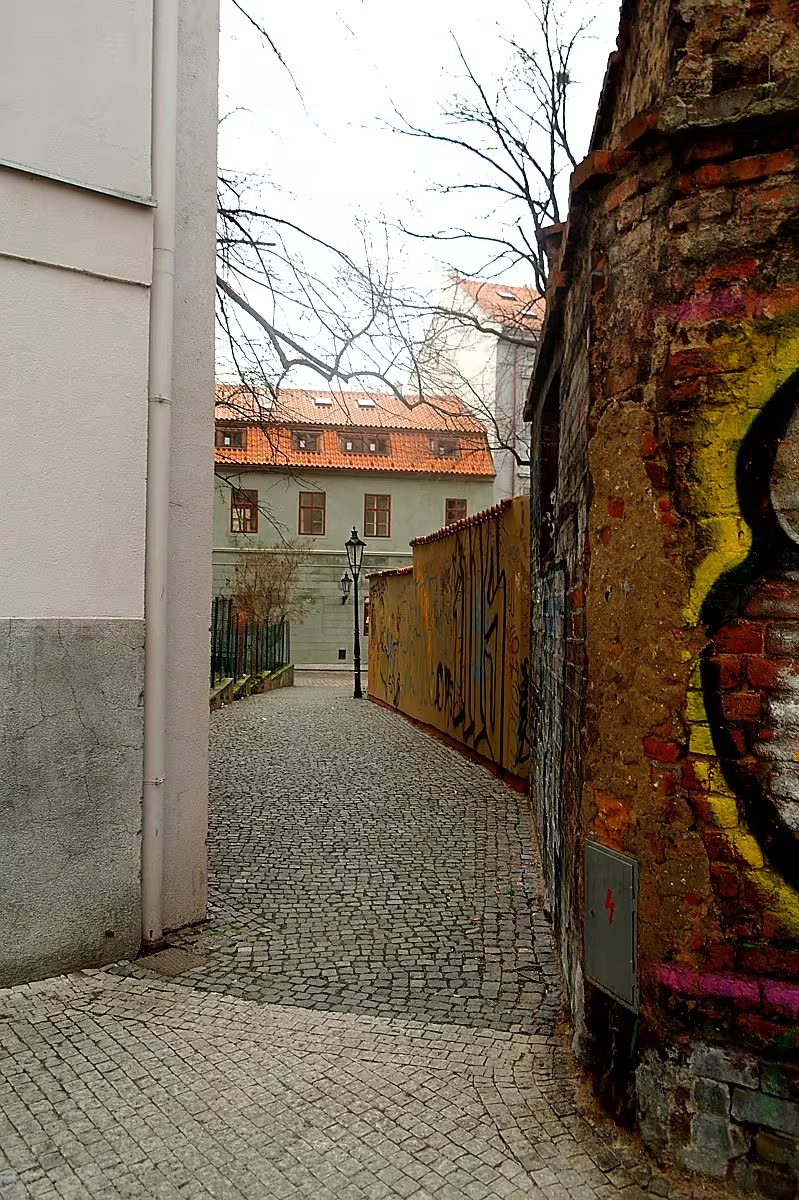
Obecní dvůr is an architecturally valuable site of economic buildings from the period 15th to 19th century. Located in the location Praha 1 in the Old Town, in the area of Josefova. This building is a cultural monument of the Czech Republic and represents a system of buildings with mostly baroque and classicist layers in which Gothic elements are preserved.
The area was established probably at the end of the 15th century in the immediate vicinity of the Anezka monastery. One of the oldest trade routes from Germany and northern Bohemia, which led along the Vltava to the Old Town Market, was passing through today's U Merciful and Goat streets. It is assumed that the Romanesque city walls once led the northeast edge of the complex, but this was not confirmed.
From the urban point of view, Obecní dvůr can be compared to nearby Ungelt, who performed a similar function even if it was a more prestigious address. The building has always been owned by the Old City of Prague and served as its economic background. The name Obecní dvůr is shown in the sources only in the 18th century, although it is already shown on maps as a closed urban complex. The historian Václav Vladivoj Tomek in the history of Prague City describes in this place four economic buildings, a brewery, a malting house, a space with southwestern shops and a large garden.
Architecturally, the complex forms a set of buildings of different ages. Originally, four baroque stables served here, two of which are preserved today. In the 1980s, a three-storey classicist building of a school close to the rectory of St. Hasthal was built on the site of the middle stable. The ground floor area is bounded by the streets of the Municipal Court and in the Shadow House from the north, by the street of the Merciful from the west and Goat street from the southwest.
The first use of the site was the housing of horses and wagons owned by the Old Town, accompanied by the storage of hay, fodder and coal. Since the 1920s, fire patrols consisting of blacksmiths, locksmiths and chimes have been housed here all year round. In 1853, after the service of Alois-Ludwig Pasty in Berlin, the City Choir was established for street cleaning and firefighting, which set up its central station in the Municipal Court. Firefighters stayed here until 1926.
In the first two decades of the 20th century, the complex underwent a drastic transformation in connection with the rendering of Joseph. The southwest part was torn down and replaced by a new installation. Subsequently, the building lost its complex use and served as a residential complex or background for small traders, for example for a thermometer or lathe factory. At the time of the Protectorate there were located garages for ambulance vehicles of the military hospital Wehrmacht from the hospital Na Františku. The last user in the 1980s was Prague Services.
From 2014 to 2016, the area underwent extensive reconstruction. The project with the authors Ricardo Bofill and TaK Architects included the new building of the apartment house in the place of the prologue after a demolished classical annex stables. The interesting thing is that Jaroslav Foglar could place its fictional Shadow Quarter in this area.
Obecní dvůr is a unique witness to the economic development of the old centre of Prague and an example of the layering of various architectural epoch. Visiting this place Allows look into the forgotten background of the historic city.
Historical milestones
- around 1490
- Likely to establish an area near the Anezka monastery
- 18th century
- First proof of name Obecní dvůr in historical sources
- 1853
- Establishment of a central station for street cleaning and fire fighting
- 1926
- End of firefighters on site
- 2014
- Start of extensive reconstruction of the complex
Architectural development
It is an association of buildings with Gothic elements, baroque and classicist layers. In the 1980s, a three-storey classicist school building was built on the site of one of the stables. In the first two decades of the 20th century, the southwest part of the complex was torn down as part of the rendering of Joseph.
Historical events
1853 - provisions of the City Council for street cleaning and fire fighting with central station in the Municipal Court; 1926 - final departure of the fire department from the premises.
Owners
Always owned by the Old City of Prague.
Points of interest
- The area dates from the 15th to 19th century and contains Gothic, Baroque and classical elements. - The building served as an economic background of the Old City of Prague and originally there were four baroque stables. - In 1853 there was a central station of the City Choir for street cleaning and firefighting, where firefighters remained until 1926. At the time of the Protectorate, there were garages for the military hospital ambulance. - A major reconstruction took place between 2014 and 2016, which included the new building of the apartment house.
Guide
Show guide text
This text was created by artificial intelligence and has not been editorially reviewed. It may contain inaccuracies.
Welcome to the heart of Prague's Old Town, in an area known as Josefov. You're standing right outside the gates of a place called Obecní dvůr. If you look at him now, at first glance, you may be interested in his calm and closure, which contrasts with the ruckus of the surrounding streets. In front of you is a complex of economic buildings, which contains layers of many centuries of Prague history. It is a space where time has stopped and where you can feel the atmosphere of old craft and urban economy.
Let us now look together at how this place was created and why it is standing here. Imagine Prague at the end of the fifteenth century, about a thousand four hundred and eighty. It was at this time that the site was probably founded near the Anezka monastery. At that time it was not a place for tourist trips, but a necessary facilities for the operation of the entire Old Town. Obecní dvůr served as a central point for economic needs, where goods were stored and the practical issues of the city were addressed. The first mention of this particular name in the historical records is then found in the eighteenth century, which confirms that this place has been important to the Pražans for many generations.
Now pay attention to the architecture itself that you see around you. It is very interesting that this complex is not the work of a single architect, but it is rather a confluence of buildings from different periods. If you look carefully at the facade and details of the buildings, you will notice fascinating mixing styles. Here you will find the Gothic elements which return us to the numbers of the complex, but there are buildings from the Baroque and Classicism era. This combination makes the Municipal Court an architecturally valuable entity. Feel how these different ages intersect into one whole. It's like reading a book about the history of Prague where every new chapter was credited to the previous one.
When we think about what really happened in these areas, we get images from the everyday life of the old town. Originally there were four baroque stables, which were key to transport and transport at the time. Imagine the noise of horses and chariots coming in at cost. However, with the advancing time, the site's function changed. In the year one thousand eight hundred and fifty-three, a central station of the city corps was established here for street cleaning and firefighting. That was a major break. Obecní dvůr became a base for people who cared about the purity of the city and fought against the greatest enemy of old cities of wood and stone, which was fire. Firemen worked here until a thousand nine hundred and twenty-six, when their activities in this area were definitively terminated.
This place is also associated with the names of persons who had a relationship with it. These include Jaroslav Foglar, Václav Vladivoj Tomek or Alois Louis Pasta. Although these men may not be directly connected to the construction of wall walls, their tracks and stories in the context of Prague give this place depth. It's fascinating to think of how many different people have walked through here, from simple hobbies and street sweepers to prominent personalities of their time.
The end of summer and autumn in these streets have their own special charm, but Obecní dvůr has its own mystery. It is a place that remains hidden from the eyes of ordinary pedestrians in many ways. While the surrounding monuments are known to the whole world, this area remained in some sense a modest helper of the city. The interesting thing is how powerful the use of space has changed over the centuries. From medieval background to baroque stables to fire station. It all points to the city's ability to adapt to new needs without having to completely destroy the old one.
In the year two thousand fourteen, the extensive reconstruction of the entire complex began. The goal was to preserve all the valuable elements that you had just realized, while at the same time preparing the space for a new era. It is a process of returning dignity to a place that has served Prague for more than 500 years.
Now that you know the story of the Municipal Court, I suggest you watch the details of the buildings quietly for a while and try to imagine what the city would look like when horses were still standing in baroque stables or when the sound of the bell called a fire alarm. Feel the contrast between the quiet courtyard and the noise of the modern centre of Prague.
Thank you for walking together through the history of this unique area. I hope you enjoyed this brief dive into the past. Now invited to further explore the surroundings of Joseph, where many other hidden corners and stories await you. I wish you the rest of the day in our beautiful city. Goodbye.
Tips for visitors
The best time to visit is in the morning or late afternoon when natural rays hit the historical wall of the economic area. Since this is a valuable architectural complex from the end of the 15th century, we recommend focusing on the construction details from outside.
To the area of Josefov in the centre of Prague we recommend to travel by public transport, which is very dense in this part of the city; Check the current connection in the Internet search engine. Since these are narrow alleys, walking is the most comfortable.
When visiting we recommend taking only light clothes and comfortable shoes to walk on the old Prague streets. Since the building is used for operation, we recommend that you have a quiet approach so that you don't disturb the people inside.
For the best photos, look for angles that capture the atmosphere of the old economic court. The most interesting light is in winter months when shadows are longer and highlight the structure of old walls.
During a short walk in the surrounding area you can visit the Anezka monastery or the rectory of St. Haštal. For families with children, the ideal way is to find old building elements and details on the facades of buildings.
Frequently asked questions
Can the monument be visited?
The building is in use (offices, a school, shops and the like). The interior is generally accessible only during operating hours and tours are not usually offered; we have not verified the details. You can see the exterior from the street.
Where is the monument?
Location: Praha 1. The map on this page shows the exact spot.
Why is the monument protected?
It is listed in the Central List of Cultural Monuments of the Czech Republic as a cultural monument (register no. 1000150796).
Businesses nearby
Do you run a restaurant, accommodation, shop, museum, rental, wellness or other visitor service near this monument? Show yourself directly to the people heading to it — this is how they will see you in the app and on the web:
Events nearby

Zdroj akcí: otevřená data měst a obcí ČR (Národní katalog otevřených dat) a kalendář akcí Národního památkového ústavu.
Nearby
Anežský klášter, fara svatého Haštala.
Accommodation nearby
Trips and activities nearby
Guided tours, tickets and activities nearby from GetYourGuide
Affiliate link: if you buy from the partner, we may receive a commission. The price for you does not change.
Search tours and activities →Themed route
Theme of the route: Parade through Old Prague
1.Obecní dvůr Type: historical park. Why: Here the 17th century of Prague's huge and oldest parts of the urban zone will be viewed, which adds a tracky historical charge.
2. Agnes monastery Type: Baroque monastery. Why: It is one of the oldest monasteries in Prague and shows a rich architecture that shows the development of Christian ideals.
3. The rectory of St. Hastal Type: Fortune of the castle. Why: This landmark offers a view of the whole city and is part of the legend of St. Hastali.
Seasonal recommendations
In the spring, the surrounding area of the building awakens into life and the first green grows in it. The light is soft and pleasant, making SLC faces of the building very natural. We recommend light spring coats and a visit in the morning when the air is the cleanest.
In the summer months it dominates the space of strong sun and hot air, which is healed in the tile. The facade stands out in its colour in bright light and the surrounding trees provide the desired shade. It is advisable to choose light, breathable clothes and avoid the most jealous midday hours.
Autumn brings golden leaves and more frequent fog to the space, which gives the building a mysterious touch. The atmosphere is quieter and the light becomes golden. For walking is ideal waterproof shoes and warm sweater, especially in late afternoon.
Zimą is a monument to the rough, often accompanied by frost or snow, which covers the details of architecture. The lighting is gray and the days are short, which creates a cool but calm mood. Warm winter clothes, hats and gloves are essential to make the visit pleasant.
Visualizations and artistic views

The visualisations are generated by artificial intelligence and serve as inspiration.
Photos from the area
Real photos taken near the monument

Zdroj a licence jsou uvedeny u každého snímku.
Tips from visitors
No tips yet. Be the first!
Log in and add your tip.
Sources and literature
Photos: Ben Skála / CC BY-SA 3.0 — Wikimedia Commons. The author and licence also appear when you hover over the image.
Faktickým podkladem tohoto textu byl článek na Wikipedii, jehož autory jsou přispěvatelé Wikipedie. Článek je dostupný pod licencí CC BY-SA 4.0.
Location on the map
Příběhy a pověsti
Legendy, pověsti a příběhy spjaté s touto památkou
Fotografie návštěvníků
Zatím žádné fotografie. Buďte první, kdo přidá fotografii z návštěvy!
Log in a přidejte svou fotografii nebo hodnoťte.
Za ověřenou návštěvu v aplikaci získáte víc bodů — poznáme podle GPS, že jste na místě.
Reviews and comments