






Palladium země české Castle
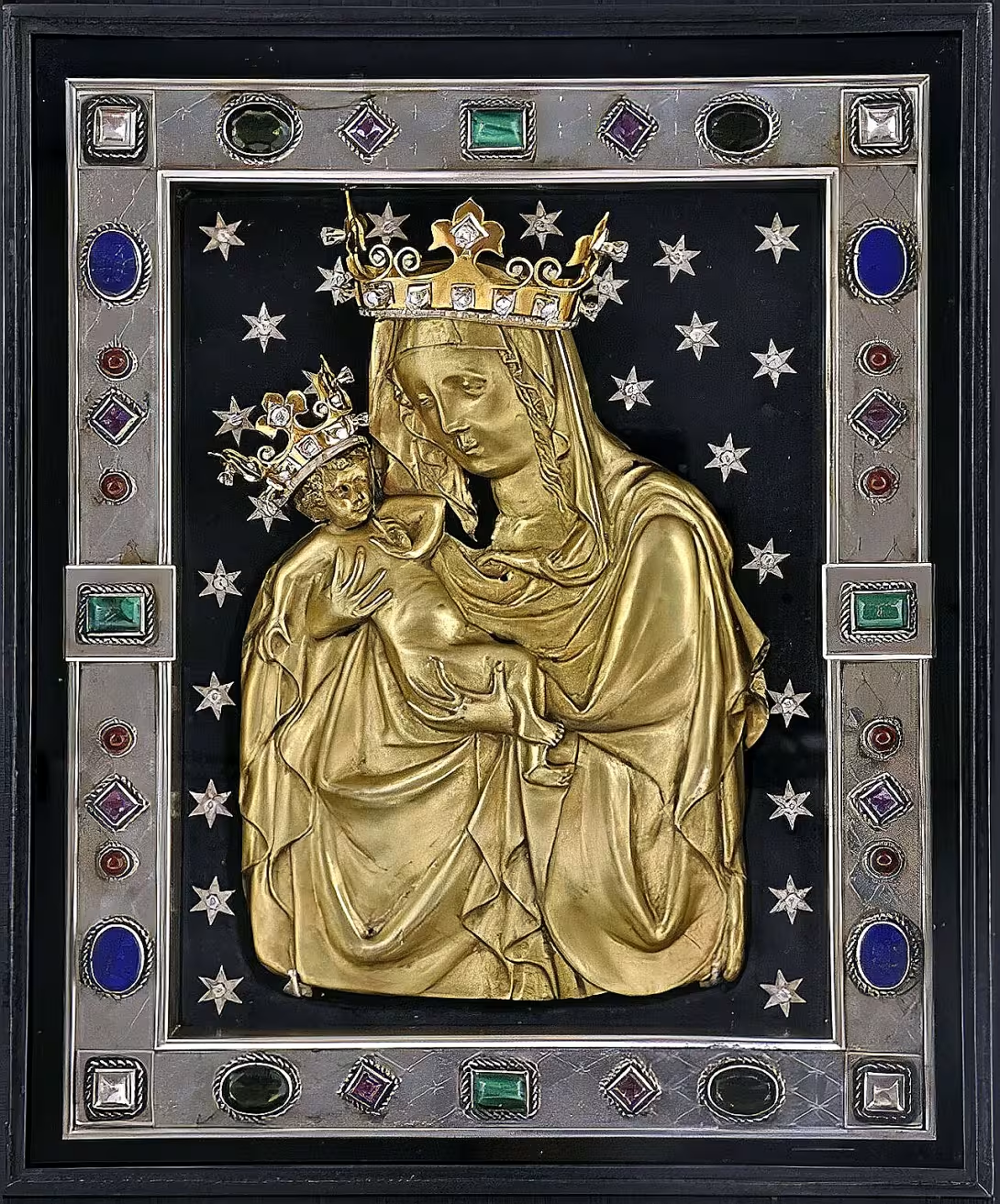
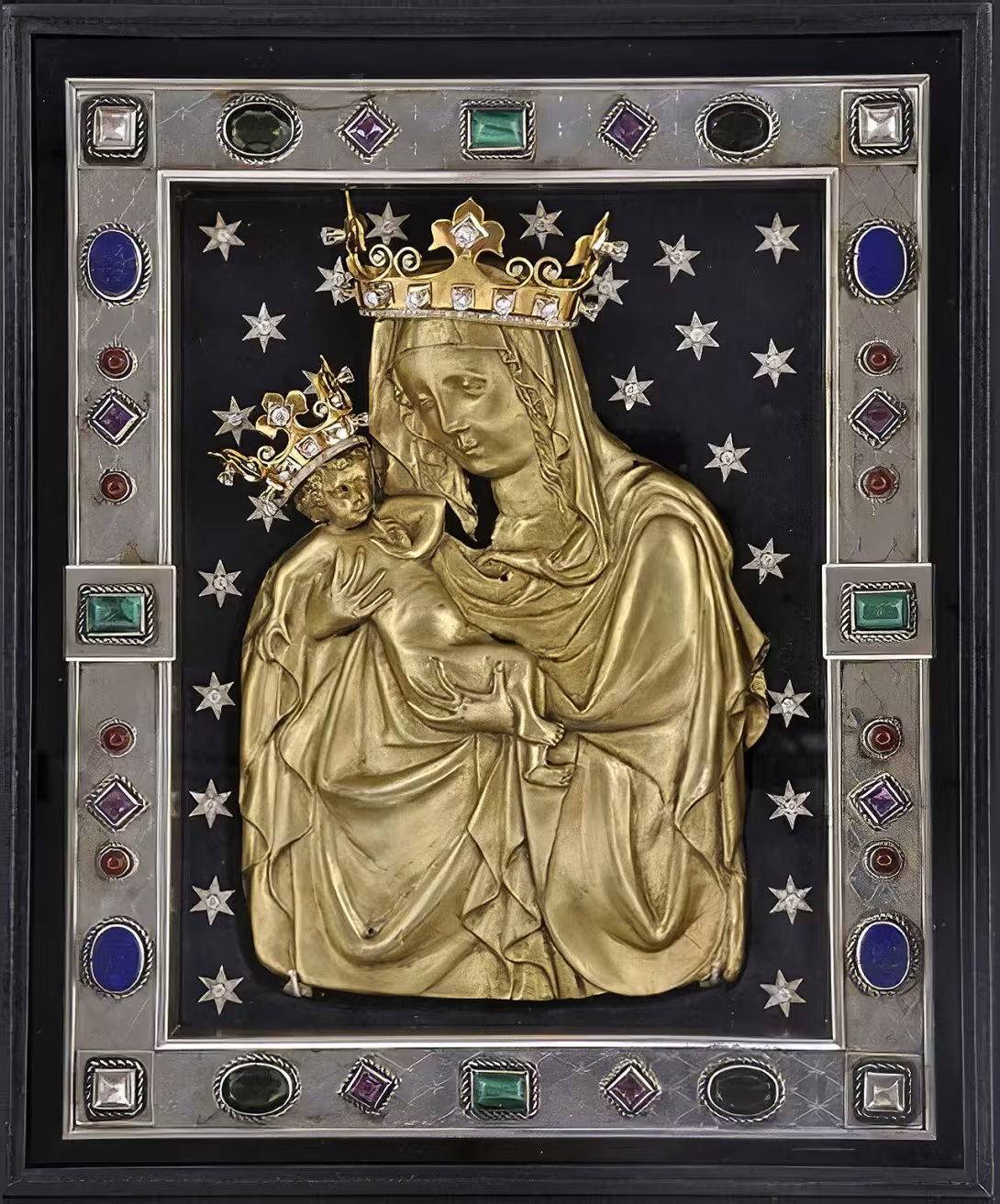
Palladium země české is a miniature metal gothic relief with dimensions 19 × 13,5 centimeters, which today decorate the Temple of the Assumption of the Virgin Mary in Bloslav. It is believed to have been created in the 1980s and was later incorporated into the frame of the gems. It is a unique Marian icon that has traditionally become a symbol of special protective power over Czech countries in the Czech Catholic awareness. Its importance and price are ranked alongside the most valuable Czech goldsmiths, such as Czech crown jewels, the reliquary of St. Maura or the Zavich Cross.
The origin of the relief covers the darkness of legends and piety stories. According to the legend, St. Ludmila received it from St. Methodius at his baptism, along with other objects needed to lead Christian ceremonies. The picture was supposed to be fired from the so-called Corinthian copper. Ludmila relief carefully preserved in her castle Tetín, where she warmly worshipped him. After her martyrdom death in September 921, she was inherited by her grandson Václav, whom she raised in deep respect for the Virgin Mary. The young prince kept the relief with him all the time, accompanied him in the war campaign against Duke Radslav.
The fate of the relief was broken on the day of St. Wenceslas's death on September 28, 935 (or according to the earlier sources of 929), when his own brother Boleslav and his own mate killed him in Old Bloslav. The faithful Wenceslas's aide Podiven, который knew of the spiritual seriousness of the relief, took him from the dead prince and tried to save him from desecration. Chased by Václav's murderers, the relief went to the ground on the hill behind Boyslav and tried to escape - Pojven had allegedly yet to kill one of them in the bath, but he was finally detained and hanged himself in a tree. So the relief for about two and a half centuries was lost in memory.
Rediscovery attaches tradition to times around 1160, under the rule of Prince Vladislav I. A peasant working on his field came across a shiny metal picture buried in the ground. When he took it home, the picture disappeared the next night and returned to its original location. This has been repeated for two more days. Convinced of the miracle of the event, the picture gave to the canons old-timey capitals. Their attempts to preserve it in the temple failed - the relief always returned to its site from morning. The Canons understood that the Virgin Mary wished to be worshipped in the place of her discovery, and they built a chapel there. On its foundations, the Church of the Assumption of the Virgin Mary was later established, where the relief remains on the altar.
The spiritual importance of Stará Bloslav increased especially after the founding of the College Capitol by Prince Břetslav I after 1039. It is this chapter that has become the traditional guardian of both the place of the martyrdom of St. Wenceslas and the cult of Marian relief. Palladium has thus gained in the awareness of Czech believers the status of protector of Czech countries, a symbol of its spiritual protection, which surpasses individual ages and generations. Human: More in accordance with the editorial style of memory. cz - read more, live more. Again.
Then and now
Drag the slider to compare how the landmark may have looked when it was built with the view today.

The historical appearance on the left is an AI-generated visualisation and serves as inspiration only.
Historical milestones
- 921
- After St. Ludmila's death, the Marian relief inherited her grandson svatý Václav.
- 935
- After the death of St. Wenceslas, his loyal species, the Podiven Relief, hid in the ground to protect him from murderers.
- 1160
- According to the legend, the image was rediscovered by a peasant while plowing the field.
Architectural development
Originally a gothic metal relief was later inserted into the decorative frame of the decorated gems. It is stored in a Baroque box on the main altar of the Old Painful Pilgrim Temple. The surrounding temple architecture has undergone a number of historical building modifications from the Middle Ages to the Baroque.
Historical events
15.-16.9.921: The martyr's death of St. Ludmila and the takeover of the relief by St. Wenceslas. September 28, 935: Killing St. Wenceslas in Old Bloslav and hiding the relief of Podiven. Around the year 1160: Rediscovery of relief with a plow in the field for the reign of Vladislav I.
Points of interest
- Palladium země české is a miniature metal gothic relief with dimensions of nineteen times thirteen and a half centimeters, decorated with the Temple of the Assumption of the Virgin Mary in Bloslav. - According to the legend, Saint Ludmila received the relief from St. Methodius at his baptism and the picture should have been cast from the so-called Corinthian copper. - The young prince Wenceslas kept the relief with him and accompanied him in the war campaign against Duke Radslav. - After the death of St. Wenceslas, the relief was taken by his loyal adjutant Podiven, who buried him in the ground on the top of the Boyslaw to save him from desecration. - Around 1160, the peasant found a shiny metal picture in his field, which, after being carried home, repeatedly returned to the original place, which led to the building of the chapel and later the temple.
Guide
This guide is narrated by a synthetic voice generated by artificial intelligence.
Show guide text
This text was created by artificial intelligence and has not been editorially reviewed. It may contain inaccuracies.
Welcome to Old Bloslav, a place where the blind faith, history and deep tradition of our ancestors. You are standing right in front of the pilgrimage temple of the Assumption of the Virgin Mary, which keeps within itself one of the most precious and most important treasures the Czech country knows. Even though you only perceive the peace and dignity of this sacral space from the outside, there is an object inside that is a symbol of national identity and spiritual protection for many. It's Palladium země české.
Let's think together about what Palladium represents. It's not a monumental statue or a giant altar that would instantly impress you with its size. On the contrary, it is a work of very modest proportions, but with incredibly strong significance. It is a gothic metal relief representing Madonna with a child. If you imagine it now, you'll see a small image of 19 times 13 and a half centimeters. It is this miniature size combined with its history that creates a fascinating contrast. This work of art probably dates back to the eighteenth century and is kept in the safety of the temple, where it serves as a place of respect and prayer.
Now pay attention to the very execution of this unique piece. It's a Marian icon that matches the Gothic style in its form. Notice that this is a relief, a plastic image in metal. Although the object is small, its price and historical value are so high that it is compared with the most important monuments of the Christian world. According to old legends and traditions, this relief is not just an ordinary work of art, but it is attributed a special protection power over all Czech countries. It is the so-called Palladium, a sacred object to guarantee the safety and prosperity of the entire nation.
In order to fully understand why this tiny metal painting is so important, we need to go on a journey deep into the past, to a time when our state establishment and our faith have yet to form. The story of Palladia is closely linked to the most important personalities of early Czech history. It all begins with Saint Ludmila, the grandmother of St. Wenceslas. According to legend, Ludmila received this relief from St. Methodius at her baptism. Imagine the moment when this sacred object first came into the hands of the Czech princess. It was believed that the relief was made from the so-called Corinthian copper, which at that time was very rare and prized material, which supplied the object with special shine and value.
Time passed and with it the fate of men. In nine hundred twenty one, after the death of St. Ludmila, this Marian relief inherited her grandson, svatý Václav. For Václav, this painting was not only a family heirloom, but probably also a spiritual opposition point in his efforts to unify and christianize Czech countries. Palladium accompanied Václav in his government and became a symbol of his piety and care for his people.
But history is full of dramatic twists. In nine hundred and thirty-five there was a tragic event, which could almost mean an end even for Palladium. St. Wenceslas was murdered by his brothers. In the chaos and fear that followed this betrayal, his loyal species, blahoslavený Podiven, came to the fore. Oddly enough, in the hands of murderers, this sacred object could be destroyed or stolen. In the act of the highest devotion and effort to save the highest value, the relief hid secretly in the ground. The object that once decorated the royal chambers and accompanied the prayers of the saints disappeared from the face of the world and remained in the silence of the clay where he was supposed to be safe from people with a black heart.
Now imagine the centuries of silence. Palladium lay in the ground, forgotten, but still present. It was a time of trial and expectation. Until more than two walls passed before something unexpected happened. In the year one thousand hundred and sixty, according to the legend of the usual plow field, the plough of one of the peasants hit something hard. When a man in the country found this metal painting, it wasn't just a random find. It was a miracle for people back then. The picture was rediscovered and returned to the world of the living so that it could perform its protective function again. This journey from heaven to earth and back to light gives Palladia a mystical dimension.
The history of this place and the subject also included the figure Vladislav the first, who was one of those who recognized and worshipped the meaning of this relief in later times. It's fascinating how one small thing has been able to work its way through centuries, survive murders, oblivion, and deep sleep in the ground, so that it can be exposed today in this temple.
Now, when you look around, feel the atmosphere of this place. Even though Palladium is not visible at first glance in full size, its presence here is felt. He's a silent witness to our history. Try to imagine the Corinthian copper, its cold and at the same time the warmth of the faith it carries. It's a mystery how such a small object could have such a huge influence on the perception of national protection. It's a reminder that the real value of things is not in their dimensions, but in the story they tell, and in the emotions they evoke in people.
This Gothic relief of the Madonna with a child is a bridge between us and the early Middle Ages. It connects us with Saint Ludmila, Saint Wenceslas and the faithful Obviven. It is a symbol of perseverance and hope that even what seems to be lost can once again be found and restarted to serve the good.
Now invited to further explore this beautiful pilgrimage place. Go through the space of the temple, perceive the peace and quiet that prevails here, and let your thoughts wander freely on the path that Palladium has gone through over a thousand years. Perhaps it will make you feel grateful that we have managed to preserve such a rare heritage for future generations.
Thank you for spending time with us on this exceptional treasure of the Czech country. We wish you the peaceful and inspirational rest of your visit to Old Bloslav. Goodbye.
Tips for visitors
The best time to visit Stará Bloslav is early in the morning during the working week or on the weekend in the morning when there is a quiet atmosphere suitable for contemplating and visiting pilgrimage places without crowds of tourists. Transportation to the city is provided by bus connections from directions from Prague and Brandýs nad Labem, and the current connection is best verified by online search engines; by car it is possible to arrive on the highway and use the parking area within walking distance from the center. With you take comfortable shoes for walking on historic tiles, suitable clothing respecting the sacred nature of sacral structures and possibly small cash. It is best to photograph the interior and exterior of the pilgrimage temple in the morning light, which gives a picturesque light to the historical architecture of the town in the Polabska lowlands. In the immediate vicinity, within 30 minutes of walking or driving you can visit other important sacral structures such as the Church of the Assumption of the Virgin Mary or the Church of St. Wenceslas, which form the heart of this historic pilgrimage place. Families with children will appreciate the peaceful setting of the Polabska lowlands for easy walks around the sights and plenty of space in the park and historic streets of the city.
Frequently asked questions
Is Palladium země české open to the public?
Yes, it's accessible by step. We recommend lifting our pants and feet to protect against sharp stones.
How do I get to the place by car / public transport?
You can get by car or bus to a nearby town, from where you can then walk. The nearest public transport stop is a 10-minute walk away.
How much is the entrance fee and is it paid on the spot?
Payment by credit card is not possible.
Is the tour suitable for children and seniors?
Yes, it's suitable for all age groups. However, we recommend that you bring comfortable shoes and plenty of water.
How long does the tour take?
The tour takes approximately 1-2 hours, depending on your pace. We recommend to reserve more time to photograph and observe the surroundings.
What are the opening times and booking is required?
The monument is accessible from 9: 00 to 17: 00, free entry. Reservation is not necessary, but we recommend ordering it in case of larger group.
What's interesting in the immediate vicinity?
In the vicinity there are beautiful forests and rivers that are suitable for hiking or cycling. We recommend you visit a nearby town where you will find many restaurants and shops.
For kids
Imagine going back into the past to when the castle Palladium země české was built on the Czech manor. This place was like a hideout for the king and his family who came here to hide from dangerous conquerors.
How did it look here? It was a great fortress with high walls and towers standing on a hill above the valley. Many people lived in the castle - royal knights, maids, chefs and even animals like dogs, cats and horses.
Businesses nearby
Do you run a restaurant, accommodation, shop, museum, rental, wellness or other visitor service near this monument? Show yourself directly to the people heading to it — this is how they will see you in the app and on the web:
Nearby
Stará Boleslav is an important pilgrimage place with a number of sacral buildings, including the Temple of the Assumption of the Virgin Mary and St. Wenceslas Church. The town is located in the Polish lowland in the Praha-východ district in the Central Bohemia region.
Accommodation nearby
Themed route
Temple of the Assumption of the Virgin Marie Type: Sacral construction Why is it worth a visit: This important temple is located in the immediate vicinity and forms an integral part of the pilgrimage site. It offers a beautiful spiritual atmosphere and rich historical decoration.
Palladium země české Type: Main objective Why is it worth a visit: This rare Marian relic is stored in the sacral area and represents one of the most important spiritual symbols of the Czech nation. It attracts pilgrims with its deep history and artistic value.
Church of St. Wenceslas Type: Sacral construction Why is worth a visit: Located close to the main destination in the historic heart of the city. The place is closely linked to Czech history and the legacy of St. Wenceslas.
Seasonal recommendations
Spring in Stara Bloslav brings a growing nature where the surrounding greenery and flowering trees create an impressive contrast to the historical walls of the temple. The bright spring sun penetrates the low angle into the side boats and makes the details of the decoration stand out. The atmosphere is calm and thoughtful. During this period, you will not see the large frequencies of tours, which allows the undisturbed perception of the place. It is convenient to wear layered clothes and solid shoes because the morning cold can be kept in the shade of ancient buildings. The best time for a tour is in the morning, when the beams illuminate the main facade.
Summer offers long days of warm light that revive the whole area before the monument. The surrounding parks and trees provide a pleasant shade and smell of hot grass. The atmosphere of the main summer season is alive, but the monument retains its dignity. For tourists and cyclists, it is ideal to come early in the morning or in the late afternoon when the heat falls. Light breathable clothes, headgear and plenty of fluids are recommended. The interior of the temple in the steam days will serve as a cool haven with unique acoustics.
Autumn turns the region of Central Bohemia into a palette of warm colors from yellow to dark red. Specific is the silenced light transiting through a misty wound, which gives the place a melancholy and deeply historical nature. The fallen leaves rustling beneath your feet increase the feeling of a return in time. The crowds of people are very thin these days, so you can enjoy maximum privacy. The practical advice is to wear a waterproof jacket, scarf, and warm shoes, because the humidity from the Elbe can be known. The best time to visit is around noon, when the fog retreats and the sun is still warm.
Winter covers Old Bloslav in silence, which sometimes only breaks the crunching snow under his shoes. Early dimming and deep shadows create a mysterious atmosphere, which is underlined in advent time by modest outdoor lighting. Warm, warm clothes, hats and gloves are absolutely necessary, as the inner spaces of historical buildings are usually cold. Visitors here in the winter months find few, which guarantees an extremely intimate experience. The best time for a ride is an early afternoon, before it is fully drawn and the frosty twilight falls.
Visualizations and artistic views


The visualisations are generated by artificial intelligence and serve as inspiration.
Atmosphere of the place
This atmospheric visualisation of the place and period was generated by artificial intelligence. It is not real footage of the location.
Tips from visitors
No tips yet. Be the first!
Log in and add your tip.
Sources and literature
Fotografie: Středočeský kraj / Public domain — Wikimedia Commons. The author and licence also appear when you hover over the image.
Faktickým podkladem tohoto textu byl článek na Wikipedii, jehož autory jsou přispěvatelé Wikipedie. Článek je dostupný pod licencí CC BY-SA 4.0.
Příběhy a pověsti
Legendy, pověsti a příběhy spjaté s touto památkou
Fotografie návštěvníků
Zatím žádné fotografie. Buďte první, kdo přidá fotografii z návštěvy!
Přihlaste se a přidejte svou fotografii nebo hodnoťte.
Za ověřenou návštěvu v aplikaci získáte víc bodů — poznáme podle GPS, že jste na místě.
Reviews and comments