



Pařez Rock castle
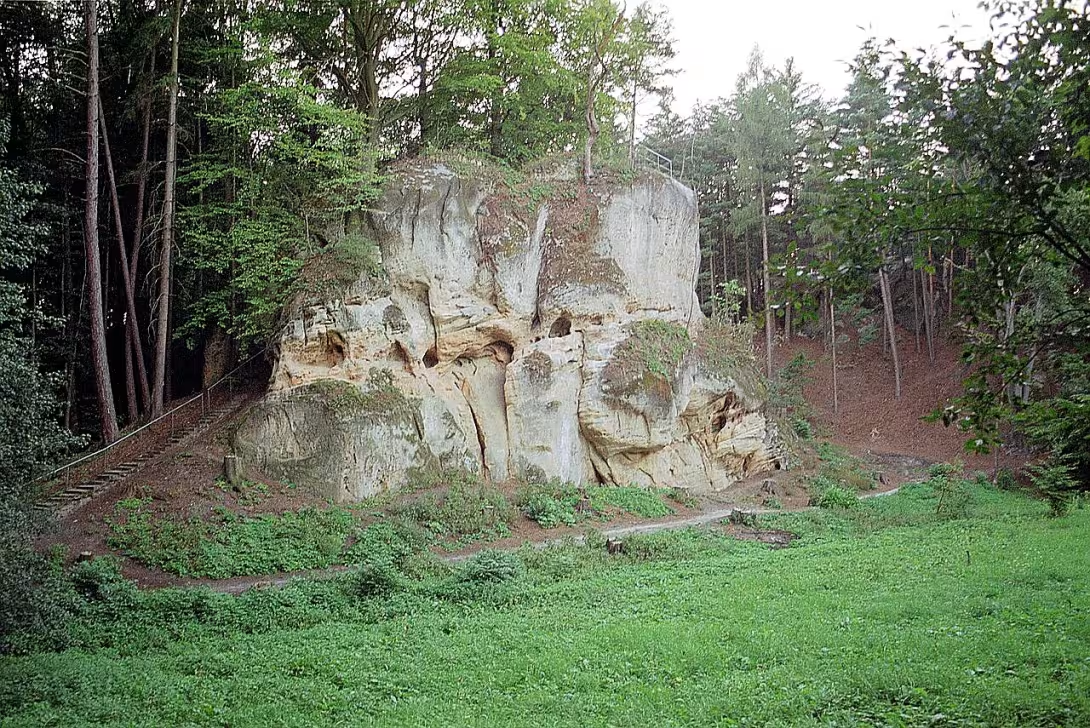
Pařez is a ruin of a rock castle from the end of the 14th century. It is located in the Jičín hill town near the northwest edge of the Prachov rocks in the district of Jičín. This site is an important archaeological site and evidence of medieval fortification construction, which used natural sandstone formations.
The castle was founded probably around 1370. The first written mention dates back to 1403 when Jan z Pařezu is listed as holder. History historian August Sedláček said that the founder could be Petr z Pařezu, commemorated in 1372. The fortress died violently during the Hussite wars; already in 1430 is mentioned as a ruin in the springs.
The building site became a lonely sandstone rock. Her defenses were fortified by carved lights with imitations of a rolled vault. The wall wall was lined on top of the platform and there was a palace, probably from a raked wall, after which only basic grooves were preserved. On the west side is a square tower torso that should be equipped with a drawbridge. It is assumed that the area around the castle could have been flooded in the past thanks to a system of dams.
The owners of the mansion were members of the family of the men from Pařez, namely Petr, Jan and Czíbor. The fate of the object was sealed in the first half of the 15th century. It was probably conquered by the Hussite in 1424, which is evidenced by the discovery of a stone ball into a bomb. Archaeological research, especially the one from 1972 led by Jiří Waldhauser and V. Weber, brought a number of findings such as ceramic fractions, an iron link chain or a bone disc decorated with rind. In 1942, a set of iron objects was found, indicating the possible existence of a blacksmith's workshop directly on the premises.
Today, the ruin is protected as a cultural monument and is freely accessible. A green-marked route from Pařez Lhota leads to the location and a red tourist sign coming from Prach passes by.
Pařez represents a valuable proof of medieval settlement and technical fitness of the then builders who were able to make effective use of natural rock formations. Visiting this place offers the opportunity to look into the history of Hussite wars and to see the specifics of rock architecture in the area of the Czech Paradise.
Then and now
Drag the slider to compare how the landmark may have looked when it was built with the view today.
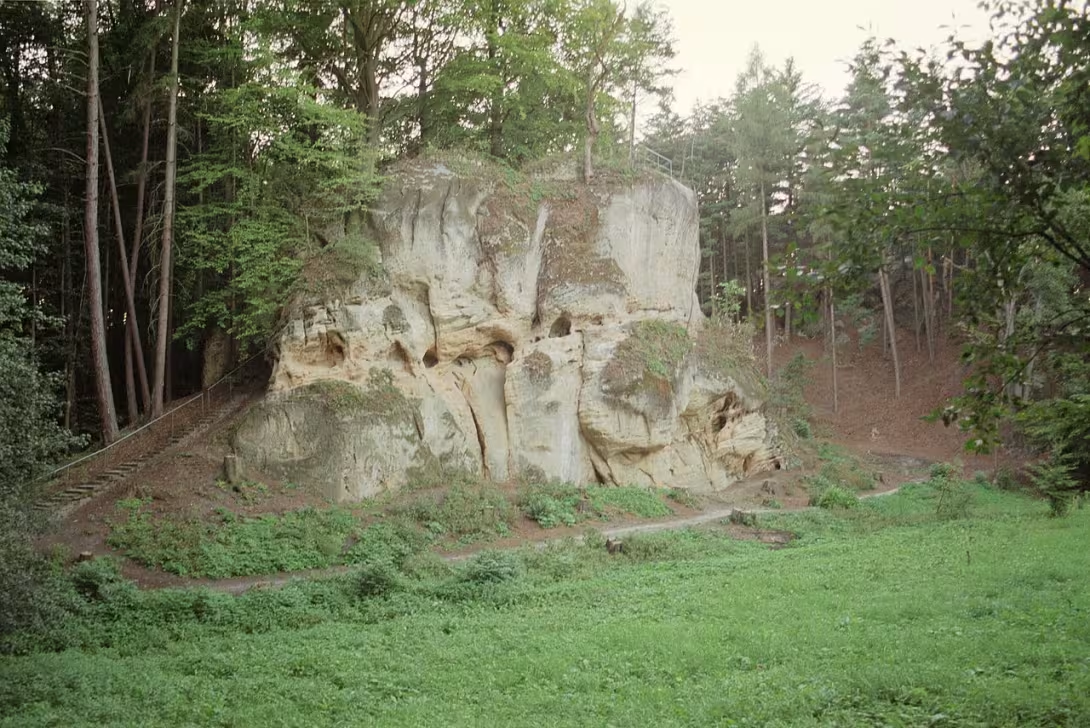
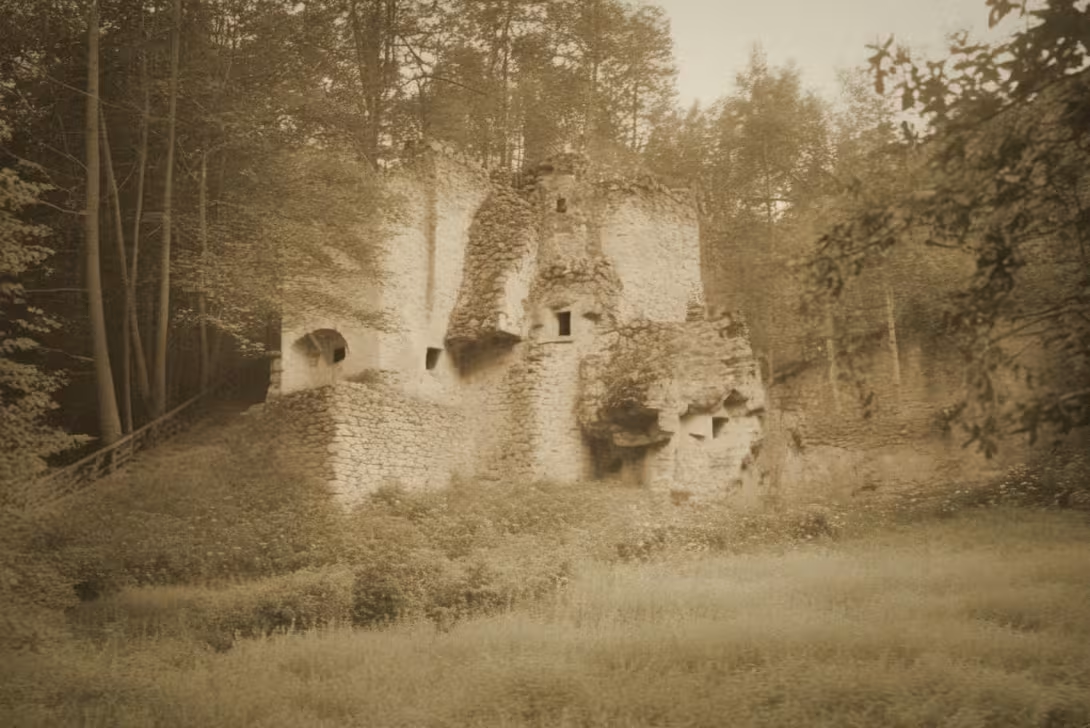
The historical appearance on the left is an AI-generated visualisation and serves as inspiration only.
Historical milestones
- 1372
- The first reminder of Peter of Pařez, a possible founder of the castle.
- 1403
- First written mention of the castle in connection with Jan from Pařez.
- 1424
- The likely demise of the castle due to Hussite wars.
- 1972
- Archaeological research on George Waldhauser and V. Weber.
Architectural development
The castle was built on sandstone rock using natural terrain and carved spaces. The plateau was carried by a palace from a raked wall and a perimeter wall. A square tower was built on the west side, which was to be equipped with a drawbridge.
Historical events
1403: First written mention of the castle. 1424: Probable conquest of the castle of husita. 1430: The castle is already listed as a ruin.
Owners
The House of Lords of Pařez (Petr, Jan, Octebor).
Points of interest
- The ruin of the rock castle was created in the late 14th century and its defenses were strengthened by carved lights with imitations of a rolled vault. - The castle disappeared violently during the Hussite wars, while already in 1430 it was mentioned as a ruin in the springs. - On the west side of the castle is a square tower, which should have been equipped with a drawbridge. - Archaeological research on the premises revealed ceramic fragments, an iron link chain, a bone disc decorated with rust and a stone ball for the bomb. - The discovery of a set of iron objects from 1942 suggests that there may have been a blacksmith's workshop in the castle area.
Guide
Show guide text
This text was created by artificial intelligence and has not been editorially reviewed. It may contain inaccuracies.
Welcome to the place where stone silence meets the echo of the ancient past. You are standing in front of the ruins of the rock castle Pařez. Before you take another step, stop for a moment and observe the surroundings. You are in the heart of Jičina hill-katina, in an area that is famous for its fascinating nature, especially due to the proximity of Prach rocks. Look around you and see this lonely sandstone rock that rises above the surrounding landscape relief. This rock is not just an ordinary body of nature; It is the cornerstone on which human ambition, strength and ultimately tragedy were built. The atmosphere of this place is filled with peace, but if you begin to imagine what happened here, you will also feel the tension that once surrounded these rocks.
In order to understand why people have decided to build their mansion here, in this remote and rocky place, we must return to the end of the 14th century. At that time, this country was a place of constant change and search for a safe haven. The first traces that tell us about this castle go back to 1372. The name Petra from Pařez first appears in the records at the time. It is very likely that he was the man who laid the first foundations of this castle in this wilderness. Imagine the work at that time, where not only had to be built, but also fought directly with the hard sandstone rock. A few years later, namely in 1403, the castle is already in a written background under the direction of John of Pařez. This clearly shows us that Pařez was not only a temporary hiding place, but it became an important seat that had its stability and a strong link to this particular rock.
Now pay attention to what's right in front of you. Looking at these ruins, you can see the unusual way the architecture was connected to nature. Pařez is not a classic castle built only from stone blocks on the plane. His defense and home itself formed a symbiosis between the carved rock and the Män building art. Look at these sandstone formations. Notice how the rocks were partially worked. The people of the time carved skylights directly into the hard sandstone, which served as a dwelling and defensive position. It's a fascinating detail that shows great work and ingenuity. If you look more closely at the inner parts of these carved spaces, you can see even small but very important details. Because there are imitations of a rolled vault carved here. Although it is an artificial element carved directly in stone, it was intended to create a sense of grandeur and stability, as if you were in a classic stone building.
In addition to these rock spaces, the castle was also defended by a walled wall and a palace, which was built from a walled wall. This combination of soft, carved sandstone and firmer, walled material created a unique building unit. If you look now towards the west side of the castle, you will see a torso square tower. This tower, although only in the form of remnants, still stands as a silent witness to the ancient power of this place and as the last clear point that defines the outlines of the former castle.
When you look at these rocks, try to summon in your mind the characters that once lived here and made this place home. Pařez wasn't just an empty rock, it was a home for the Pařez family. In addition to Peter and John, which we have already talked about, in connection with this place in historical sources also appears the name of Actubora from Pařez. Imagine these men deciding their fate in these areas, defending their territory, and seeing this rock as their firm support. To them, it was a fortress, a symbol of their position and safety in the troubled times of the Middle Ages.
But history also has its dark and very harsh side, which brought the castle to an end. The first half of the 15th century brought a storm to Czech countries, which spared nothing and no one. The Hussite wars were a period of great chaos and violence that affected even this remote place. Probably just around 1424 there was a devastating fall of castle Pařez. The violence that ruled back then was so devastating that the castle was no longer able to face impact. It's fascinating and sad at the same time how quickly the fate of a place that was built with such effort can change. In 1430, only debris is mentioned in the sources at the time. The speed at which a prosperous mansion has become a ruin reminds us of how fragile human creation can be in confrontation with the destructive power of history.
However, there is also one interesting thing that may interest you during the tour. It's just the unusual aesthetic effort in an unusual environment. As we have already mentioned, the carving of a coiled vault directly into the sandstone is a unique element. It's as if the builders at the time were trying to bring the nobility of the great stone palaces to a harsh, rocky reality. This quest for beauty in the middle of raw nature is something that makes Pařez a truly special place.
Even though the castle no longer exists in its former form, we still feel the presence of history in it. Thanks to archaeological research carried out in 1972 under the leadership of George Waldhauser and V. Weber, we gained a much better idea of what really happened here and what the castle looked like at the time of its greatest glory. This research has helped us connect individual stones and rocks into one story.
But now it is time for you to start writing this story yourself. Continue the tour, feel the atmosphere of this place, look into the details carved into the rock and let yourself be drifted by imagination. Explore the surrounding rocks, perceive the peace and quiet that prevails here, and try to hear the echoes of ancient voices. Thank you for visiting the ruins of Pařez. We wish you a pleasant continuation in discovering the beauty and mystery of this wonderful landscape.
Tips for visitors
The best time to visit is in the morning or late afternoon during working days, avoiding crowds of tourists heading for nearby Prach rocks. In the morning's light sandstone formations excel beautifully and the ruins seem very photogenic.
For the tour of the ruins, wear solid footwear suitable for the field, as the surface of sandstone rocks can be uneven and wet slippery. Don't forget enough water and snacks, because there are no refreshments stalls in the castle area.
Photographers are advised to focus on the details of the carved space in the rock and the views between sandstone blocks. The best light to capture the texture of the stone is during side lighting, which highlights the depth of the carved elements.
For families with children, the location is attractive due to the adventurous nature of the ruins, but take care of the safety at the rocky edges. In the surrounding area you can visit the Prachov rocks that offer a variety of routes, or explore the picturesque surroundings of the village of Holín and the Jičín hill.
Frequently asked questions
Can the monument be visited?
This is a ruin. Such sites are often freely accessible, but some can only be visited with a guide or are closed for safety reasons. We have not verified the current situation – take care and respect any restrictions.
Where is the monument?
Location: Královéhradecký kraj. The map on this page shows the exact spot.
Why is the monument protected?
It is listed in the Central List of Cultural Monuments of the Czech Republic as a cultural monument (register no. 1000153442).
Businesses nearby
Do you run a restaurant, accommodation, shop, museum, rental, wellness or other visitor service near this monument? Show yourself directly to the people heading to it — this is how they will see you in the app and on the web:
Nearby
Drachov rocks, Pařez Lhota, village Holín, Jičina hill.
Accommodation nearby
Themed route
Thematic cruise route around Pařez
1. Pařez (ruin) * Type: * Historical ruins It is worth a visit for its rich history and impressive location in Prachov Rocks, where you can enjoy beautiful views of the surrounding landscape. The ruin is the rest of the antique castle and offers a unique view of the past.
2. Dust Rock * Type: * Natural landmark These impressive rock shapes are not only beautiful, but they also offer several perspectives and opportunities to recognize geological processes. Their unique form and location in the South China hill makes them an ideal place for nature lovers.
3. Pařez Lhota * Type: * Municipal village Visit this picturesque village, which offers you a view of the traditional Czech countryside and an opportunity to explore local culture. It is an ideal place to relax on the road between rocks and other attractions.
4. * Type: * Village with historical center Holin is famous for its history and picturesque station area, which deserves attention. Explore the local sights and relax in a quiet atmosphere of this place.
This route offers a combination of historical and natural experiences, ideally for those who want to know the region around Pařez and its surroundings.
Seasonal recommendations
In spring, the ruins of Pařez awaken into life together with the surrounding vegetation. The light is fine and scattered during this period, which beautifully highlights the texture of the old stone and the new germ green. It is ideal to visit early in the morning, when morning fog may still be floating in the trees. Prepare your layered clothes because the morning cold during the day can quickly turn into warmer air.
The summer months bring intense sunlight to the ruins and the hot air that radiates from the stones. Nature around the monument is in full bloom, but dry grass can cause a little stust. Due to the increased number of visitors, I recommend that you come right after the opening so that you enjoy your peace and avoid the noon heat. Don't forget enough drinking water, headgear and fixed shoes to move on uneven terrain.
Autumn visit offers a melancholy and magical atmosphere, especially when fog decreases around the ruins and leaves turn golden. The low sun creates long shadows that give the memory depth. However, it is necessary to count on moisture and slippery roads, so wear a waterproof jacket and shoes with good grip. The best time to observe color transformation is in the morning.
In winter, Pařez is crude and uncompromising. Without leaves you can see all the details of stone structures and frost can create beautiful ice patterns on the ruins. The atmosphere is quiet and lonely, which is ideal for those who seek peace. Dress very warm and robust because the wind can be very unpleasant in the open. Due to short days, plan to visit in clear hours of the day.
Visualizations and artistic views


The visualisations are generated by artificial intelligence and serve as inspiration.
Photos from the area
Real photos taken near the monument


Zdroj a licence jsou uvedeny u každého snímku.
Tips from visitors
No tips yet. Be the first!
Log in and add your tip.
Sources and literature
Photos: No machine-readable author provided. Olaf1541 assumed (based on copyright claims). / CC BY 2.5 — Wikimedia Commons. The author and licence also appear when you hover over the image.
Faktickým podkladem tohoto textu byl článek na Wikipedii, jehož autory jsou přispěvatelé Wikipedie. Článek je dostupný pod licencí CC BY-SA 4.0.
Location on the map

Příběhy a pověsti
Legendy, pověsti a příběhy spjaté s touto památkou
Fotografie návštěvníků
Zatím žádné fotografie. Buďte první, kdo přidá fotografii z návštěvy!
Log in a přidejte svou fotografii nebo hodnoťte.
Za ověřenou návštěvu v aplikaci získáte víc bodů — poznáme podle GPS, že jste na místě.
Reviews and comments