

Pádolí Castle
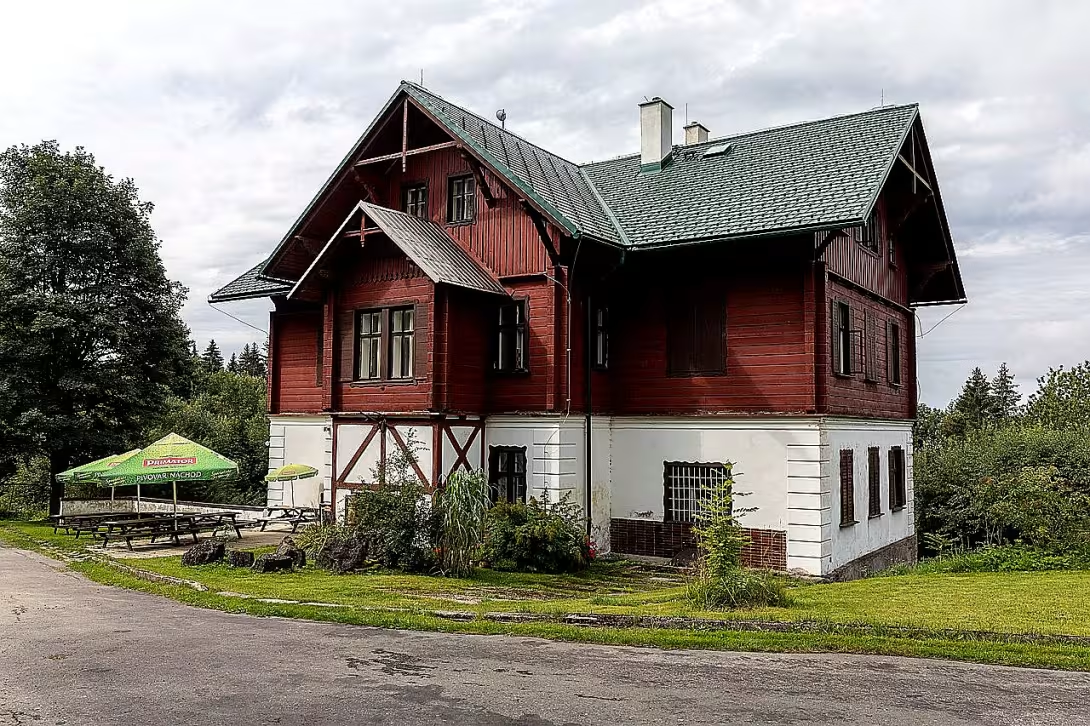
The hunting castle Pádolí is situated under the ridge of the mountains Plane and Lubný in the Orlické Mountains. It is located at a small settlement of Podolí (also known as Pádolí), which falls under the municipality of Uhřínov and part of Liberec. The location is well available: yellow and green tourist signs and cycling routes 4309 and 4367 pass through here, making it a suitable destination for hiking and cycling trips. Today, the building is dominated by its function as a pension facility, where history combines with hospitality.
The castle was built in 1905 by Wilhelm Karl Königswarter, owner of the salt estate, in close proximity to the original hunting grounds. To the south of the building, the already extinct settlement with the corresponding economic background was spread out. The roof of the castle was later taken over by František Janeček, founder of the JAWA brand, which became part of the industrial tradition of Czech engines. The Janek family remained connected to the object for decades. Another twist came after World War II: in 1948 the castle was nationalized and converted into a hostel for forest workers. Only after the velvet revolution and restitution in 1992 did the property return to the descendants of the Janek family, who subsequently sensitively adapted it to today's pension operation.
The architecture of the chateau reflects a simple, elegant approach: it is a storey object on a rectangular plan with two rising risalties on the east and west side. The ground floor is lined with bricks while the floor is shrouded in wooden panelling. The construction is dedicated to a saddle roof with characteristic supports. On the west side, it complements the pavilion hall. The core of the interior is a richly equipped dining room, which kept its original cassette ceiling and party of tiled stones decorated with reliefs. The windows in the castle are decorated with stained glass with coats of arms of the Königswarters and Wertheimers von Wertheimstein, which expresses the urban status of the first owners.
Today the castle presents a unique combination of tourist accessibility and architectural authenticity. The visitor will find not only comfortable accommodation and refreshments, but also a live link with a rich history of Czech industry and nobility. Every corner of the building says about the transfers of power, the industrialists who lived here, and the fate of property during the twentieth century. Pádolí thus remains a place where the tourist route meets the cultural heritage.
Then and now
Drag the slider to compare how the landmark may have looked when it was built with the view today.
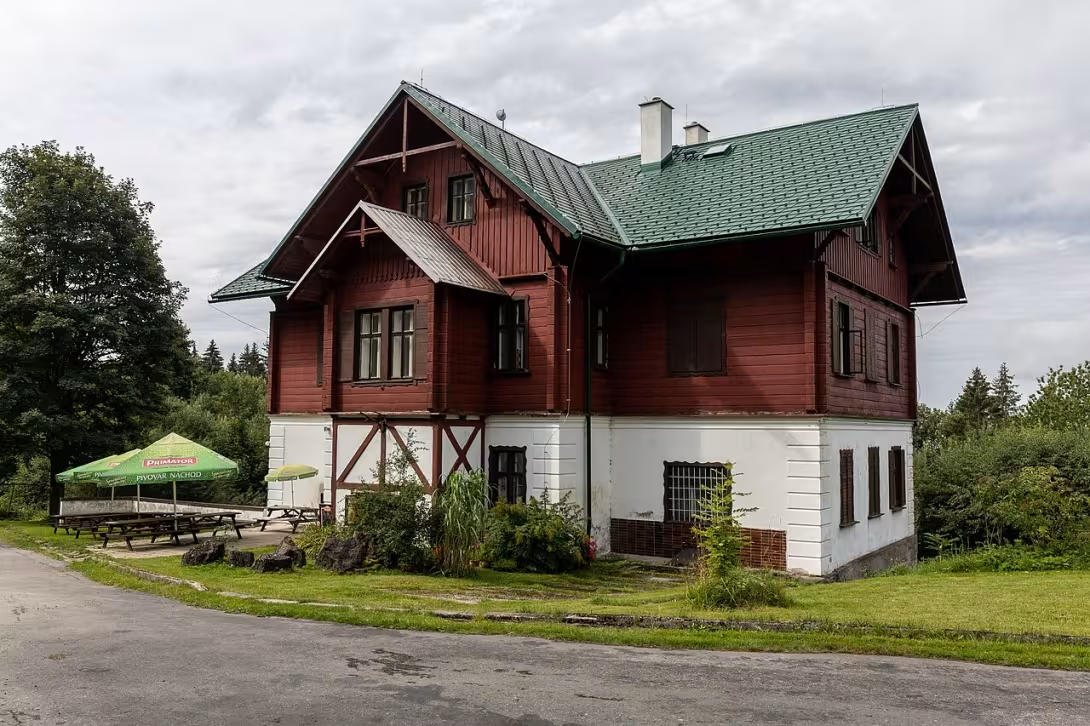

The historical appearance on the left is an AI-generated visualisation and serves as inspiration only.
Historical milestones
- 1905
- construction of hunting castle by owner of salt estate Wilhelm Karl Königswarter
- 1948
- nationalisation of the building and its use as a hostel of forest workers
- 1992
- restitution into the family Janek
Architectural development
It is a rectangular storey object with rising risties on the east and west side. The ground floor is walled, while the floor is covered with wood and the building ends with a saddle roof. The west side of the building is filled with a steam engine.
Historical events
1905: construction of hunting castle; 1948: nationalization of the object; 1992: restitution into the property of the Janek family.
Owners
Wilhelm Karl Königswarter (1905), František Janeček, state / hostel of forest workers (from 1948), family of Janek (from 1992)
Points of interest
- The hunting castle was built in 1905 by Wilhelm Karl Königswarter, owner of the salt estate. The building later belonged to František Janek, the founder of the engine brand. - In 1948 the building was nationalized and served as a hostel for forest workers. - The interior has a dining room with original cluster ceiling and tiled stove with reliefs. - The windows decorate the windows with the coats of arms of the Königswarters and Wertheimers von Wertheimstein.
Guide
This guide is narrated by a synthetic voice generated by artificial intelligence.
Show guide text
This text was created by artificial intelligence and has not been editorially reviewed. It may contain inaccuracies.
Welcome to Uhřínov, the heart of the beautiful Royal Hradec Region. You're standing in front of a building that, with its atmosphere of sentient peace and history, attracts everyone who comes here. The Pádolí hunting castle stands before you. The first impression of this building is very pleasant and cosy, which is exactly what this object should have radiated from the beginning. Look at it as a whole and see how it naturally fits into the surrounding landscape of the Orlické Mountains, where there is also a hunting ground in the neighbourhood. It is a place where human architecture meets wild nature in harmony, which immediately calms people down.
Now let's stop a little bit at how this building came into being and why it's even standing here. Let us move back in time more than a hundred years, namely to the year one thousand nine hundred and five. It was this year that the castle was built by Wilhelm Karl Königswarter, which was the owner of the salt estate at the time. At that time, it was customary for owners of large mansions to build such villas for their pleasure, for rest and especially for hunting, which was a very popular activity in these brands. So Pádolí was not created as the headquarters for year-round housing, but rather as a luxury shelter for people who were looking for an escape from the urban rush and wanted to be close to their passion, which in this case was hunting.
Now pay attention to the architecture of the building itself. When you look at it carefully, you will notice that it is not a monumental palace with many ornaments, but a very clean and understandable storey object. It is a combination of two basic materials that is typical of this type of construction. The lower part, i.e. the ground floor, is walled, which gives stability and strength to the building. The upper floor is brought out of the wood, which makes the whole a cozy villa rather than a cold castle. It is this contrast between stone and wood that creates the right nature of the hunting grounds. Look at the facade and see how this simplicity looks elegant and functional. The architects who proposed this project remained anonymous, but their work in the form of this house survived for decades and still fulfils its role.
If we move around in the history of this place, we'll find interesting personalities who left a trail. In addition to the founder of Wilhelm Karl Königswarter, the name František Janečka was joined with Pádolí. For many of you, this name is known primarily because of its contribution to industry and the creation of a brand with engines. So imagine that people from completely different worlds met in these areas. On the one hand, aristocracy and owners of the estate, on the other hand, visionaries and industrialists who changed the face of the modern world with their work. It's fascinating to think that these people spent their free time here, maybe watching animals in the surrounding forests or discussing the future in an environment that separated them from the noisy operation of factories.
But the fate of the building was not just about luxury and relaxation. History has a darker side and Pádolí was no exception. In the year one thousand nine hundred forty-eight there was a fundamental change. The construction was nationalized, which meant it came into the hands of the state. At that time, its use changed dramatically. The exclusive hunting grounds became an object that served as a hostel for forest workers. Imagine the contrast. Where there used to be conversations about art and industry, people who worked hard in nearby forests have now rested. Although the function of the building changed, its walls still protected those who lived in it, leaving the building operating in this new, much more modest regime.
This condition lasted until a thousand nine hundred ninety-two, when the time for restitution came. The building returned to the property of the Janek family, which closed one of the great circles in the history of this house. Today Pádolí no longer serves as a hostel for workers or as a private villa for hunters. Currently the building is used as a guesthouse, which is probably the best way to keep the building in good condition while opening it to the public.
Now, I want to impress you with one interesting thing that lies inside. If you can see the interiors, focus mainly on the dining room. It is here that one of the most important details of the construction is the original cluster ceiling. The cassette ceiling is typical of its division into deep squares or rectangles, which creates a game of light and shadow and gives the space certain sense of grandeur. It is one of those elements that survived all changes in regimes and owners and remind us of the original luxury with which the castle was built in a thousand and nine hundred and five. He's such a silent witness to everything that's happened in this room in the last hundred years.
When you look at this house today, you see more than just a combination of walls and wood. You see the story of ambition, industrial expansion, the hard work of foresters and the return to the original owners. Pádolí is a small mirror of the great history of our countries. It is a place where the various social layers collide and where time has stopped in the form of beautiful architecture in the heart of the Orlich Mountains.
Imagine now you were here a century ago. Do you hear the sound of hunting horns or traffic in the form of horse wagons in the distance? And maybe you can smell the smell of wood and forest air that's been walking this place for decades. It's a space that encourages thought and slow walking around.
I am now finishing my short lecture and letting you see the castle Pádolí at your own pace. I recommend that you continue to explore and see the details you missed at first sight. Note how light is reflected from the walls and how this beautiful building persists in the silence of the forests. I hope you are interested in this short trip to history and that you will take a pleasant feeling from visiting this unique place. I wish you a pleasant rest of the day and a wonderful experience while exploring our sights. Goodbye.
Tips for visitors
The best time to visit is autumn months, when the colors of the surrounding forests in the Orlické Mountains are beautifully added to the appearance of the hunting villa. Transportation to the settlement is possible by car or public connections, check the specific path in maps.
In the area we recommend to take suitable shoes for nature walks and plenty of water. Since the building is located in a mountain environment, it can be colder in the morning.
For the best photos we recommend using morning or late afternoon light to highlight the details of the facade from 1905. Ideal angles are from surrounding forest roads that offer a view of the building in the context of the landscape.
The surrounding area offers beautiful natural paths. Close to the Luisa valley and the ridges of the hills of Plane and Lubný, they are ideal for lovers of tourism.
Families with children will appreciate walking in the surrounding countryside and exploring the history of hunting grounds. The terrain around the villa is suitable for joint trips to explore the mountain landscape.
Frequently asked questions
Can the monument be visited?
Yes. We verified the opening hours or admission on the official website (21. 11. 2026); you will find them in the visitor information on this page. Please double-check with the operator before you travel.
What are the opening hours and admission?
Details verified on the official website (21. 11. 2026) are listed in the visitor information on this page. Official website: http://www.padoli.eu/
Where is the monument?
Location: Uhřínov, Královéhradecký kraj. The map on this page shows the exact spot.
For kids
Imagine going back to when this place was the most beautiful castle in the whole Czech countryside. The name was Pádolí and its owners were earls from Rožmberk. Back then, it looked like a princess and a knight. The castle stood on a steep hill above the river, so he could defend himself against the enemy.
Businesses nearby
Do you run a restaurant, accommodation, shop, museum, rental, wellness or other visitor service near this monument? Show yourself directly to the people heading to it — this is how they will see you in the app and on the web:
Nearby
🏰 Historic sites (76)
- Skanzen Villa Nova 3.0 km
- Slavín 3.9 km
- Klečkov 3.9 km
- Muzeum zimních sportů, turistiky a řemesel 4.0 km
- Obětem 1. Světové války 4.3 km
- Svatá Anna 4.4 km
- Svatý Jan Nepomucký 4.4 km
- Svatý Václav 4.4 km
- Svatý Jan Nepomucký 4.4 km
- Povodeň 1998 4.7 km
- Steinmann-Weg 6.4 km
- Kościół pw. św. Antoniego 7.1 km
- Hrad Skuhrov nad Bělou 7.4 km
- Ignác Preissler 7.6 km
- Kościół pw. Narodzenia NMP 8.0 km
- Památník Miroslava Tyrše 8.3 km
- Stonehenge Říčky v Orlických horách 8.5 km
- Kamień Rübartscha 8.7 km
- Dobřany hrad 8.9 km
- Místo smíření 10.4 km
🍽️ Restaurants and dining (88)
- U dvou brášků 2.3 km
- V klidu 2.3 km
- Smažírna pstruhů 3.0 km
- Hotel Alba 3.2 km
- Karolina 3.3 km
- Apidae 3.3 km
- Hotel Praha 3.4 km +420 724 168 070
- Bistro U Borůvků 3.5 km
- Kozí chlívek 3.6 km +420734622699 web
- Sport Bar's 4.2 km
- Pizzaria Zlatý Golem 4.2 km
- Penzion U Matulů 4.3 km +420 777 889 506
- Kiosek u lyžařského vleku 4.8 km
- Masarykova chata 6.4 km +420 737 078 555; +420 728 650 811 web
- Šerlišský mlýn 6.5 km
- Kovárna 6.8 km
- Mała Karczma 6.9 km
- Nartorama 6.9 km
- Pod Kapličkou 6.9 km
- Karczma Diemanet 6.9 km
🏨 Accommodation (148)
- Penzion Zámeček 0.0 km web
- Chata Na konci světa 1.9 km web
- Mlýn u skály 2.9 km
- Start 3.0 km
- Chata Jedlová 3.0 km
- Penzion Verner 3.1 km
- Alba 3.2 km
- Karolina 3.3 km
- Domov 3.3 km
- Penzion Sport 3.3 km
- Šedý vlk 3.3 km
- Orlice 3.4 km
- Penzion a autocamp Zákoutí 3.4 km +420 494663335
- Camping Destne-Zakoutí 3.4 km +420 494663335
- Apartmán Bělá 3.4 km
- Penzion Pod strání 3.4 km
- Chata Prim 3.6 km
- Kozí chlívek 3.6 km web
- Na Staré cestě 3.9 km
- Arnika 3.9 km
🚲 Rentals and sport (13)
- Lezecká stěna 3.0 km
- Skicentrum Deštné 3.4 km
- Lanový park 3.5 km
- Pohl Sport 4.3 km
- Požární nádrž 7.0 km
- Sklep-wypożyczalnia 8.0 km
- Koupaliště Bystré 10.4 km
- Spartan aréna 11.7 km
- Centrum Polskiego Biathlonu i Turystyki Aktywnej Jamrozowa Polana 13.2 km
- Outdoor Sport, s.r.o. 13.4 km
- Sportisimo 13.7 km
- Krytý bazén Dobruška 14.9 km
- BN Aktivity 15.0 km Kostelní 369 +420 724 123 120 web
🥾 Hiking and nature (263)
- Pádolský kopec 1.2 km
- Pramen Kněžné 1.3 km
- Lubný 1.6 km
- Zálesí 1.6 km
- Pláň 1.8 km
- Ovčár 2.1 km
- Studený vrch 2.4 km
- Bělá 2.5 km
- vyhlídka na Studeném 2.6 km
- Sfinga 2.8 km
- Vápenný vrch 2.9 km
- Skanzen Villa Nova - středověká vesnice 3.0 km
- Liebichův kopec 3.0 km
- Srázný 3.0 km
- Bartova studánka 3.3 km web
- Kačenčina zahrádka 3.4 km
- Pod starou kaplí 3.4 km
- Kupcův kopec 3.5 km
- Maruša 3.5 km
- Magnetický kopec Kačerov 3.5 km
Accommodation nearby
Themed route
Here is the design of the thematic route:
1. Luisa valley (natural monument) - Walk a beautiful landscape total, which serves as the ideal start of the trip. 2. Pádolí (lock) - The main destination of the trip in the village Uhřínov, where you can admire the historical architecture and atmosphere of the building. 3. Plane and Lime (hills) - Climb to the ridge of surrounding hills for views of the Orlicka Mountains landscape.
Seasonal recommendations
In spring the surroundings of the castle awaken to the colours and nature around Pádolí begins to bloom. The light is fine and the air is fresh, which creates a pleasant atmosphere for walks. We recommend shoes suitable for wet ground and light jacket, the best is to visit the place in the morning when dew is still visible.
Summer brings full green and bright sun, which highlights the details of the construction. The atmosphere is hot and lazy, typical of the high season. It is advisable to choose light, breathable clothes and a sun hat. The ideal time for visiting is early morning or late afternoon to avoid the greatest heat.
The autumn landscape around Uhřínova is painted in gold and red tones, which gives the memory a melancholy touch. Lighting is soft and golden, ideal for photography. It's practical to bring with you a waterproof jacket and tight shoes because the road can be covered and slippery by leaves.
Zimą reigns in the area of peace and quiet, possibly snowy landscape that surrounds the object with a white layer. The atmosphere is dreamy and freezing, especially in advent time. Hot clothes, thermal pads and quality winter shoes are essential. The best thing is to come in daylight, which quickly disappears in the winter months.
Visualizations and artistic views


The visualisations are generated by artificial intelligence and serve as inspiration.
Photos from the area
Real photos taken near the monument

Zdroj a licence jsou uvedeny u každého snímku.
Atmosphere of the place
This atmospheric visualisation of the place and period was generated by artificial intelligence. It is not real footage of the location.
Tips from visitors
No tips yet. Be the first!
Log in and add your tip.
Sources and literature
Photos: A.Patek / CC BY-SA 3.0 — Wikimedia Commons. The author and licence also appear when you hover over the image.
Faktickým podkladem tohoto textu byl článek na Wikipedii, jehož autory jsou přispěvatelé Wikipedie. Článek je dostupný pod licencí CC BY-SA 4.0.
Location on the map
Příběhy a pověsti
Legendy, pověsti a příběhy spjaté s touto památkou
Fotografie návštěvníků
Přidat fotografiiZatím žádné fotografie. Buďte první, kdo přidá fotografii z návštěvy!
Máte k místu vzpomínku nebo zajímavý příběh?
Log in a přidejte svou fotografii nebo hodnoťte.
Za ověřenou návštěvu v aplikaci získáte víc bodů — poznáme podle GPS, že jste na místě.
Reviews and comments