



Pernštejn Castle
This page was machine-translated from Czech. The translation has not been language-checked and may contain errors.
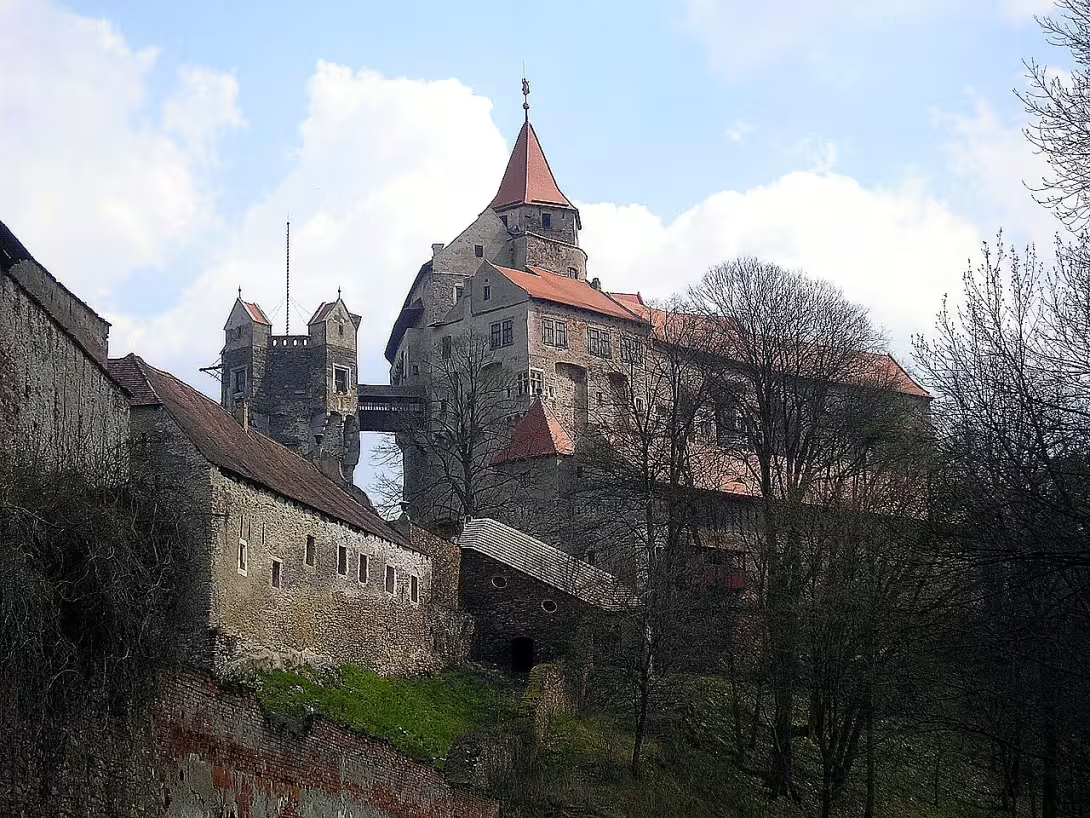
Pernštejn Castle stands on a rocky spur above the Nedvědička stream, next to the hamlet of Pernštejn, which today belongs to the market town of Nedvědice. Nedvědice once served as the castle's outer settlement. The castle has been a National Cultural Monument since 1995; it is owned by the Czech Republic and managed by the National Heritage Institute (NPÚ), which opens it to the public.
From a keep castle to the seat of a powerful family
The castle was founded no later than around 1270 as a typical noble castle with a keep (bergfried): a curtain wall enclosed a palace and a cylindrical tower, later named Barborka after Saint Barbara, patron saint of miners. Its defensive prow, which deflected missiles away from the approach road, was exceptional. It was probably inspired by the keep of the royal castle of Veveří, where the ancestors of the Pernštejns, the Lords of Medlov, served as royal administrators. The first written record dates from 1285, when Štěpán of Pernštejn and Medlov is mentioned.
As the family's power and wealth grew, a major rebuilding at the turn of the 15th and 16th centuries turned the castle into a representative political and administrative centre. A new courtyard, further residential buildings and an outer curtain wall were added. The Knights' Hall became the largest room in the castle. The walls were strengthened with towers, the ground-floor entrance area received a cell vault and a library and several living rooms were built near the Black Gate.
Oriels, galleries and the "marble castle"
Pernštejn is known for its corbels of many different shapes, which carry oriels and galleries, so that the upper floors are larger than the lower ones. Local Nedvědice marble was used extensively in the construction, which is why the castle is sometimes called the "marble castle". The castle chapel of the Conversion of St Paul was painted in 1716 by František Řehoř Ignác Eckstein, and stucco reliefs by G. A. Corbellini were added to the Knights' Hall in the early 18th century. The wall paintings in the bedroom, the children's room and the governess's room date from about the 1760s.
The Swedish siege and a provincial fortress
The castle's greatest military test was the Swedish siege of 1645. The square tower probably lost its wooden upper section, and the tower above the third gate lost its top floor, which was never rebuilt. The resilience the castle demonstrated, however, led to its inclusion among the maintained provincial fortresses. By the end of the 18th century, the original tall Gothic-Renaissance roofs and the covered wooden galleries had disappeared and were replaced by low roofing.
The last owners, the Mitrovský family of Nemyšl, lacked the funds for a planned romantic reconstruction. Thanks to this, Pernštejn has kept its original Gothic-Renaissance appearance, valued for its complex building history, architectural details and sculptural and painted decoration.
Then and now
Drag the slider to compare how the landmark may have looked when it was built with the view today.
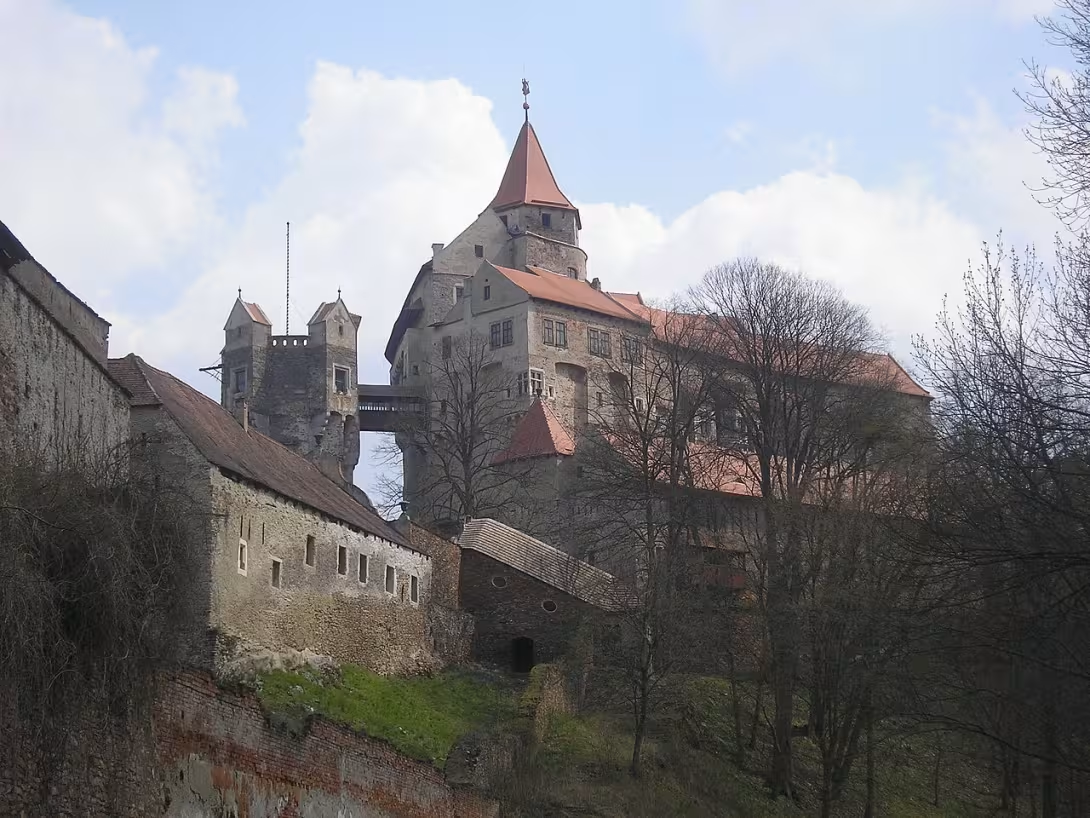

The historical appearance on the left is an AI-generated visualisation and serves as inspiration only.
Historical milestones
- c. 1270
- Castle founded by the Lords of Medlov at the latest.
- 1285
- First written record – Štěpán of Pernštejn and Medlov.
- turn of the 15th/16th century
- Major rebuilding into a representative seat; the Knights' Hall is created.
- 1596
- Jan V of Pernštejn sells the castle; the family loses its seat.
- 1645
- The castle withstands the Swedish siege and becomes a maintained provincial fortress.
- 1716
- František Řehoř Ignác Eckstein paints the castle chapel.
- 1818–1945
- The castle belongs to the Mitrovský family of Nemyšl.
- 1995
- Declared a National Cultural Monument.
- 2005
- Fire in the former granary; the collections on the tour routes remain undamaged.
Architectural development
The oldest layout consisted of a curtain wall with a palace and a cylindrical keep with a defensive prow (the Barborka tower). At the turn of the 15th and 16th centuries the castle was extended by a new courtyard with the Knights' Hall, residential buildings, an outer curtain wall and wall towers. Corbels carrying oriels and galleries are characteristic. After the Swedish siege of 1645 it remained a maintained provincial fortress. By the end of the 18th century the tall roofs had been replaced by low roofing and the wooden galleries had disappeared.
Historical events
In 1645 the castle withstood a siege by the Swedish army. On 2 October 1809 the bandmaster and composer Antonín Emil Titl, author of the opera Die Burgfrau about the White Lady of Pernštejn, was born here as the son of the estate manager. On Friday 15 April 2005 a fire broke out in the former granary, which served as a depository for about 800 objects. The most valuable pieces were on display along the tour routes and were not affected. In 2017 the restoration of the terraced garden on the south-western slope of the castle spur began.
Owners
The castle was founded by a branch of the South Moravian Lords of Medlov, who began to call themselves "of Pernštejn" after their new seat. The Pernštejns owned it until 1596, when Jan V of Pernštejn had to sell it. It was then bought by Pavel Katarin of Katar, and in 1609 by Adam Lev Licek of Rýzmburk from his sons. His widow Ester Sejdlicová of Šenfeld married Count Kryštof Pavel of Liechtenstein-Kastelkorn in 1623. In 1710 the castle was bought from the Liechtensteins by František of Stockhammer, and from 1798 it belonged to Ignác Schröffel of Mannsberk.
Points of interest
- The name Pernštejn is most often derived from the German Bärenstein, "bear stone". Below the castle flows the Nedvědička and lies Nedvědice – both names refer to the bear (medvěd in Czech).
- The cylindrical Barborka tower is named after Saint Barbara, patron saint of miners, whose attribute is a tower.
- The castle is called the "marble castle" because local Nedvědice marble was widely used in its construction.
- An ancient yew grows in the castle grounds. According to legend it grew from a traveller's staff, and the fate of the tree is bound to the fate of the castle.
- Pernštejn is a popular film location – for example the fairy tales Jak se budí princezny and Sedmero krkavců and Werner Herzog's Nosferatu the Vampyre were filmed here.
Guide
This guide is narrated by a synthetic voice generated by artificial intelligence.
Show guide text
This text was created by artificial intelligence and has not been editorially reviewed. It may contain inaccuracies.
The Gothic castle Pernštejn was built no later than around 1270 on the eastern edge of the Českomoravská vrchovina. The castle town of Nedvědice was located at its foot. It was built by the lords of Pernštejn, and the first written mention dates from 1285, when Štěpán z Pernštejna and Medlova is mentioned. Since 1995, the castle has been a national cultural monument and ranks among the most significant castles in Moravia.
The name is most commonly explained from the German Bärenstein, meaning bear stone. A small river called Nedvědička flows beneath the castle, whose name is related to the Old Czech word nedvědice, meaning she-bear. The bear also appears in the original surname of the lords of Medlova. Germanized castle names were quite fashionable in the Czech lands at that time.
Initially, it was an ordinary noble castle with a perimeter wall, a palace, and a powerful cylindrical tower, later called Barborka after Saint Barbara, patron saint of miners. Exceptional was its defensive edge, which deflected gunfire in the direction of approach to the castle. The inspiration was apparently the royal castle Veveří, where the ancestors of the Pernštejns had served as administrators.
As the power and wealth of the family grew, the castle expanded. Around the turn of the 15th and 16th centuries, it transformed into a representative political and administrative center. Residential buildings were added, along with an outer wall, a new courtyard, and a building containing the largest room in the castle, the Knights' Hall. The fortifications were strengthened with effective towers, the entrance area on the ground floor was covered with a vaulted ceiling, and a library was created near the Black Gate. Distinctive features of Pernštejn are corbels of various shapes that support oriels and galleries. The upper floors therefore have a larger area than the lower ones. Despite becoming a comfortable residence, the castle did not lose its defensive capability. Because of the abundant use of local Nedvědice marble, it is sometimes called the marble castle.
The greatest military test was the siege by the Swedes in 1645. The pyramidal tower apparently lost its wooden upper part at that time, and the tower above the third gate lost its top story, which was never restored. However, the castle held out, and precisely its proven resilience paradoxically benefited it.
The later decoration is also valuable. The castle chapel of the Conversion of Saint Paul was painted in 1716 by František Řehoř Ignác Eckstein. At the beginning of the 18th century, the stuccoist Corbellini complemented the decoration of the Knights' Hall with stucco reliefs. The wall paintings in the bedroom, children's room, and governess's room date from around the 1760s.
Tips for visitors
The castle stands on a rock above Nedvědice and the path to the gate goes uphill on foot, so sturdy shoes are a good idea. Inside there are many stairs and the interiors are not barrier-free – a baby carrier is better than a pushchair for small children. Current opening hours, tour routes and admission are published by the castle's administrator, the National Heritage Institute, on the official castle website. The main season can be busy; weekdays and spring or autumn are quieter.
Frequently asked questions
Can the monument be visited?
Yes. We verified the opening hours or admission on the official website (20. 9. 2026); you will find them in the visitor information on this page. Please double-check with the operator before you travel.
What are the opening hours and admission?
Details verified on the official website (20. 9. 2026) are listed in the visitor information on this page. Official website: https://www.hrad-pernstejn.cz/
Where is the monument?
Location: Pernštejn, Jihomoravský kraj. The map on this page shows the exact spot.
Why is the monument protected?
It is listed in the Central List of Cultural Monuments of the Czech Republic as a national cultural monument (register no. 222).
For kids
Pernštejn looks like a castle from a fairy tale – and it has actually appeared in many fairy-tale films. Can you recognise it from Jak se budí princezny or Sedmero krkavců?
The castle has a tower called Barborka with an unusual sharp edge, called a prow. When enemies attacked the castle long ago, their missiles glanced off it. The castle has lots of oriels and galleries that stick out of the walls like little balconies.
Businesses nearby
Do you run a restaurant, accommodation, shop, museum, rental, wellness or other visitor service near this monument? Show yourself directly to the people heading to it — this is how they will see you in the app and on the web:
Natáčelo se zde
- Jak se budí princezny (1978) film
- Upír Nosferatu (1979) film
- Fantaghirò (1991) seriál
- Sedmero krkavců (1993) film
- V erbu lvice (1994) film
- Wanted (2008) film
- The Three Musketeers (2013) seriál
- Návštěvníci 3: Revoluce (2016) film
Zdroj: Wikidata (vlastnost „místo natáčení“) · Všechna filmová místa
Nearby
Right below the castle is the wooden bridge in Pernštejn. Within two kilometres lies Černvír with the Church of the Assumption of the Virgin Mary, and within four kilometres there are churches in Věžná, Doubravník and Olší. Castle lovers will find the ruins of Košíkov, Víckov and Žďárec and the castles of Skryje, Rysov, Osiky, Aueršperk and Loučky nearby. The château of Dolní Rožínka is about eight kilometres away, and Bystřice nad Pernštejnem just under nine kilometres.
Accommodation nearby
Themed route
Castles along the Nedvědička: in the morning Pernštejn and the wooden bridge below the castle, then a short trip to Černvír and its Church of the Assumption. In the afternoon the ruin of Košíkov or Aueršperk Castle, and finally the churches in Bystřice nad Pernštejnem.
Seasonal recommendations
Spring and autumn are the most pleasant times at Pernštejn: fewer visitors and the Nedvědička valley in colour. In summer there are the most tours and the most people – it pays to arrive early. Outside the main season opening hours are usually limited; current dates are published by the castle administrator.
Visualizations and artistic views


The visualisations are generated by artificial intelligence and serve as inspiration.
Photos from the area
Real photos taken near the monument


Zdroj a licence jsou uvedeny u každého snímku.
Atmosphere of the place
This atmospheric visualisation of the place and period was generated by artificial intelligence. It is not real footage of the location.
Tips from visitors
No tips yet. Be the first!
Log in and add your tip.
Sources and literature
Photos: Dominik Tefert at de.wikipedia / Public domain — Wikimedia Commons. The author and licence also appear when you hover over the image.
Faktickým podkladem tohoto textu byl článek na Wikipedii, jehož autory jsou přispěvatelé Wikipedie. Článek je dostupný pod licencí CC BY-SA 4.0.
Location on the map


Příběhy a pověsti
Legendy, pověsti a příběhy spjaté s touto památkou
Fotografie návštěvníků
Zatím žádné fotografie. Buďte první, kdo přidá fotografii z návštěvy!
Log in a přidejte svou fotografii nebo hodnoťte.
Za ověřenou návštěvu v aplikaci získáte víc bodů — poznáme podle GPS, že jste na místě.
Reviews and comments