






Písečník Other
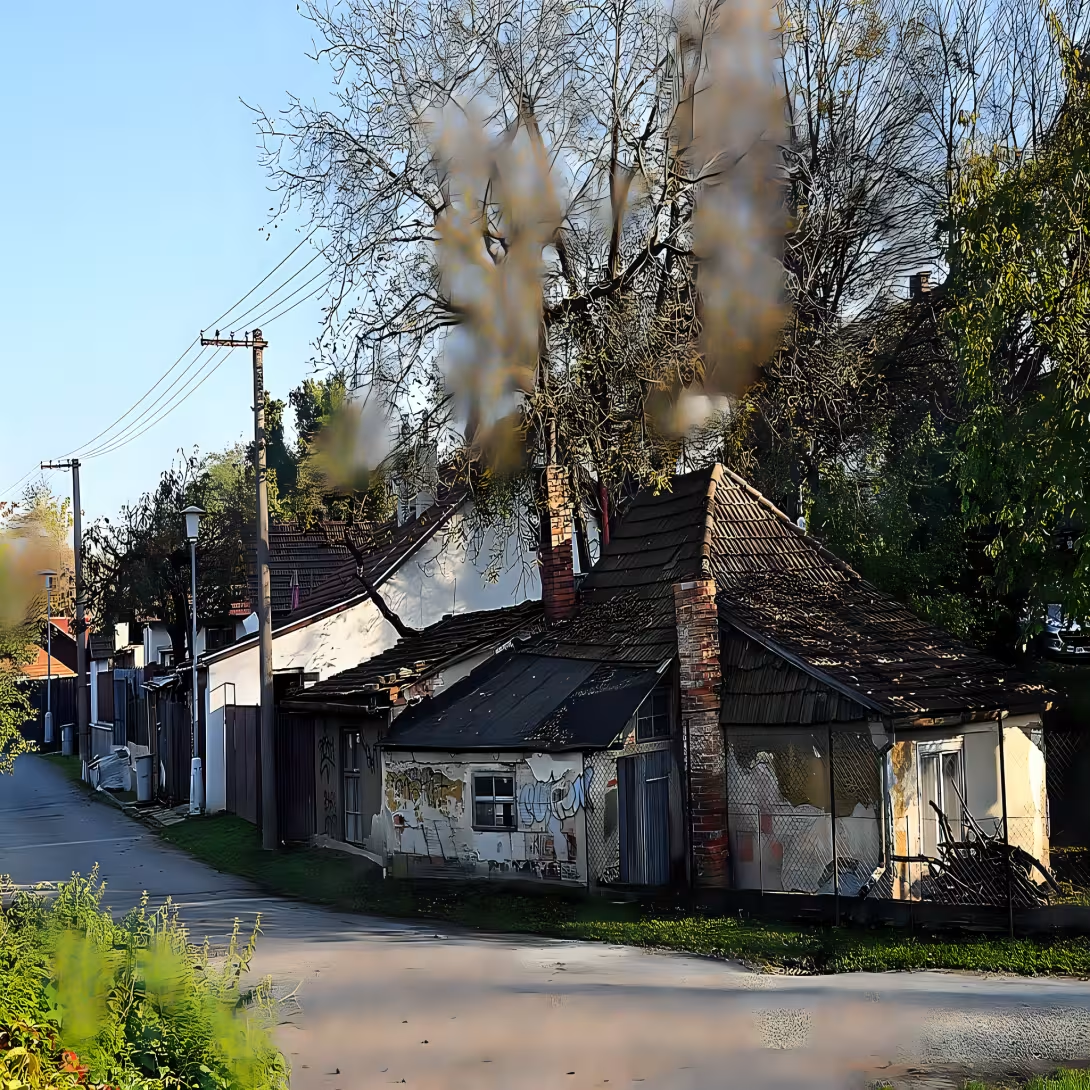
Písečník is an aristocratic and in many ways a unique working colony in Brno city district Brno-north, in the cadastral territory of Husovice. It is one of the former emergency colonies that was created at the site of the former sandpit. Its space with a dripping outline consists of the only blind street Písečník, which comes from the intersection with the street Upper and Lozíbka. An interesting thing is the pedestrian connection with the stairs leading to the street Soběšická; Access to the street is prohibited except for traffic service. The western colony is bounded by the body of a railway line called "Tisnovka," which is closed by a steep slope from the south and by a gradually stopped area of the neighbouring colony Lozíbka.
The name of the colony (over time it was found as Colony in der Sandstätte, Colony in Sand Pand or Colony) is directly related to the operation of the sandpit. Gradually extracted areas were replaced by small houses designed for the families of workers of nearby Kralopolské strojíny, which connected with the colony by a direct road. The first buildings in Písečník were built at the beginning of 1919, especially on the road towards Královo Pole. The number of houses increased gradually, especially in the southern part of the property. Part of the land belonged to a general, part to a builder named Grimm.
The construction was very dense from the beginning. In the 1930s, there were eighty-four houses and thirty-two other places for construction were laid out in the rest of the space, if we also add three shops. However, small gardens were inserted between the buildings. The houses had different forms - they were simple wooden buildings, but also so-called dwellings made of disabled railway wagons, which were available for working families at a price of approximately 1,500 CZK per piece. During the reconstruction, the railway wagons were lined with reeds with plastered mesh, their walls were cleaned out and the saddle roofs with burnt roofs were added. In the 1930s, there were also ordinary brick houses. The speciality of Písečník was the cellars excavated directly in sandstone walls. Overall, it is assumed that around 400 inhabitants could live in this part of Brno.
After the end of World War II, the population of Písečník declined rapidly. The plan was the demolition of the entire colony in connection with a railway line envelope that was completed in 1953. In the end, however, only the northern edge of the settlement was cut off and only a few houses were demolished. A building closure was subsequently imposed throughout the territory in connection with a plan for the construction of the Husovický tunnel - but it eventually leads elsewhere and Písečník did not touch it. The construction closure has, to some extent, preserved the appearance of the houses.
In the 1980s, many houses served as garages, workshops or were used as weekend huts. The significant conversion of the site began only in the 1990s. Since then, the resemblance of this extraordinary place has gradually and irretrievably disappeared. Relative quiet and very good transport accessibility contribute to the attractiveness of the accommodation - the location is located near the entrance to the Grand Town District, the bus stop Lesná is only 100 metres away, there is also a railway stop Brno-Forest and tram loop Štefánikova district.
Then and now
Drag the slider to compare how the landmark may have looked when it was built with the view today.
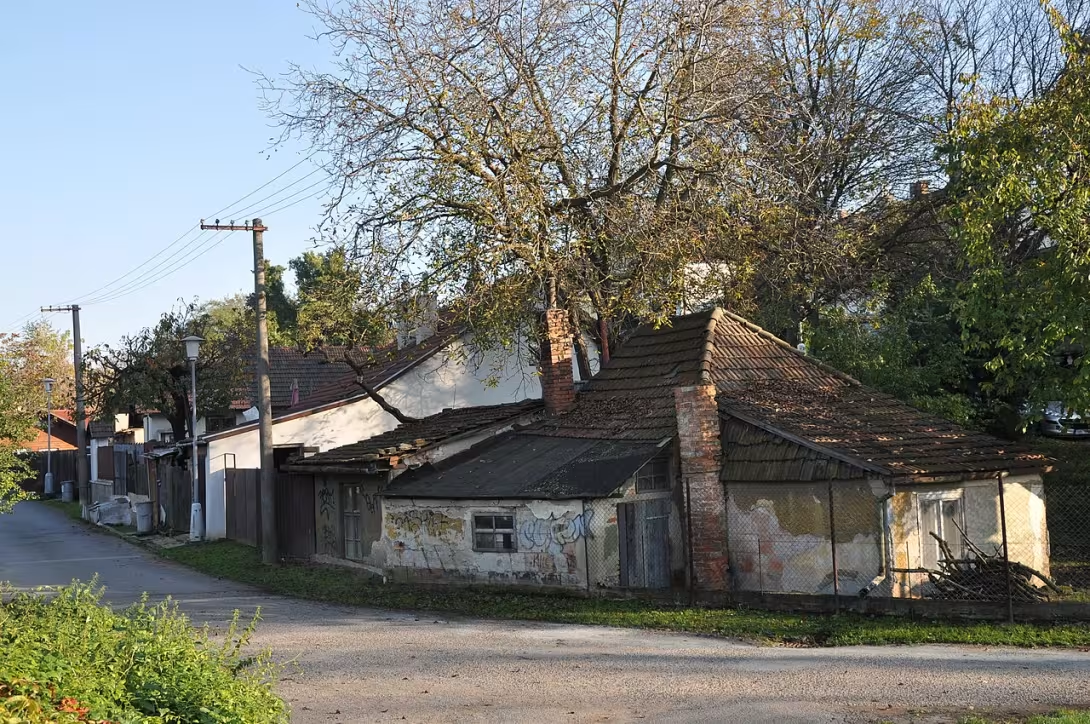

The historical appearance on the left is an AI-generated visualisation and serves as inspiration only.
Historical milestones
- 1919
- The creation of the first working buildings in the location of the former sandpit.
- 1930-1939
- The height of colony development, the construction of brick houses and shops.
- 1953
- Completion of the railway track transponder and partial demolition of houses.
- 1980-1989
- Use of houses as garages, workshops or recreational facilities.
- 1990-1999
- The beginning of a significant change of location and the gradual demise of the original for
Architectural development
The construction began with wooden houses and dwellings from disabled railway wagons, which were later lined with reeds with plaster. In the 1930s, ordinary brick houses dominated. Specifics were the cellars excavated directly in the sandstone walls of the quarry.
Historical events
1919: Construction of the first houses by the road towards the King's Pole. 1953: Completion of the transponder of the railway line, which cut off the northern edge of the settlement and led to demolition of several houses.
Owners
Part of the land was municipal, part belonged to the builder Grimm.
Points of interest
- Písečník was created at the site of the former sandpit and its name is directly related to the operation of this sandpit. - Part of the colony was dwellings made of discarded railway wagons, which were lined with rake mesh with plaster and fitted with saddle roofs. - The speciality of Písečník was the cellars excavated directly in sandstone walls. - A building closure was imposed on the territory because of the planned construction of the Husovický Tunnel, but it eventually leads elsewhere, which to some extent preserved the appearance of houses. - The colony space has a droplet outline a
Guide
This guide is narrated by a synthetic voice generated by artificial intelligence.
Show guide text
This text was created by artificial intelligence and has not been editorially reviewed. It may contain inaccuracies.
Welcome to Brno Husovice. Please stop for a moment and just feel the space you are in. You are standing in a place that may appear at first glance, but beneath the surface of the present today hides fascinating layers of history. A site known as Písečník is situated in front of you. Even though you don't have to see the dense development that was here today, feel the atmosphere of this place. Imagine going back more than a hundred years to a time when this space was filled with noise, work, and the lives of hundreds of people who were here looking for their home.
In order to understand why this place is called and how it was created, we have to transfer to the year one thousand nineteen nineteen. There was no colony at the time, but a sandbox. It was the sand mining that defined the nature of this terrain and gave the place its name. Once the sandbox was extracted, there was space left, which, in the time of postwar chaos and lack of housing, had a new, urgent function. There was a so-called emergency worker colony. Imagine the situation at that time: hundreds of men were working in the nearby Kingsbuilding, but they had no place to live. Living was a critical problem at the time and Písečník became a quick and practical solution. People came here hoping for their own piece of roof above their head, so the first buildings gradually began to appear in the former quarry space.
Now let's think about what this place looked like at the time of its bloom. If you look around and try to reconstruct a plan in your mind, notice one very strange thing. The streets in Písečník did not have a classic rectangular order, but were characterized by a specific dripping shape. This organic, almost natural line of the shell provided the colony with a very intimate and cozy character, although it was a very dense installation.
When you go through the surroundings, feel the contrast of the materials used here. Písečník was not uniform. There were ordinary brick houses, which provided relative stability, but beside them were real architectural curiosities. Imagine disabled railway cars being brought here to serve as apartments. But they weren't just bare metal cabinets. People put a lot of effort into making them real homes. These cars were lined with reeds, which were then plastered to make houses look like classical buildings. On top were housed saddle roofs which protected them from rain and snow. It's a fascinating testimony of human ingenuity and ability to adapt to difficult conditions.
This space wasn't just a set of houses, it was a living organism. Between a thousand and nine hundred thirty and a thousand and nine hundred thirty-nine Písečník experienced its peak. It wasn't just an emergency colony at the time, it was a full neighborhood. There were also small shops next to the houses where workers and their families bought everyday supplies. It was a world enclosed in itself where people knew each other, helped each other and shared the fate of the working class together. One of the key figures involved in the creation and construction of this place was a builder named Grimm. He was the one who helped shape the face of this unique settlement, even though we now do not know specific architects who would design individual houses. Everything here was based on need and practical instinct rather than large architectural plans.
However, the history of Písečník is also a story of gradual extinction. If you look around now, you'll see that the original form of the colony is almost gone. The break came in a thousand nine hundred fifty-three. At that time there was a transversal of the railway line, which was an intervention that fundamentally changed the geometry of the place. Some of the houses had to be demolished to make way for new tracks. That was the first big blow that disrupted the cohesion of a dripping street arrangement.
Over time, the function of this place began to change. In the 1980s, Písečník was no longer a primary place to live. The houses that survived began to serve as garages, workshops or small recreational objects. Instead of children laughing and the morning rush of workers travelling to the machine shop, there were noises of tools and repaired machines. It was a time of transition when the original nature of the colony finally began to melt. And then came the 1990s, which brought a significant change of location. Gradually the last remnants of the original form disappeared and Písečník began to transform into what you see today.
Before we say good-bye and you go on, allow me to interest you in one interesting thing that remains in the background only as a hint, but is very strong in the spirit of this place. Apart from the unusual car houses, the Písečník and its cellars were a specialty. Since the entire colony was created in the area of the former sandpit, the soil was specific and easy to process. The cellars were not just food storage sites, but they formed an invisible net underground that mirrored the density of the building above the surface. Imagine all the underground spaces that once existed beneath the feet of the people hidden in the sandstone.
Písečník is now a reminder of when the city grew faster than it could build quality houses. It's a story about people who could create a community even in emergency conditions, in a former quarry, in car houses. It is a reminder of how fleeting human development is, but how permanent the traces that history leaves in the landscape are.
Now I encourage you to look around for a while. Try to imagine the reed walls, the smell of sand dust and the sound of railway bikes. Feel the silence that rules today where the heart of the workers' colony used to beat. We wish you a pleasant continuation of your journey and hope that the story of Písečník inspired you to look for hidden layers of the past and other places in the landscape. Goodbye.
Tips for visitors
The best time to visit is during a sunny morning or late afternoon when the low sun highlights the broken terrain of the former quarry and the historic atmosphere of the worker colony. Avoid rainy days when roads in this location may be less viable.
The location is available by public transport and by car. Take advantage of Lesná stop and continue on foot from there. Parking is possible in adjacent streets, but we recommend that local traffic signs be respected and do not block the entrances to residents.
For the tour, wear a fixed footwear suitable for the field and a charged phone or camera. Písečník offers unique industrial aesthetics, which makes it ideal to photograph details of old buildings in contrast to the surrounding greenery. The best light for images is captured at the golden hour.
In the surrounding area you can explore the industrial link of the Králové Opolské engineering plant or take a walk along the route of the former railway line Tišnovka. Walk through the street Lozíbka offers an interesting view of the urban development of the district, while the proximity of the Great Town Circuit resembles the modern artery of the city.
For families with children, the location is an interesting lesson in open-air history. We recommend to take a visit as a discovery of a hidden location, but take care of the safety of children near unequal terrain and frequent road moves around.
Frequently asked questions
Is Písečník open to the public?
The monument is generally accessible, but it is recommended to inform ourselves first about possible restrictions or events on the official website.
How do I get to the place by car / public transport?
Access to Písečník is possible both by car and public transport. We recommend checking current connections and parking possibilities before visiting.
How much is the entrance fee and is it paid on the spot?
Admission fees are usually paid on the spot. Current prices can be found on the official site of the sights.
Is the tour suitable for children and seniors?
Yes, Písečník is suitable for visiting with family and seniors. It offers various activities and comfortable journeys.
How long does the tour take?
The tour time depends on your interest in details. In general, you can look forward to spending a few hours here.
What are the opening times and booking is required?
Opening hours may vary, so we recommend checking the current information on the official website. Reservation is not usually necessary.
What's interesting in the immediate vicinity?
In the vicinity of Písečník there are picturesque pavements suitable for walking. These roads are ideal for relaxing and exploring nature in the surroundings.
For kids
Hi! Today we are going to look at a very special story room that is real and not a lie, and that is Písečník in Brno. It was about 1946 - you know what? That was 80 years ago! You think that makes sense? It's like looking at old cameras and suddenly seeing your grandfather's or grandma's feet!
Businesses nearby
Do you run a restaurant, accommodation, shop, museum, rental, wellness or other visitor service near this monument? Show yourself directly to the people heading to it — this is how they will see you in the app and on the web:
Events nearby


Zdroj akcí: otevřená data měst a obcí ČR (Národní katalog otevřených dat) a kalendář akcí Národního památkového ústavu.
Nearby
Royal Polish Engineering, railway line Tisnovka, street Lozíbka, Great city circuit, stop Lesná.
Accommodation nearby
Trips and activities nearby
Guided tours, tickets and activities nearby from GetYourGuide
Affiliate link: if you buy from the partner, we may receive a commission. The price for you does not change.
Search tours and activities →Themed route
Thematic cruise route: Písečník and industrial heritage Husovic
1. Písečník - * Monument and symbol of resistance * A unique monument from 1945 commemorating the victims of Nazi terror. Its symbolism - sandstone monolith with engraved names - is a strong impression and reminder of local history.
2. Royal Polish Engineering - * Industrial legend * (approx. 1 km) One of the oldest and most important engineering plants in the Czech Republic, founded in the 19th century. The area with historical halls and technology shows the industrial development of the region.
3. Railway line Tisnovka - * Technical interest * (approximately 500 m from Písečníka) The old railway line connecting Brno with Tishnov, today serving as a bike path. It offers a view of industrial architecture and green corridors.
4. Lozebka street - * Local atmosphere * (about 300 m from Písečníka) Quiet street with family houses and typical Brno development. Ideal for walking and knowing everyday life in Husovice.
5. Forest stop - * Transport node * (approximately 800 m from Písečníka) Local public transport station connecting Husovice to the Brno centre. It shows how the city developed around the transport arteries.
Seasonal recommendations
Spring Spring on Písečník is the time when the monument awakens to life after winter peace. The sun illuminates rock formations with fine, scattered light, which emphasizes their fine details and shadows in narrow crevices. Nature is blooming around - meadows are transformed into a sea of yellow and white flowers, forests are dressed in green clothes and the air smells of wet soil and early spring plants. The atmosphere is calm, but not without movement: the raindrops of birds nesting here, and the rustling of leaves on trees give life. It is convenient to visit a memorial in the middle of spring when the temperature is pleasant and the crowds are not yet disturbing silence. Dress light but protective clothes against the wind because spring weather is unpredictable - add a raincoat to your backpack. The best time to visit is in the morning when light is mild and tourists less.
Summer Summer on Písečník brings hot, sunny days when rock formations shine under bright sky. The sun reflects here from bright limestone surfaces, creating playful shadows and heating the air at pleasant 25 to 30 degrees. Nature is in full power - meadows are filled with flowers, trees have grown and forests are green. The atmosphere is lively, but also a little busy, because the monument is among the favorite goals of families and nature lovers. In the main summer season you have to count on a larger number of visitors, so get on the road early in the morning, before opening. Wear light, airy clothes, but don't forget to wear a hat or a sun hat and plenty of water. Due to the heat, avoid the noon hours when the sun is most intense.
Autumn Autumn at Písečník is a magical time when nature transforms its colors. The sun is no longer high, its light is softer and more scattered, which gives the rock formations a golden or brown shade. The leaves on the trees turn from green to yellow, orange and red, and when wind autumn winds blow, they form a quiet, almost freezing atmosphere around the monument. Nature prepares for winter, but still offers beauty - mushrooms grow in wet places and birds prepare for departure. The visit should be planned for the beginning of autumn, when temperatures are still pleasant and nature has not yet started to lose colors. Wear layered clothes because the weather changes quickly - it may be cold in the morning, but the sun may overheat at noon. Avoid late afternoon hours when clouds and precipitation often appear.
Winter Winter at Písečník is a period of quiet and quiet, where the monument resembles an ancient sleeping face. The sun stands low above the horizon, its light is weak and scattered, which creates fine shadows on rock formations and gives the place a mysterious atmosphere. Nature is covered with snow or ice, the forests are quiet and the air smells cold. The atmosphere is calm and almost mystical, as if time stood here. The winter visit is ideal for those looking for peace and rest from the crowds. The opening times of the monument are shortened in winter, so check in advance. Put on warm, layered clothes to protect you from cold and possible collisions. The best time to visit is noon, when the light is brightest and the snow covers are shining. Avoid late afternoon hours when the outside can be very cold and light weak.
Visualizations and artistic views


The visualisations are generated by artificial intelligence and serve as inspiration.
Photos from the area
Real photos taken near the monument

Zdroj a licence jsou uvedeny u každého snímku.
Tips from visitors
No tips yet. Be the first!
Log in and add your tip.
Sources and literature
Fotografie: Ben Skála, Benfoto / CC BY-SA 3.0, rozlišení zvýšeno umělou inteligencí — Wikimedia Commons. The author and licence also appear when you hover over the image.
Faktickým podkladem tohoto textu byl článek na Wikipedii, jehož autory jsou přispěvatelé Wikipedie. Článek je dostupný pod licencí CC BY-SA 4.0.
Location on the map

Příběhy a pověsti
Legendy, pověsti a příběhy spjaté s touto památkou
Fotografie návštěvníků
Zatím žádné fotografie. Buďte první, kdo přidá fotografii z návštěvy!
Přihlaste se a přidejte svou fotografii nebo hodnoťte.
Za ověřenou návštěvu v aplikaci získáte víc bodů — poznáme podle GPS, že jste na místě.
Reviews and comments