



Pístovský památník Memorial
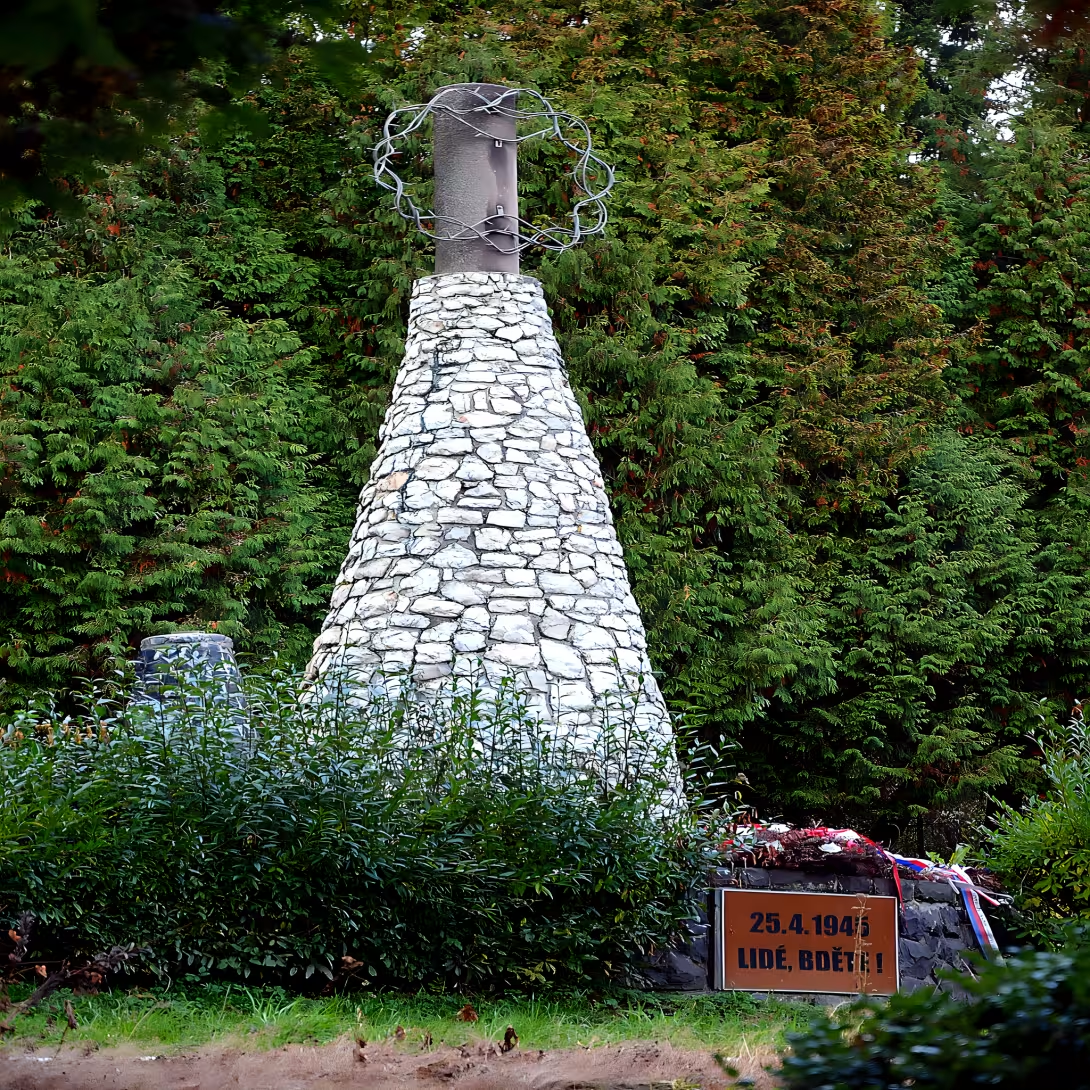
Pístovský památník is a piety place near the village of the Piston near Chodova Plana, which reminds the victims of the death march from the end of World War II. The monument was built in 1965 and formed by a needle made of roughly carved stones supplemented by an iron thorn crown.
The history of the site is linked to the tragic events of April 1945. On 13 April 1945, 1450 men and 150 women were exiled from Zwickau and Legenfeld concentration camps. On April 21, 1945, a motorcade on the road between Martinov and Holubin was attacked by an American squadron shooting. In the attack, 16 prisoners died instantly, followed by a march to shoot all wounded. The inhabitants of German nationality then removed the bodies from Pistov and buried them in a pit in the forest about 100 metres from the local cemetery, and did not mark the place of the mass grave.
In the spring of 1946 there was an exhumation in which 66 victims from Poland, the Soviet Union, Italy, Belgium, Germany, Yugoslavia, Hungary and Czechoslovakia were found. The remains were stored in coffins and buried in a cemetery. In 1950, two English airmen were added to the memorial, who died in an emergency jump from a burning aircraft near Lower Kramolín.
The memorial itself was created in 1965, in the period of political easing preceding Prague Spring, when efforts to commemorate war crimes grew in Europe. The architectural solution uses a composition made of roughly carved stone in the shape of a needle on top of which is placed an iron thorn crown. The art page is complemented by glass panes with engraved images and inscriptions. The whole area is designed as a piety park with paths, rose beds and coniferous planting.
Today, Pístovský památník is an accessible place that serves as a permanent reminder of the tragic events of the end of the war. Visiting this piety complex offers the opportunity to honor the victims' memory and to become familiar with the history that has been indelibly written into the form of the local landscape.
Historical milestones
- 1945
- The march of death and the slaughter of prisoners near Pistova.
- 1946
- Exhumation of mass grave and identification of 66 victims.
- 1965
- The ceremonial revelation of a memorial in the shape of a needle.
Architectural development
The monument was built in 1965 as a composition of roughly carved stone. The creative solution is supplemented by elements of metal and glass with engraved motifs. The whole area is designed as a piety park with paths and coniferous planting.
Historical events
1945: The march of death and the subsequent shooting of prisoners at Pistov. 1946: Exhumation of the mass grave and burial of victims in the cemetery. 1950: Saving the remains of two English airmen to the memorial.
Points of interest
- The monument consists of a needle made of roughly carved stones, which complements the iron thorn crown. - In 1950 the bodies of two airmen were added to the monument, who died in an emergency jump from a burning machine. - Glass boards with engraved images and inscriptions are part of the art solution. - Pieté grounds are designed as a park with paths, rose beds and coniferous trees. - The monument was built in 1965, at a time of political relaxation prior to Prague Spring.
Guide
Show guide text
This text was created by artificial intelligence and has not been editorially reviewed. It may contain inaccuracies.
Welcome to the Pistol Memorial in Chodova Plana. Stop for a moment, take a breath and feel the silence of this place. You're standing right in front of a piety area that carries the weight of deep sadness, but also the hope of not forgetting. Look ahead. The dominance of this space is a powerful needle that has grown from roughly carved stones. Its walls are neither smooth nor perfectly worked, acting raw and naturally, as if they themselves were telling the story of the difficult fate and intransigence of fate. When you raise your eyes to the very top of this stone tip, you will see an iron thorn crown. It is a powerful symbol of suffering and sacrifice, which in contrast to the heavy stone seems fragile and painful.
To understand why this monument is standing here, we have to go back many decades in our minds, to a tragic year of a thousand nine hundred forty-five. In the complete conclusion of World War II, at a time when the end of the horrors seemed to be near, events took place that had marked this place forever. The so-called death march has just arrived here. Imagine thousands of exhausted, starving and ill prisoners being driven from Zwickau and Legenfeld concentration camps. They were people who had almost no power, yet were forced to walk miles in the cold and fear driven by cruel guards. There was then a massacre near Pistova, which left a deep wound in this country. Many of these people have exhaled their last breath, victims of violence and exhaustion.
This space has not been forgotten. A year later, in the year one thousand nine hundred forty-six, important and painful work was done. An exhumation has been carried out, i.e. excavating remains from a mass grave. It was an attempt to give the victims dignity and identify those who died here. Sixty-six victims were found underneath. Each of these people had a name, a family, and dreams that were brutally interrupted. This is where their remains were then stored to find their last and lasting peace.
The monument itself in the form of a stone needle, which you see before you, was festively revealed in the year one thousand nine hundred and sixty-five. Notice the stones again. They're rough, unworked, resembling rocks that resist time. This choice of material is not random. It is intended to create a sense of stability, but also to remind us of the hardness of the conditions that prisoners faced. And then there's the iron thorn crown on top. It's a painting to make us think about the pain of the individual and how low humanity can sink.
Now please take a look around. Note that the site is not just about this one stone pillar. The entire spatial solution includes engraved glass panes. Come closer to them. Glass is a transparent material, fragile, which makes a special contrast to the massive stone of the needle. On these boards you will find inscriptions and engraved images that serve as a bridge between us and those who are no longer. Names carved into glass are like silent testimonies begging us not to forget. Feel how light hits these surfaces and blends with the silence of the surrounding park. The whole area is modified as a park, making it a place for a quiet walk and deep reflection. They help to dampen the noise of the outside world and allow us to concentrate fully on the importance of this place.
When you say memorial, we often imagine one single tragic event. But Pístovský památník also carries another, less well-known, but no less sad story. Let's stop at one interesting thing that gives this place another layer of sadness and respect. In a thousand and nine hundred and fifty years after the end of the war, the remains of two airmen were added to the memorial. These men didn't die in the concentration camp or the death march. Their tragedy was different. They died in an emergency jump from a burning machine. Imagine the scary moment when a plane in flames falls to the ground and the airmen, in a desperate rescue attempt, plunge into the void. Their fate was different from that of the prisoners, but so tragic and sudden. The fact that they were stored right here combines different forms of human suffering at one common point of memory.
So you're standing in a place where stories come from different years and different circumstances, but they all connect one thing: loss of life and the need for someone to remember them. Take another look at that needle. It's like a finger pointing to heaven, a plea for peace and justice. The rough stones remind us of the earth, the dust and the mortality, while the crown of thorns reminds us of the spiritual power and suffering that is part of human existence.
Now give a moment of silence to all who rest here. Go through the entire area slowly, stop at each glass board, read the inscriptions and feel the atmosphere of this drinking place. Let the silent presence of history surround you. This monument is not just a pile of stones and a piece of iron, it is a living lesson about what happens when hatred wins, and it is also proof that humanity can build places of respect and repentance.
When you leave this space, there may be a sense of sadness in you, but I hope that you will leave with it a sense of gratitude for the peace and security that we are experiencing today. Pístovský památník in Chodova Plana will still stand by to guard the memory of sixty-six death and two unfortunate airmen, and to wait for other visitors to stop and listen to stories written in stone and glass.
Thank you for your journey through this quiet and important place. I wish you the rest of the day and safe continuation of your discovery. Goodbye.
Tips for visitors
The best time to visit is during spring or autumn months, when the surrounding landscape is quiet and the piety atmosphere of the place most excels. In the summer months, the surrounding forests offer a pleasant shade and shelter from direct sun. For photography we recommend using soft light during the morning or late afternoon, when the sun highlights the details of the monument and surrounding natural scenery. The place is suitable for a peaceful walk, so bring with you comfortable shoes suitable for outdoor movement and possibly small flowers or candles to honor the memory of the victims. In the vicinity of the monument you can visit the local cemetery in the village of Pístov, which complements the piety of the place, or take a walk along the surrounding forest roads near the village Chodová Planá.
Frequently asked questions
Can the monument be visited?
This is a structure in a public space that can usually be seen from outside free of charge. We have not verified that this particular one is freely accessible.
Where is the monument?
Location: Chodová Planá. The map on this page shows the exact spot.
Why is the monument protected?
It is listed in the Central List of Cultural Monuments of the Czech Republic as a cultural monument (register no. 1000156707).
Businesses nearby
Do you run a restaurant, accommodation, shop, museum, rental, wellness or other visitor service near this monument? Show yourself directly to the people heading to it — this is how they will see you in the app and on the web:
Nearby
Obec Chodová Planá, osada Pístov, místní hřbitov, okolní lesní porosty.
Accommodation nearby
Themed route
1. Municipality of Chodová Planá (municipality) - The entry point of the trip, which serves as a base for the beginning of the trip. 2. Ambient forest crops (nature) - A walk between the trees offers peace and the possibility to observe the local flora. 3. Osada Pístov (settlement) - A small mansion that forms the immediate vicinity of the main target. 4.Pístovský památník (memorial) - Main point of the route, which resembles important events or persons. 5. Local cemetery (cemetery) - A place for silent contemplation and the memory of the deceased.
Seasonal recommendations
Spring: In the spring period, Pístovský památník in Chodova Plana appears in the light of the newly blooming nature, where flowering shrubs and trees colour the surrounding landscape. The sunny days offer ideal conditions for visiting, but it is advisable to equip yourself for rain or cool breeze. This time of year is usually less visited, which allows a more peaceful tour of the monument without unnecessary crowd pressure.
Summer: For years Pístovský památník is surrounded by a warm and bright atmosphere, where everything around it is full of life. I illuminate the statue in a special way, which can contribute to a unique impression since the visit. It is advisable to visit the memory early in the morning or late in the evening to avoid hot noon sun and potential children's crowds during summer holidays.
Autumn: Autumn brings to Pístovský památník a colourful palette of fallen leaves that color the surrounding forests and mountains. This time of year is ideal for lovers of photography and peaceful walks. However, it is important to equip yourself with cooler weather, as the temperature may fall suddenly, especially in the shade of old trees.
Winter: In winter, Pístovský památník is dressed in snow and glaciers, adding magic and calm. Sunny days offer a beautiful atmosphere to visit while shady or rainy days require warm clothes, including a hat and protective shoes. Visiting during freezing days is ideal for those looking for a quiet environment without large crowds.
Visualizations and artistic views

The visualisations are generated by artificial intelligence and serve as inspiration.
Photos from the area
Real photos taken near the monument


Zdroj a licence jsou uvedeny u každého snímku.
Tips from visitors
No tips yet. Be the first!
Log in and add your tip.
Sources and literature
Photos: Levap75 / CC BY-SA 3.0, rozlišení zvýšeno umělou inteligencí — Wikimedia Commons. The author and licence also appear when you hover over the image.
Faktickým podkladem tohoto textu byl článek na Wikipedii, jehož autory jsou přispěvatelé Wikipedie. Článek je dostupný pod licencí CC BY-SA 4.0.
Location on the map
More monuments – Chodová Planá
Show all in the municipality

Příběhy a pověsti
Legendy, pověsti a příběhy spjaté s touto památkou

Fotografie návštěvníků
Zatím žádné fotografie. Buďte první, kdo přidá fotografii z návštěvy!
Log in a přidejte svou fotografii nebo hodnoťte.
Za ověřenou návštěvu v aplikaci získáte víc bodů — poznáme podle GPS, že jste na místě.
Reviews and comments